1031 Exchange Realtor and Broker Resources
Realtors and brokers need four things to support a 1031 exchange well. Those are authoritative IRS materials, continuing education, technology that surfaces qualifying properties fast, and a standing Qualified Intermediary relationship. Agents find and market property and hold the timeline together, while brokers structure the more complex deals. Neither may hold the exchange funds, which is why the QI relationship is essential rather than optional.
Universal Pacific 1031 Exchange has acted as a Qualified Intermediary since 2015, serving investors in all 50 states, with experience across more than $100 million of commercial real estate. Contact us to discuss a client’s exchange before the relinquished property goes into escrow.
This blog covers the role of realtors and brokers, the best resources available, common mistakes, and pro tips for success.
Who Are 1031 Exchange Realtors and Brokers?

Realtors and brokers are licensed real estate professionals who help facilitate real estate transactions, including 1031 exchanges. A realtor is a licensed real estate agent or broker who is a member of the National Association of Realtors (NAR). This membership requires them to follow the strict NAR Code of Ethics. That code sets the standards realtors must follow to uphold honesty, integrity, and professionalism in real estate practice.
On the other hand, a real estate broker is someone who has obtained a higher level of licensing than a sales agent. Brokers must complete additional education and pass a state broker’s exam. They can run their own brokerage firms, supervise agents, and handle more complex transactions. Some brokers also work directly with clients, while others focus on managing their teams.
Note that not every real estate agent is a realtor. Only those who belong to NAR can use the title. Also, all realtors are either licensed agents or brokers, but not all agents or brokers are realtors since NAR membership is optional. Brokers have more authority and can run their own firms, while agents, even if they are realtors, usually work under a broker’s supervision.
Who Does What in a 1031 Exchange?
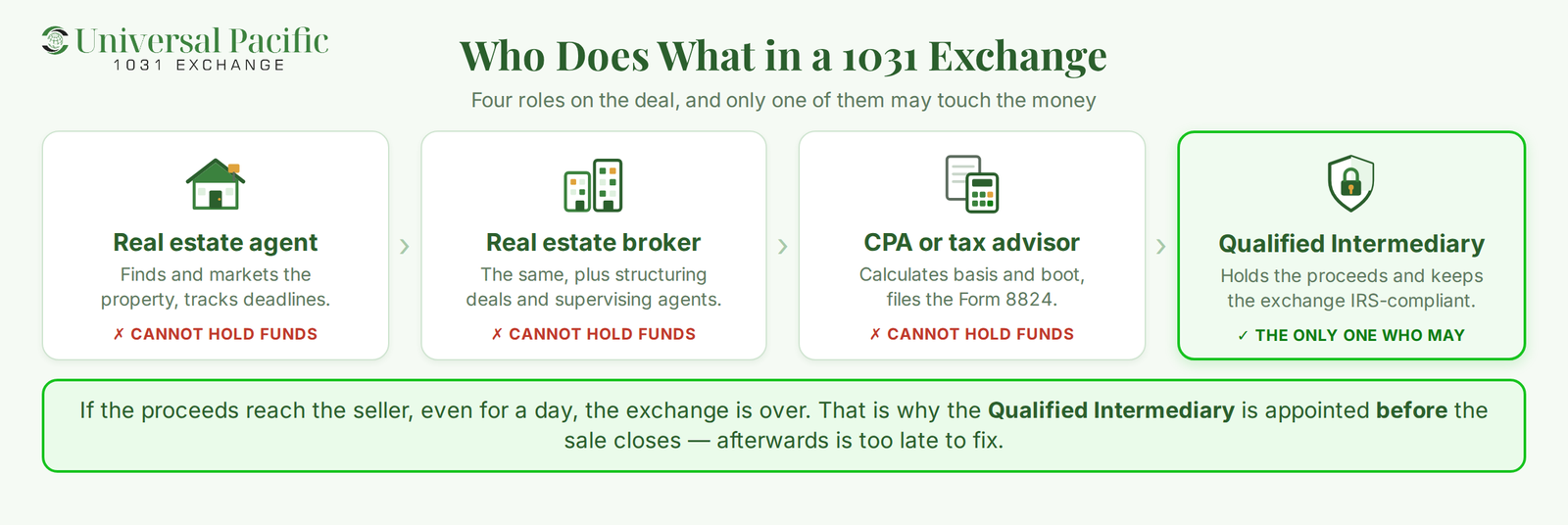
Clients routinely assume their agent can handle the whole transaction. The most consequential misunderstanding here is who may touch the money. The table below sets out the roles.
| Role | What They Do | Licensing | May Hold Exchange Funds? | Cost to the Client |
|---|---|---|---|---|
| Real estate agent | Markets the property, handles offers and deadlines | State salesperson license, under a broker | No | Commission |
| Real estate broker | The same, plus deal structuring and supervising agents | State broker license | No | Commission |
| Qualified Intermediary | Holds the proceeds and keeps the exchange IRS-compliant | Not federally licensed | Yes, only the QI | Set by the intermediary |
| CPA or tax advisor | Calculates basis and boot, files Form 8824 | State CPA license | No | Hourly or per-return |
The row that matters is the funds row. If anyone other than a QI takes constructive receipt of the proceeds, including the agent, the broker, or the client, the exchange fails.
How Can Realtors and Brokers Support a 1031 Exchange?
A 1031 exchange is a tax deferral strategy that allows real estate investors to defer capital gains taxes by reinvesting the sale proceeds of a relinquished property into a like-kind replacement property. By deferring taxes, you get to keep more of your investment capital, which helps you grow your portfolio and invest in higher-value properties and markets.
To defer capital gains taxes using a 1031 exchange, real estate investors must follow strict IRS rules and tight deadlines. Therefore, they nearly always need professional support to do it. Realtors and brokers provide that support by guiding the process, finding qualifying properties, and ensuring they meet the timeline for 1031 exchanges. Their roles in a 1031 exchange include the following.
1. Helping Investors Find Like-Kind Properties
Realtors know the market better than most investors. They identify investment properties that qualify as “like-kind” under IRS rules, whether residential rentals, commercial units, or land. Since investors only have 45 days to identify replacements, this quick market knowledge is crucial. Without it, clients risk missing deadlines and losing tax benefits.
2. Providing Market Insights and Valuation Guidance
Beyond finding property options, brokers evaluate the fair market value of each property. They review cash flow potential and long-term appreciation prospects. By explaining these numbers in simple terms, they help investors see whether the property supports both immediate goals and long-term financial growth.
3. Managing the Strict Timeline
Tax-deferred exchange transactions must be completed within the stipulated timeline. For 1031 exchanges, both clocks start on the day the relinquished property transfers, and they run at the same time. The investor has 45 days to identify replacement properties, and the exchange must close by the earlier of the 180th day or the due date of that year’s tax return, including extensions. An investor who closes late in the year and does not file an extension can lose weeks off the back end of the exchange. Realtors keep the process on track by coordinating with lenders, property owners, sellers, and intermediaries. They manage schedules, follow up on paperwork, and remove delays that could cause an investor to lose their tax-deferred status.
4. Marketing and Selling the Relinquished Property
The 1031 exchange starts only after selling the original property. A quick and successful sale gives the investor enough time to secure the replacement property, which is essential to keeping the exchange alive. Realtors handle this by pricing it correctly, marketing it widely, and negotiating strong offers. They also manage inspections and closing details.
5. Connecting Clients with Qualified Professionals
Most people don’t know where or how to find a qualified intermediary (QI), which is one of the IRS requirements for a 1031 exchange. So, realtors often connect clients with reliable QIs, attorneys, and tax professionals. This network ensures funds are held properly, paperwork is accurate, and compliance rules are followed. Without such guidance, an investor could easily make costly mistakes.
6. Structuring Deals to Comply with IRS Rules
A 1031 exchange has many technical details that can affect the process. Brokers help manage these details by advising on how the title should be held and warning against the pitfalls associated with related-party 1031 exchanges. They also guide clients through negotiations so the final deal meets IRS standards. This oversight protects investors from disqualification and unexpected tax liabilities.
What Are the Best 1031 Exchange Realtor and Broker Resources?

Realtors and brokers who want to serve investors well must stay informed about the 1031 exchange process, rules, requirements, tools, and strategies. The process is highly regulated, and rulings, regulations, and tax codes change regularly.
Clients expect their agents not just to know both the basics and the more technical details, but also to understand the most recent updates in the industry. So, with the right resources, professionals can guide clients more effectively, close deals faster, and build stronger long-term relationships. Some of the most common sources of realtor and broker resources include:
Educational Tools and Guides
Reliable education is the foundation for understanding 1031 exchanges. The IRS provides official publications and FAQs that outline requirements directly from the source. With that, real estate professionals and investors can stay current on the most recent IRS updates.
Moreover, industry associations such as the NAR and the CCIM Institute publish practical guides and share policy updates, and host workshops. Sometimes, they also host workshops where investors can learn from industry experts. In addition, specialized 1031 exchange companies often produce brochures, webinars, and case studies tailored to real estate professionals. Together, these tools help agents translate complex tax law into clear advice for clients.
Many organizations also offer continuing education courses that focus on real estate taxation, including like-kind exchanges. For example, the CCIM Institute offers a Real Estate Tax Update Course that teaches strategic tax planning, the fundamental areas of taxation, new tax issues and rulings, and even proposed tax changes. Realtors and brokers in California can also take continuing education courses on external websites such as The CE Shop.
Technology and Research Platforms
Technology makes supporting 1031 exchanges more efficient. Some Multiple Listing Service (MLS) systems now include filters that highlight properties suitable for exchange investors. Moreover, U.S. market analysis platforms, such as Zillow or Renomy, allow brokers to track neighborhood trends, rental income potential, and appreciation forecasts. This helps clients identify stronger opportunities.
Real estate tax software also provides projections of deferred taxes, cash flow, and long-term investment performance. Other platforms, such as property data aggregators and exchange-specific listing services, give brokers access to nationwide opportunities beyond their local markets. With these tools, realtors can analyze and present options quickly while remaining compliant with IRS deadlines.
Professional Partnerships
No 1031 exchange is complete without experienced partners. Realtors should maintain strong connections with QIs, since the IRS requires a QI to handle funds and documentation. Collaborating with tax advisors and attorneys ensures clients receive accurate legal and financial guidance.
Furthermore, building referral strategies with other brokers, property managers, or commercial specialists also creates win-win opportunities by sharing deals and client leads. Some professionals also partner with financial planners, who help investors fit exchanges into their broader wealth strategy. These partnerships give Realtors the credibility and resources to support clients from start to finish.
Michael Bergman is President and CEO of Universal Pacific 1031 Exchange and a California CPA licensed since 1990. He sees where the referral relationship pays off. “The agents who send us the most business are not the ones who know the tax code best. They are the ones who call before the listing goes live. At that point we can still shape the contract language and closing sequence. After the offer is accepted, we are just reacting.”
A Worked Example: How Early Coordination Saves an Exchange
The following is an illustrative scenario rather than an actual client matter, and figures are rounded for clarity.
A broker lists a client’s $1.4 million retail building. The client mentions in passing that he wants to buy something larger. The broker initiates a 1031 exchange at the first meeting rather than after an offer arrives and introduces a Qualified Intermediary the same week.
Because the QI is engaged before escrow opens, the cooperation language is included in the purchase agreement. The assignment is prepared in advance, and the client understands he cannot touch the proceeds. The property closes 40 days later, starting the clock.
The broker has already shortlisted replacement candidates, so identification is submitted in writing on day 22 rather than day 44. The first choice falls through during due diligence on day 60. The client identified three properties under the three-property rule instead of one. The second candidate is still live, and the exchange closes on day 141.
Had the QI been engaged after the offer was accepted, two things would likely have gone differently. The contract would have lacked cooperation language, and the client would have identified a single property under time pressure. When that deal collapsed on day 60, the exchange would have collapsed with it, and the full capital gain would have become taxable. The broker’s contribution was not tax expertise. It was sequencing.
Common Mistakes Realtors and Brokers Should Avoid

Because the 1031 exchange rules are strict and deadlines are short, even small errors can disqualify the transaction and trigger unexpected taxes. Realtors and brokers need to understand these pitfalls so they can protect their clients and strengthen their reputation as trusted advisors. The most common mistake to avoid is missing key deadlines. The investor has only 45 days to identify replacement properties and 180 days to close at least one of them. If you fail to keep clients on schedule, you risk invalidating the exchange entirely.
Recommending properties that don’t qualify is another common failure. Not every property qualifies as like-kind. Suggesting a real estate asset that doesn’t meet IRS eligibility criteria creates delays, frustration, and potential disqualification. To avoid this, realtors and brokers must ensure that the properties are used for business or investment purposes, and fulfill other criteria.
Overlooking the role of the qualified intermediary is the error with the least room for recovery. Some agents mistakenly think they can hold exchange funds. In reality, only a qualified intermediary can legally handle sale proceeds. If an unqualified entity takes custody of the exchange funds, it might disqualify the exchange.
Ignoring financing and title issues is another major pitfall. If the relinquished property has more debt than the replacement property, or if the title isn’t properly structured, the investor may face taxable “boot.” Therefore, realtors must pay attention to financing details.
Failing to educate the client is a mistake of assumption. Some agents assume investors already know how a 1031 exchange works. But most of the time, investors need step-by-step guidance. Failing to explain the process leaves clients unprepared and vulnerable to mistakes.
Finally, neglecting tax and legal partnerships exposes everyone involved. Without collaboration with tax advisors or attorneys, critical compliance details often get overlooked. On the other hand, professional partnerships prevent unnecessary risks.
7 Pro Tips for Success as a 1031 Exchange Realtor or Broker

To stand out in the competitive market as a 1031 exchange realtor or broker, you must learn to combine expertise, education, partnerships, and smart marketing to create a competitive advantage. Here are pro tips to help you achieve that.
Start by sharing insider secrets for maximizing exchange benefits. This will help you build industry authority. Remember, clients want more than just a basic explanation or tax advice. Show them how exchanges can grow portfolios, reduce taxes, gift a 1031 exchange property, open doors to larger or more profitable real estate investments, and bring financial success.
Next, advise on strategic planning for timing and execution. Success in real estate, especially 1031 exchanges, depends on preparation. Encourage clients to explore replacement options before selling, so deadlines don’t cause stress. Early planning avoids rushed decisions and keeps the exchange moving smoothly.
Third, market yourself as a 1031 exchange-savvy realtor or broker. Positioning and client perception matter. Take advantage of marketing materials, presentations, and online profiles to highlight your experience. Showcase your knowledge in specialized 1031 exchange investment options such as Delaware Statutory Trusts (DSTs), reverse exchanges, 1031 exchange for primary residences, multiple properties exchanges, etc.
After this, you can offer client workshops and webinars. Hosting workshops or online sessions allows you to simplify complex IRS rules, answer live questions, and attract investors who value professional guidance. You should also teach practical steps on proactively identifying opportunities, negotiating purchase prices, managing multiple properties, penetrating new niche markets, and handling improvement exchanges.
Fifth, publish case studies and success stories. Talk is cheap, so demonstrating real-world success is a powerful way to prove experience. Share examples of satisfied clients who used 1031 exchanges to achieve growth. These stories help potential clients picture what’s possible when working with you.
Sixth, leverage technology for exchange opportunities. Modern tools create efficiency, and clients trust professionals who deliver fast, accurate insights with the help of technology. Use MLS filters, projection software, and property data platforms to quickly identify qualifying opportunities.
Seventh, build strong relationships with exchange professionals. As a realtor or broker, you cannot do everything alone. Partner with qualified intermediaries, tax advisors, attorneys, and other experienced agents. These connections ensure compliance, strengthen your credibility, and create more opportunities for referrals.
Partner With Trusted QIs for Your 1031 Exchange
Realtors and brokers are often the first line of support for investors navigating 1031 exchanges. But to succeed in their jobs, these professionals need to stay current with IRS updates, leverage technology, and avoid common mistakes that can disqualify a transaction. Most importantly, as a realtor or broker, you should partner with experienced Qualified Intermediaries and legal advisors to ensure every detail is compliant and every opportunity maximized.
As a Qualified Intermediary in Los Angeles and beyond, our experienced team at Universal Pacific 1031 Exchange has all the experience and expertise you need to facilitate a smooth 1031 exchange. Whether you’re upgrading to larger properties, diversifying into new markets, or seeking more passive income, we make sure you achieve maximum tax deferral while protecting your investments. Book a free consultation with us today to start an exchange.
Frequently Asked Questions
These are the questions realtors and brokers ask us most often.
Do Realtors Help With a 1031 Exchange?
Yes, Realtors guide clients in finding qualifying replacement properties, marketing the property being sold, and coordinating timelines. They also connect clients with qualified intermediaries and tax professionals.
How Much Does a 1031 Facilitator Cost?
Fees vary between intermediaries and with the complexity of the transaction. Ask for the fee in writing before the exchange begins, and confirm what it covers.
Do Realtors Need Special Certification for 1031 Exchanges?
No special certification is required to handle clients in a 1031 exchange. However, additional training or coursework can help Realtors market themselves as experts in this specialized area.
Can a Broker Act as a Qualified Intermediary?
No, brokers and realtors cannot serve as qualified intermediaries. The IRS requires an independent third party to hold exchange funds and oversee compliance.
How Do Brokers Help Clients Meet IRS Deadlines?
Brokers manage timelines by coordinating the sale and purchase process, keeping all parties on schedule. Their organization helps clients meet the 45-day and 180-day IRS deadlines.
How Large Is the 1031 Exchange Market?
The Joint Committee on Taxation estimates the deferral of gain on like-kind exchanges at roughly $10.8 billion in foregone federal revenue for fiscal 2025. That splits into about $8.3 billion for individuals and $2.5 billion for corporations. Across fiscal years 2025 through 2029, the figure reaches $53.6 billion. Those numbers come from the JCT’s published estimates of federal tax expenditures.
This page was reviewed by Michael Bergman, CPA, California CPA #56113. Verify license.
Disclaimer: The information provided in this article is for general educational purposes only and does not constitute legal, tax, financial, or investment advice. 1031 Exchange rules are complex and depend on the specific facts of each transaction. Consult a qualified tax or legal professional before proceeding with an exchange. Universal Pacific 1031 Exchange does not provide legal or tax advice.
Editorial Policy
All articles are reviewed for accuracy by licensed tax professionals and sourced from official government publications. Read our Editorial Policy →
About The Author
 Michael Bergman is a California licensed CPA and Real Estate Broker with over 35+ years of CPA-supervised 1031 exchange experience in commercial real estate. Specializing in 1031 tax-deferred exchanges and financial oversight, his expertise covers complex real estate transactions. Michael’s unique blend of financial acumen and real estate knowledge positions him as a trusted advisor in the industry, offering sound advice and strategic insights for successful property management and investment.