

Qualified Intermediary for 1031 Exchanges in Portland
A qualified intermediary holds the proceeds from the sale between the two closings, so the investor never takes receipt of the funds and the exchange stays valid with the IRS. For Portland investors that covers delayed, simultaneous, reverse and improvement exchanges, with the 45-day identification and 180-day closing deadlines tracked throughout.
Looking for a reliable qualified 1031 exchange intermediary in Portland? Universal Pacific 1031 Exchange can help! Tax-deferred 1031 exchanges for property owners in Portland, Oregon.
Reviewed by Michael Bergman, CPA
Last updated 9 November 2026 · Sources for this page


Welcome to Universal Pacific 1031 Exchange! Our deep knowledge of Oregon real estate transactions and tax-deferred exchange strategies positions us to guide Portland investors through every stage of a 1031 exchange.
With a professional history managing transactions ranging in price from $100,000 to over $100M, our company combines genuine business acumen, real estate insight, and financial literacy.
Portland Incomes and the Local Taxes a 1031 Exchange Keeps Off Your Gain
In Portland, three income taxes can land on the same real estate gain: Oregon's, Metro's tax for supportive housing services, and Multnomah County's Preschool for All tax. The last two start at incomes that are common here. A 1031 exchange keeps a deferred gain out of all three for the year of the sale. The Census and tax figures below explain why that matters more here than in Oregon outside the Metro area.
| Figure | Why it matters when you sell here | Source |
|---|---|---|
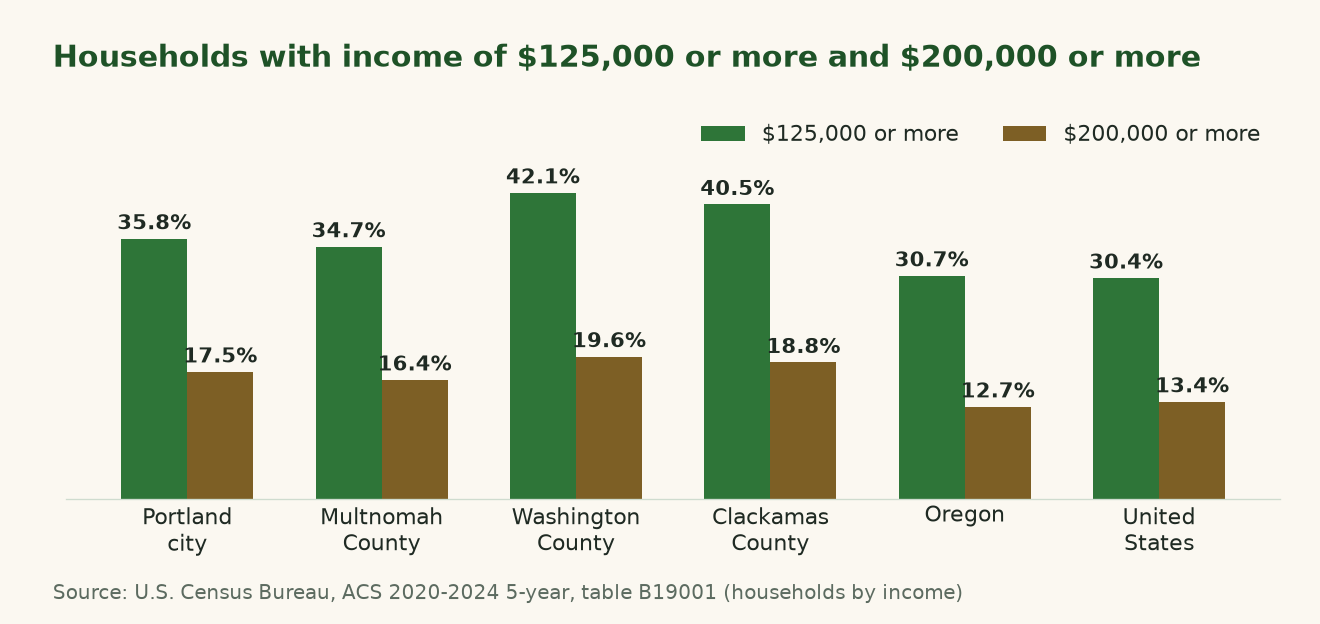
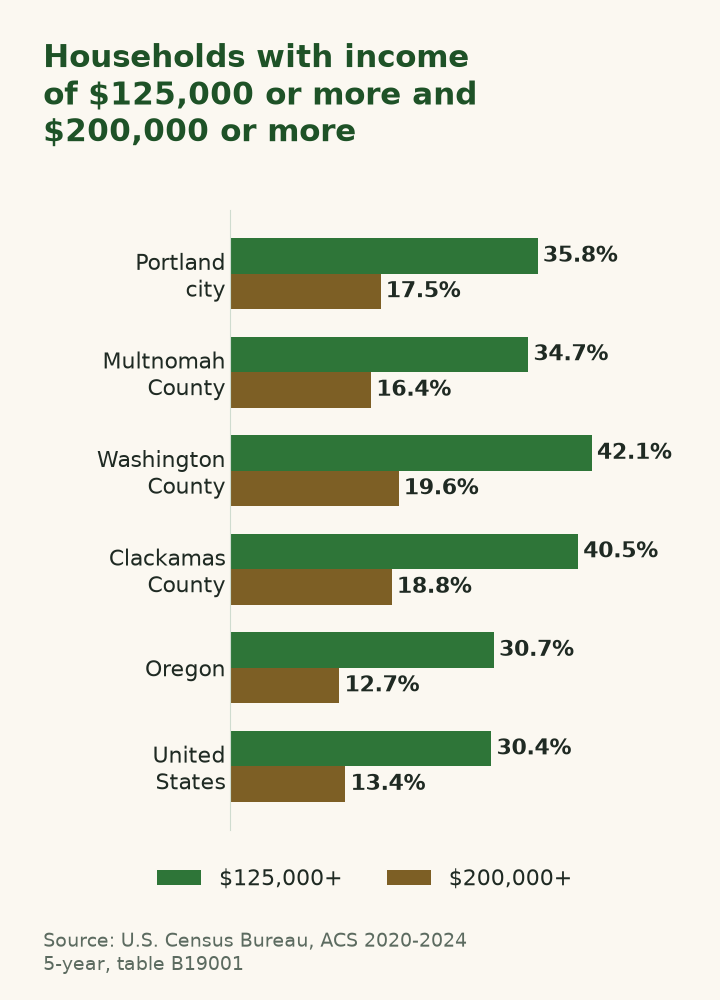
| 17.5% of Portland households have income of $200,000 or more (Oregon 12.7%, U.S. 13.4%) | $200,000 of taxable income is where joint filers start paying the Preschool for All tax, and Metro's tax through 2025 (Metro indexes its figure from 2026). Household income isn't taxable income, so read this as a rough guide to how many are near the line | Census ACS 2020-2024, table B19001 |
| 35.8% have $125,000 or more (Oregon 30.7%) | $125,000 is the starting point for single filers (Metro's figure is indexed from 2026). A one-off gain can push an ordinary salary past it in the year of the sale | ACS B19001 |
| Median household income $90,919 (Oregon $83,011) | The typical household sits below both thresholds until a large gain is added | ACS B19013 |
| Median home value $581,500; 48.0% of households rent (matching the housing panel further down) | The worked examples on this page use a $581,500 sale | ACS B25077, B25003 |
| Oregon income tax: top rate 9.9% (2025 tables) | Apart from a special rate for some farm sales, Oregon taxes a gain together with your other income, at the same rates | Oregon DOR, Publication OR-17; ORS 316.037 and 316.045 |
| Metro tax: 1% above the threshold; Preschool for All: 1.5%, and 3% above $250,000 (single) or $400,000 (joint) | Both start from Oregon taxable income, with a few local adjustments | Metro SHS tax FAQ; Multnomah County, 27 Aug 2026 |
| Washington County transfer tax: $1 per $1,000 of the selling price ($581.50 on a $581,500 sale) | Due on deeds for property anywhere in Washington County; Multnomah and Clackamas counties charge none | Washington County Assessment & Taxation |
On this page:
- Exchange services and how each one runs
- How the exchange company holds the money
- Oregon, Metro and Preschool for All taxes on a gain
- Selling from outside Oregon: withholding at closing
- The eight steps, contract to deed
- Recording in Multnomah, Washington or Clackamas County
- Buying the replacement in the Portland area
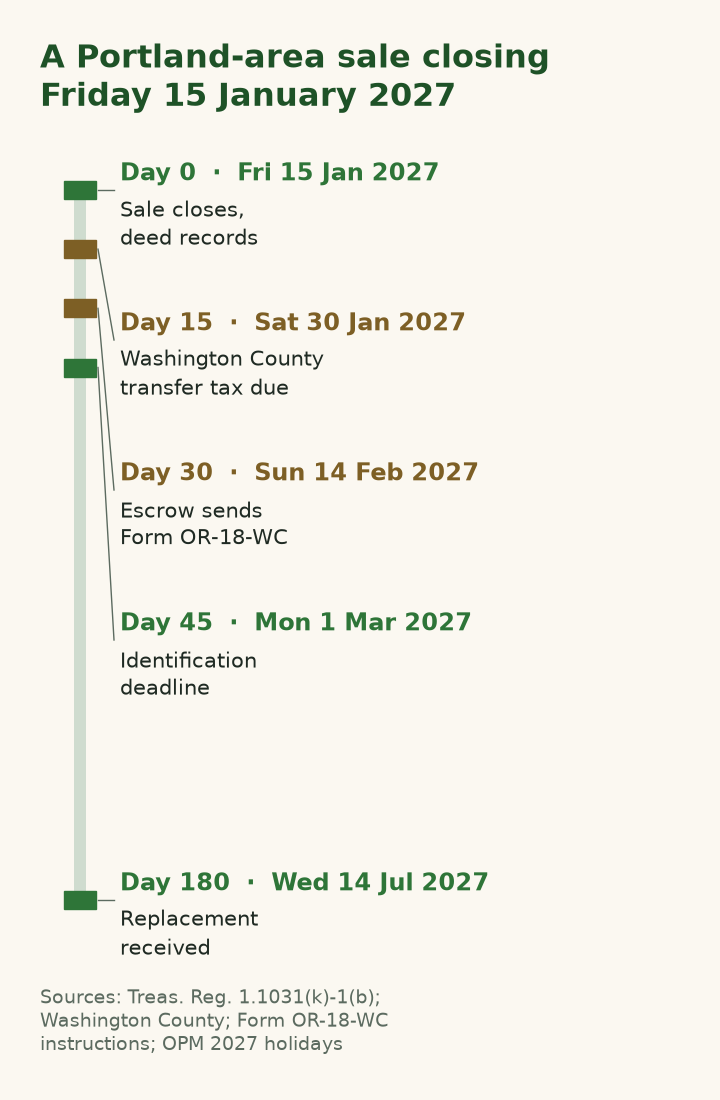
- A sale closing 15 January 2027, day by day
- Questions from Portland searches
1031 Exchange Intermediary Services in Portland, Oregon: Four Ways to Structure the Sale
Whether you’re considering a Delayed, Simultaneous, Reverse, or Improvement Exchange, we offer dedicated support tailored to your unique investment needs. Our 1031 exchange process ensures secure handling of your funds, alignment with applicable IRS requirements, and strategic optimization of your tax benefits. Navigate your real estate transactions with the confidence that comes from partnering with an industry expert who puts your interests at the forefront of every exchange.
Our 1031 Exchange Intermediary Services Include:
Delayed exchange: proceeds wait with the intermediary after the Portland closing
A delayed exchange is the most widely used structure among Portland investors selling rental properties, commercial spaces, or mixed-use buildings. After closing on your relinquished property, you have 45 days to identify up to three replacement properties (or more, if their combined value stays within 200% of what you sold) and 180 days to complete the purchase. We work closely with Oregon title and escrow professionals to keep your exchange on track.

Simultaneous exchange: both deeds on one closing date
When both sides of a Portland transaction are ready to close on the same date, a simultaneous exchange streamlines the process into a single coordinated closing. Our role as qualified intermediary ensures that funds never touch your hands, preserving the tax-deferred status of the exchange while the title company records the deeds with the county as usual.
Reverse exchange: buy first, sell the Portland property after
Portland’s competitive housing and commercial market often means desirable replacement properties don’t wait. A reverse exchange lets you lock in the new property before your current one sells. We arrange for an Exchange Accommodation Titleholder to park the replacement property for up to 180 days while you finalize the sale of your relinquished asset.
Improvement exchange: renovation paid from exchange funds
Oregon investors frequently use improvement exchanges to add value to replacement properties — whether converting a Pearl District warehouse, renovating a multifamily property in Southeast Portland, or completing tenant improvements on a commercial space. We coordinate construction draws and timelines so the work can be finished within your exchange period.
Choosing a 1031 Exchange Company in Portland: Where Your Money Sits
Updates and controls against fraud
As your Qualified Intermediary, we prioritize clear, open communication and absolute reliability. We keep you updated throughout the exchange process and work to keep every transaction within IRS regulations. We have in place internal controls to protect your funds against potential fraud or theft.
A structure that fits your sale
No two clients or transactions are alike. Recognizing this, we offer customized solutions to align with your unique needs and objectives. Our role goes beyond standard Qualified Intermediary functions, providing end-to-end guidance to ensure each transaction is properly structured.
Held in trust, backed by a policy
We keep your funds safe in an Exchange Trust, affording you maximum protection. Furthermore, our operations are underpinned by a comprehensive Errors & Omissions (E&O) insurance policy.
How we measure the work
Your satisfaction is our benchmark for success. At Universal Pacific 1031 Exchange, we take our fiduciary duties seriously and strive to exceed your expectations with every transaction.
At Universal Pacific 1031 Exchange, we do more than handle 1031 transactions – we leverage decades of industry expertise to guide you through a process that’s as seamless as it is successful. Reach out today and discover the benefits of partnering with us.

Selling a rental or commercial property in the Portland area? Talk to us before the sale closes. Your sale contract has to be assigned to the intermediary, with written notice to the other parties, on or before the closing, and that step can’t be added afterwards. A first 1031 exchange consultation with us is free, and you are under no obligation.
Start an ExchangeOregon, Metro and Preschool for All: What a Portland Gain Can Owe, and What the Exchange Defers
Federal tax is the same wherever you sell. What sets Portland apart is the stack of state and local income taxes behind it, and the fact that your home address decides which local taxes reach all of your income. Someone who lives elsewhere can still owe on income sourced to where the property is.
How Oregon Taxes the Deferred Gain
Oregon starts from your federal taxable income (ORS 316.048). A gain you defer on the federal return under section 1031 therefore stays out of your Oregon income for the year of the Portland sale too. It comes due when you sell the replacement without another exchange, as part of your Oregon taxable income at the regular rates, which reach 9.9% on taxable income above $125,000 for a single filer or $250,000 on a joint return (2025 tables).
Buying the replacement in another state adds paperwork. Oregon asks for Form OR-24 with the return for the exchange year and then once a year for as long as you own the out-of-state property, and ORS 316.738 lets Oregon collect the deferred gain when that property is finally sold. Who files and how the add-back works is covered on our Oregon 1031 exchange guide.
Metro's supportive housing services tax
Metro, the regional government, taxes the income of people who live in its district at 1% above an exemption: $125,000 for single filers and $200,000 for joint filers through tax year 2025, adjusted for inflation each year from 2026 (Metro SHS tax FAQ). Portland is one of the 24 cities Metro serves, along with Beaverton, Gresham, Hillsboro, Lake Oswego and Tigard (Metro service boundary). Metro's code defines Oregon taxable income as the income "as reported or as reportable to the State of Oregon" (Metro Code 7.05.020), and Metro's FAQ calls it the starting point for Metro taxable income.
Multnomah County's Preschool for All tax
Multnomah County residents pay 1.5% on Oregon taxable income over $125,000 (single) or $200,000 (joint), and 3% on income over $250,000 or $400,000. The county says that "all Oregon Taxable Income is subject to the tax for residents of Multnomah County" (Preschool for All tax FAQ). A 0.8% increase was due on 1 January 2027; on 27 August 2026 the commissioners moved it to 1 January 2028 and said they would revisit it next year (county news release). People who live outside the county pay only on Multnomah County-sourced income. The county's FAQ explains that with wages and does not say how it sources a gain on real estate, so ask your tax preparer if you live in Beaverton and sell a rental in Southeast Portland.
Which of the taxes reach a deferred gain
None of them, for the year of the sale. All three start from Oregon taxable income, and Oregon taxable income starts from federal taxable income, which leaves out the gain you defer under section 1031. What does get taxed is any part of the gain you recognize: cash you keep from the sale, or a loan paid off at closing that the new property doesn't replace. That money is taxed federally and also counts toward the Oregon, Metro and county taxes for the year.
$50,000 kept from a $581,500 Portland sale: the state and local cost
Take a single filer whose Oregon taxable income is already above $250,000 before the sale. She sells a rental in the Washington County part of Portland for $581,500, buys a $531,500 replacement with no loan on either property and keeps $50,000 in cash. Her gain is larger than $50,000, so all of the cash is taxed, at her top rates. The figures below are the state and local share only; federal capital gains tax comes on top.
| Tax on the $50,000 | Lives in Multnomah County | Lives in the Washington or Clackamas County part of Metro |
|---|---|---|
| Oregon, 9.9% | $4,950 | $4,950 |
| Metro, 1% | $500 | $500 |
| Preschool for All, 3% | $1,500 | $0 |
| Total before federal tax | $6,950 (13.9%) | $5,450 (10.9%) |
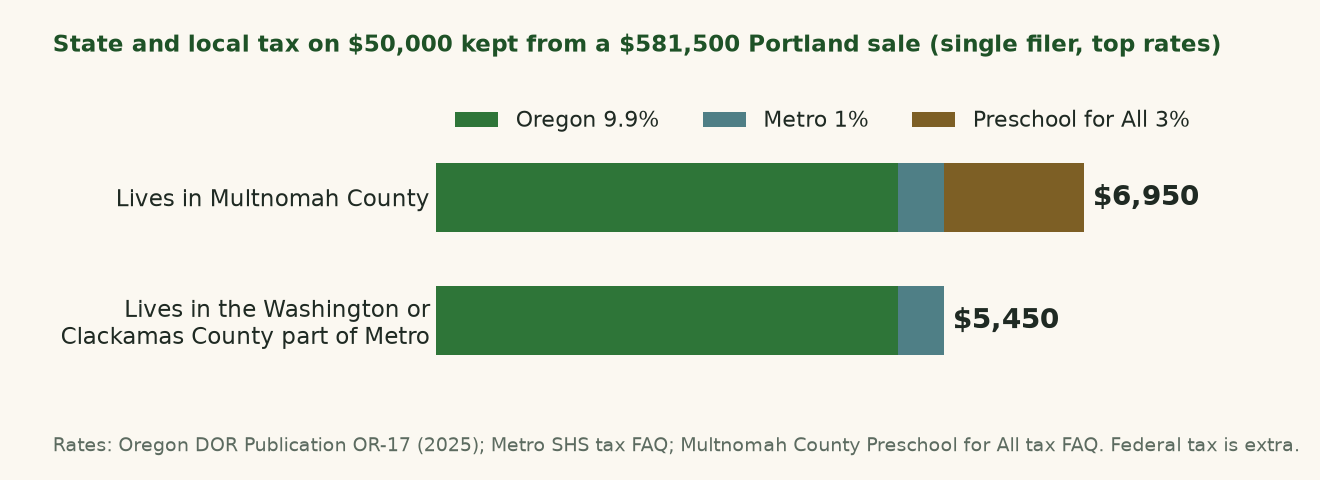
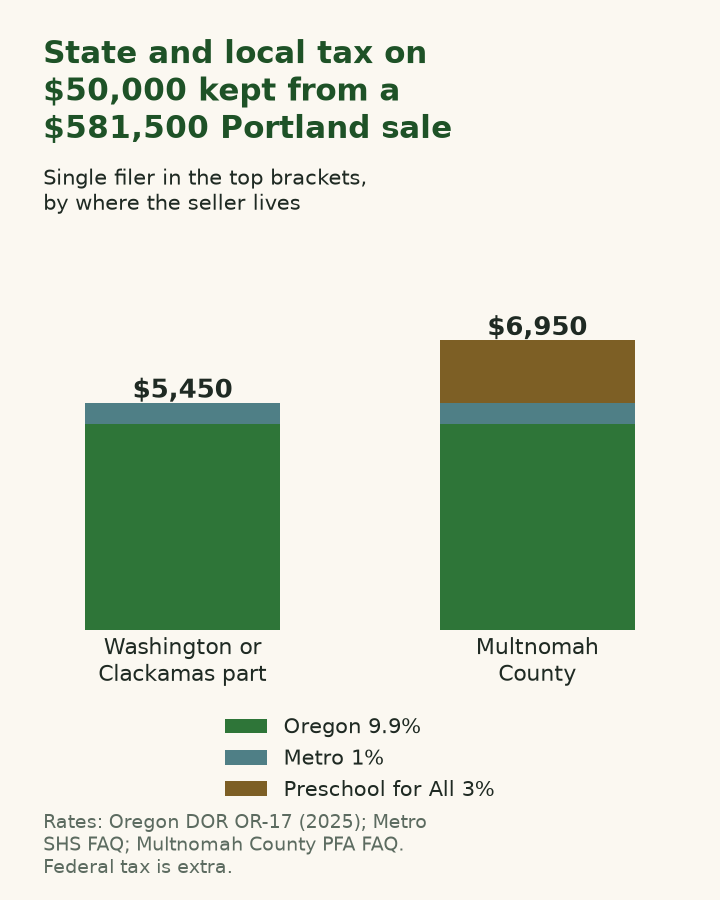
If she puts the whole $581,500 into the replacement, every line in the table is $0 for the year of the sale. A lower income changes the rates: the Preschool for All rate is 1.5% between the two thresholds, and below the thresholds neither local tax applies. Our guide to boot explains how cash and debt relief are counted.
Planning to keep some cash from a Portland sale? Tell us the amount before closing. It is easier to plan the boot than to discover it on the settlement statement.
Selling Portland Property From Outside Oregon: The Withholding at Closing
If you live in another state when your Portland property closes, Oregon law makes the escrow or title company hold back part of the money for the Department of Revenue (ORS 314.258). The rule covers nonresident individuals and C corporations that are not registered or otherwise qualified to do business in Oregon (Form OR-18-WC instructions). Oregon taxes nonresidents on gains from "the ownership or disposition of any interest in real or tangible personal property in this state" (ORS 316.127), so a gain on a Portland property is Oregon income wherever you live.
How much escrow holds back
The amount is the smallest of three numbers: 4% of the price, the net proceeds paid to you, or 8% of the gain that goes into your Oregon taxable income. Sales of $100,000 or less are exempt, and so is any case where the amount comes to less than $100. The statute has no exemption that names a like-kind exchange.
How the exchange is shown on Form OR-18-WC
The exchange works through the form instead. The instructions say not to use the exemption section (Part C) when the gain is excluded under a federal law other than the home-sale exclusion, but to complete Part D and enter the code section and the excluded gain on line 11 (Form OR-18-WC instructions). Money that escrow sends to the intermediary is not paid to you, so it stays out of the net proceeds; the instructions' own example forwards $200,000 to a qualified intermediary and counts only the $75,000 paid to the seller.
On the $581,500 sale above, a nonresident who exchanges everything has no recognized gain to enter, so the 8% figure is $0 and nothing is held back. A nonresident who keeps $50,000 has $50,000 of recognized gain: 8% of it is $4,000, below both 4% of the price ($23,260) and the $50,000 paid out, so escrow holds back $4,000. That payment is credited to your Oregon return for the year. Escrow has to send the form, or a written assurance, to the department within 30 days of closing; if tax is held back, the form and the payment are due within 20 days of the payout.
Completing a 1031 Exchange in Portland in Eight Steps, From the Sale Contract to the Last Deed

The exchanger signs a contract to sell a relinquished property to the buyer.

Universal Pacific 1031 Exchange and the exchanger enter into an exchange agreement to retain Universal Pacific 1031 Exchange as the Qualified Intermediary and the exchanger then assigns the exchanger’s rights in the sale contract to Universal Pacific 1031 Exchange.

At the closing of the relinquished property the exchange funds are wired to Universal Pacific 1031 Exchange who then instructs the settlement officer to transfer the deed directly from the exchanger to the buyer.

The exchanger must identify possible replacement properties in writing to Universal Pacific 1031 Exchange within the 45-day identification period.

The exchanger has a maximum of 180 days in the exchange period (or until the tax filing deadline, including extensions, for the year of the sale of the relinquished property, if that comes first) to acquire all replacement property.

The exchanger signs a contract to purchase the replacement property with the seller and the exchanger assigns the exchanger’s rights in the purchase contract to Universal Pacific 1031 Exchange.

At the closing of the replacement property, Universal Pacific 1031 Exchange wires the exchange funds to complete the exchange and Universal Pacific 1031 Exchange instructs the settlement officer to transfer the deed directly from the seller to the exchanger.

Congratulations!
Your 1031 exchange is complete!
Recording the Deed in Multnomah, Washington or Clackamas County
Most of Portland lies in Multnomah County, but small parts of the city reach into Washington and Clackamas counties, and so do many of its suburbs. Your deed is recorded by the county where the land sits, not by the city, and that county decides whether a transfer tax is due on top of the recording fees.
- Multnomah County. The Recorder’s Office of the County Clerk records deeds for property in the county. There is no county transfer tax.
- Washington County (Beaverton, Hillsboro, Tigard). The Recording Division of the Department of Assessment & Taxation in Hillsboro records the deed, and the county charges a transfer tax of $1 per $1,000 of the selling price, due within 15 days of recording. Buyer and seller decide between them who pays it. None of the county’s exemption forms covers a 1031 exchange, so budget for it on a Washington County sale and on a Washington County replacement.
- Clackamas County. The Recording Division of the County Clerk’s office records the deed. There is no county transfer tax.
Oregon has barred new local taxes on real estate transfers since 1997 (ORS 306.815), and the Legislative Revenue Office’s table of local taxes names only Washington County’s.
Buying the Replacement in the Portland Area: Property Tax, Transfer Tax and the Address on the List
Your property tax bill won't start over at the purchase price
Oregon doesn't reassess property when it sells. Each year the maximum assessed value is the greater of 103% of last year's assessed value or 100% of last year's maximum, and the tax is figured on that value or on real market value, whichever is lower (ORS 308.146). Multnomah County's assessor puts it this way: "Property values and taxes on real property are tied to the property, not the owner" (Multnomah County Assessment). So before you sign, look up the property's current tax statement. The tax you will pay follows that record, not your price, though a sale can bring to light earlier unpermitted work that the assessor then adds as exception value.
The exceptions matter for an improvement exchange. New construction, additions, or remodeling worth more than $18,700 in one year or $46,200 over five years (thresholds indexed after 2024, per the county's property assessment FAQ; another county page gives slightly lower remodeling figures) let the assessor add value on top of the 3% limit, as do partitions and rezoning. Renovating a replacement with exchange money can therefore raise its assessed value by more than the usual 3%.
Transfer tax on the purchase side
The Washington County tax applies to the deed you receive as well as the deed you give. A replacement in Beaverton, Hillsboro or Tigard at $581,500 carries $581.50 of tax; the county says liability for it "is between the purchaser and seller." If a titleholder holds the property for you in a reverse or improvement exchange, the property is often deeded more than once. The county's definition of a taxable transfer includes "every grant, sale, exchange," and none of its exemptions mentions a titleholder, so ask the title company how many deeds will carry the tax before you pick a structure.
Describing a Portland property on the 45-day list
The regulations generally accept a street address, a legal description or a distinguishable name (Treas. Reg. 1.1031(k)-1(c)(3)). With condominiums and plexes the street address alone can be ambiguous, so name the unit number, or use the legal description from the deed or the title report.
A Portland Sale Closing on Friday 15 January 2027: Every Deadline in Order
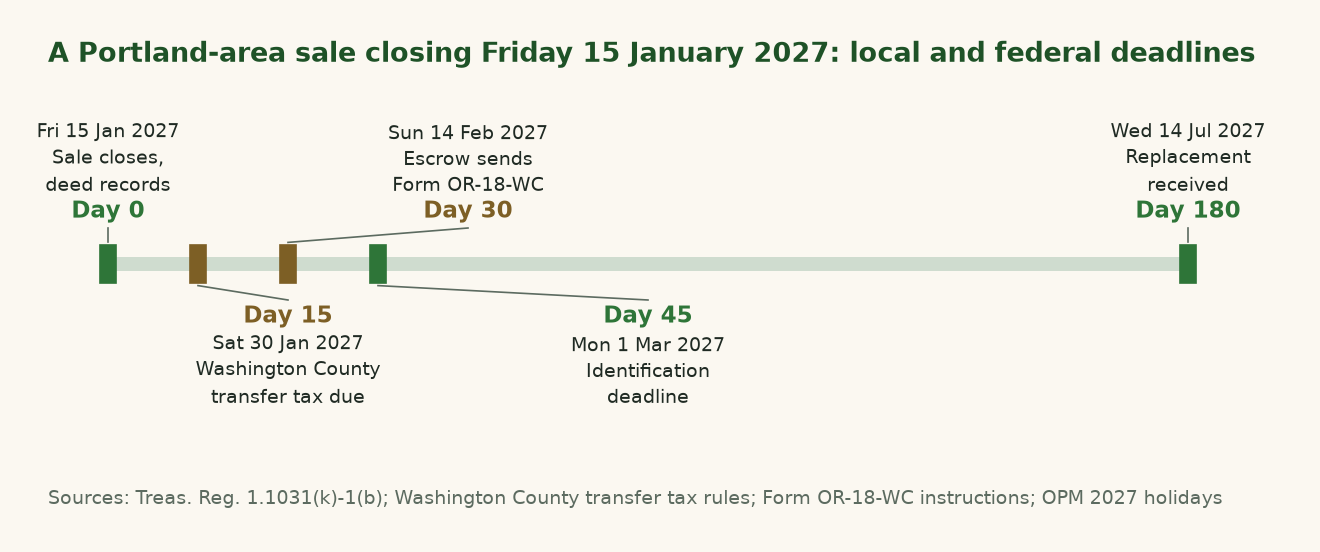
Here is a delayed exchange for a Washington County rental sold by an owner who lives in another state, so every local deadline on this page applies. The federal clocks start on the day the sale closes and count weekends and holidays like any other day.
| Date | Day | Deadline | Who acts |
|---|---|---|---|
| Fri 15 Jan 2027 | 0 | Sale closes and the deed records; exchange funds go to the intermediary | Exchange agreement and contract assignment already signed |
| Sat 30 Jan 2027 | 15 | Washington County transfer tax (or the exemption filing) due, 15 days from recording | Title company. Day 15 is a Saturday, so aim for Friday 29 January |
| Sun 14 Feb 2027 | 30 | Form OR-18-WC to the Oregon Department of Revenue, 30 days from closing (this example is a full exchange, so nothing is held back; when tax is held back, form and payment are due within 20 days of the payout) | Escrow. Day 30 is a Sunday and the Monday is a holiday, so aim for Friday 12 February |
| Mon 1 Mar 2027 | 45 | Identification deadline, midnight | You, with a signed list sent to us |
| Wed 14 Jul 2027 | 180 | Last day to receive the replacement, midnight | You and your purchase escrow |
A January sale has one advantage over a late-year one: the return for 2027 is not due until April 2028, months after day 180, so you don't need an extension to get the full 180 days. The return still has to report the exchange on federal Form 8824, and Oregon Form OR-24 if the replacement is outside Oregon.
To try a different closing date, use the 1031 exchange deadline calculator.
These are Census figures for the city of Portland from the 2020-2024 American Community Survey, next to the U.S. figure.
Source: U.S. Census Bureau, American Community Survey 2020-2024 5-year estimates. The rent-to-value figure compares median rent with median home value; it is not a property yield. See the table for all 51 cities.
Portland 1031 Exchange Services, Companies and Accommodators: Questions From Local Searches
Yes, you need an intermediary for a 1031 exchange regardless of your location, including Portland. Strictly, the IRS regulations list a Qualified Intermediary (QI) as one of several safe harbors, alongside qualified escrow accounts and qualified trusts (Treas. Reg. 1.1031(k)-1(g)(3) and (g)(4)), but when you sell first and buy later the QI is the practical way to keep the sale money out of your hands. Cash in an escrow account or trust only secures your buyer's promise to deliver the replacement property, so that route works only if your buyer agrees to take on the role. You may also hear a QI called an accommodator or an exchange facilitator. The QI holds the proceeds from your relinquished property and uses them to acquire the replacement property, which is deeded straight to you. At Universal Pacific 1031 Exchange, we serve as your experienced Qualified Intermediary and run the exchange in line with the tax laws and regulations that apply.
Finding a suitable qualified intermediary (QI) for a 1031 exchange requires some research, but the firm doesn't need an office in Portland. You can deliver your 45-day identification by hand, mail, fax or other means (Treas. Reg. 1.1031(k)-1(c)(2)), and the intermediary's work is documents and wire transfers. Your escrow still closes locally, and the deed is still recorded by the county where the land sits, as the recording section above explains. Check their credentials and experience with 1031 exchanges, then ask three questions. Does the exchange agreement limit your rights to the money in the way Treas. Reg. 1.1031(k)-1(g)(6) requires? In whose name, and in what kind of account, will your sale proceeds be held? And what are their fees for your exchange type? Get the answers in writing before your sale closes.
No, according to IRS guidelines, you cannot serve as your own Qualified Intermediary in a 1031 exchange (Treas. Reg. 1.1031(k)-1(g)(4)(iii)). The regulations also exclude disqualified persons: your agent, anyone who has acted as your employee, attorney, accountant, investment banker or broker, or real estate agent or broker within the two years prior to the transfer of the relinquished property, and certain related people and companies (Treas. Reg. 1.1031(k)-1(k)). Work done only on your 1031 exchanges doesn't count toward the two years, and neither do routine title insurance, escrow, trust or banking services from a title company, escrow company or bank. So the escrow company closing your Portland sale is not ruled out by having done that work for you before.
The fees charged by Qualified Intermediaries for a 1031 exchange can vary widely. Our fee guide puts a standard delayed exchange at $600 to $1,500 and a reverse or improvement exchange at $3,000 to $7,500. The cost often depends on the complexity of the transaction: in a reverse or improvement exchange, a separate company holds title to one of the properties until the exchange is finished. County charges come on top of the exchange fee. If either property is in Washington County, its transfer tax of $1 per $1,000 of the selling price applies (Washington County transfer tax), and none of the county's exemptions covers a 1031 exchange. Ask for a written quote for your exchange type before your sale closes.
We are a qualified intermediary, not a brokerage, so we don’t sell or list property and have no Portland listings to offer. You or your broker choose the replacement. Our part is the identification step: within 45 days of your sale closing, you give us a signed, written list of the properties you might buy (Treas. Reg. 1.1031(k)-1(c)(2)). You can name up to three properties of any value, or more if their combined value stays within 200% of what you sold (Treas. Reg. 1.1031(k)-1(c)(4)). The 45 days start the day your sale closes, so it helps to start looking before then.
The same job as a qualified intermediary; the three names are used for one role. Under a written exchange agreement, the accommodator takes your place in the sale contract, receives the proceeds at closing and uses them to buy the replacement, which is then deeded to you. The agreement must stop you from receiving, pledging or borrowing against that money until the exchange ends (Treas. Reg. 1.1031(k)-1(g)(4) and (g)(6)). In a reverse exchange you may also see "exchange accommodation titleholder." That is a different role: the company that holds title to a property while you wait to sell the other one.
Usually three. Each closing runs through a Portland title or escrow company, which also sends the deeds to the county for recording; for a seller who lives outside Oregon it also handles the Form OR-18-WC withholding. A tax preparer, often a CPA, reports the exchange on federal Form 8824 and on your Oregon return, plus the Metro and Preschool for All returns if your income reaches them. A real estate broker helps you find the replacement. The intermediary's part is narrower: it holds the sale money and prepares the exchange paperwork.
At the county, yes, by the transfer tax. Tigard and Beaverton are in Washington County, which records deeds at its office in Hillsboro and charges $1 per $1,000 of the selling price, or $581.50 on a $581,500 sale (Washington County transfer tax). A deed in the Multnomah County part of Portland carries recording fees only. For income taxes, your home address decides which local taxes reach all of your income. Tigard and Beaverton are inside Metro, so residents there pay Metro's tax above the threshold. They are outside Multnomah County, so its Preschool for All tax reaches only their Multnomah County-sourced income; the county's FAQ doesn't say whether a gain on a rental in the Multnomah County part of Portland counts, so ask your tax preparer.
For the deferred part, yes. Both taxes are figured from Oregon taxable income (Metro SHS tax FAQ; Preschool for All tax FAQ), and a gain deferred under section 1031 isn't in Oregon taxable income for the year of the sale. Cash you keep, or debt relief that isn't replaced, is recognized and counts toward both. The deferral isn't forgiveness: if you later sell the replacement without another exchange the gain can be taxed by Metro, the county, or both, depending on where you live that year.
Unless an exception applies, yes. Escrow must hold back the smallest of 4% of the price, the net proceeds paid to you, or 8% of the gain that counts toward your Oregon taxable income (ORS 314.258). In an exchange you complete Part D of Form OR-18-WC and enter the deferred gain on line 11 (Form OR-18-WC instructions), so a full exchange usually leaves nothing to hold back. On a $581,500 sale where you keep $50,000, the payment would be $4,000, credited on your Oregon nonresident return.
Not because of the price you paid, though a sale can bring to light earlier unpermitted work that the assessor then adds as exception value. Oregon taxes the assessed value, which can grow by 3% a year and does not reset when the property sells (ORS 308.146). Your bill depends on the value already on the county's record. Two things can raise it faster: work worth more than the county's exception thresholds ($18,700 in a year or $46,200 over five years, indexed after 2024), and a year in which real market value had been below the maximum and then rises above it (Multnomah County Assessment).
Yes. An exchange accommodation titleholder takes title to the new property, you identify the Portland property you will sell within 45 days, and the arrangement must finish within 180 days of the titleholder's purchase to stay inside the IRS safe harbor (Rev. Proc. 2000-37). Budget for the extra deed if either property is in Washington County, where each recorded transfer with a selling price can carry the county's transfer tax. Fees for reverse exchanges are higher than for delayed ones; our reverse exchange fee guide lists them.

Before the Portland Sale Closes: Assign the Contract to Your Intermediary
At Universal Pacific 1031 Exchange, our unique blend of extensive real estate, financial, and tax expertise sets us apart in the field of 1031 exchanges. With our commitment to personalized service, meticulous attention to detail, and decades of experience managing complex transactions, we aim to give every client a reliable exchange from the first call to the final closing.
Start an ExchangeSources: 26 U.S.C. 1031; Treas. Reg. 1.1031(k)-1; City of Portland, Mitigation Action Plan (draft, 2022); Multnomah County, Recording documents; Washington County, Recording; Washington County, Transfer tax and exemptions; Clackamas County Clerk, Recording; ORS 306.815; Legislative Revenue Office, Basic Facts 2025; ORS 316.048 and 316.738; Oregon Department of Revenue, Publication OR-17 (2025); Form OR-24 instructions; U.S. Census Bureau, ACS 2020-2024, tables B19001; B19013; B25077; B25003; Metro, Supportive Housing Services tax FAQ; Metro Code chapter 7.05 (Ordinance 21-1465); Metro, Cities and counties in the Metro service boundary; Multnomah County, Preschool for All tax FAQ (rev. 10/06/2025); Multnomah County news release, 27 August 2026; ORS 314.258; ORS 316.127; Form OR-18-WC instructions (rev. 09-03-25); ORS 308.146; Multnomah County, Property assessment; U.S. Office of Personnel Management, federal holidays.
Photo at the top of the page: Portland skyline and Mount Hood from Pittock Mansion, by Truflip99, CC BY-SA 4.0, via Wikimedia Commons, cropped.
From the 1031 Exchange Blog: Reverse Exchange Fees, Tax Reporting and Second Homes


Set up your Portland 1031 exchange
Call Now For A Free Consultation · (424) 469-8111