How to Properly Vet a 1031 Qualified Intermediary
Knowing how to properly vet a 1031 Qualified Intermediary is not just an option, but a necessity if you want your 1031 exchange to succeed without complications. This is because a single misstep on their part could void the tax benefits you are relying on.
Some of the ways to properly vet a 1031 Qualified Intermediary include checking their track record, confirming regulatory compliance, and reviewing their previous clients. These steps, along with others, will help protect you from future tax liabilities and fraud issues.
Universal Pacific 1031 Exchange is a well-known QI service provider with a solid reputation. With over three decades of experience, our team brings deep expertise in helping clients navigate the complexities of a 1031 exchange while keeping their funds secure and the exchange compliant. Contact us today to start an exchange.
This article is a comprehensive guide on the steps to thoroughly evaluate a 1031 Qualified Intermediary.
What Is a 1031 Qualified Intermediary?

A Qualified Intermediary (QI), sometimes called an exchange accommodator, is a neutral third party responsible for facilitating a 1031 exchange. Under IRS 1031 exchange rules, investors can defer capital gains taxes by reinvesting the proceeds of the sale of one investment property into the procurement of another like-kind property.
However, this exchange can only be made possible with the aid of a Qualified Intermediary. The QI's primary role is to hold and manage the sale proceeds so the taxpayer never takes “constructive receipt” of the funds, a crucial IRS requirement for preserving the tax deferral benefit.
It is important to note that under Treasury Regulation § 1.1031-1(g)(4), a QI must be completely independent, meaning they cannot be your agent, attorney, accountant, or broker from the past two years. There must also be a formal exchange agreement outlining the QI's duties and restrictions. A QI handles several essential tasks to keep the exchange compliant.
The QI prepares all necessary documents and receives and holds the escrow funds. They also help to track deadlines and help you identify potential replacement properties within the 45-day identification period. They ensure you close on the new property within 180 days to avoid taxable consequences. The QI assigns a purchase-and-sale contract and releases money for the purchase of the identified property once all requirements are met.
Beyond that, the QI maintains detailed records for tax reporting. They coordinate with all parties involved, such as your tax advisor, financial advisor, tax professional, and real estate agent, to ensure a smooth exchange process and avoid costly mistakes. Finally, they provide the taxpayer with statements and closing documents necessary for completing IRS Form 8824, ensuring accurate tax reporting for the tax year in which the exchange occurs and maintaining full compliance with IRS rules.
Why Proper Vetting Is Crucial in a 1031 Exchange
Properly vetting a 1031 Qualified Intermediary is one of the most important steps in completing a 1031 exchange successfully. While a QI plays a vital role in helping you defer capital gains taxes when selling a relinquished property and buying a replacement property, not all intermediaries offer the same level of security, transparency, and experience.
Choosing the wrong QI can lead to missed deadlines, loss of tax deferral, and even loss of your escrow funds. Since the exchange process involves large sums from the sale of your investment property, any mistake or mishandling can create serious potential tax liability and wipe out the intended benefits of a like-kind exchange. A failed exchange can also trigger capital gains and depreciation recapture taxes.
Unfortunately, there have been cases where investors suffered major financial losses because they trusted an inexperienced or dishonest QI. For example, in some widely reported fraud cases, QIs misappropriated exchange funds, used client money for personal investments, or filed for bankruptcy. In this real case study, Edward Okun, who ran a group of QI companies, misappropriated about $126 million in client exchange funds. In 2009, the U.S. Department of Justice reported he was sentenced to 100 years in prison. Even large firms can fail, too. In 2008, LandAmerica’s exchange unit filed for bankruptcy and froze hundreds of clients’ funds.
In other instances, mishandled exchanges occurred because the QI failed to follow IRS guidelines, missed the 45-day identification period, or did not properly document the entire process. It caused the IRS to disallow the tax deferral and demand immediate payment of capital gains taxes. Michael Bergman, CPA, who leads Universal Pacific 1031 Exchange, has watched these failures up close. “People shop on price and forget they are handing a stranger their sale proceeds,” he says. “Ask where the money sits and who can move it.” That single question weeds out most weak intermediaries.
Part of the risk comes from the fact that QIs are not federally regulated. There is no national licensing requirement, and the IRS regulations governing them focus mainly on their responsibility to prevent constructive receipt, not on financial oversight.
Some states impose their own bonding or insurance rules. But, in most of the country, anyone can present themselves as a Qualified Intermediary without meeting strict professional standards. This lack of oversight makes it the responsibility of the real estate investor to perform due diligence before selecting a QI.
Choosing the right Qualified Intermediary requires careful planning. When vetting a Qualified Intermediary, there are some key factors to look out for to ensure that your investment, escrow funds, and ability to defer capital gains taxes are duly protected.
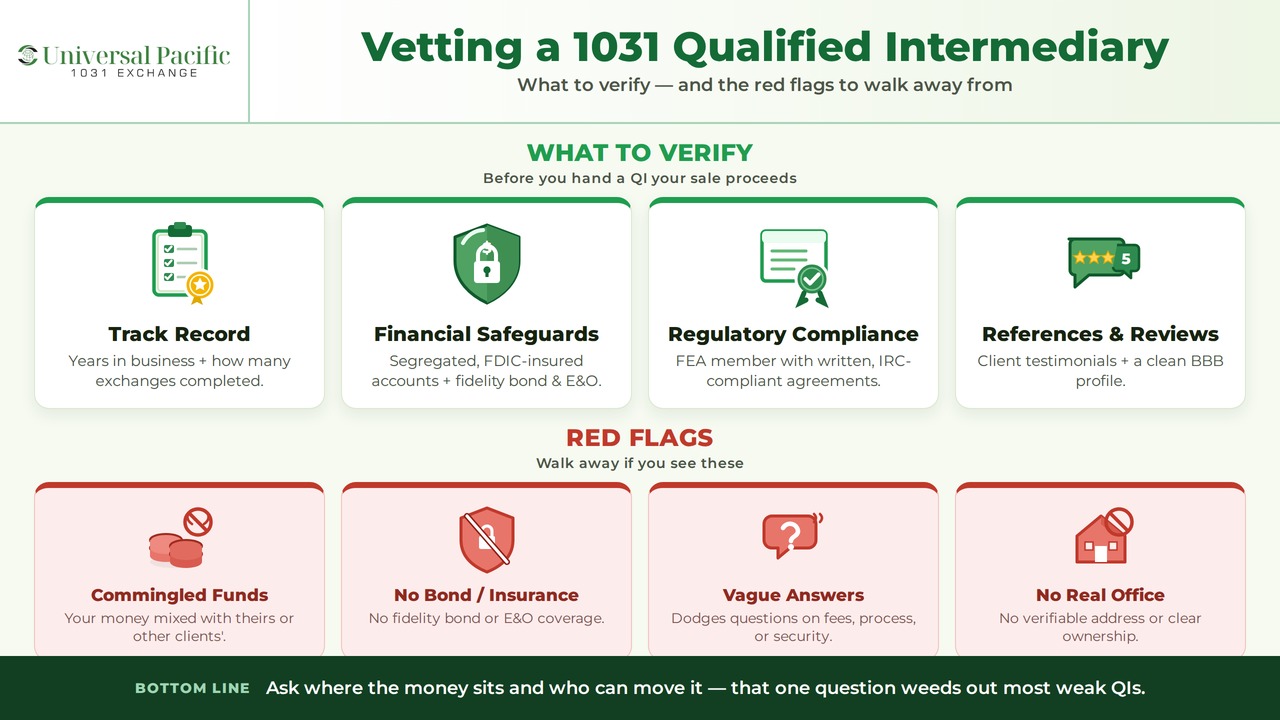
Check Their Experience and Track Record
One factor to consider is the QI's experience and proven track record. Ask how many exchanges they have completed and how many years they've been in business. Also, ask what types of exchanges they handle, whether delayed, reverse, or improvement exchanges.
A QI well-versed in the different exchanges across various jurisdictions will have a better understanding of the nuances of like-kind exchanges and be prepared for unforeseen circumstances. Experience across different property types, from rental property to vacation homes used as investments or primary residences converted to rental use before the sale, is a strong sign that they can guide you through the entire process while following IRS guidelines.
Verify Financial Safeguards
Next, verify their financial safeguards. The funds from your relinquished property's sale should be kept in separate, FDIC-insured accounts and never mixed with other clients' money. It is important to ask about their bonding and insurance policies, including whether they carry fidelity bond coverage and errors and omissions (E&O) insurance. These protections can help safeguard you against fraud, mishandling, or potential penalties if something goes wrong.
Review Legal and Regulatory Compliance
In addition to this, be sure to review their legal and regulatory compliance. Membership in the Federation of Exchange Accommodators (FEA), adherence to IRS safe harbor guidelines, and provision of written agreements that meet Internal Revenue Code requirements are strong indicators of professionalism and commitment to ensuring compliance.
Ask About Internal Controls
Before entrusting hundreds of thousands or even millions of dollars to a QI, it is critical to understand how those funds are protected and managed. Ask specifically who within the organization has the authority to access client money and whether they have dual authorization protocols before any funds are disbursed.
Dual authorization means that no single person can move your escrow funds without a second layer of approval, which adds a significant safeguard against fraud or accidental errors. It is also necessary to ascertain the audit processes they use, whether conducted internally, externally, or both. This information constitutes the backbone of a smooth exchange process and your first line of defense against financial mishandling.
Request References and Reviews
A QI's history speaks volumes about their professionalism, reliability, and ability to deliver a successful exchange. Request client testimonials, preferably from real estate investors who have completed like-kind exchanges similar to yours. Look for independent reviews on trusted platforms. You can start by checking their Better Business Bureau profile to see if any complaints or disciplinary actions have been filed that might signal red flags.
Evaluate Communication and Transparency
The right QI should be able to communicate properly with their clients to ensure transparency and the clients' peace of mind. They should be able to explain the process clearly, respond quickly to calls and emails, and properly educate you on the IRS requirements and deadlines. Good communication can help you stay informed, avoid costly mistakes, and navigate your 1031 exchange with ease.
How to Spot a Bad 1031 Qualified Intermediary

A bad 1031 Qualified Intermediary often shows warning signs that can put your exchange and money at risk. One of the biggest red flags is commingling client funds. When a QI intermingles your money with either their own funds or other clients' accounts, it makes it harder to track your funds and automatically increases the risk of loss if the QI faces financial trouble.
Another clear danger is the lack of proper insurance or bonding. Professional QIs carry fidelity bonds and error-and-omissions insurance to protect clients against theft, fraud, or costly mistakes. If an intermediary cannot provide proof of adequate coverage, you're taking on unnecessary risk. The absence of insurance often signals a lack of professionalism or financial stability.
A clear warning sign is when a QI frequently avoids answering direct questions, especially regarding their fees, process, or security measures. A reliable QI should not be vague in explaining the exchange process, how they safeguard your funds, and how they comply with the IRS's rules.
Another red flag is if a QI has no physical office or is unclear about its ownership. A solid QI should have a verifiable business address and transparent ownership information. So, if you can't verify this information, your money could be at greater risk when fraud or a dispute arises.
Lastly, if a QI has poor knowledge of IRS rules and deadlines, such as the 45-day identification rule or the 180-day exchange period, they are unfit to handle your transaction. These timelines are non-negotiable, and misunderstanding them can cause your exchange to fail, triggering a full tax liability.
Common Mistakes When Vetting a 1031 Qualified Intermediary and How to Avoid Them
Even careful investors make vetting mistakes. Knowing the common ones helps you avoid them.
The first mistake is overlooking financial safeguards. Many people focus on price and forget to ask where their funds are held and how they are protected. Always confirm segregated accounts, bonding, and E&O insurance before you sign.
A second mistake is ignoring state-specific rules. A handful of states regulate QIs or require bonding, and skipping that check can leave you exposed. Ask whether the QI meets your state’s requirements.
A third mistake is not verifying past exchange success and client complaints. A quick look at references and a Better Business Bureau profile can reveal a pattern of problems. The fourth mistake is failing to understand the fee structure, which leads to surprise costs later.
Impact of Mistakes on Your 1031 Exchange Outcome
These mistakes carry real consequences. A QI that mishandles funds or misses a deadline can get your exchange disqualified. That means immediate capital gains taxes, possible penalties, and, in the worst cases, lost funds. Careful vetting up front is far cheaper than an audit or a lawsuit later.
How to Choose the Best 1031 Exchange Company

When selecting a 1031 exchange company, the right choice can mean the difference between a seamless transaction and a costly failure. A reliable QI will help protect your funds, ensure IRS compliance, and guide you through every step of the process.
Look for a company specializing in the type of exchange you need, whether delayed, reverse, or simultaneous exchanges. Ensure they provide end-to-end support, meaning they go beyond just drafting documents or signing papers to guiding you through the process. Choose a QI service provider with a dedicated 1031 exchange team rather than a generic escrow or title service. Check if they offer educational resources and explain their exchange process in clear, understandable language.
Beyond that, confirm that their strategies align with your unique investment goals. Generally, the best firms protect your assets and explain every step. Verify that their fees are transparent and explained upfront, with no hidden costs. Select a company that uses secure, segregated escrow accounts to protect your funds.
Prioritize firms that effectively collaborate with your CPA, attorney, and real estate agent. Ask if they provide online tools or dashboards to track your exchange process. Choose a provider with a proven track record, strong reputation, and long-standing industry presence.
What Questions to Ask a Potential Qualified Intermediary?
Here's an expanded list of smart, practical questions to ask when vetting a potential Qualified Intermediary (QI) for your 1031 exchange:
- Can you provide proof of fidelity bonding and errors-and-omissions coverage?
- How are client funds held? Are they kept in segregated escrow accounts?
- What steps do you take to stay up-to-date with changes in IRS regulations and 1031 requirements?
- Who will handle my exchange daily, and how accessible will they be?
- How many exchanges have you completed in the past year, and what kind of exchanges were they?
- Do you have experience handling complex exchanges such as reverse or improvement transactions?
- How do you structure your fees, and what additional costs may arise during the exchange process?
- Can you share references from recent clients who've completed a similar exchange?
- How do you ensure all IRS timelines are met without last-minute rushes?
- Will you communicate directly with my CPA, attorney, and other advisors?
- What is your operational backup plan if your company faces a major disruption?
- Is there an online platform to track exchange progress and document status?
Should You Choose a Local or National QI?
When choosing between a local QI and a national QI, key factors are your budget, preferences, and the kind of exchange you plan to complete. A local QI is a good choice if you prefer face-to-face meetings and someone who has an in-depth understanding of your regional market.
A local QI thoroughly understands state-specific nuances, which is valuable when performing an intrastate 1031 exchange. On the other hand, a national QI offers a vast range of experience from handling complex exchanges across multiple states.
Ultimately, what matters most is that the QI is reliable and trustworthy. A good QI should be easy to reach, quick to respond, and able to coordinate smoothly with your tax, legal, and real estate professionals. Also, the QI ensures your funds are protected throughout the process, whether they are based down the street or across the country.
How Much Does a Qualified Intermediary Charge?

A Qualified Intermediary fee largely depends on the QI and the complexity of the exchange. On average, QI fees can range from $500 to $8,500, but the exact amount depends on the type of exchange and the level of service required.
For a standard delayed exchange, which is the most common type, fees typically fall between $500 and $2,500. Reverse exchange fees range from $4,500 to $7,500 because they are more complex and carry greater risk. If your transaction involves swapping one existing investment property for several replacement properties, you can expect to pay an additional $400 to $800 per extra property.
Beyond the QI fee, it is also advisable to factor in 1031 exchange costs that may arise, including transfer fees, document preparation costs, and other potential hidden fees. Therefore, before committing to a QI, it is essential to understand the full scope of the potential costs involved to avoid unpleasant surprises. The table below breaks down what to expect.
| Fee Type | Typical Cost Range | What It Covers | Question to Ask |
|---|---|---|---|
| Standard delayed exchange | $500 to $2,500 | Base QI service for the most common exchange | Is this a flat fee? |
| Reverse exchange | $4,500 to $7,500 | Added complexity and risk | Why is the fee higher? |
| Extra replacement property | $400 to $800 each | Each property beyond the first | How many are included? |
| Other exchange costs | Varies | Transfer fees, document prep, escrow | Are there any hidden fees? |
Want Peace of Mind With Your Exchange?
When initiating a 1031 exchange, your choice of a Qualified Intermediary can significantly influence the success or failure of the exchange. This is why careful vetting of potential QIs is essential. Don't just choose a QI because of their fees.
Examine their experience with the kind of exchange you want to do, the safeguards they use to protect client funds, their understanding of IRS requirements, and their reputation with past clients. Ultimately, choosing the right intermediary is one of the most important steps you can take to ensure your 1031 exchange works in your favor.
As one of the most experienced providers of Qualified Intermediary services, Universal Pacific 1031 Exchange has 35+ years of experience in helping clients defer capital gains taxes. With 1,000+ transactions completed, we are trustworthy, reliable, and capable enough to ensure your 1031 exchange runs smoothly and successfully. Contact us now to start an exchange.
FAQs
Here are frequently asked questions on how to vet a potentially Qualified Intermediary and their provided answers.
What Are the Risks of Choosing an Unqualified 1031 Intermediary?
An inexperienced or unqualified QI may mishandle your exchange funds, miss crucial deadlines, or fail to prepare proper documentation. These mistakes can invalidate your exchange, triggering immediate capital gains taxes and possible IRS penalties. In extreme cases, poor fund security can expose your proceeds to fraud or bankruptcy risks.
How to Become a Qualified Intermediary for 1031 Exchanges?
There is no formal federal licensing for QIs, but reputable intermediaries follow strict industry standards, maintain fidelity bonds, and use secure escrow arrangements. Many QIs come from backgrounds in real estate law, tax advisory, or title services, and so they combine this knowledge to ensure a compliant exchange process.
Who Is Typically a Qualified Intermediary for a 1031 Exchange?
A QI can be a specialized 1031 exchange company, an attorney, a CPA, or an escrow or title company. However, not all title companies are automatically eligible. They must be an independent third party with no disqualifying relationship or conflict of interest to you or your business.
How to Choose a Qualified Intermediary?
Look for proven experience, strong security measures for exchange funds, a transparent fee structure, and deep familiarity with both straightforward and complex exchanges. Ask about their internal controls, client references, and whether they carry errors and omissions insurance. The right Qualified Intermediary should have a clear track record of reliability and transparency.
This page was reviewed by Michael Bergman, CPA, California CPA #56113. Verify license.
Disclaimer: The content on this blog is provided for informational purposes only and is not intended as legal, tax, financial, or investment advice. Universal Pacific serves as a Qualified Intermediary for 1031 exchanges and does not provide legal or tax advice. Because every exchange is different, you should consult with your attorney, CPA, or tax advisor before making decisions about your transaction. Reading this blog or contacting Universal Pacific does not create a legal, tax, or fiduciary relationship.
Editorial Policy
All articles are reviewed for accuracy by licensed tax professionals and sourced from official government publications. Read our Editorial Policy →
About The Author
 Michael Bergman is a California licensed CPA and Real Estate Broker with over 35+ years of CPA-supervised 1031 exchange experience in commercial real estate. Specializing in 1031 tax-deferred exchanges and financial oversight, his expertise covers complex real estate transactions. Michael’s unique blend of financial acumen and real estate knowledge positions him as a trusted advisor in the industry, offering sound advice and strategic insights for successful property management and investment.