

Qualified Intermediary for 1031 Exchanges in Washington, D.C.
On a Washington, D.C. sale, the qualified intermediary holds the sale money between your two settlements, so it never reaches your hands, and the federal 45-day and 180-day periods start on the day the sale settles. The District's recordation and transfer taxes are still due when the deed is recorded, at 1.45% each on a sale of $400,000 or more, and D.C. income tax follows the federal deferral. If you are selling a rented building, the D.C. tenant opportunity to purchase law can add months before that settlement date.
Washington D.C.'s real estate market combines stable demand from federal employment, embassies, and a strong professional sector with one of the highest property value bases in the country. From condos in Logan Circle to mixed-use properties along H Street and commercial assets in NoMa, D.C. investors use 1031 exchanges to defer capital gains and reposition their portfolios.
Reviewed by Michael Bergman, CPA
Last updated 9 November 2026 · Sources for this page


Welcome to Universal Pacific 1031 Exchange! Our deep knowledge of District of Columbia real estate transactions and tax-deferred exchange strategies positions us to guide Washington investors through every stage of a 1031 exchange.
With a professional history managing transactions ranging in price from $100,000 to over $100M, our company combines genuine business acumen, real estate insight, and financial literacy.
Washington, D.C. Rental Property in Census Figures: Rowhouses, Large Buildings and Tenants
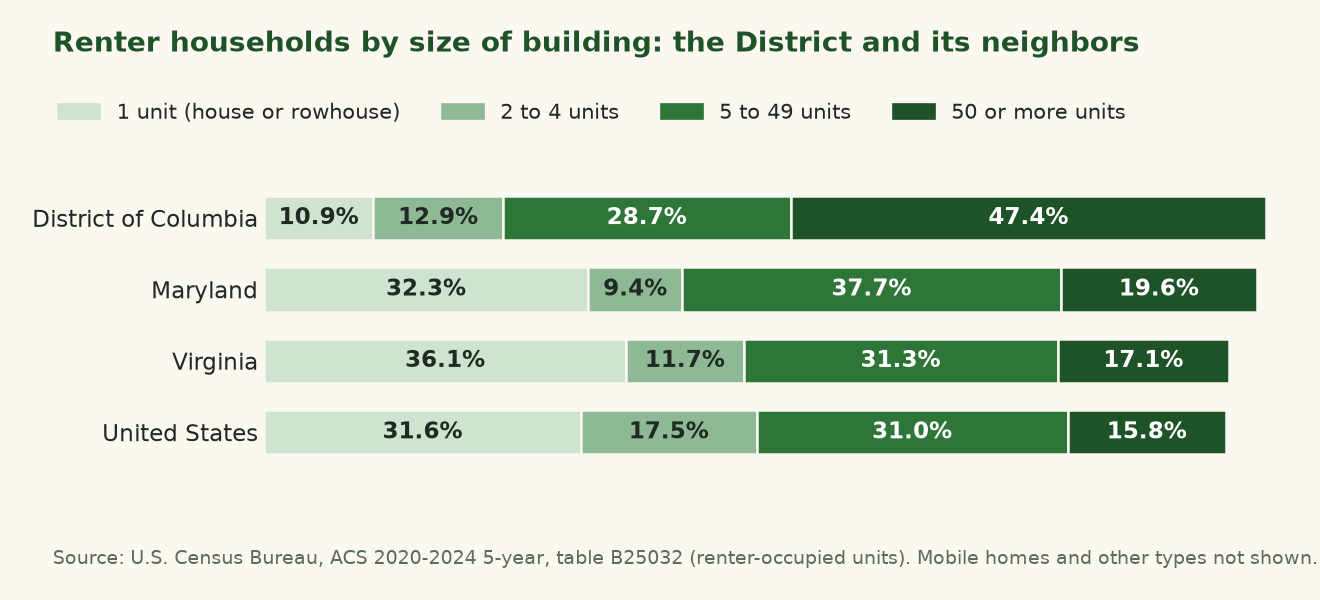
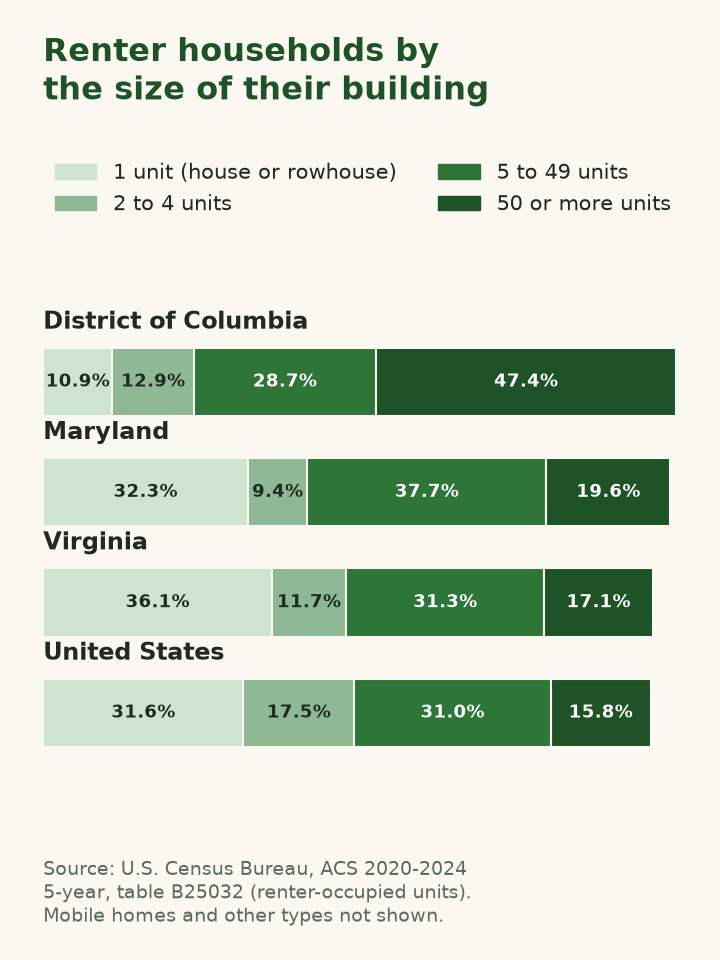
Most homes in the District are rented, and most of its renters live in apartment buildings. That mix decides which District rules come into play when you sell. Each row below pairs a Census figure with what it changes about an exchange.
| Census figure | Why it matters on a D.C. sale | Source |
|---|---|---|
| 58.5% of occupied homes are rented (U.S. 34.8%) | Tenants live in most of the District's occupied homes, so the tenant purchase rules covered below come up before many sales | Census ACS 2020-2024, table B25003 |
| 76.1% of renter households live in buildings with 5 or more units, and 47.4% in buildings with 50 or more (U.S. 46.8% and 15.8%) | Selling a whole building of 5 or more units brings the longest tenant purchase periods. A single rented condo unit is treated as a single-family accommodation under the same law, even inside a large building | ACS B25032; § 42-3401.03 |
| Buildings of 2 to 4 units house 12.9% of renter households (U.S. 17.5%) | At this size, the full tenant purchase periods apply only when a D.C. business corporation owns the majority of the building | ACS B25032; § 42-3404.10 |
| 21.7% of all housing units are single-family attached homes, the Census group that holds rowhouses and townhouses (Maryland 21.3%, U.S. 6.2%) | An owner who intends to sell a rented rowhouse must tell the tenant in writing within 3 calendar days of receiving or soliciting a written offer to buy it | ACS B25024; § 42-3404.09(b) |
| 31.5% of housing units were built in 1939 or earlier (U.S. 11.7%) | A building's age doesn't affect the like-kind test, which looks at the nature of the property, not its grade or quality, so a rowhouse built in 1910 and a condo finished last year are like-kind to each other | ACS B25034; Treas. Reg. 1.1031(a)-1(b) |
| Median home value $737,100 (U.S. $332,700), the same figure as the housing panel further down | The median is well above $400,000, the price at which each District deed tax on a residential sale rises from 1.1% to 1.45% | ACS B25077; OTR Recorder of Deeds FAQs |
Jump to a section:
- Exchange services for D.C. property
- Hiring an exchange company for a D.C. sale
- The eight steps of the exchange
- Selling a rented building: tenant purchase rights
- Deed taxes, D.C. income tax, Maryland and Virginia
- A settlement on 17 March 2027, day by day
- Questions about accommodators, realtors and intermediaries
Washington, D.C. 1031 Exchange Services for Rowhouses, Condos and Apartment Buildings
Whether you're considering a Delayed, Simultaneous, Reverse, or Improvement Exchange, we offer dedicated support tailored to your unique investment needs. Our 1031 exchange process is built around secure handling of your funds and the IRS requirements for a valid exchange. Navigate your real estate transactions with the confidence that comes from partnering with an industry expert who puts your interests at the forefront of every exchange.
Our 1031 Exchange Intermediary Services Include:
Delayed exchange, the usual route for D.C. investors
A delayed exchange is the most common structure for D.C. investors selling investment properties. After closing on the relinquished property, you have 45 days to identify replacement properties and 180 days to close. We coordinate with D.C. title companies and closing attorneys to manage fund security and IRS compliance.

Simultaneous exchange at a single D.C. settlement
In a simultaneous exchange, both sides close on the same day. D.C.'s high transaction values and attorney-led closings require precise timing — we prepare exchange documentation in advance and manage the fund flow between transactions to satisfy Section 1031 requirements.
Reverse exchange when the next D.C. property comes up first
D.C.'s competitive corridors — including Capitol Hill, Dupont Circle, and Georgetown — often require investors to secure a replacement property before their current asset sells. A reverse exchange enables this through an Exchange Accommodation Titleholder holding the property for up to 180 days.

Improvement exchange for an older D.C. row house
D.C. investors use improvement exchanges to renovate or convert replacement properties — from updating older row houses in Shaw to building out commercial space in the Wharf. We coordinate construction draws and timelines to meet IRS requirements within the 180-day exchange period.
Hiring a 1031 Exchange Company for a Washington, D.C. Sale
How we keep you informed
As your 1031 Exchange Company, we prioritize clear, open communication and reliability. We keep you updated throughout the exchange process and structure each transaction around the IRS regulations. We have in place internal controls to protect your funds against potential fraud or theft.
Where your money is held
We keep your funds in an Exchange Trust for added protection. Furthermore, our operations are underpinned by a comprehensive Errors & Omissions (E&O) insurance policy.
What has to be signed before settlement
The exchange agreement comes first. Your rights in the sales contract are then assigned to us, and every party to that contract must receive written notice of the assignment on or before the day the deed is transferred (Treas. Reg. 1.1031(k)-1(g)(4)(v)). So we need the signed contract and your settlement agent's contact details while the sale is still under contract. A notice that reaches the buyer after settlement is too late for the safe harbor in that regulation.

Comparing intermediaries for a D.C. sale? Our guide on how to vet a 1031 qualified intermediary lists the questions to ask before you sign. The first consultation is free and comes with no obligation.
Start an ExchangeThe Eight Steps of a 1031 Exchange in Washington, D.C.

The exchanger signs a contract to sell a relinquished property to the buyer.
Universal Pacific 1031 Exchange and the exchanger enter into an exchange agreement to retain Universal Pacific 1031 Exchange as the Qualified Intermediary and the exchanger then assigns the exchanger's rights in the sale contract to Universal Pacific 1031 Exchange.
At the closing of the relinquished property the exchange funds are wired to Universal Pacific 1031 Exchange who then instructs the settlement officer to transfer the deed directly from the exchanger to the buyer.
The exchanger has a maximum of 180 days in the exchange period, or until the tax filing deadline (including extensions) for the year of the sale of the relinquished property if that comes first, to acquire all replacement property.
The exchanger must identify possible replacement properties in writing to Universal Pacific 1031 Exchange within the 45-day identification period.
The exchanger signs a contract to purchase the replacement property with the seller and the exchanger assigns the exchanger's rights in the purchase contract to Universal Pacific 1031 Exchange.

At the closing of the replacement property, Universal Pacific 1031 Exchange wires the exchange funds to complete the exchange and Universal Pacific 1031 Exchange instructs the settlement officer to transfer the deed directly from the seller to the exchanger.

Congratulations!
Your 1031 exchange is complete!
Selling a Rented D.C. Building: Tenant Purchase Rights Before the 45-Day Clock Starts
Before an owner sells most rental housing in the District, the tenants get the chance to buy it at a price and on terms that make up a bona fide offer of sale (D.C. Code § 42-3404.02(a)). This is the tenant opportunity to purchase, known as TOPA. The owner sends the written offer to each tenant and, on the same date, a copy to the Mayor (§ 42-3404.03(b)). How long the tenants then have depends on what is being sold.
| What is being sold | What the tenants get | Minimum periods in the D.C. Code |
|---|---|---|
| A house or rowhouse, alone or with one accessory unit, or a single condo or co-op unit (a "single-family accommodation") | Written notice within 3 calendar days after the owner receives or solicits a written offer. The right to purchase applies only to a tenant who is 62 or older or has a disability, signed the lease by 31 March 2018 and moved in by 15 April 2018 | For those tenants: 20 days to state an interest, at least 25 days to negotiate, at least 45 days from contract to settlement (§ 42-3404.09) |
| A 2-to-4-unit building owned in majority by a D.C. business corporation | The tenants together have 15 days to state an interest; if they don't, each tenant then has 7 days | At least 90 days to negotiate, then 30 more days in which any one tenant may contract; at least 90 days from contract to settlement, or longer if a lender estimates up to 120 days in writing (§ 42-3404.10(a)) |
| Any other 2-to-4-unit building, including one owned by an LLC or an out-of-state corporation | The same written notice as for a single-family accommodation | Otherwise exempt (§ 42-3404.10(b)) |
| A building with 5 or more units | The tenants form a tenant organization and apply to register it within 45 days of the offer (30 days if one already exists) | At least 120 days to negotiate after registration; at least 120 days from contract to settlement, or longer if a lender estimates up to 240 days in writing (§ 42-3404.11) |
The Code ties the 2-to-4-unit rule to a "business corporation" as defined in § 29-101.02(2)(A): a domestic business corporation incorporated under or subject to the District's business corporation chapter. An LLC or a corporation formed in another state doesn't fit that definition, so a 2-to-4-unit building it owns falls in the notice-only row. Separately, the tenants have a 15-day right of first refusal after they receive a valid sales contract from an outside buyer (§ 42-3404.08).
Why TOPA moves day 0, not day 45
The 45-day and 180-day periods both begin on the date you transfer the property you are selling (Treas. Reg. 1.1031(k)-1(b)(2)), so the time the tenants spend deciding comes before the exchange starts, not out of it. It still affects your plans: until the tenants' periods run out or they waive their rights, you can't fix a settlement date. A replacement property you put under contract early may have to wait for that date, or be bought through a reverse exchange.
A reverse exchange has its own 180 days
In a reverse exchange, you have 45 days from the date the titleholder takes ownership to name the property you will sell, and the titleholder must pass the replacement property to you within 180 days of that same date (Rev. Proc. 2000-37, sec. 4.02(4) and (5)). Counting only the shortest periods in the table, the total already passes 180 days before a sale to the tenants can settle: at least 15 + 90 + 90 = 195 days for a 2-to-4-unit building owned by a D.C. business corporation, and at least 45 + 120 + 120 = 285 days for 5 or more units. If you want to buy first, send the offer of sale well before the titleholder takes title, and plan around the full periods.
When the replacement is a rented D.C. building
The same law binds the owner of a building you want to buy. Say a four-unit building in Columbia Heights owned by a D.C. business corporation fits your plans: if its tenants are still within their periods, they may buy it ahead of you, or push its settlement past your day 180. Ask the seller's agent where the TOPA process stands before you put such a building on your 45-day list, and use the other slots for backups. The 3-property rule lets you name up to three properties of any value (Treas. Reg. 1.1031(k)-1(c)(4)).
TOPA has exemptions and procedures this summary leaves out. Have a D.C. attorney review the offer of sale and any contract for a building with tenants.
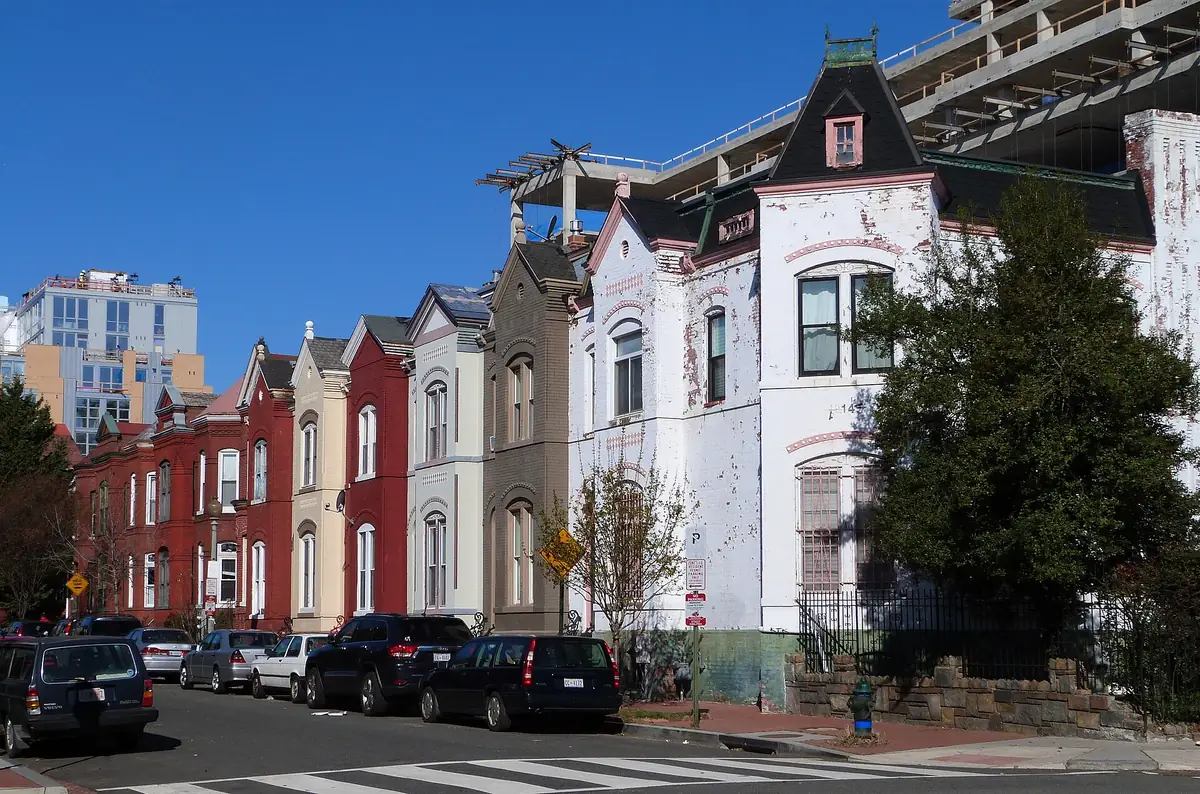
Selling a D.C. building with tenants in place? Call us before the offer of sale goes out, so the exchange plan fits the dates TOPA sets.
What a 1031 Exchange Changes in the District, and What It Doesn't
The exchange rules are federal, so the 45-day and 180-day periods run the same way for a D.C. sale as for a sale in any state (26 U.S.C. 1031(a)(3)). The District adds two things of its own: deed taxes at settlement and its own income tax return. Below is how each one treats an exchange, and what changes when the replacement property is in Maryland or Virginia.
D.C. recordation and transfer taxes still apply
Two District taxes are charged when a deed is recorded: the recordation tax (D.C. Code § 42-1103) and the transfer tax (D.C. Code § 47-903). The Office of Tax and Revenue lists the same rate for both: 1.1% on a residential sale under $400,000, and 1.45% of the full price once a sale reaches $400,000 (OTR Recorder of Deeds FAQs). Under both statutes, the extra 0.35% that makes up the higher rate is waived only for residential property under $400,000, so commercial property pays 1.45% at any price.
The transfer tax is the seller's responsibility, and the buyer becomes liable only if the seller fails to pay it (§ 47-903(c)). For the recordation tax, all parties to the deed are jointly and severally liable (§ 42-1103(c)), so the sales contract is where the split gets settled. On a $900,000 sale, each tax comes to $13,050.
A 1031 exchange doesn't reduce either one. Section 1031 defers federal income tax on your gain, while these taxes are charged for recording the deed, and neither exemption list (§ 42-1102 for recordation, § 47-902 for transfer) includes like-kind exchanges. Budget for them on the sale, and expect the replacement deed to be taxed the same way if you buy in the District again.
What the Recorder of Deeds needs with each deed
Every deed recorded in the District has to be accompanied by a completed FP 7/C tax form, and the deed has to give the property's lot and square number (OTR, General Recording Requirements & Fees; D.C. Code § 47-1431(a)). The fee to record a deed is $25 plus a $5 surcharge. In an exchange that happens twice if both properties are in the District: once for the sale at step 3 and once for the purchase at step 7. The Recorder of Deeds, at 1101 4th Street SW, takes deeds for recording from 9 a.m. to 3 p.m. (OTR Recorder of Deeds FAQs).
How D.C. income tax treats the deferred gain
The District starts from the federal numbers. Its income tax law gives "gross income" and "adjusted gross income" the same meaning as sections 61 and 62 of the Internal Revenue Code (D.C. Code § 47-1803.02), so a gain your exchange defers on the federal return stays off your D.C. return for that year as well. The gain is carried forward, not erased. Your replacement property takes over the old property's basis, adjusted under 26 U.S.C. 1031(d), so the deferred gain is still there when you later sell in a taxable sale.
Buying the replacement property in Maryland or Virginia
State lines don't limit the exchange. The IRS says real properties are generally like-kind to each other and draws the line only at property outside the United States (IRS: Like-kind exchanges, real estate tax tips), so a Petworth rowhouse can be exchanged for a fourplex in Silver Spring or a condo in Arlington. What changes is the tax collected at that closing and the rules that apply when you sell the new property. Our article on doing a 1031 exchange in a different state covers the general picture; here are the District's two neighbors.
Maryland. The state transfer tax is 0.5% of the price (Md. Code, Tax-Property § 13-203), and each county sets its own recordation tax rate (§ 12-103(b)). If you later sell the Maryland property while living in D.C., the deed can't be recorded until a payment toward the nonresident seller's tax is made, unless an exception applies, such as a Comptroller certificate showing that no tax or a reduced amount is due (Md. Code, Tax-General § 10-912).
Virginia. The state recordation tax is 25 cents per $100 of the price or the assessed value, whichever is greater (Va. Code § 58.1-801), and the city or county can add a local tax equal to one-third of the state amount (§ 58.1-3800). The grantor tax of 50 cents per $500 is paid by the seller unless the contract shifts it to the buyer (§ 58.1-802), so it comes due when you sell the Virginia property later. Virginia counts gain from owning Virginia real estate as income from Virginia sources (§ 58.1-302) and taxes nonresidents on their share of that income (§ 58.1-325).
If you still live in the District when you sell the Maryland or Virginia property in a taxable sale, D.C. taxes the gain as well and gives you a credit for the income tax paid to the other state on the same income, limited to the part of your D.C. tax that comes from that income (D.C. Code § 47-1806.04).
Your agent finds the replacement property, and we run the exchange
If you came here looking for District of Columbia properties for sale or a 1031 exchange realtor in Capitol Hill, Shaw or Logan Circle, that search belongs with a real estate agent. We don't list or sell property. Your agent finds the building, prices it and negotiates the contract; our part is the exchange itself, the steps set out above. Bring your agent in before your sale closes, because the 45-day identification period starts on that date, and our resources for realtors and brokers explain how the two roles fit together. The agent on your sale can't double as your intermediary, for the reason given in the FAQ below.
This section is general information, not legal or tax advice. Rates are as published by each jurisdiction in November 2026; check them for your own closing with your settlement agent and tax adviser.
A D.C. Settlement on 17 March 2027: The Federal Clock and the District's Recording Deadline
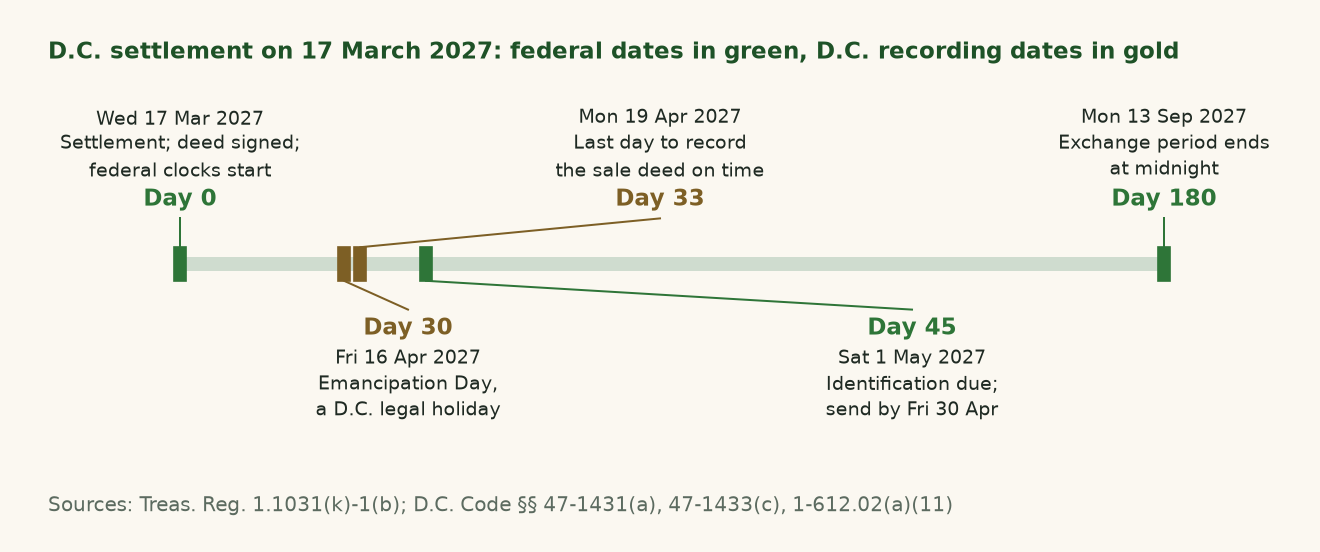
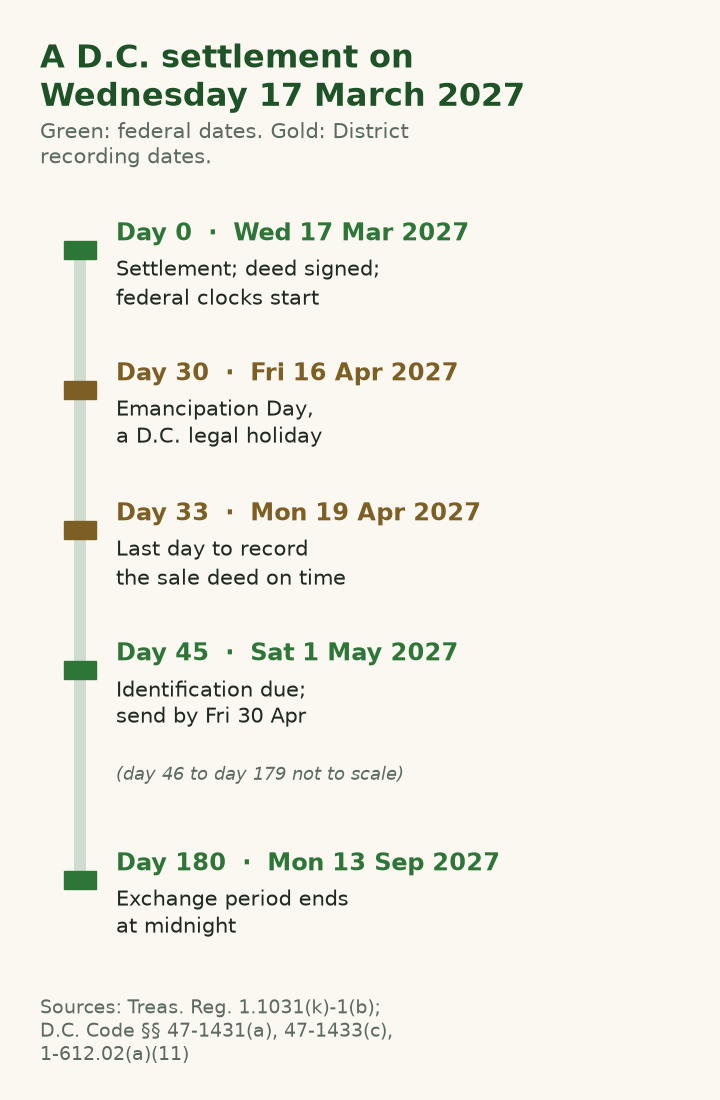
Take a Logan Circle condo that has been rented out as an investment and sells at a settlement on Wednesday, 17 March 2027. Two sets of deadlines start that day. The federal regulation sets its two by calendar day, with no rule for weekends or holidays (Treas. Reg. 1.1031(k)-1(b)(2)). The District's deadline for recording the deed is 30 days after the deed is signed, and when the 30th day is a Saturday, Sunday or legal holiday it moves to the next day that is none of those (D.C. Code § 47-1431(a)). D.C. Emancipation Day, 16 April, is one of the District's legal public holidays (§ 1-612.02(a)(11)).
| Date | Day | What happens | What to watch |
|---|---|---|---|
| Wed 17 Mar 2027 | 0 | Settlement; the deed is signed and the sale proceeds go to the intermediary | The 45 days, the 180 days and the 30 days for recording the deed all start today |
| Fri 16 Apr 2027 | 30 | 30th day after the deed was signed | D.C. Emancipation Day, a legal holiday, so the recording deadline moves past it and the weekend |
| Mon 19 Apr 2027 | 33 | Last day to record the sale deed on time | Recording later misses § 47-1431, and § 47-1433(c) adds a $250 penalty |
| Sat 1 May 2027 | 45 | Identification deadline, at midnight | A Saturday, and the regulation doesn't move it to Monday. Send the signed list by Friday 30 April |
| Mon 13 Sep 2027 | 180 | Exchange period ends, at midnight | Your 2027 tax return is due in April 2028, after day 180, so the full 180 days apply. A D.C. replacement deed gets its own 30 days to be recorded |
Keep the District's extra days apart from the federal dates. Ask your settlement agent to submit the deed well before day 30, and send your list by Friday 30 April even though day 45 is Saturday 1 May. The day-180 row assumes a calendar-year individual: the exchange period ends on the due date of your return for the year of the sale, including extensions, if that comes first, and for a 2027 sale that date is 15 April 2028 or later (26 U.S.C. 6072(a)).
Our 1031 exchange deadline calculator gives the federal dates for any settlement day; add the District's recording date yourself.
These are Census figures for the city of Washington DC from the 2020-2024 American Community Survey, next to the U.S. figure.
Source: U.S. Census Bureau, American Community Survey 2020-2024 5-year estimates. The rent-to-value figure compares median rent with median home value; it is not a property yield. See the table for all 51 cities.
Washington, D.C. 1031 Exchange Questions: Accommodators, Realtors and Intermediaries Near Me
For a delayed exchange, in practice yes, and the answer is the same regardless of your location, including Washington, D.C. The IRS regulations don't strictly require a Qualified Intermediary (QI), but a QI is one of the safe harbors that keeps you from being treated as receiving the sale money (Treas. Reg. 1.1031(k)-1(g)(4)). The QI holds the proceeds from your relinquished property and uses them to acquire the replacement property on your behalf. The same regulations also accept a qualified escrow account or qualified trust (Treas. Reg. 1.1031(k)-1(g)(3)), but the cash in either one only secures your buyer's promise to deliver the replacement property, so your buyer has to agree to take on that role. A direct swap between two owners at one closing needs none of these. At Universal Pacific 1031 Exchange, we serve as your Qualified Intermediary and handle the exchange documents and the movement of funds.
"Accommodator" is the name many investors use for the qualified intermediary, the company that holds your sale money and prepares the exchange documents. The word also turns up in reverse exchanges, where an exchange accommodation titleholder takes title to a property for you and has to pass it on within 180 days (Rev. Proc. 2000-37, sec. 4.02(5)). If the titleholder takes title to a D.C. property by deed, that deed and the later deed out of the titleholder each go to the Recorder of Deeds, and each is due for recording within 30 days after it is signed (D.C. Code § 47-1431(a)). Before you sign, ask your settlement agent how the recordation and transfer taxes will be figured on each of those deeds.
Finding a suitable qualified intermediary (QI) for a 1031 exchange requires some research, but the firm doesn't have to be in the District. You can deliver your 45-day identification by hand, mail, fax or other means (Treas. Reg. 1.1031(k)-1(c)(2)), and the intermediary's work is documents and wire transfers. Settlement still takes place with your D.C. title company or settlement attorney, and the deed is still recorded with the Recorder of Deeds at the Office of Tax and Revenue. When you compare firms, ask three things. Does the exchange agreement limit your rights to the money in the way Treas. Reg. 1.1031(k)-1(g)(6) requires? In whose name, and in what kind of account, will your sale proceeds be held? And what is the fee for your exchange type? Get the answers in writing before settlement.
Not if your realtor is the only one who gets it. The signed list has to go to the person selling you the replacement property, or to someone else involved in the exchange who is neither you nor a disqualified person, such as the intermediary, an escrow agent or a title company (Treas. Reg. 1.1031(k)-1(c)(2)). A real estate agent who worked for you within the two years ending on the date of your sale is a disqualified person (Treas. Reg. 1.1031(k)-1(k)(2)), so a list sent only to the agent who handled your Shaw or Petworth sale doesn't count. Copy your agent if you like, but send the list to us before the deadline.
Yes, as far as the exchange rules go. The exchange agreement has to keep the money out of your reach, but the regulations disregard "transactional items" when they test whether you had access to it. These are costs of the sale or the purchase that appear, under local standards, in the typical closing statement as the buyer's or the seller's responsibility. The regulation's own examples are commissions, prorated taxes, recording or transfer taxes, and title company fees (Treas. Reg. 1.1031(k)-1(g)(7)(ii)). On a D.C. settlement statement, that covers the agents' commission and the seller's share of the recordation and transfer taxes. Ask your tax adviser how each item is reported on your return.
The regulations accept a legal description, a street address or a distinguishable name, as long as the property is unambiguously described (Treas. Reg. 1.1031(k)-1(c)(3)). In the District, the safest choice is the street address together with the square and lot number, which every D.C. deed has to carry anyway (D.C. Code § 47-1431(a)). For a condo, add the unit number, because a building address alone could describe any unit in it. The property's last recorded deed shows its square and lot, and the online public records the Recorder of Deeds links to go back to August 1921 (Recorder of Deeds).
Yes, if you hold it as a rental or other investment. The regulations list stock in a cooperative housing corporation among the intangible assets that count as real property for a 1031 exchange (Treas. Reg. 1.1031(a)-3(a)(5)). The District taxes a co-op sale under its economic-interest rule rather than the deed rates above. The recordation tax is 2.9% of the consideration allocable to the real property, or 2.2% when that consideration is under $400,000 (D.C. Code § 42-1103(a)(2)). Ask your settlement agent for the full District tax on your co-op sale before you set the price you need.
Generally, yes. Section 1031 looks at the property you give up and the property you receive, so a sale to your tenants, or to a buyer they assign their purchase rights to (D.C. Code § 42-3404.06), can start an exchange like any other sale. The exchange agreement and the assignment of the contract still have to be in place before settlement, and the settlement date will follow the TOPA periods set out above. If a tenant is a family member or a company you control, the related-party rules in 26 U.S.C. 1031(f) come into play; ask your tax adviser before you sign.
No, according to IRS guidelines, you cannot serve as your own Qualified Intermediary in a 1031 exchange (Treas. Reg. 1.1031(k)-1(g)(4)(iii) and (k)). The regulations also exclude certain related parties, plus anyone who has acted as your agent, such as your real estate agent, accountant, or attorney, within the two years prior to the transfer of the relinquished property. The two-year rule has two exceptions. An attorney or accountant whose only work for you has been on 1031 exchanges is not caught by it, and neither is a title company or bank that has only provided routine title insurance, escrow, trust or banking services. "Related parties" means close family members and companies you own more than 10% of.
The fees charged by Qualified Intermediaries for a 1031 exchange can vary widely. Our fee guide puts a standard delayed exchange at $600 to $1,500 and a reverse or improvement exchange at $3,000 to $7,500. The cost often depends on the complexity of the transaction: in a reverse or improvement exchange, a separate company has to hold title to one of the properties until the exchange is finished. The exchange fee is separate from the District's deed taxes. The recordation and transfer taxes covered above are charged when a deed is recorded, whether or not you exchange (D.C. Code § 42-1103, § 47-903). Ask for a written quote for your exchange type before settlement.
For a D.C. resident, the gain becomes part of D.C. taxable income for the year it is recognized and is taxed on the same brackets as other income. For tax years after 2021 they run from 4% on the first $10,000 to 10.75% on taxable income over $1,000,000, with steps at 9.25% from $250,000 and 9.75% from $500,000 (D.C. Code § 47-1806.03(a)(11)). That comes on top of the federal tax on the same gain. The brackets above are the rates for individual residents; if you sell through a business entity or live outside the District, ask your tax adviser which D.C. taxes apply to you.
No, a 721 exchange falls under a different section of the tax code. Section 721 says no gain is recognized when you contribute property to a partnership in exchange for an interest in it (26 U.S.C. 721(a)), with an exception for a partnership that would be an investment company if it were incorporated (§ 721(b)). A 1031 exchange has to end with real property, and the regulations list interests in a partnership among the things that are not real property (Treas. Reg. 1.1031(a)-3(a)(5)). So partnership units generally can't be your replacement property; the regulation's exception is a partnership that has elected under section 761(a) to be excluded from the partnership tax rules. If an advisor proposes a 721 step, have your tax adviser look at it as a transaction of its own; our work as intermediary covers the 1031 exchange.

Talk Through Your D.C. Property With a CPA-Led Intermediary
Universal Pacific 1031 Exchange is led by Michael Bergman, a California CPA licensed since 1990. Call with the property's address, the settlement date if you have one, and whether tenants live there, and we'll tell you which of the dates and rules on this page apply to your sale.
Start an ExchangeSources: 26 U.S.C. 1031; Treas. Reg. 1.1031(k)-1; IRS: Like-kind exchanges, real estate tax tips; D.C. Code § 42-1102; § 42-1103; § 47-902; § 47-903; § 47-1803.02; § 47-1806.04; D.C. Office of Tax and Revenue, Recorder of Deeds FAQs; Recorder of Deeds; Md. Code, Tax-Property § 13-203; § 12-103; Md. Code, Tax-General § 10-912; Va. Code § 58.1-801; § 58.1-802; § 58.1-3800; § 58.1-302; § 58.1-325; Treas. Reg. 1.1031(a)-1; Treas. Reg. 1.1031(a)-3; Rev. Proc. 2000-37; 26 U.S.C. 721; 26 U.S.C. 6072; D.C. Code § 42-3401.03; § 42-3404.02; § 42-3404.03; § 42-3404.06; § 42-3404.08; § 42-3404.09; § 42-3404.10; § 42-3404.11; § 29-101.02; § 47-1431; § 47-1433; § 47-1806.03; § 1-612.02; OTR, General Recording Requirements & Fees; U.S. Census Bureau, American Community Survey 2020-2024 5-year estimates, tables B25003, B25024, B25032, B25034 and B25077.
Photo at the top of the page: Washington, D.C. skyline seen from Arlington, Virginia, by Washington Photo Safari, CC BY-SA 4.0, via Wikimedia Commons, cropped.
Charts: built by Universal Pacific 1031 Exchange from the Census tables and statutes listed above.
Further Reading for D.C. Sellers From the 1031 Exchange Blog
Set up your Washington DC 1031 exchange
Call Now For A Free Consultation · (424) 469-8111