Can You Live in a 1031 Exchange Property After 2 Years?
Yes, you can live in a property you bought through a 1031 exchange, but not right away and not without clearing a few IRS conditions first. Hold and use it as a real investment property before you move in. The IRS safe-harbor guideline is to rent it at fair market value for at least 14 days in each of the first two 12-month periods, while keeping your own personal use under 14 days or 10% of the days it was rented. Document that investment intent, and only then convert the property into a residence. Move in too soon and the IRS can decide you never really held it for investment, which puts your tax deferral at risk.
This is where the so-called “2-year rule” fits in. It is not a law that says you can move in the day you hit two years. It is the holding-period practice that shows the IRS you bought the property to invest, not to flip it or quietly move in. Below we answer the living-in question in full, then break down the 2-year rule itself, the IRS exceptions, the penalties for getting it wrong, and how to plan a conversion that holds up.
At Universal Pacific 1031 Exchange, our experienced qualified intermediaries have 35+ years of experience guiding investors through smooth and IRS-compliant exchanges. We help make sure your transactions are documented thoroughly, aligned with applicable IRS requirements, and structured to support available tax-deferral benefits. Schedule a free consultation with us today and let us guide you throughout the process.
Can You Live in a 1031 Exchange Property After 2 Years?
Yes, you can, but there are specific conditions under which you can live in a real property acquired through a 1031 exchange while deferring capital gains taxes on the sale proceeds of the relinquished property. These conditions mainly involve the intent and use of the new property both before and after the exchange. The key considerations include:
- Primary Purpose as an Investment: The IRS is keenly interested in your intent to hold the investment properties for business or investment purposes. So, you need enough time to sufficiently prove intent to hold; otherwise, the IRS might suppose that you acquired the property for personal use and not for investment purposes.
- Safe Harbor Rules: The IRS provides a safe harbor rule under the Revenue Procedure 2008-16, which allows for an investment property to be considered as held for investment purposes if:
- The property is rented at a fair market value for 14 days or more in each of the two 12-month periods following the exchange.
- The individual’s personal use of the rental property does not exceed the greater of 14 days or 10% of the number of days during the 12-month period that the property is rented at fair rental.
- Conversion to a Primary Residence: After successfully meeting the safe harbor conditions for investment intent, you can convert the property into personal property for primary residence. However, to qualify for the Section 121 exclusion, which allows for the exclusion of gain from the sale of a primary residence, the property must be owned for at least five years after the 1031 exchange. This is also known as the 5-year rule.
- Change of Intent: The IRS considers the taxpayer’s intent at the time of the exchange. Circumstances change sometimes and the property originally acquired for investment purposes is later converted for personal use. The conversion does not necessarily invalidate the 1031 exchange. However, it is crucial to document the investment intent at the time of the exchange and any reasons for the change in use.
- Reporting and Compliance: If you live in a property that was part of a 1031 exchange, it’s essential to comply with all IRS reporting requirements and to document your adherence to the rules governing investment intent and personal use.
It’s important to note that moving in after two years does not automatically eliminate future tax consequences. If you later sell the property, different rules apply to how much of the gain may still be taxable. Considering all these, it’s recommended to consult an experienced qualified intermediary or tax professional before converting a 1031 property into a personal residence.
The 2 year rule in short
| What the rule asks | Where it lands |
|---|---|
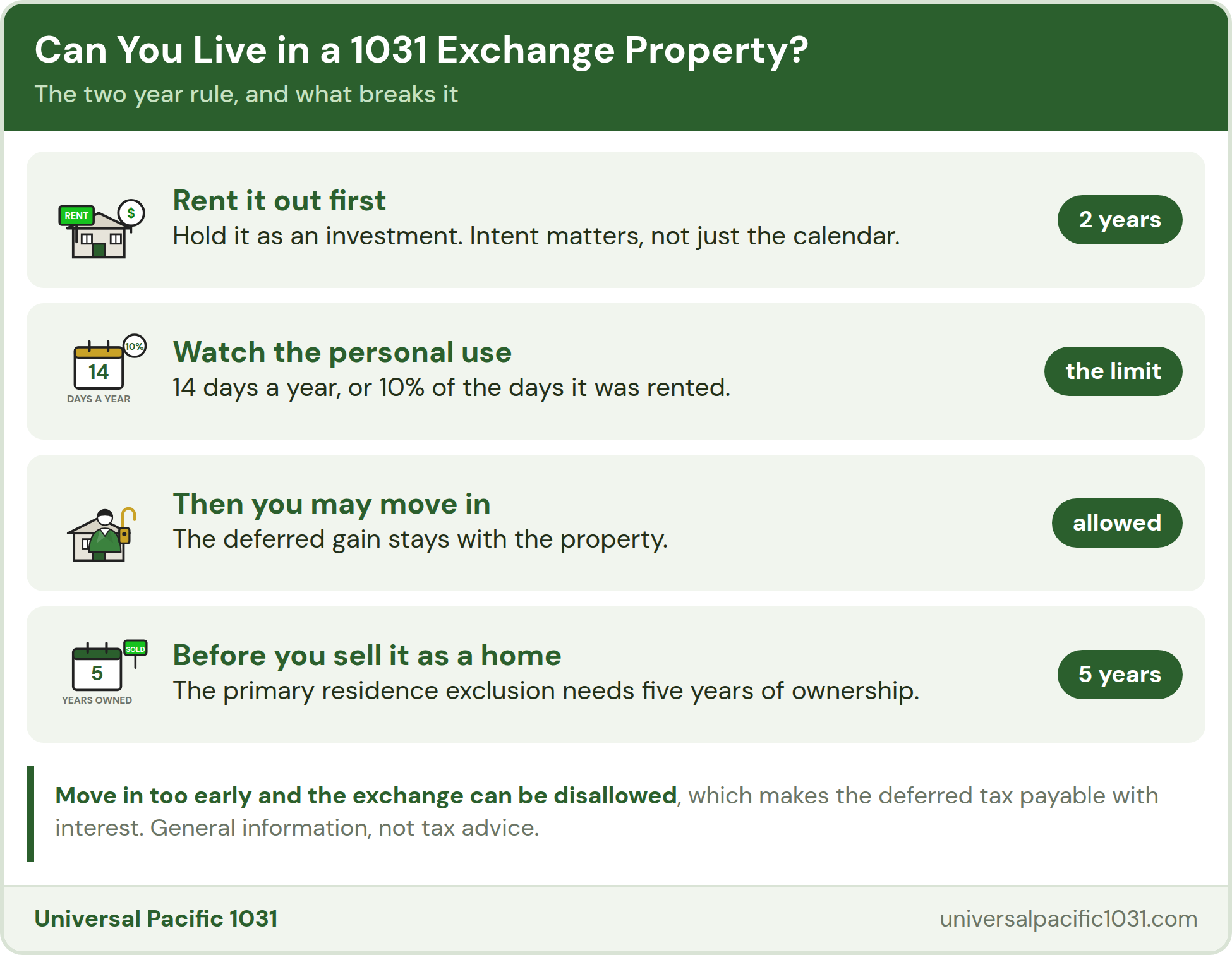
| Holding period | Two years is the safe harbour. The IRS weighs your intent, not the calendar alone. |
| Personal use allowed | 14 days a year, or 10 per cent of the days it was rented, whichever is greater. |
| After you move in | The deferred gain stays with the property. Converting it to a home does not erase it. |
| Selling it as your home | Five years of ownership before the primary residence exclusion applies. |
| Moving in too early | The exchange can be disallowed and the deferred tax becomes payable, with interest. |
Conditions Under Which You Can Live in a 1031 Exchange Property
There are specific conditions under which you can live in a real property acquired through a 1031 exchange while deferring capital gains taxes on the sale proceeds. These conditions mainly involve the intent and use of the new property both before and after the exchange. The key considerations include:
- Primary Purpose as an Investment: The IRS is keenly interested in your intent to hold the investment properties for business or investment purposes. So you need enough time to sufficiently prove intent to hold; otherwise, the IRS might suppose that you acquired the property for personal use and not for investment purposes.
- Safe Harbor Rules: The IRS provides a safe harbor rule under the Revenue Procedure 2008-16, which allows for an investment property to be considered as held for investment purposes if:
- The property is rented at a fair rental for 14 days or more in each of the two 12-month periods following the exchange.
- The individual’s personal use of the property does not exceed the greater of 14 days or 10% of the number of days during the 12-month period that the property is rented at fair rental.
- Conversion to a Primary Residence: After successfully meeting the safe harbor conditions for investment intent, you can convert the property into personal property for primary residence. However, to qualify for the Section 121 exclusion which allows for the exclusion of gain from the sale of a primary residence, the property must be owned for at least five years after the 1031 exchange. This is also known as the 5-year rule.
- Change of Intent: The IRS considers the taxpayer’s intent at the time of the exchange. Circumstances change sometimes and the property originally acquired for investment purposes is later converted for personal use. The conversion does not necessarily invalidate the 1031 exchange. However, it is crucial to document the investment intent at the time of the exchange and any reasons for the change in use.
- Reporting and Compliance: If you live in a property that was part of a 1031 exchange, it’s essential to comply with all IRS reporting requirements and to document your adherence to the rules governing investment intent and personal use.
What Is the 2-Year Rule for 1031 Exchanges?

The 1031 exchange 2-year rule is an IRS guideline that requires a real estate investor to hold the exchanged properties for at least two years to keep the exchange valid and prevent tax avoidance. Although the IRS does not specify a particular holding period for regular property exchanges, the two-year holding period is to demonstrate intent to hold for investment or business purposes. This rule mainly applies to related-party exchanges and certain ownership and use requirements after completing a 1031 exchange.
The purpose of the 2-year rule is to prevent taxpayers from using related parties as a disguise to quickly sell or flip properties after an exchange. If either party disposes of the property within the two-year period, the IRS may disqualify the exchange and impose capital gains taxes and other potential tax liabilities retroactively. There are limited exceptions, such as death or involuntary conversions, but in most cases, maintaining ownership for the full two years is critical for compliance.
IRS Exceptions to the 2-Year Rule
The IRS recognizes that some events are beyond an investor’s control and provides limited exceptions in such cases. These exceptions are narrowly defined and must be properly documented to avoid disqualifying the exchange.
- Death of the property owner: The IRS recognizes that ownership changes caused by death are not done to avoid taxes. So, if either party to a related-party 1031 exchange dies within the two-year period, the exchange is not disqualified.
-
For example, if a related party in a 1031 exchange dies before the two-year holding period ends and the property is later sold by the estate or heirs, the IRS does not disqualify the exchange because the sale happened due to death, not tax avoidance.
- Divorce or court-ordered transfers: Transfers required by a divorce decree or court order are generally exempt from the two-year holding requirement. Since the transfer is legally mandated, it does not violate the intent of the rule.
- Casualty or natural disaster situations: If a property is destroyed, condemned, or involuntarily converted due to a natural disaster or similar event, the two-year rule may be waived. The IRS treats these situations as involuntary and not intentional early dispositions.
- An involuntary conversion: This happens when a property is taken, destroyed, or condemned due to circumstances such as eminent domain, government seizure, or forced sale. When any of these happen, the IRS may allow more flexibility with the timing requirements.
To prove these exceptions, it is important to keep accurate and detailed documentation. These documents could include insurance reports, government notices, condemnation orders, disaster declarations, repair estimates, and proof of reinvestment timelines.
Penalties for Violating the 1031 Exchange 2-Year Rule
Violating the 2-year rule can cause the IRS to disqualify the entire 1031 exchange. When this happens, the transaction is treated as a taxable sale rather than a tax-deferred exchange. As a result, capital gains taxes, depreciation recapture, and other applicable state taxes become due as if the exchange never occurred.
In addition to the immediate tax liabilities, the IRS may also assess interest and penalties for underpaid taxes. These costs can add up quickly and significantly reduce the financial benefit of the transaction. Because of this risk, investors involved in related-party exchanges should carefully plan and maintain proper ownership for the full two-year period to preserve their tax advantages.
To further explain, let’s consider this hypothetical scenario of an investor who deferred $400,000 in capital gains through a related-party exchange. When the property was sold after 16 months, the IRS disqualified the exchange, which in turn triggered capital gains tax, depreciation recapture, interest, and penalties. This unexpected tax bill exceeded $120,000, far outweighing the short-term profit for an early sale.
“The so-called ‘2-year rule’ is one of the most misunderstood aspects of 1031 exchanges. While there’s no IRS mandate requiring a 2-year hold for regular exchanges, treating it as a best practice demonstrates investment intent and keeps you out of the gray zone.” – Michael Bergman, CPA, Universal Pacific 1031 Exchange.
How to Comply with the 2 Year Rule
To comply with the 2-year rule, you must hold the exchanged property with clear investment intent for the full two-year period. This means keeping the property as a rental or business asset, collecting income where appropriate, and reporting it consistently as an investment on your tax returns. Any early sale, transfer, or personal use during this time can signal noncompliance.
You also need to avoid related-party transfers or property ownership changes that could be viewed as an early disposition. If multiple properties are involved, track each one carefully to ensure none are sold or transferred within the two years. In addition, keep strong records, such as leases, rental income, and expense reports, to demonstrate good-faith compliance if the IRS reviews the exchange.
Finally, work closely with a qualified intermediary and a tax professional throughout and after the exchange. They can help you monitor holding periods, handle reporting on Form 8824, and identify risks before they become problems.
How to Comply with the 2 Year Rule in Different Ownership Structures
Complying with the 2-year rule for individual ownership is very straightforward. The individual who acquired the property must hold it for at least two years before selling or exchanging it. Selling a like-kind property to a related party within these two years can trigger immediate taxation of deferred gains.
When exchanging property through a multi-member LLC, the two-year rule applies at the entity level. The IRS views the LLC as a single taxpayer, and so expects all members to maintain consistent ownership of the replacement asset for the stipulated period. Transferring ownership interests among members or to related parties can trigger IRS scrutiny.
In partnerships, the rule applies to the partnership entity as a whole, but also takes into account the ownership share of each partner. Changes in the partnership structure, such as taking in new partners or transferring interests to related parties, can jeopardize the exchange.
Therefore, when performing an exchange with any of these ownership structures, it is important to keep clear ownership records and the property acquisition dates. Also, avoid sales or exchanges to related parties within the two-year holding period. Consulting a tax professional or an exchange facilitator before making any changes is crucial to avoid scrutiny from the IRS and preserve tax-deferral benefits.
Here is a comparison table that outlines the key compliance requirements for each ownership structure:
| Ownership Type | Compliance Requirements | Exceptions Allowed | Key IRS Considerations |
|---|---|---|---|
| Individual | The individual taxpayer must hold the property for at least two years before selling or exchanging, especially when related parties are involved. | Involuntary conversions, casualty losses, and certain IRS-approved hardship situations. | Related-party transactions are closely scrutinized; early resale may trigger immediate tax liability. |
| Multi-Member LLC | The LLC must retain ownership for the full two-year period; member ownership percentages should remain consistent. | Limited exceptions for involuntary conversion or casualty loss if the entity, not members, is affected. | Changes in membership interests may be treated as indirect transfers, risking non-compliance. |
| Partnership | The partnership entity must meet the two-year holding requirement, with continuity among partners. | Similar exceptions to LLCs, but applied at the partnership level. | Partner changes, buyouts, or transfers to related parties can violate continuity rules. |
How to Plan for 1031 Exchange Conversion (Step-by-Step Framework)

Successfully deferring capital gains taxes when converting your replacement property to a personal residence requires careful and strategic planning. This is the right framework to follow to achieve your conversion goals:
1. Understand 1031 Exchange Rules
The IRS has specific rules and guidelines regarding 1031 exchanges, including how long the property must be held as an investment before it can be converted into a primary residence. Make sure you fully understand these rules before proceeding.
2. Observe the Holding Period
Be mindful of the holding period. The IRS generally requires a property acquired through a 1031 exchange to be held for business, rental, or investment purposes. To convert investment property into a primary residence, you may need to hold the property for a certain period to meet the residency requirements.
3. Document Intent to Convert
Document your intent to convert the property into your primary residence. This could include changing your address on official documents, such as driver’s licenses, voter registration, tax returns, and other relevant paperwork to reflect the property as your primary residence.
4. Keep Detailed Records
When converting a 1031 exchange property into a primary residence, it is important to keep detailed records of all transactions and documentation to support your decision. This will help ensure that you are in compliance with IRS regulations and can provide evidence if needed.
5. Be Aware of Potential Penalties
If you do not follow the IRS rules for 1031 exchanges, you may be subject to penalties and additional taxes. Make sure you are fully informed and prepared to comply with all regulations.
6. Seek Legal and Tax Advice
Consult with a qualified tax professional or attorney who specializes in 1031 exchanges and residential real estate conversions. They can provide personalized guidance based on your specific situation and help ensure compliance with all legal and tax requirements.
Common Questions and Misconceptions
There is a common misconception that living in a 1031 exchange property is prohibited. While the primary purpose of a 1031 exchange is for investment or business use, there are certain cases where the property can be used for personal use without nullifying the exchange.
Another misconception is that you cannot reside in the new 1031 exchange property immediately. In reality, there are no strict guidelines prohibiting immediate residence; however, the IRS has specific rules regarding the intended use of the property.
Many investors also believe that any form of personal use of a 1031 exchange property will disqualify the exchange. While there are limitations on personal use, understand that some personal use is permitted without violating the 1031 exchange rules.
Consult a Qualified Intermediary
Understanding and adhering to the 1031 exchange 2-year rule is essential for protecting your tax-deferred benefits and avoiding costly IRS penalties. By understanding the holding requirements, documenting investment intent, following safe harbor provisions, and planning for any property conversion, you can confidently complete property exchanges without risking disqualification. You also need to stay informed about exceptions and work closely with experienced professionals to ensure every transaction is compliant with tax regulations.
At Universal Pacific 1031 Exchange, our qualified intermediaries guide investors through every step of the 1031 exchange process. With 35+ years of experience, we help investors optimize tax benefits, minimize risks, and complete smooth exchanges. Contact us today or visit our 1031 exchange office in Los Angeles for a free consultation.
Accuracy & Sources Disclaimer
The information in this article is sourced from official government publications and is accurate to the best of our knowledge as of the last update on March 18, 2026. All claims can be independently verified through the sources listed below:
- 26 U.S.C. § 1031, Like-Kind Exchanges (including subsection (f) on Related Parties)
- 26 U.S.C. § 121, Exclusion of Gain from Sale of Principal Residence
- 26 U.S.C. § 1033, Involuntary Conversions
- 26 U.S.C. § 1041, Transfers Between Spouses Incident to Divorce
- IRS Like-Kind Exchanges Under IRC Section 1031
- IRS Revenue Procedure 2008-16, Safe Harbor for Dwelling Units
- IRS Topic No. 409, Capital Gains and Losses
- IRS Topic No. 701, Sale of Your Home
- IRS Publication 523, Selling Your Home
- IRS Publication 544, Sales and Other Dispositions of Assets
- IRS Form 8824, Like-Kind Exchanges
- Treasury Regulation § 1.1031(k)-1, Treatment of Deferred Exchanges
Tax laws are subject to change. This content is for informational purposes only and does not constitute tax, legal, or investment advice.
FAQs on 1031 Exchanges and Personal Use
With 35+ years of experience handling tax-deferred exchanges, we’ve provided comprehensive answers to some of the major questions you may have about the 1031 exchange 2-year rule.
Can You Live in a 1031 Exchange Property After 2 Years?
Yes, but only if you first held it as a genuine investment. Meet the IRS safe-harbor test, rent it at fair market value for at least 14 days in each of the first two 12-month periods and keep personal use under 14 days or 10% of the rented days, document your investment intent, then convert it to a residence. If you later want to exclude gain under Section 121, plan on owning it at least five years after the exchange.
Can I Sell My Replacement Property After 18 Months and Still Qualify?
No, selling the property before the two-year period generally disqualifies the exchange for related-party transactions. The IRS may consider the transactions as attempts to flip the properties or just avoid tax. Hence, they may treat the sale as a taxable event, triggering capital gains taxes.
Does the 2-Year Rule Apply if I Inherit the Property?
No, inherited property is exempt from the 2-year rule. The IRS recognizes that ownership changes due to death are involuntary and not intended to bypass tax rules.
What Happens if I Rent the Property for Only 1 Year Before Selling?
If you sell after only one year, the IRS may challenge whether the property was genuinely held for investment. This can disqualify the exchange and make the transaction taxable.
Are There Exceptions for Disaster-Related Sales or Exchanges?
Yes, properties lost or destroyed due to natural disasters, condemnation, or other involuntary conversions are generally exempt from the 2-year holding rule. However, proper documentation is required to qualify for this exception to maintain the tax-deferred status.
How Does the 2-Year Rule Impact Like-Kind Exchanges for Multiple Properties?
When exchanging multiple properties, each property must meet the 2-year holding requirement for related-party transactions. Selling any of the properties too early can disqualify the entire exchange.
Can Related-Party Transactions Violate the 2-Year Rule?
Yes, related-party transactions are the most strictly monitored by the IRS. Any sale or transfer within the two-year period can trigger penalties and retroactive taxes unless an exception applies.
This page was reviewed by Michael Bergman, CPA, California CPA #56113. Verify license.
Disclaimer: This article is for informational purposes only and is not legal, tax, or financial advice. Tax laws change and every situation is different. Please consult a qualified attorney, CPA, or tax advisor before making decisions about your property, sale, or 1031 exchange.
Editorial Policy
All articles are reviewed for accuracy by licensed tax professionals and sourced from official government publications. Read our Editorial Policy →
About The Author
 Michael Bergman is a California licensed CPA and Real Estate Broker with over 35+ years of CPA-supervised 1031 exchange experience in commercial real estate. Specializing in 1031 tax-deferred exchanges and financial oversight, his expertise covers complex real estate transactions. Michael’s unique blend of financial acumen and real estate knowledge positions him as a trusted advisor in the industry, offering sound advice and strategic insights for successful property management and investment.