1031 Exchange 5-Year Rule for Real Estate Investors
Quick answer
The five-year rule applies when a property acquired through a 1031 exchange is later converted into a primary residence. The property must be owned for at least five years before the sale, and within the five years ending on the sale date it must have been used as a residence for at least two, which limits how much of the home-sale exclusion applies.
Imagine going through all the processes of a 1031 exchange and property conversion to a primary residence only to find out your property does not qualify. You'll most likely feel disappointed when you pay the capital gains taxes that you'd have deferred.
That's why it's important to understand every relevant rule for a successful tax-deferred exchange, including the 1031 exchange 5-year rule. The 5-year rule was established to help prevent the abuse of the 1031 exchange by investors looking to exploit the strategy for tax deferral while acquiring personal properties.
With 35+ years of experience in facilitating 1031 exchanges, our experienced qualified intermediaries at Universal Pacific 1031 Exchange have the required experience to guide you through a smooth and compliant 1031 exchange property conversion. We're always available to answer your questions and facilitate your exchange. Schedule a free consultation with us today to get started.
This article will help you understand the 5-year rule, why it is important for 1031 exchange property conversion, and best practices to help you stay compliant.
Understanding the 1031 Exchange 5-Year Rule
A 1031 exchange lets you defer capital gains tax when you sell one investment property and buy a like-kind replacement property. Both the relinquished and replacement properties must be held for business or investment purposes. The property acquired must serve that use.
The 5-year rule sets how long you must hold that replacement property before treating it as a personal residence. It ties two parts of the tax code together. Section 1031 governs the exchange, and Section 121 governs the primary residence exclusion.
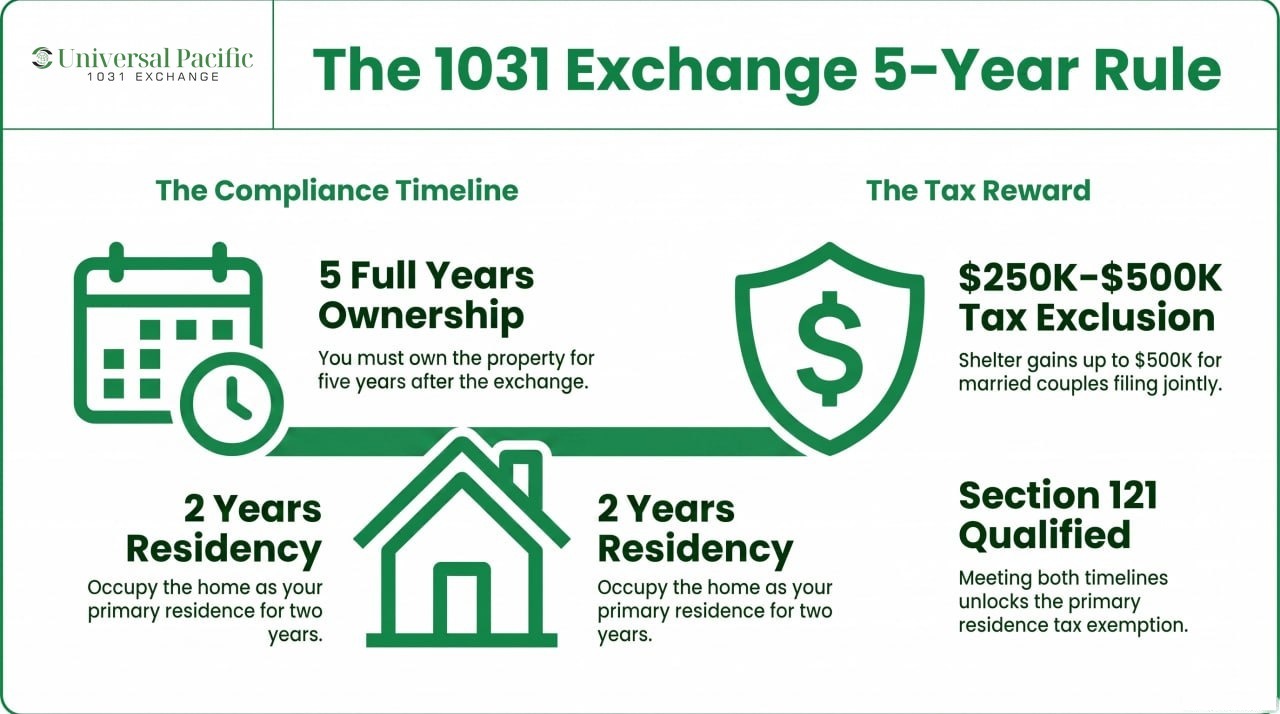
The rule matters most when you plan to eventually sell and convert an investment property into a home. You must hold the replacement property for at least five years. You must also live in it for at least two of those years to claim any Section 121 exclusion.
Section 1031 Overview and Timeline
Section 1031 sets strict deadlines, and missing either one can void the tax deferral. This standard forward structure is also called a delayed exchange. The exchange process follows a clear sequence once your relinquished property sells.
1. The 45-day identification period
The identification period begins the day your relinquished property closes. You then have 45 days to identify replacement property in writing, using a legal description or street address. Most investors identify up to three properties under the three-property rule. Others name more, as long as the aggregate value stays within 200% of the sold property. Your written notice lists the identified properties.
2. The 180-day exchange period
The exchange period runs 180 days from the sale of your relinquished property. You must close on the replacement purchase within that window. The exchange begins the day your sale closes, when a qualified intermediary receives the sales proceeds. The intermediary holds the exchange funds the whole time, so you never take constructive receipt of the proceeds. It then applies the net proceeds to your replacement purchase.
The five-year holding clock is separate. It starts after you acquire the new property, not during the 45-day or 180-day windows.
What Is the 5-Year Rule in a 1031 Exchange?

The 5-Year Rule in 1031 exchanges is a provision in Section 121(d)(10), added by the American Jobs Creation Act of 2004 that prevents real estate investors from abusing the capital gains tax exclusion benefits of Section 121. According to this rule, you may be eligible to receive up to $250,000 or $500,000 if you file as a married couple, with tax exemption, provided you keep the personal residence you purchased via 1031 exchange for up to five years before selling it.
If your capital gains tax exceeds this sum, you must pay the remaining immediately. Notably, you cannot purchase a primary residence directly through a 1031 exchange. So this rule applies to those who bought investment properties via like-kind transactions and converted them to primary residences.
As earlier mentioned, no provision in Internal Revenue Code Section 1031 mandates a real estate investor to observe the 5-Year Rule when exchanging their relinquished property for a replacement property. So if you're not looking for primary residence tax exclusion, don't concern yourself with this rule.
What Is the 2 out of 5-Year Rule in 1031 Exchange?
The 2 out of 5 years rule is a clause in the 5-Year Rule that requires you to live in the converted primary residence for at least two years, counting from the date of purchase. Apart from the specific minimum holding period of five years, you must observe the 2-out-of-5-Year Rule to qualify for Section 121 tax exemption. Once you are qualified, you can sell the primary home for cash without having to identify potential replacement properties or observe other IRS 1031 exchange rules.
This rule exists because some investors may simply convert the investment property into a primary residence without necessarily treating it as one. Again, this is another smart move by the IRS to block obvious tax provisions investors use to defer capital gains taxes from their 1031 relinquished property sale and get outright exemption within a short while.
The table below compares the two holding requirements side by side. Both must be met before you can claim the Section 121 exclusion on a converted property.
| Requirement | 2 out of 5-Year Rule | 5-Year Rule |
|---|---|---|
| What it measures | Occupancy as a primary residence | Total ownership after a 1031 exchange |
| Minimum period | Live there 2 of the last 5 years | Own the property at least 5 years |
| Governing law | Section 121 use test | Section 121(d)(10), added in 2004 |
| Applies to | Any home sale for the exclusion | Homes acquired via a 1031 exchange |
| Tax benefit | Up to $250,000 or $500,000 excluded | Unlocks the Section 121 exclusion |
| Compliance tip | Keep proof of residency | Track your acquisition date closely |
What Exceptions Exist to the “2 out of 5-year” Rule for the Capital Gains Tax Exclusion?
The IRS Publication 523 captures some exceptions to the 2-out-of-5-Year Rule. These exceptions allow taxpayers to get primary residence exclusion benefits of the 5-Year Rule even if they didn't live in the home for up to two years as required by law. They include:
Health reasons: either you or your immediate family member develops a serious health issue that makes you sell the property to raise funds for diagnosis or treatment.
Active federal service: if you undergo any federal service, such as in the military, requiring you to move more than 50 miles away from the home for at least 90 days, you will be eligible for an extension of the 5-year window to 10 years.
Change of employment: A change of job or transfer to a new office that is more than 50 miles farther from the home than the previous place of work.
Destruction of the primary residence due to accidents or natural disasters.
Other grounds for exception are unforeseen circumstances such as divorce or separation, death of a spouse, or job loss leading to eligibility for unemployment benefits. Typically, qualifying for an exception to this rule makes you eligible for partial tax exemption.
How the 1031 Exchange 5-Year Rule Impacts Your Real Estate Investment Strategy
The 5-year rule shapes when you can sell without losing tax benefits. If you sell a converted property too early, you forfeit the Section 121 exclusion on that sale. The deferred capital gains tax from the original exchange then comes due, often with the current year’s gain on top.
The Section 121 personal residence exclusion applies only to a taxpayer’s principal residence, not to an investment property. A property owner who plans ahead keeps the deferred gain out of taxable income until they eventually sell without another exchange.
Timing is the core planning question. Selling before the five-year mark means the property never met the holding requirement, so no exclusion applies. Even after five years, the exclusion is prorated for the years the property served as a rental rather than a home. That split reflects how long the property was held for investment use versus personal use.
Good planning matches the holding period with your life plans. Investors who know the timeline can schedule a sale, a conversion, or a new replacement purchase around it. This is where a qualified intermediary and a tax advisor earn their fee. The tax implications of an early sale are rarely small.
A 1031 Exchange 5-Year Rule Example
John is a real estate investor, and he purchased a rental property in January 2020 by using the funds derived from his sale of properties through a 1031 exchange to defer capital gains tax. He leases it for three years (2020 – 2023). John moves in and takes it as his main residence from 2023 to 2025.
John decides to sell the property in 2026. The wrinkle is that he did a 1031 exchange to acquire it, so the property must be owned for at least five years, which it was (2020 – 2026). Additionally, he lived in it as his primary residence for two years which is compliant with the 2-out-of-5-year requirement.
As a result, John can exclude part of the capital gain from taxes, but since it was a rental property for part of the time, the exclusion will be prorated, and he'll owe taxes on the rental years.
How to Prove Investment Intent in a 1031 Exchange?
The IRS often checks the investor's intent in the procurement of a property in a 1031 exchange. One of the first factors the IRS considers in determining whether the property was bought for investment purposes is the length of time it was held before being sold.
Investment properties must be held for at least two years and should be used as rental property or for commercial purposes. To prove this, you should show rental income documentation, lease agreements, or other paperwork that demonstrates the activities going on in the property. Your tax records, financial statements, and other supporting documents will also come in handy.
For instance, in Reesink v. Commissioner (T.C. Memo. 2012-118), a couple bought a rental as replacement property, then moved in about eight months later. The U.S. Tax Court still allowed 1031 treatment. The record showed genuine investment intent when they acquired the property. They had advertised the home for rent and had not used it personally first.
The IRS also has a safe harbor for investors who want certainty. Under Revenue Procedure 2008-16, the agency will not challenge your intent if you meet its terms. You must own the property for at least 24 months. In each year, you rent it at fair market value for 14 days or more, with limited personal use.
Related 1031 Exchange Rules to Know in 2026 and Beyond
The 5-year rule does not stand alone. Several related 1031 exchange rules affect holding periods, property types, and timing. Only like-kind real property held for investment or business purposes qualifies. A single-family rental, an apartment building, or raw land held for investment can qualify. A primary residence or a vacation home used mainly for personal enjoyment cannot. For your property to qualify, its use, not its type, controls.
Like-kind exchanges are a large part of the real estate economy. One study found they support about 976,000 jobs and add $97.4 billion to the economy each year, according to 1031 Builds America.
Special structures exist for different needs. A reverse exchange lets you buy first and sell later. An improvement exchange lets you use exchange funds to build on the new property. Watch the related party rules if you trade with family or a connected business.
Recent talk about tax reform has raised questions about the future of like-kind exchanges. The One Big Beautiful Bill Act, signed in July 2025, left Section 1031 for real property untouched. Earlier proposals to cap deferral at $500,000 never became law. For now, the 5-year rule remains fully in force, and it stays central to any conversion strategy.
Reverse 1031 Exchange Explained
A reverse 1031 exchange flips the usual order. You acquire the replacement property first, then sell the relinquished property later. You cannot hold title to both at once under the rules. So an exchange accommodation titleholder parks one property during the process. The IRS set out this safe harbor in Revenue Procedure 2000-37.
The same deadlines apply. You have 45 days to identify the property you will sell and 180 days to complete the exchange. It does not change the five-year holding rule for a later conversion.
The Importance of the 1031 Real Estate 5-Year Rule

The 5-Year Rule in a tax-deferred exchange is useful for strategic planning, tax optimization, and investment flexibility. Understanding and leveraging this rule can lead to substantial financial benefits and influence investment decisions. Some of the reasons the 5-Year Rule is crucial in real estate investment include:
1. Tax Exclusion Under Section 121
When taxpayers convert 1031 property to a primary residence, the 5-Year Rule is key to maximizing the tax exclusion offered under Section 121 of the Internal Revenue Code. By meeting the requirement of owning the property for at least five years, you can potentially exclude up to $250,000 (or $500,000 for married couples filing jointly) of capital gains from your income when you sell the property.
2. Strategic Investment Planning
The 5-Year Rule encourages long-term planning and investment. Especially if you need to convert an investment property into a personal property, you need to consider your future needs and investment goals when acquiring property through a 1031 exchange. So, the rules help ensure you're not just after the immediate tax benefits of a 1031 exchange, but also long-term investment growth.
3. Preventing Abuse of Tax Provisions
The rule helps prevent the abuse of tax laws designed to benefit genuine investors. Many real estate investors are just looking to quickly flip properties for tax advantages. But with the five-year ownership and holding period, the IRS ensures such people do not get to just exploit the system.
4. Investment Stability
The 5-Year Rule in 1031 exchange can contribute to market stability by encouraging longer-term investment holding periods. Investors who are aware of the benefits of meeting the 5-Year Rule may be less likely to sell their properties quickly, leading to reduced volatility in real estate markets. This stability is beneficial not just for individual investors but also for communities and the real estate market as a whole.
5. Flexibility in Personal and Investment Planning
The 5-Year Rule provides a clear framework within which you can plan your investment if you're looking to convert your investment property to primary residence while deferring taxes. Knowing the rules and timelines helps you to align your real estate strategies with personal life changes, retirement planning, or relocation plans.
6. Enhanced Portfolio Management
Good portfolio management involves knowing the right time to hold, sell, or convert real estate properties. With proper knowledge of this rule, you can make informed decisions while staying compliant and growing your portfolio by holding the right property at the right time.
7. Legal and Financial Compliance
Following the 5-Year Rule helps you stick to IRS rules, which means you can avoid tax audits, fines, or disagreements over taxes you owe. It highlights how crucial it is to follow the law when investing in real estate and planning your taxes.
Best Practices in Complying With the 5-Year Rule

To remain structured to support IRS compliance, these are some of the tips to keep in mind when converting your investment real estate property to a primary residence for tax exclusion.
Maintain Proper Documentation
Keep records that demonstrate your intent to use the property as an investment at the time of the exchange. Once you convert the property to your primary residence, also maintain documentation such as utility bills or a driver's license address change to prove your residency.
Plan Early for Conversion
Carefully plan the timing of converting your investment property into your primary residence. Ensure that you have met any required holding periods for investment purposes before making the conversion. Also, weigh the benefits of tax deferral under a 1031 exchange against the potential tax exclusions of using the property as your primary residence.
Consult with Professionals
Engage tax advisors, real estate professionals, or a reputable qualified intermediary who are knowledgeable about 1031 exchanges and the 5-Year Rule. If you're confused about any step of the process, book a free consultation with our experienced team at Universal Pacific 1031 Exchange for proper guidance.
Compliance with Other Tax Rules
Tax laws can change. So, you need to stay informed about any updates to the 1031 exchange rules or the primary residence exclusion that might affect your situation. Some states have their own rules regarding 1031 exchanges and primary residence capital gains exclusions. So, look up state tax laws that might impact your strategy.
Regular Review and Adjustment
From time to time, review your investment strategy and property status to ensure you're on track with the 5-Year Rule and other tax regulations. Adjust your plans as needed based on changes in your investment goals, tax laws, or personal circumstances.
How to Maximize Tax Benefits through the 1031 Exchange 5-Year Rule
Holding discipline is the simplest way to protect your tax benefits. Meeting both the five-year ownership period and the two-year occupancy test keeps the Section 121 exclusion available. Selling a day early can undo years of deferral.
“Most problems we see come from investors who move in too soon,” says Michael Bergman, CPA, president and CEO of Universal Pacific 1031 Exchange. “Document your investment intent, hold the property, and the conversion takes care of itself.”
Structure matters too. Investors who hold property through partnerships have options. They can use like-kind exchanges of partnership interests to keep deferral intact. Weighing exchange expenses and closing costs against the deferred gain also helps you decide whether a conversion pays off. A qualified intermediary and a tax advisor can model the numbers before you commit.
Want to Know More About the 5-Year Rule?
The 5-Year Rule in a 1031 exchange is an important requirement for tax exemption under Section 121. It also plays a significant role in planning long-term investment strategies and optimizing portfolios. However, to be qualified for such tax relief, you must successfully execute your like-kind exchange in compliance with the law and work with a qualified intermediary.
At Universal Pacific 1031 Exchange, we offer top-notch qualified intermediary services aimed at helping our clients defer capital gains taxes successfully. We can also guide you to leverage the 5-Year Rule to receive an outright tax exemption. Contact us today to get started.
FAQ
Here are common questions about the 1031 exchange 5-year rule.
Where Does the 5-year Rule Associated With 1031 Exchanges Originate From?
The association between the 5-Year Rule and 1031 exchanges originated from the American Jobs Creation Act of 2004. The rule became necessary because real estate investors who deferred taxes from the 1031 exchange were using Section 121 to completely write off their tax by converting their commercial or rental properties to primary homes.
How Long Do You Have to Keep a Property After a 1031 Exchange?
You must keep a property for at least two years after a 1031 exchange to remain eligible for tax deferral. However, if you want to get a Section 121 tax exemption, you must keep the property for up to five years.
How to Prove the 2-out-of-5-Year Rule?
To prove you lived in a personal property for at least two years in compliance with the 2 out of 5-Year Rule, you must show valid documents that list the property as your official residence.
They include utility bills for gas, power, water, and internet, driver's licenses, state ID cards, voter's registration records, tax returns, bank statements, and property tax records, among others. If need be, you may also obtain an affidavit from your neighbors swearing that you reside in the apartment.
What Is the 5-Year Rule for Capital Gains?
The 5-Year Rule is a law in the tax code that empowers taxpayers to receive tax exemptions for capital gains when they sell their official residence. As the name suggests, you must hold the property for five years or more before the sale.
The 5-Year Rule for capital gains is a provision in the American Jobs Creation Acts of 2004 that serves as an amendment of the 1997 Section 121, closing existing tax provisions for exploitation of tax exemption benefits.
What Are the Basics of 1031?
According to the IRS Code, Section 1031, you can get tax deferral after the sale of one investment property if you invest the sale proceeds into buying a replacement property with an equal or greater value than the relinquished property. The law also allows you to exchange multiple properties provided you adhere to the essential rules.
One of the important IRS 1031 exchange rules in 2025 is that only a like-kind property for investment may be traded. This means primary residences or vacation homes are not eligible. Most importantly, you must work with a qualified intermediary.
This page was reviewed by Michael Bergman, CPA, California CPA #56113. Verify license.
Disclaimer: The content on this blog is provided for informational purposes only and is not intended as legal, tax, financial, or investment advice. Universal Pacific serves as a Qualified Intermediary for 1031 exchanges and does not provide legal or tax advice.
Because every exchange is different, you should consult with your attorney, CPA, or tax advisor before making decisions about your transaction. Reading this blog or contacting Universal Pacific does not create a legal, tax, or fiduciary relationship.
Editorial Policy
All articles are reviewed for accuracy by licensed tax professionals and sourced from official government publications. Read our Editorial Policy →
About The Author
 Michael Bergman is a California licensed CPA and Real Estate Broker with over 35+ years of CPA-supervised 1031 exchange experience in commercial real estate. Specializing in 1031 tax-deferred exchanges and financial oversight, his expertise covers complex real estate transactions. Michael’s unique blend of financial acumen and real estate knowledge positions him as a trusted advisor in the industry, offering sound advice and strategic insights for successful property management and investment.