1031 Exchange for Vacation Home
Your favorite beach house could become a tax-deferred investment, not just a getaway. Many owners assume a vacation home cannot fit the 1031 exchange rules, yet the tax code says otherwise. The catch is how you use it, rent it, and hold it. Get those pieces right, and you can defer the capital gains taxes on a swap.
Universal Pacific 1031 Exchange operates out of Los Angeles and serves investors in all 50 states. The firm handles delayed, reverse, and improvement exchanges, with client funds held in segregated, bank-custodied accounts backed by $2 million in insurance. Contact us today for a free consultation.
This article breaks down how you can use the 1031 Exchange for vacation homes, the IRS rules to follow for compliance, and other important details you need to know.
Can Vacation Homes Qualify for a 1031 Exchange?

Yes, vacation homes qualify for 1031 exchanges provided that the vacation property is for investment or productive use in a trade or business and meets the applicable Section 1031 requirements. However, unlike vacation properties, a primary residence does not qualify for the tax-deferred exchange if it has not been classified as an investment property.
The Safe Harbor Rule
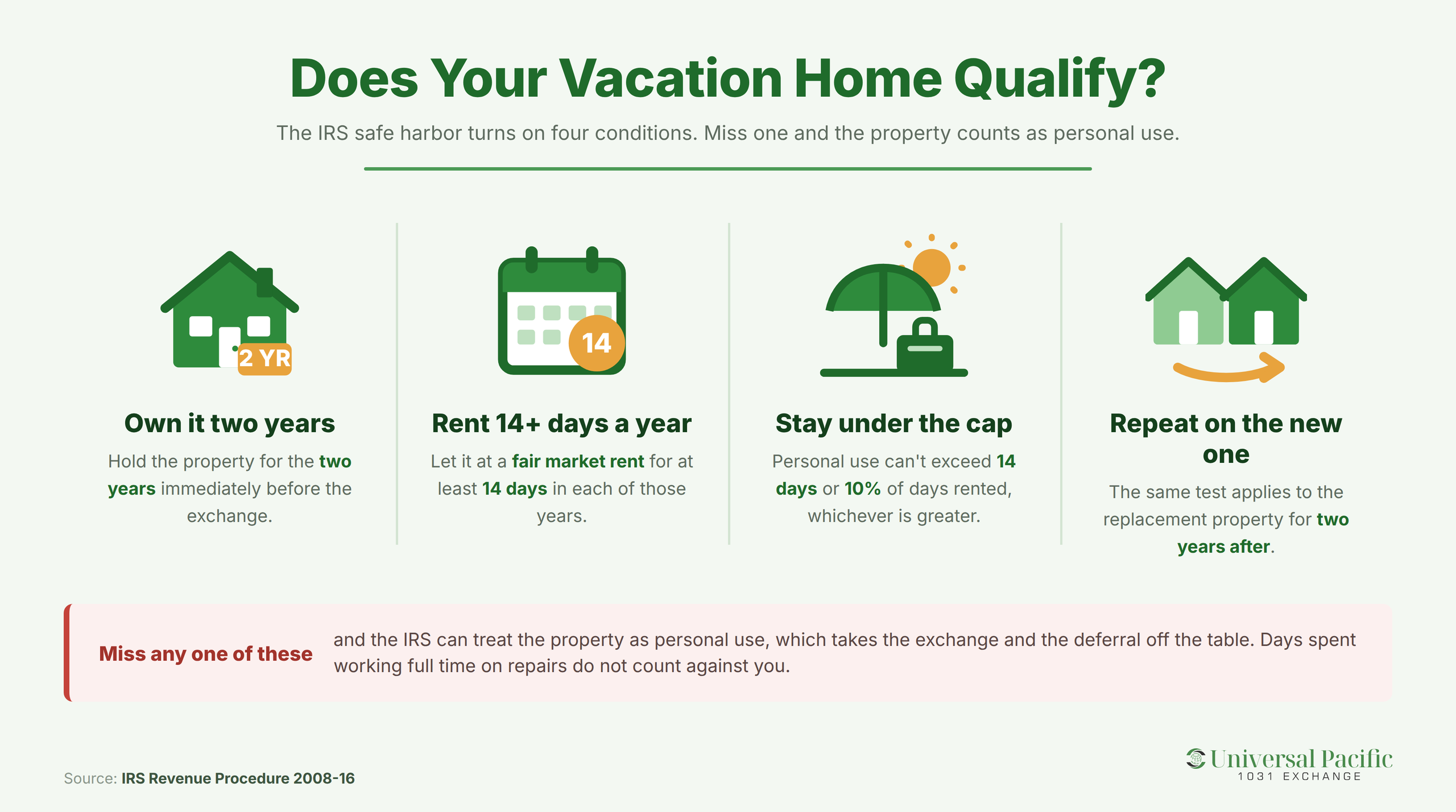
The Revenue Procedure 2008-16, also known as the Safe Harbor Rule, became effective on March 10, 2008. The rule provides a safe harbor under which the IRS will not challenge whether a qualifying dwelling unit, such as a vacation home, primary residence, second home, etc., is held for investment or productive business use, provided the specified requirements are met. Such criteria include:
- You must own the investment property for at least two years immediately preceding the 1031 exchange.
- In each of those two years, you must rent the real property at a fair market rent for 14 days or more.
- Personal use is capped in each of the two years preceding the exchange. You cannot exceed the greater of 14 days or 10% of the number of days it was rented at a fair market rental.
Days you spend working substantially full time on repairs and maintenance do not count as personal use, though that exception does not automatically extend to days spent making improvements or renovations.
The same requirements apply to the replacement property after you complete the exchange.
Basic Requirements for a Vacation Home 1031 Exchange

According to Section 1031 of the Internal Revenue Code, a valid 1031 exchange requires that you fulfill the following conditions.
- You must hold the existing property productively for investment, trade, or business and not for personal use.
- The replacement property and the relinquished property must be like-kind or similar in nature regardless of their difference in quality or grade.
- US real property and real property outside the US are not like-kind to each other, so you cannot exchange a US property for a foreign one. Two foreign properties can still be exchanged for each other.
- The exchange must comply with the 45-day and 180-day timeline as stipulated by the IRS. You have 45 days to identify a replacement property after you transfer the relinquished property in the exchange. Likewise, you must complete the exchange within 180 days.
How to Structure a 1031 Exchange for Vacation Homes to Maximize Tax Benefits
The most common way to qualify a personal vacation home is to convert it into a rental first. Before the exchange, rent the house at a fair market rent and limit your own stays. That way it meets the safe harbor over the two years prior. Report the rental income on Schedule E to back up your investment use. Keep leases, listings, and receipts that show real rental use, since strong records answer the IRS if it questions your intent.
A qualified intermediary is central to this process. The QI holds the sale proceeds so you never take receipt of the funds. It prepares the exchange agreement and tracks the 45-day and 180-day deadlines. The vacation home exchanges that hold up under scrutiny are the ones with a paper trail behind them. Rent the property at a real market rate, log your days, and the investment intent proves itself. That documentation is what separates a clean exchange from a disqualified one.
You can also plan the other direction. After you acquire the replacement vacation home, rent it for two years under the safe harbor. You may then later convert it into a primary residence. Just remember the holding rules that apply to a later sale, covered below.
Benefits of a 1031 Exchange for Vacation Homes

There are several benefits of a 1031 exchange. Here’s how those benefits can apply to vacation homes.
1. Continuous tax deferral
There are no limits to how often you can execute 1031 exchanges for a vacation property. You can continuously defer tax liabilities by rolling capital gains over from one vacation property to another until you finally dispose of the property in a taxable transaction.
2. Diversifying real estate portfolio
The 1031 exchange is a smart strategy to optimize your investment opportunities and, in turn, maximize your potential return.
3. Improvement opportunities
Exchange proceeds do not have to go only into buying a finished property. In an improvement exchange, an exchange accommodation titleholder takes title to the replacement property while construction or renovation is carried out, so exchange funds can pay for the work as well as the purchase. Only improvements actually completed inside the 180-day window count toward the value you have to reinvest.
4. Acquiring properties in more desirable locations
The 1031 exchange provides you with the opportunity to upgrade your investment to an area where vacation properties have higher values, better rental income, and significant growth potential.
5. Freedom to enjoy your vacation home after 24 months
After completing the 24-month safe-harbor period, you may choose to increase your personal use of the property, but additional tax rules may apply, particularly if you later convert the property to a principal residence or sell it.
Potential Pitfalls and Mistakes to Avoid

- Failure to meet the use requirement: If you fail to comply with the IRS use requirements (for example, exceeding the 14-day or 10% limit) for a vacation property exchange, your exchange will be unsuccessful.
- Missing the exchange timeline: Failure to meet the given timelines can also disqualify you. Identify your replacement property and submit it to the QI within the 45-day period. Also note that these timelines are calendar days (weekends and holidays included).
- Not structuring the transaction correctly: Your exchange may fall through if you do not follow the correct process. To avoid this, use an intermediary like the Universal Pacific 1031 Exchange. We structure and facilitate your exchange transactions accurately per IRC 1031.
- Not considering the impact on state taxes: Tax rules and regulations may vary across different states. So, you need a tax professional to guide you through the process to ensure compliance with the applicable regulations.
Risks and Limits to Weigh First
The strategy is powerful, but it carries real limits worth weighing before you start. Personal use is the first concern. Because a vacation home is easy to enjoy, the IRS watches personal use closely, and heavy personal use can disqualify the exchange. The five-year rule is the second. It lives in Internal Revenue Code Section 121(d)(10).
If you later convert the replacement property into your primary residence, a holding rule applies. If property acquired through a Section 1031 exchange is later sold, the Section 121 exclusion generally does not apply if the sale occurs within five years after the acquisition. That exclusion can reach $250,000, or $500,000 if married filing jointly. When you convert the property to a principal residence, the old cost basis carries over. Depreciation deductions taken while the property was used as a rental can affect the property’s adjusted basis and may result in taxable depreciation-related gain when the property is later sold.
Mixed-use properties, used partly for personal purposes and partly as a rental, draw extra IRS scrutiny. If your personal use is too heavy, you would owe capital gains taxes on the sale. Cost and complexity round out the list. You will pay qualified intermediary fees and closing costs, and the tight 45-day and 180-day windows leave little room for error. The table below sums up the main requirements and risks.
| Factor | Vacation Home 1031 Requirement |
|---|---|
| Ownership before the exchange | At least 24 months |
| Rental at fair market rent | 14 or more days in each of the two prior years |
| Personal use cap | Greater of 14 days or 10% of days rented |
| Exchange timeline | 45 days to identify, 180 days to complete the exchange |
| Conversion to primary residence | No Section 121 exclusion if you sell within 5 years of acquiring it in the exchange; depreciation and non-qualified-use periods are excluded even then |
Worked Example
Here is how the numbers work on a hypothetical exchange. The figures below are an illustration, not a client outcome.
An owner holds a second home that cost $230,000 and is now worth $430,000. For about two years and ten months before the sale, the owner rents it at a fair market rent and keeps personal stays inside the IRS limits, which is what establishes that the property is held for investment.
The home then sells for $430,000. The gain works out to roughly $200,000 before accounting for the depreciation taken during the rental period and the costs of selling. Within 45 days of closing, the owner identifies a $500,000 beachfront home in Miami as the replacement property and completes the purchase with the $430,000 held by the qualified intermediary plus $70,000 of personal funds.
Because the replacement property meets the applicable 1031 requirements and the exchange rules were followed, the gain is deferred rather than taxed in the year of the sale.
Real cases show the other side too. In Moore v. Commissioner, T.C. Memo. 2007-134, the Tax Court disallowed a 1031 exchange of two lakefront vacation homes. The Moores never rented either property and used both for family weekends. The court ruled they were held for personal use, not investment. Hoping a property will appreciate is not enough to prove investment intent.
Background of Section 1031

Section 1031 is a tax rule in the Internal Revenue Code (IRC) that allows real estate investors to defer capital gains taxes on real estate exchanges. The 1031 exchange structure began with the Revenue Act of 1921, which permitted both like-kind and non-like-kind exchanges. However, the Revenue Act of 1924 later declared the ineligibility of non-like-kind exchanges for tax deferral.
After the Starker court case in 1979, Congress added the 45-day and 180-day deadlines in 1984. The qualified intermediary safe harbor followed in the 1991 Treasury regulations.
Revenue Procedure 2002-22 provided guidance on when an undivided fractional interest in rental real property could qualify for Section 1031 treatment.
When to Consult a Professional
To ensure a successful tax-deferred exchange, you need experienced professionals: tax consultants, attorneys, and a QI. With their understanding of the IRS Code Section 1031 and its complexity, they help simplify the process and ensure compliance with the IRS Safe Harbor Rule.
Working with 1031 exchange professionals helps you mitigate potential risks and eliminate potentially costly errors in the exchange transactions. Also, the QI can help you identify and analyze a suitable replacement property.
So, when do you consult these professionals? It’s recommended you involve these professionals as early as possible. Consult them before initiating the exchange and ensure they are actively involved throughout the process.
Other scenarios where you might need experienced professionals include tax reporting for the sale of an existing vacation property, structuring your exchange, the period of identification (45 days), and the exchange period (180 days).
Related Investment Property Options Beyond Vacation Homes in 1031 Exchanges
A vacation home is one option, but a 1031 exchange works across many property types. You can exchange into rental properties, commercial property, or even a fractional interest in a larger property held for investment. Each must be held for productive use, not personal use, to qualify. Spreading your equity across different property types is one way investors use a 1031 exchange to diversify and manage risk.
Ready to Plan Your Vacation Home 1031 Exchange?
A 1031 exchange for a vacation home lets you defer capital gains taxes, diversify your portfolio, and move into more desirable locations. It also opens the door to renovations and the freedom to enjoy the home after 24 months of compliance.
Still, you must weigh the risks, since poor structuring, heavy personal use, or missed deadlines can make your gain taxable. The second-home market is both large and cooling: the National Association of Home Builders counts 6.2 million second homes in the US as of 2024, 4.3% of the housing stock and down from 6.5 million in 2022.
At Universal Pacific 1031 Exchange, we provide the experience and expertise to complete a successful exchange. Contact us today to schedule a free consultation and start your tax-advantaged journey.
Frequently Asked Questions
This section provides answers to common questions about a 1031 exchange for vacation homes.
Do Vacation Homes Qualify for a 1031 Exchange?
Yes, if you hold the vacation home for investment and meet the safe harbor. You must rent it at a fair market rent for at least 14 days a year and limit your personal use. A pure personal getaway does not qualify.
Can a Second Home Be Considered for a 1031 Exchange?
A second home can qualify only if you treat it as an investment, not a personal residence. That means renting it at fair market value and keeping personal use within the safe harbor limits. Documentation of that rental use is key.
How Do You Avoid Capital Gains on a Vacation Home?
You can defer the capital gains taxes with a 1031 exchange into a like-kind investment property. Deferred gain may potentially be reduced or eliminated at death if the property receives a basis adjustment under applicable estate and tax rules, but investors should discuss this with an estate-planning and tax professional.
What Is the 2-Year Rule for a Vacation Home 1031 Exchange?
Revenue Procedure 2008-16 provides a safe harbor requiring the taxpayer to own the dwelling unit for at least 24 months before and, for replacement property, 24 months after the exchange, along with specified rental and personal-use requirements.
What Happens When You Sell a 1031 Exchange Property?
When you sell without another exchange, the deferred capital gains and depreciation recapture become due. You can keep deferring by rolling into another 1031 exchange. Selling outright ends the deferral and triggers the tax.
This page was reviewed by Michael Bergman, CPA, California CPA #56113. Verify license.
Disclaimer: This article is for general informational purposes only and is not tax or legal advice. The rules for a 1031 exchange of a vacation home are complex, and their application depends on your specific facts. Tax laws change, and each situation is different. Consult a qualified intermediary and a licensed tax professional before acting.
Editorial Policy
All articles are reviewed for accuracy by licensed tax professionals and sourced from official government publications. Read our Editorial Policy →
About The Author
 Michael Bergman is a California licensed CPA and Real Estate Broker with over 35+ years of CPA-supervised 1031 exchange experience in commercial real estate. Specializing in 1031 tax-deferred exchanges and financial oversight, his expertise covers complex real estate transactions. Michael’s unique blend of financial acumen and real estate knowledge positions him as a trusted advisor in the industry, offering sound advice and strategic insights for successful property management and investment.