

Qualified Intermediary for 1031 Exchanges in Los Angeles
Between your two closings in a Los Angeles 1031 exchange, the sale money sits in the qualified intermediary's exchange account and not in yours; that separation is what keeps the federal tax deferred. Universal Pacific runs all four structures here (delayed, simultaneous, reverse and improvement), and we watch day 45 and day 180 for you from the closing date.
Work with the experienced Qualified Intermediary for 1031 exchanges in Los Angeles. Fast, easy, and reliable 1031 tax-deferred exchanges in California. Contact Universal Pacific 1031 today!
A Los Angeles sale adds its own layer to the federal rules: City and County transfer tax and Measure ULA at recording, California's exchange facilitator law for the company holding your money, and the choice between a qualified intermediary and a qualified escrow. This page takes them in the order they come up in escrow.
Reviewed by Michael Bergman, CPA
Last updated 18 November 2026 · Sources for this page
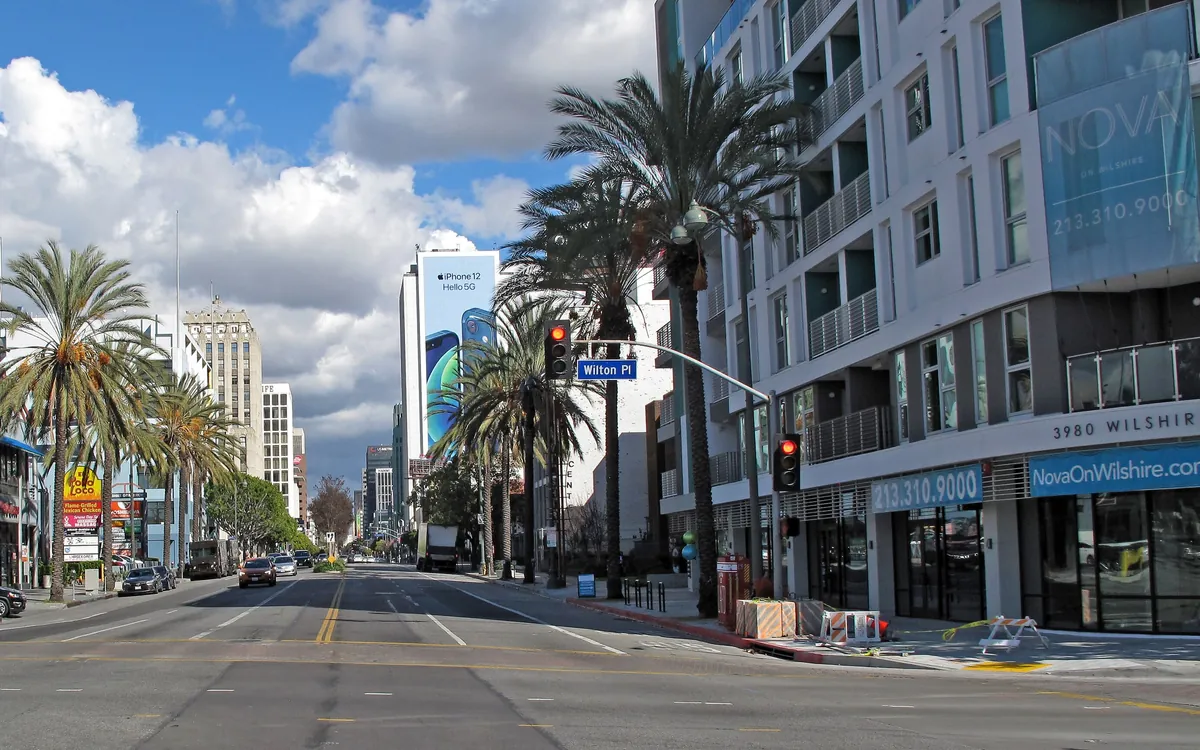

Los Angeles is our home market. We work from 1180 S. Beverly Drive, Suite 500, and the Los Angeles sales we hold money for close at escrow and title companies all over the county.
With a professional history managing transactions ranging in price from $100,000 to over $100M, our company combines genuine business acumen, real estate insight, and financial literacy.
1031 Exchange Intermediary Services in Los Angeles, Handled From Our Beverly Drive Office
Irrespective of the type of 1031 exchange you choose, Universal Pacific 1031 Exchange is dedicated to helping you defer capital gains tax through our Qualified Intermediary services. Our Los Angeles-based intermediary services are aligned with applicable IRS requirements and strategic optimization of your tax benefits.
You also work with a CPA-led intermediary that puts your interests first in every exchange, and the first conversation is a free consultation before you commit to anything. Most of the questions we hear from Los Angeles owners fall into a few groups: whether a qualified intermediary is needed at all (the safe harbor section), what California asks of the companies that hold exchange money (Financial Code 51003), how the 45 and 180 days run (the steps), and what the City and County charge when the deed records (transfer tax and ULA).
What we do between your Los Angeles sale and your purchase
A Qualified Intermediary is an authorized facilitator of 1031 exchanges responsible for holding the sale proceeds of relinquished investment property, releasing the funds for acquiring replacement properties, and ensuring that the entire transaction is fully IRS-compliant.
The regulations spell out what that job involves: someone who is neither you nor a disqualified person enters a written exchange agreement with you and steps into your side of the sale and of the purchase, so your buyer's money goes to it instead of to you (Treas. Reg. 1.1031(k)-1(g)(4)). In practice, that means we sign the exchange agreement with you before the sale escrow closes, take an assignment of your purchase and sale contracts, and give the other side written notice of it. The buyer's money, less closing costs, goes from escrow straight into the exchange account, and at your purchase we send it on to the purchase escrow so that title is deeded to you.
Which structure fits the timing of your Los Angeles sale
Each structure answers a different timing problem. Read across the row that matches yours; the paragraphs under the table explain the parts that most often go wrong in a Los Angeles file.
| Structure | Who holds what in between | Clock | Fits a Los Angeles owner who |
|---|---|---|---|
| Delayed | Universal Pacific keeps the proceeds in an exchange account for you | Name candidates by day 45; close by day 180 | has a buyer now and is still choosing the next building |
| Reverse | An accommodator holds title to the building you buy first | Day 45 to name the sale property, day 180 to finish | has a purchase lined up while the current building is still unsold |
| Improvement | An accommodator holds the replacement while work is paid for | Day 180 for the work to be in place | is buying a building that needs work before it fits |
| Simultaneous | Two escrows close together; we take the contract assignments | Same day | has both contracts ready to close at once |
Delayed. A delayed exchange is the most common form of a 1031 exchange, providing you with the opportunity to sell your existing property in Los Angeles and purchase a replacement property within 180 days. We hold the proceeds from the day your sale escrow closes and wire them to the purchase escrow after you have named the replacement in writing, in the order the IRS rules set out.
Reverse. A reverse exchange provides you with the flexibility to acquire a replacement property before selling your relinquished property, addressing unique timing challenges that can occur in real estate transactions. We can serve as your exchange accommodator to temporarily hold the replacement property in keeping with IRS regulations. In the IRS's own term the accommodator is an exchange accommodation titleholder (Rev. Proc. 2000-37), and a building can sit with it for 180 days at most. Owners sometimes try to park a building they already own and plan to improve. That falls outside the safe harbor if the building was yours within the 180 days before the accommodator received title (Rev. Proc. 2004-51).
Improvement. Exchange money can pay for work on the replacement, but only what is built before the deed passes to you counts toward the exchange. Our improvement exchange page explains how the accommodator, the contractor and the 180 days fit together.
Simultaneous. The property you sell and the one you buy change hands on the same day, usually through two escrows set to close together. The assignment and the written notice to both sides still have to be in place by the closing (Treas. Reg. 1.1031(k)-1(g)(4)(v)), because the deferral rests on that paperwork and not on the timing.
Why the IRS Does Not Require a Qualified Intermediary, and What Can Hold the Money Instead
You will often read that the IRS requires a qualified intermediary. It does not. What the regulation demands is narrower: from the sale closing until the replacement deed, the cash must stay beyond your reach. A qualified intermediary is the most common way to meet that requirement, and it is not the only one.
The rule underneath is that you cannot touch the cash
An exchange has to be a transfer of property for property. A sale followed by a purchase does not qualify, even when the second property is bought within the deadlines (Treas. Reg. 1.1031(k)-1(a)). Money counts as yours the moment it is credited to an account of yours or set apart for you to draw on, and money paid to someone acting for you counts the same way (Treas. Reg. 1.1031(k)-1(f)(2)). So the question for a Los Angeles seller is not which company to hire. It is how to arrange the closing so that the proceeds are never yours to draw on before the exchange is finished.
The safe harbors listed in paragraph (g)
The regulation gives four arrangements that keep you out of actual or constructive receipt, and more than one can be used in the same exchange as long as each one's terms are met on their own (Treas. Reg. 1.1031(k)-1(g)(1)):
- security for the buyer's promise to deliver the replacement, such as a mortgage on other property or a standby letter of credit that can be drawn only on default (paragraph (g)(2));
- a qualified escrow account or qualified trust holding the cash (paragraph (g)(3));
- a qualified intermediary (paragraph (g)(4));
- interest or a growth factor on the money, if the agreement limits your right to it (paragraph (g)(5)).
A qualified escrow account or a qualified trust
The escrow holder or trustee cannot be you or a disqualified person, and the written agreement must expressly limit your right to receive, pledge, borrow or otherwise benefit from the cash (Treas. Reg. 1.1031(k)-1(g)(3)(ii) and (iii)). Those limits follow paragraph (g)(6): no access before the exchange period ends, except after day 45 if nothing was identified, after you have received everything you identified and are owed, or after a written, material contingency outside your control. Two details matter in a Los Angeles escrow. A right under California law to dismiss the escrow holder is ignored for this test, and money paid to you directly by a party to the deal does not spoil the safe harbor, while money paid to you out of the escrow account does (Treas. Reg. 1.1031(k)-1(g)(3)(iv) and (v)).
The reason Los Angeles sellers rarely rely on escrow alone
Under the escrow and trust safe harbor, the cash only secures a promise by your buyer to deliver the replacement property to you. In the regulation's own example, the buyer is the one who purchases the replacement with the escrowed funds and transfers it to you (Treas. Reg. 1.1031(k)-1(g)(8), Example 1). A buyer of a Koreatown fourplex or a Valley strip center rarely wants that job. The qualified intermediary safe harbor solves it: the qualified intermediary is treated as acquiring and transferring both properties once the contracts are assigned to it and every party is told in writing (Treas. Reg. 1.1031(k)-1(g)(4)(iv) and (v)), so nobody else has to buy anything for you.
A straight swap between owners
If you and another owner simply deed your buildings to each other at the same closing, there is no sale money for you to receive, so no safe harbor is needed. Any cash that evens out the values, or a loan the other side takes over, is taxable to the extent of the gain (26 U.S.C. 1031(b) and (d)). Swaps like that are uncommon in Los Angeles, where most buyers pay cash or finance and most sellers want to choose their next property after the sale.
Which arrangement still makes the firm an exchange facilitator in California
California does not treat a qualified escrow holder as outside the system. A company that acts for a fee as your qualified escrow holder or trustee is an exchange facilitator under the Financial Code, the same as a qualified intermediary or an accommodator, unless it is a bank, title company or escrow company acting solely in that role and not facilitating exchanges (Cal. Fin. Code 51000(b)). The next section covers what that status requires.
1031 Exchange Companies in California and the Financial Code's $1 Million Rule
Federal law says who may not hold your exchange money. California goes further and regulates the companies that do. Division 20.5 of the Financial Code, in force since 1 January 2009, sets the rules for every "exchange facilitator" that works on California property (Cal. Fin. Code 51000 to 51013). If you are comparing 1031 exchange companies in California, or choosing a qualified intermediary for a Los Angeles sale, these sections are the checklist the law already gives you.
Which firms the law covers
An exchange facilitator is a person who, for a fee, takes over your contract rights to sell California relinquished property as a qualified intermediary, takes title to California property as an exchange accommodation titleholder, or acts as your qualified escrow holder or trustee. A firm that keeps an office in California to solicit that business, or advertises it to the public in California, is covered too (Cal. Fin. Code 51000(b)(1)). The fee test is broad: any compensation, direct or indirect, received by the firm or a related person. A Los Angeles seller cannot escape the statute by choosing an out-of-state company, because the trigger is where the relinquished property sits. The exclusion for intermediaries applies only to funds from relinquished property outside California (51000(b)(2)(E)).
Section 51003 asks for a bond, a deposit, or money the company cannot move alone
Every exchange facilitator must at all times do at least one of three things (Cal. Fin. Code 51003(a)):
- carry a fidelity bond of at least $1,000,000 from an insurer authorized in California or an eligible surplus line insurer;
- park $1,000,000 or more of cash, securities or irrevocable letters of credit in an interest-bearing or money market account at a bank of its choosing; or
- hold the funds of every client in a qualified escrow account or qualified trust at a financial institution, so that a withdrawal takes your written consent as well as the company's.
The first two are a cushion behind the company. The third changes how your money moves: no wire leaves the account without your signature. A firm named as an insured on fidelity bonds totalling $1,000,000 meets the section (51003(c)). Anyone harmed by a facilitator's failure to comply can file a claim against the bond, deposit or letter of credit (Cal. Fin. Code 51005).
Insurance and custody of the money
Separately, the facilitator must carry errors and omissions insurance of at least $250,000 or keep a $250,000 deposit (Cal. Fin. Code 51007). Whatever it receives for you, it holds as custodian, and the law tells it to invest that money the way a prudent investor would, keeping it liquid and protecting the principal. That standard is breached if the funds are knowingly mixed with the company's operating accounts, lent to an affiliate other than a financial institution, or invested so that the company could not pay out when your purchase closes. Exchange funds cannot be seized to pay claims against the facilitator (Cal. Fin. Code 51009).
When the company changes hands, or fails to perform
If more than 50% of a facilitator's assets or ownership is transferred, it must notify every client with California relinquished property, or with California replacement property held by an accommodator, within 10 business days, and post the notice on its website for at least 90 days with the new owners' contact details (Cal. Fin. Code 51001). The law also bars material misrepresentations about an exchange, failing to account for client money within a reasonable time, and failing to deliver property or funds as the contract requires (Cal. Fin. Code 51011), and a client can sue over any violation (Cal. Fin. Code 51013).
Where your Los Angeles proceeds sit with Universal Pacific
Secure and Insured. Prior to any purchase agreements, we'll keep your sale proceeds in a safe, segregated escrow account. As another layer of security, all escrow accounts are FDIC-insured, and we also carry Errors & Omissions (E&O) insurance coverage.
Exchange Trust and fiduciary duty. We keep your funds in an Exchange Trust. At Universal Pacific 1031 Exchange, we take our fiduciary duties seriously and strive to exceed your expectations with every transaction.
Universal Pacific carries $2M E&O insurance, eight times the $250,000 floor in section 51007. We have in place internal controls to protect your funds against potential fraud or theft. Read plainly, section 51009 means your money stays liquid, apart from our own, and ready when your purchase closes.
Transparent and Reliable. The first level of trust is clear communication. As such, we'll keep you updated throughout the exchange process while with every step aligned to IRS Section 1031 requirements.
Tailor-Made Solutions. No two clients or transactions are alike. Recognizing this, we offer customized solutions to align with your unique needs and objectives. Before you sign anything, we walk you through each exchange document, so you know what we hold and when it is paid out.
Questions to put to any California exchange company
- Which of the three section 51003 options do you use, and can I see the bond, the deposit or the escrow terms?
- Will withdrawals from my exchange account need my written authorization?
- In whose name, and at which financial institution, is my exchange account held?
- What errors and omissions cover do you carry, and with which insurer?
- Who else holds an ownership stake in your company?
Steps for Completing a 1031 Exchange in Los Angeles, Dated From the Day Your Sale Records
Every date in a Los Angeles 1031 exchange is counted from the day your sale escrow closes and the deed records. Here is the order we follow as your qualified intermediary, and the point where each one gets tight.
Before the sale escrow closes
- Make a decision to sell your property to a willing buyer. Section 1031 covers property used in a trade or business or held as an investment; your own residence and property kept mainly for resale are outside it (26 U.S.C. 1031(a)).
- Reach out to Universal Pacific 1031 Exchange to retain our services as your Qualified Intermediary for the transaction. Bring us in before the sale closes: once the proceeds reach you, they cannot be put back into an exchange.
- We will review your investment property and do other due diligence to ensure that it qualifies for a 1031 exchange. We will also notify the other party that the transaction is part of a like-kind exchange.
- Once everything is in order, Universal Pacific 1031 Exchange will prepare all other necessary documentation for the transaction, which includes the Qualified Escrow Agreement and Instructions to Escrow.
Where the buyer's money goes on closing day
- The buyer will vet the documents and pay the agreed sum into the escrow account we set up for you. Under the Treasury regulations, an exchanger (you) must not touch the sale proceeds of a 1031 exchange.
The City and County transfer tax, commissions, prorated property taxes and title fees can be paid out of the sale at closing without breaking the safe harbor: the regulation disregards transactional items that appear on a typical closing statement as the seller's or buyer's responsibility, and it names recording and transfer taxes (Treas. Reg. 1.1031(k)-1(g)(7)(ii)). Prorated rents you receive at closing are disregarded as well (paragraph (g)(7)(i)). Ask escrow to show on its estimate how your tenants' security deposits will be credited to the buyer.
Getting the identification to us before the 45th midnight
- After the sale of the old property, you must use any of the IRS identification rules to identify one or more replacement properties within the next 45 days. Send us a written list of identified properties.
You sign the identification and hand it to us, or to the seller of the replacement, before the 45th day is over. Any of these identifies a building: its street address, its legal description or a name nobody could confuse. To drop one, you sign and deliver a written revocation the same way, before the same midnight (Treas. Reg. 1.1031(k)-1(c)(2), (c)(3) and (c)(6)). Copy the address exactly as the purchase contract shows it; Los Angeles has many buildings with two street numbers or a unit range.
Late-year sales and the April filing date
- If the identified properties meet the IRS requirements, we will transfer the exchange funds from the escrow account to the seller. This must be done within 180 days from the sale of the relinquished property.
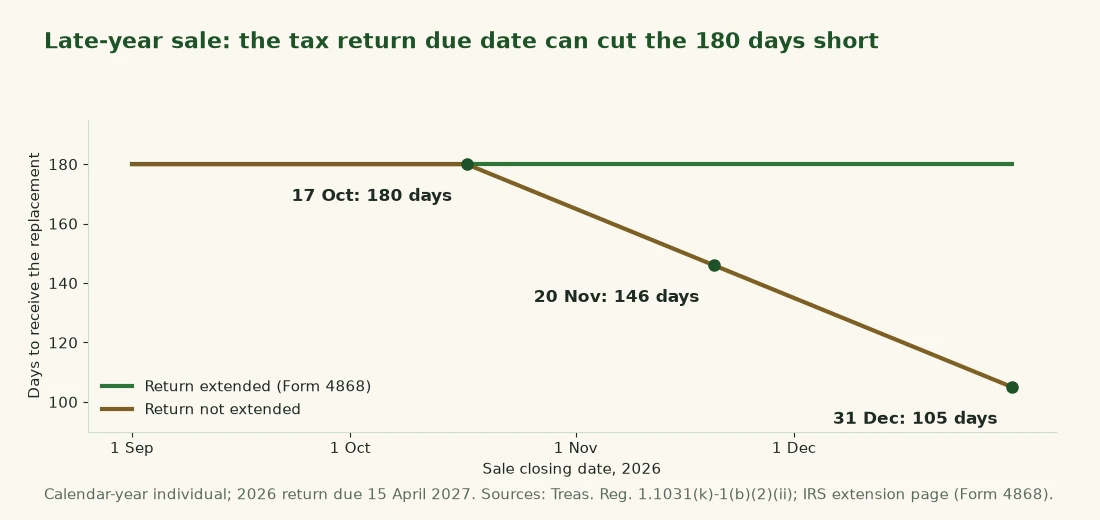
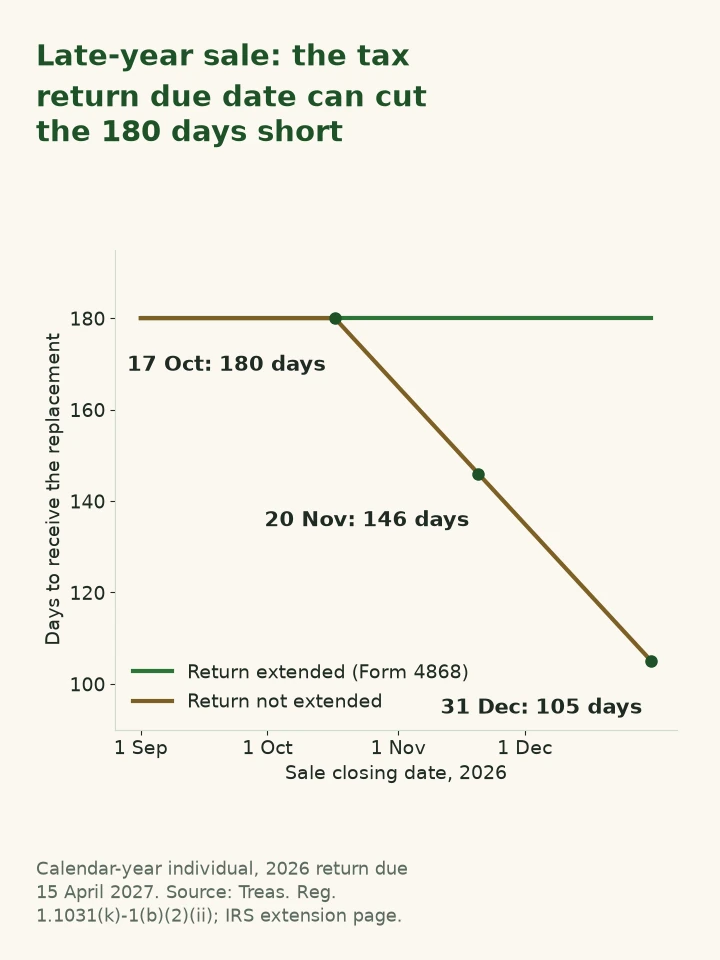
Your replacement must be received by the earlier of two midnights: the 180th day, or the due date of that year's return counting any extension (Treas. Reg. 1.1031(k)-1(b)(2)(ii)). That catches late-year sellers. A Mar Vista duplex sale that records on Friday, 20 November 2026, has day 180 on 19 May 2027. The owner's 2026 return is due 15 April 2027, so without an extension the exchange period closes 34 days early. An extension request filed by the April date gives you until 15 October to file (IRS: extension to file), and with it the full 180 days come back. An LLC or partnership that sells files its own return with its own due date, so check the entity's date, not yours.
When a disaster declaration covers Los Angeles County
After the January 2025 wildfires, the IRS gave everyone living or doing business in Los Angeles County until 15 October 2025 for deadlines falling between 7 January and that date (IRS news release IR-2025-10). Exchange deadlines can move under relief of that kind, but only for an exchange whose sale closed by the disaster date, and only as far as Rev. Proc. 2018-58, section 17 allows: never past the extended return due date, and never by more than a year. One detail matters to our clients outside California. The hardships that qualify include a qualified intermediary whose principal place of business is in the covered area, and ours is in Los Angeles County. If a declaration lands in the middle of your exchange, call us that week.
After the replacement closes
- The final step is to complete and file other relevant documents. This includes Form 8824, which legally notifies the IRS of the transaction. With this, you've completed an IRS-compliant like-kind exchange.
Transfer Tax, Measure ULA and Other Los Angeles Costs a 1031 Exchange Does Not Defer
Section 1031 postpones federal income tax and nothing else. These are the figures that change the budget of a Los Angeles exchange, each with what it does to the money and where it comes from. Only one of them, the qualified intermediary fee, is ours.
| Figure | Effect on a Los Angeles exchange | Source |
|---|---|---|
| $5.60 per $1,000 of value (County $1.10 plus City of Los Angeles $4.50) | Due at recording whether or not you exchange, and paid from cash that would otherwise go to the replacement | Registrar-Recorder |
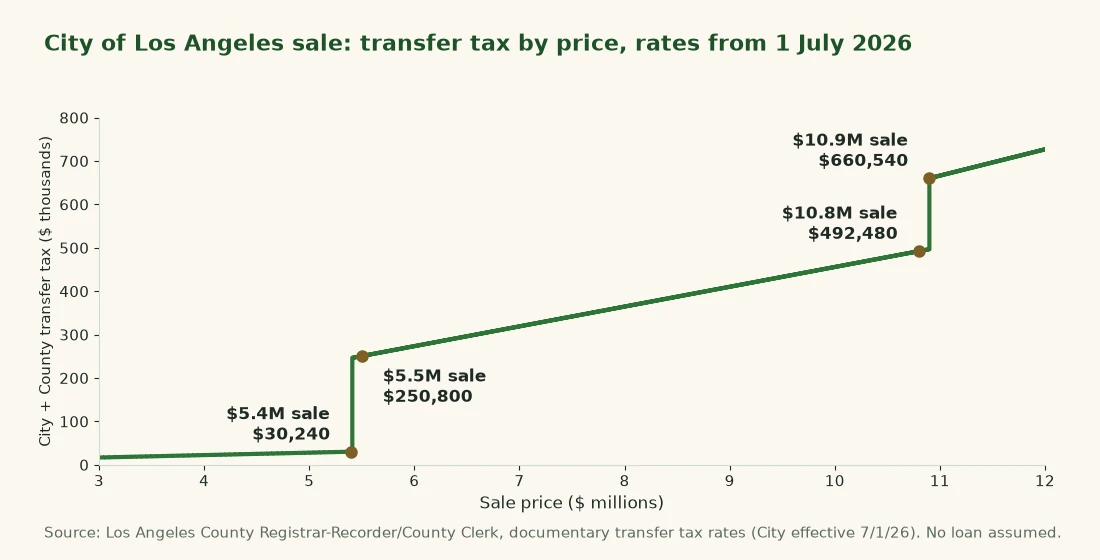
| Measure ULA: 4% of the whole price above $5,400,000, 5.5% at $10,900,000 and above (from 1 July 2026) | A sale just over a threshold can cost more in tax than the extra price brings in | LAHD, Measure ULA |
| 45 days, then 180 days or the return due date | Weekends count; the count starts the day your sale deed transfers | Treas. Reg. 1.1031(k)-1(b)(2) |
| Intermediary fee: $600 to $1,500 delayed, $3,000 to $7,500 if an accommodator takes title | The listed qualified intermediary fee range, before outside costs | Our fee guide |
| 15% of the price withheld when the seller is a foreign person | Held by the buyer's escrow, not the qualified intermediary; a certificate application filed by closing can delay payment to the IRS | IRS: FIRPTA withholding |
| $1,000,000 bond, deposit or dual-signature escrow; $250,000 E&O | The floor every California exchange company must meet | Cal. Fin. Code 51003, 51007 |
| $6 first page, $3 each further page | A certified copy of a recorded deed for your exchange file | Recording requirements |
The base rate
The County charges $0.55 for each $500 of value or fraction of $500, and the City of Los Angeles adds $2.25 for each $500, so a sale inside the city pays $5.60 per $1,000 together. The tax is figured on the price less any loan that stays on the property, and the Registrar-Recorder collects the City's share when the document is recorded (Registrar-Recorder, documentary transfer tax).
Measure ULA above $5.4 million
City voters approved Measure ULA in November 2022 with 58% of the vote, and collections began on 1 April 2023 (Los Angeles Housing Department, ULA). From 1 July 2026 it adds 4% of the total transaction value on sales above $5,400,000 and below $10,900,000, and 5.5% at or above $10,900,000; the thresholds in the previous year were $5,300,000 and $10,600,000. Because the rate applies to the whole price, a $5,400,000 sale pays $30,240 in City and County transfer tax and a $5,500,000 sale pays $250,800. The revenue goes 70% to affordable housing and 30% to homelessness prevention, and the Housing Department handles exemptions for qualifying affordable-housing buyers under Municipal Code section 21.9.14.
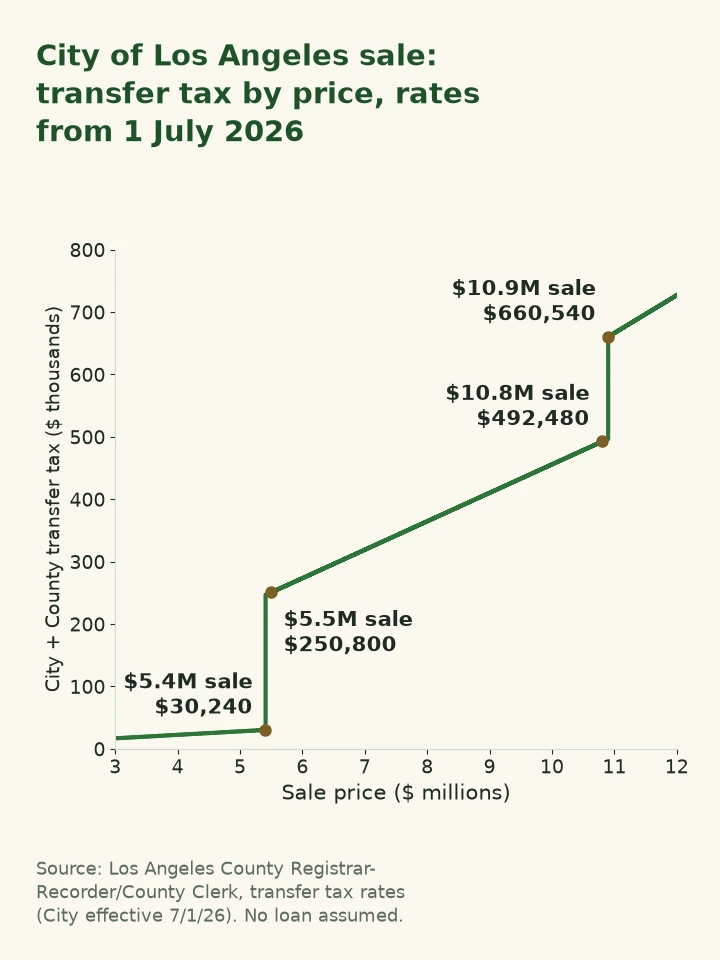
Where transfer tax leaves your exchange budget
Whoever pays it under the contract, the transfer tax is cash that does not reach the replacement. A seller near a threshold should price the sale with the tax in mind, and a buyer weighing a City of Los Angeles building should find out where the purchase contract puts the tax before naming the building on the list. Reverse exchanges add a wrinkle: title goes to the accommodator and later to you, which means two recorded transfers of one property, so ask escrow how each is taxed before signing.
Where the paperwork goes
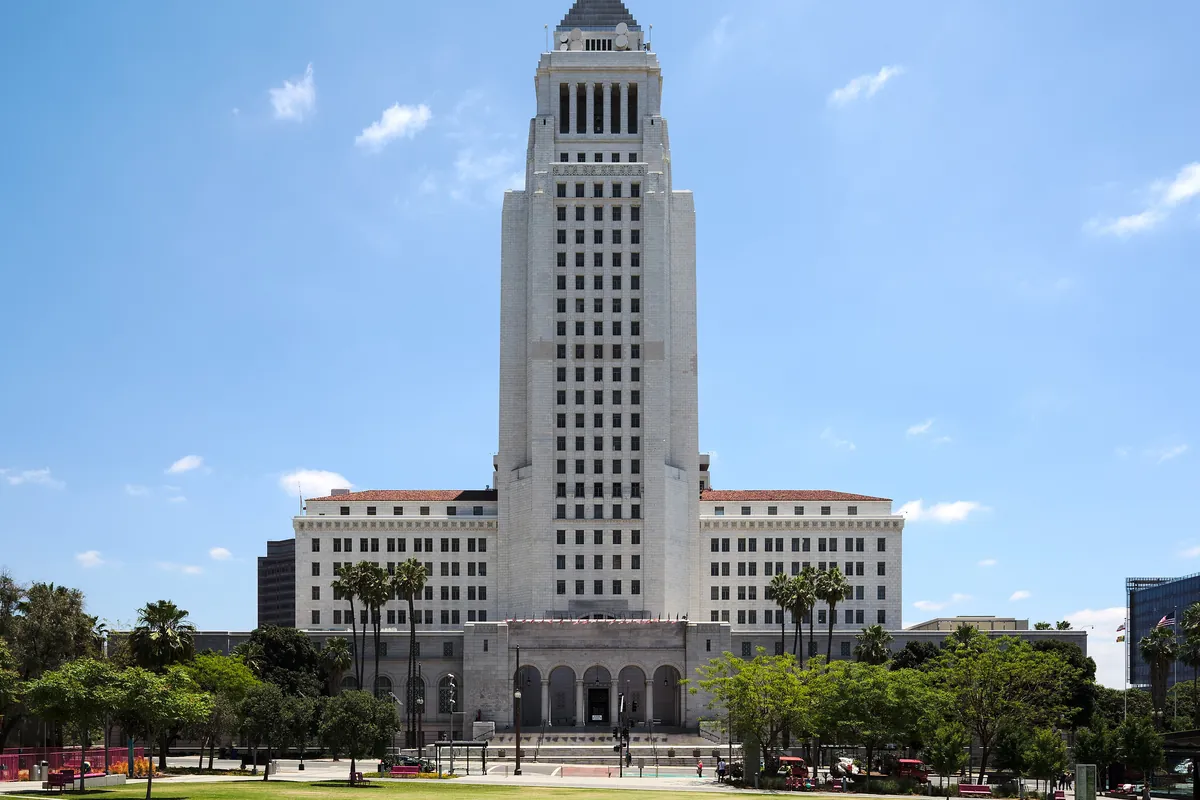
City Hall, at 200 N. Spring Street in ZIP 90012 (City of Los Angeles), sets the City's rate, but deeds are not recorded there. Mailed documents go to the Registrar-Recorder/County Clerk's Document Analysis and Recording Section, P.O. Box 1250, Norwalk, CA 90651-1250. A certified copy of a recorded document costs $6 for the first page and $3 for each additional page (recording requirements).
Proposition 13 starts over on the replacement
A 1031 exchange defers income tax, but the County Assessor does not look at it that way. The Assessor reads each recorded deed, and a change in ownership resets the property's value as of that date anywhere in the county (Los Angeles County Assessor, change in ownership). Under Proposition 13 the general levy cannot exceed 1% of assessed value, plus voter-approved bonds and direct assessments, and the assessed value can rise by no more than 2% a year until the property changes hands or new construction is completed (Assessor, real property assessment). An owner who bought a Silver Lake fourplex in 2005 and trades it for a $3 million building gives up a low assessed value on the old property and starts the replacement at roughly its purchase price. Put the new property tax into the replacement's numbers before you name it on the day 45 list, because the exchange does nothing about it.
Supplemental bills after the purchase closes
The reassessment shows up as a supplemental assessment: the difference between the new value and the old one, prorated by the months left in the fiscal year that runs from 1 July to 30 June. A purchase that closes between 1 January and 31 May produces two supplemental bills, one for the rest of that fiscal year and one for the next. Those bills come on top of the regular annual bill, and they go to the owner, not to a lender's impound account (Assessor, real property assessment). Keep cash outside the exchange for them; once the exchange has ended, the money in it has either bought property or been paid out to you.
The ownership report filed with the deed
When a transfer is recorded, the new owner files a Preliminary Change of Ownership Report with it; an unrecorded transfer calls for a Change in Ownership Statement within the time limits instead, and failing to notify the Assessor can bring penalties, with reassessment reaching back as many as eight assessment years (Assessor, change in ownership). Escrow usually prepares the report for the purchase deed. In a reverse exchange, ask escrow which report goes with each of the two deeds.
Before you sign, ask escrow for an estimated closing statement at the contract price. It shows the transfer tax, the escrow and title charges and the commissions as line items, which is the quickest way to see how much of the sale will actually reach the exchange account.
What to Check, Block by Block, Before Naming Los Angeles County 1031 Exchange Properties for Sale
Your broker finds the listings. Our part as your qualified intermediary is to check that each one can work as replacement property before it goes on your day 45 list, and in Los Angeles that means a few local checks on top of the federal ones. The three-property rule, the 200% rule and the 95% exception decide how many candidates you may name; our identification rules guide works through each one.
City Hall, Chinatown and the renters of ZIP 90012
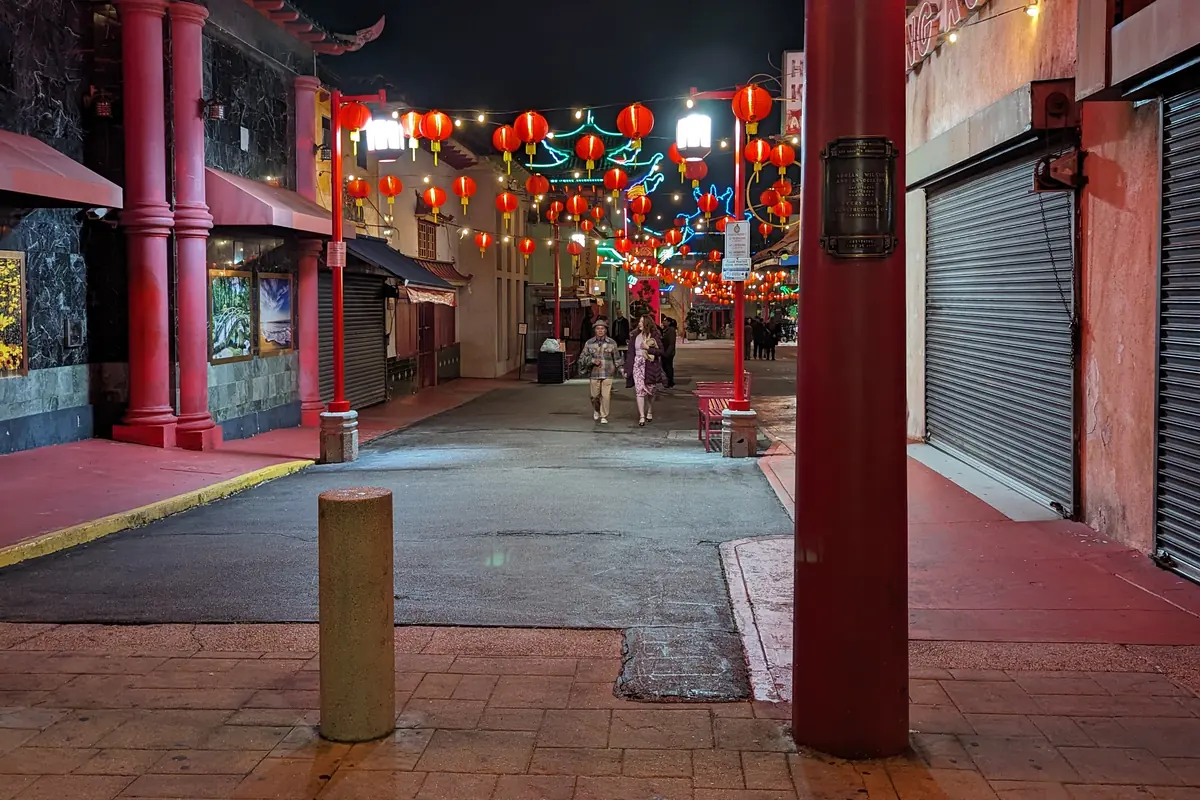
The Census tabulation area for ZIP 90012 takes in City Hall and Chinatown (Census Geocoder), and 92.5% of its occupied homes are rented (ACS 2020-2024, B25003). A replacement building there is likely to come with a full tenant roll. Ask for the estoppel certificates, the rent roll and every lease during the 45 days, not after you have named the building.
Rent-stabilized buildings in the City of Los Angeles
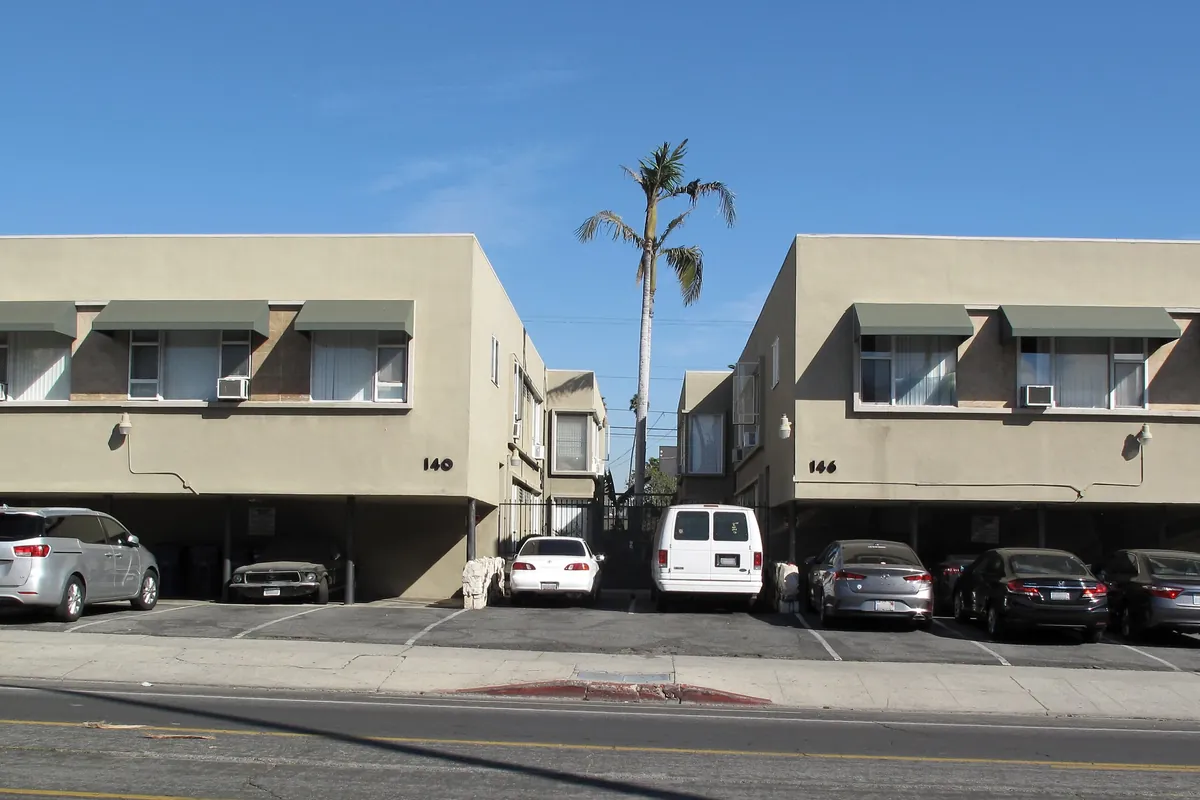
The City's Rent Stabilization Ordinance generally covers rental property first built on or before 1 October 1978, including two or more houses on one parcel. Units have to be registered with the Los Angeles Housing Department, and rent can rise once every 12 months by the allowed percentage (LAHD, RSO overview). Rent stabilization does not take a building out of section 1031, because it is still real property held for investment (26 U.S.C. 1031(a)). What the ordinance changes is the rent you can count on, so check the year built and the registration before the building goes on your 45-day list.
Across Los Angeles County
The City's rent ordinance and its transfer tax stop at the city limits. Woodland Hills and West LA are inside the City of Los Angeles; Santa Clarita, Santa Monica and Culver City are separate cities with their own rules. Owners in Long Beach, the South Bay and Orange County will find the local details for their area on our Long Beach 1031 exchange page.
A 1031 Exchange Consultant in Los Angeles or West LA Is Not the Firm That Holds Your Funds
Many owners look for a "1031 exchange consultant" or a "1031 advisor in California" when they want the whole thing explained before they commit. That is a sensible first step, and it is a different job from the qualified intermediary's.
What the qualified intermediary does
The qualified intermediary holds the money and the exchange paperwork: the exchange agreement, the assignment of your sale and purchase contracts, the receipt of your identification list, and the wires to the purchase escrow. Its role is defined by the safe harbor in the regulations, not by advice.
What your tax adviser does
Your CPA or tax attorney models the tax on a sale against an exchange, the depreciation that would be taxed, and whether the replacement keeps your debt as well as your equity in the deal. Debt matters because a loan paid off at the sale and not replaced counts like cash received, since liabilities taken over by the other side are treated as money (26 U.S.C. 1031(d)).
Can a consultant also hold the money?
Sometimes. Work done for you only on 1031 exchanges does not make a firm your agent for the two-year test, but a firm that has been your accountant, attorney, broker or real estate agent on other matters in that window cannot hold the funds (Treas. Reg. 1.1031(k)-1(k)(2)). For a fuller list of checks, read our guide to vetting a qualified intermediary.
Papers that make a consultant meeting useful
- The closing date you expect for the sale, and whether a buyer is already in escrow.
- Your purchase price, improvements and depreciation taken, so your adviser can size the gain.
- The loan balance on the property you are selling, and the financing you expect on the replacement.
- The tax status of every owner on title, including anyone who lives outside the United States.
- The city each property sits in, so the transfer tax can be priced at the right rate.
Los Angeles Owners With Family, Funds or Property in Another Country
More than a third of Angelenos (35.7%) were born outside the United States (Census ACS 2020-2024, B05002), and many Los Angeles exchanges involve a relative abroad, a co-owner who is not a U.S. tax resident, or a deed signed at a consulate. This section covers what those facts change in the exchange itself.
A house in another country stays out of the trade
Section 1031 treats U.S. real estate and real estate abroad as two different kinds of property (26 U.S.C. 1031(h)), so a Los Angeles rental cannot be exchanged for an apartment in Seoul or land outside Guadalajara, in either direction. Our article on whether a 1031 exchange applies to foreign property covers that rule on its own. If you own property abroad as well, keep it out of the exchange plan and buy or sell it with money that was never part of the exchange.
Born abroad is not the same as foreign for tax
For FIRPTA, a foreign person is a nonresident alien individual or a foreign corporation, partnership, trust or estate; a resident alien is not one (IRS FIRPTA definitions). You are a U.S. resident for tax if you hold a green card at any time during the calendar year (IRS green card test) or meet the substantial presence test (IRS residency rules). A naturalized citizen or a green card holder selling a Koreatown fourplex is a U.S. person, and no withholding applies once the buyer has the seller's certification of non-foreign status.
The buyer's escrow holds back 15% of the price
The rate is generally 15% of the amount realized, which is broadly the price and not the gain (IRS: FIRPTA withholding). Take a $1,200,000 duplex: escrow would keep back $180,000 of the price at closing. The buyer is the withholding agent and can be held liable for the tax if it does not withhold.
Why the short notice does not work for a delayed exchange
For some tax-free transfers, the seller can give the buyer a signed notice that no gain is recognized, and the buyer mails it to the IRS within 20 days instead of withholding (Treas. Reg. 1.1445-2(d)(2)). The regulation closes that route for a delayed exchange when the buyer cannot tell, at the time the withholding is due, that the exchange is finished and every condition met. It is also closed for any exchange where only part of the gain is deferred (paragraphs (d)(2)(ii) and (iv) of the same section). At the closing of the property you sell, the replacement has usually not been bought yet.
Form 8288-B has to reach the IRS by the closing date
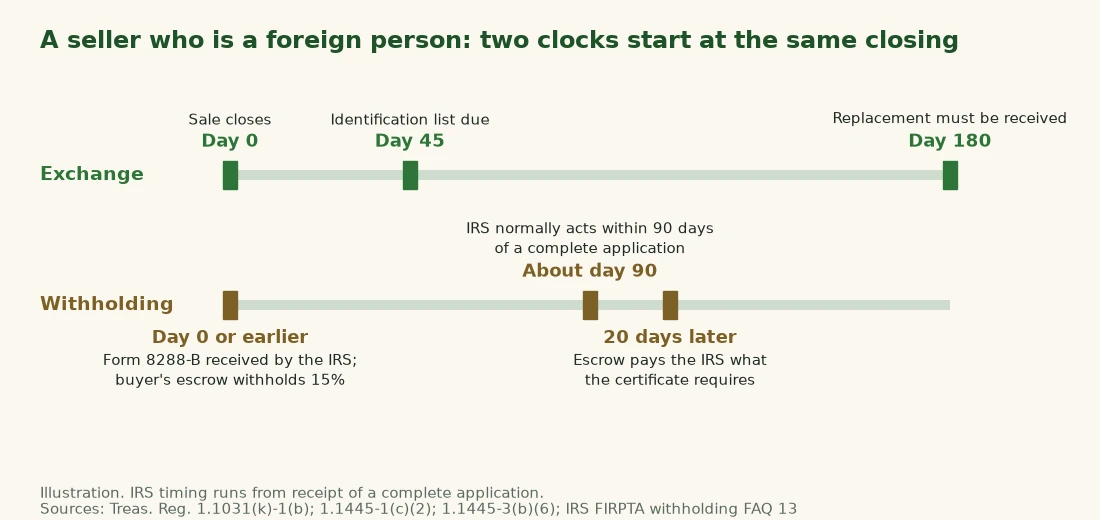
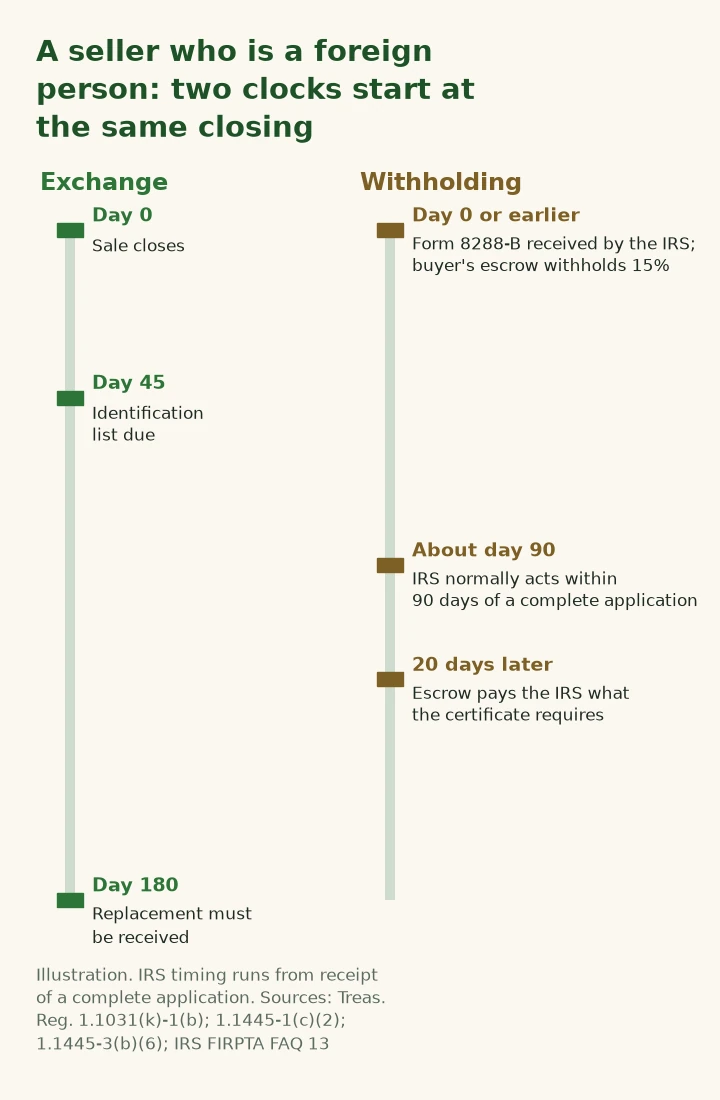
The route left is a withholding certificate. The seller or the buyer applies on Form 8288-B, and the application has to show that the section 1031 requirements are met (Treas. Reg. 1.1445-3(b)(6)). Timing decides the rest. If the IRS receives the application on or before the date of transfer, escrow still withholds the 15% but does not pay it over until the 20th day after the IRS mails its decision (Treas. Reg. 1.1445-1(c)(2)). A seller who applies must tell the buyer before the transfer, giving the application date. Miss the closing date and that deferral is gone. The IRS says it normally acts within 90 days of receiving everything it needs (IRS FIRPTA FAQ 13). A seller with no U.S. taxpayer number can apply for an ITIN only once a binding contract exists, so the W-7 and the 8288-B are prepared together.
Keeping the withheld 15% inside the exchange
While the certificate is pending, 15% of your price sits with the buyer's escrow and not with the qualified intermediary, and the 45-day and 180-day periods keep running from the closing. The chart shows the two clocks side by side. Plan the replacement purchase around that gap. Before closing, settle in the escrow instructions where any amount the certificate releases will go: paid to you before the exchange ends, it is taxable cash, not exchange money (Treas. Reg. 1.1031(k)-1(f)(1)).
Selling a Los Angeles property while you live abroad? Call us before you sign the purchase agreement. The 8288-B has to reach the IRS by the closing date, and the ITIN cannot be requested until the contract is binding. Start an exchange.
Buying from, or trading with, family
The IRS has ruled on this directly. If you sell through a qualified intermediary and buy the replacement from a related person who receives cash or other property that is not like-kind, the exchange does not qualify (Rev. Rul. 2002-83).
A direct trade between related persons can work, but both sides have to keep what they received for two years after the last transfer. If either sells inside that window, the deferred gain becomes taxable in the year of that later sale (26 U.S.C. 1031(f)(1)). Three kinds of later disposition are not counted: those after the death of either party, a condemnation that was not threatened when the trade happened, and a sale where the IRS is satisfied that tax avoidance was not a principal purpose (section 1031(f)(2)).
Related means the relationships listed in sections 267(b) and 707(b)(1). For family, that is brothers and sisters, a spouse, ancestors and lineal descendants (26 U.S.C. 267(c)(4)). Cousins, aunts, uncles, nieces, nephews and in-laws are not on that list, although a company, partnership or trust can still be related under the entity rules in the same sections. Our guide to related-party exchanges walks through the entity cases.
A cousin in Mexico City or a son in Glendale who keeps the proceeds "just until the new building is found" is holding them as your agent, which the regulation treats as you holding them (Treas. Reg. 1.1031(k)-1(f)(2)). Relatives can sign, translate and courier documents; the wire goes to the exchange account.
A grant deed signed outside the United States
California accepts an acknowledgment taken abroad by a U.S. minister, commissioner or chargé d'affaires accredited in that country, a U.S. consul, vice consul or consular agent there, a judge of a court of record of that country, or a notary public. A foreign notary's signature must then be proved before a local judge, by a U.S. consular officer, or with an apostille under the Hague Convention (Cal. Civ. Code 1183). The County Recorder accepts only properly acknowledged documents (Registrar-Recorder recording requirements), so a foreign notary seal without that proof can hold up the recording of your sale.
Deeds or exchange papers written partly in another language
The recorder may not accept a document executed or certified, even in part, in a language other than English. The fix is an English translation by a certified or registered court interpreter or by a translator accredited by the American Translators Association, with the translator's notarized declaration. The county clerk checks the translator's standing, certifies the translation under seal for a $10 fee per document, and the recorder then records the original with the certified translation (Cal. Gov. Code 27293). The Los Angeles County Clerk takes these requests by in-person appointment, bookable up to three weeks ahead, or by mail to 12400 Imperial Highway, Room 1201, in Norwalk; the request needs the original document, the English translation and the notarized declaration (County Clerk certification services). Either way, build the time into the 180 days.
Leases the building already carries
A rental bought as replacement property comes with its leases. A landlord who negotiates a residential lease of more than one month mainly in Spanish, Chinese, Tagalog, Vietnamese or Korean has to hand over a translation of the whole lease before it is signed. Since 1 January 2025 the same applies to commercial leases with qualified commercial tenants: microenterprises, restaurants with fewer than 10 employees and nonprofits with fewer than 20. If the translation was never given, the tenant may rescind, although the English version governs the terms (Cal. Civ. Code 1632). During the 45 days, ask the seller for the signed English lease and the translation for every unit.
If a lease turns up without the translation it should have had, the risk sits with the new owner, which means you once the replacement closes. Raise it with your attorney before the contingency period ends.
Your Los Angeles File, Ready Before the Listing Agreement Is Signed
Each line points back to a rule above. Gather what applies to you before the sale escrow opens and bring the list to the first call.
- Signed exchange paperwork with us, including the assignment of your sale contract, finished before the closing date.
- The written terms of whatever holds the money: intermediary, qualified escrow or qualified trust.
- The section 51003 option your exchange company uses, and who must sign a withdrawal.
- The date day 45 and day 180 fall on, and your return due date if the sale closes after mid-October.
- The City, County and any ULA transfer tax at the contract price.
- Every name on title with each owner's tax status; for a foreign seller, Form 8288-B and Form W-7 ready for the closing date.
- For any signer abroad: where the deed will be acknowledged (U.S. consulate, local judge, or notary plus apostille).
- Any document written partly in another language, a qualified translator lined up, and a County Clerk appointment or mailing date.
- For a replacement rental in the City of Los Angeles: year built, RSO registration, rent roll, and each lease with its translation.
These are Census figures for the city of Los Angeles from the 2020-2024 American Community Survey, next to the U.S. figure.
Source: U.S. Census Bureau, American Community Survey 2020-2024 5-year estimates. The rent-to-value figure compares median rent with median home value; it is not a property yield. See the table for all 51 cities.
What Los Angeles Sellers Ask Before Choosing an Exchange Company
In everyday use the word covers whichever firm holds your sale money in a delayed exchange. Rev. Proc. 2000-37 reserves its own term for a reverse exchange: an exchange accommodation titleholder, which takes title to the parked building and keeps it until the swap is finished. That company may not be you or a disqualified person and must be a federal income taxpayer; the two of you sign a written qualified exchange accommodation agreement no later than five business days after it takes title; the property you are selling is identified by day 45; and the arrangement closes out by day 180 (Rev. Proc. 2000-37, section 4.02). See our reverse exchange page.
That depends on what your exchange needs, and no intermediary is the right one for every file. Compare Los Angeles 1031 exchange companies on things you can check: whose name the exchange account is in, how the funds are protected, how the firm handles a withholding certificate when a seller is a foreign person, and whether it will walk you through each document. Universal Pacific 1031 Exchange is happy to answer those questions for your sale. Working with a local intermediary in Los Angeles also eases communication, since you can meet at the office where your file is handled.
California adds a state layer on top of the federal rules. Division 20.5 of the Financial Code does not create a state license or registry for exchange companies. Instead it sets duties that apply to any firm acting for a fee on California relinquished property: a $1,000,000 fidelity bond, a $1,000,000 deposit, or a qualified escrow or trust that needs your written authorization for every withdrawal (Cal. Fin. Code 51003); E&O cover of $250,000 or more, or a deposit of that size instead (51007); and custody of your money under a prudent investor standard (51009). A client can enforce those duties in court (51013). Who may not serve at all is set by the Treasury regulations, as the question on being your own qualified intermediary explains.
A standard sale-then-buy exchange is $600 to $1,500 on our published fee schedule, and once an accommodator has to own the property for part of the time, which reverse and improvement exchanges require, the schedule moves to $3,000 to $7,500. Those ranges come before the outside costs every Los Angeles closing has anyway: escrow and title charges, the City and County transfer tax, and in some files a translator, the County Clerk's $10 certification per declaration, or the adviser who prepares Form 8288-B. Get the qualified intermediary fee on paper before the exchange agreement is signed.
Nothing in the Code or the regulations obliges a Los Angeles seller to hire one. Paragraph (g) of the regulation names qualified escrow accounts and qualified trusts as a separate safe harbor (Treas. Reg. 1.1031(k)-1(g)(3)). What no Los Angeles seller can do is let the proceeds reach them or their agent before the replacement is theirs: then the transaction is a sale, even if another property is bought afterwards (paragraph (f)). Most sellers here choose a qualified intermediary because it can take over both contracts by assignment, so the buyer of your building does not have to buy anything for you. The details are in why the IRS does not require a qualified intermediary.
Not you, in any case. Beyond you, the regulation shuts out disqualified persons, a group with two halves. The first is your agents, a term stretched to cover whoever was on your payroll, or was your lawyer, CPA, investment banker, broker or real estate agent, at any point in the 24 months before your first sale closes. The second is family and companies linked to you under sections 267(b) and 707(b), where a 10% stake is enough (Treas. Reg. 1.1031(k)-1(k)). So a Los Angeles attorney who has handled other legal work for you in those 24 months cannot act as your qualified intermediary. Past help on 1031 exchanges does not count toward those 24 months, and neither do the everyday services of a bank, a title insurer or an escrow company (paragraph (k)(2)(i) and (ii)). The rule comes from the Treasury regulations, not from California law.
You can find a Qualified Intermediary for a 1031 Exchange via a quick Google search. However, not all the results you will see are local and reliable. Hence, it's important to localize your search in order to partner with a Qualified Intermediary near you. Universal Pacific 1031 Exchange has 35+ years of CPA-supervised 1031 exchange experience for real estate investors all over the US.
Whoever you call, near or far, put the questions from the California section to them. A firm that cannot say quickly how it meets section 51003 is not the right one for a Los Angeles sale.
Any of the 50 states works. Real property anywhere in the 50 states or the District of Columbia, held for business or investment, can replace a Los Angeles property; section 1031(h) rules out property abroad and sets no other limit on location (26 U.S.C. 1031(h)). The funds stay with us in Los Angeles until the purchase closes; then they go by wire to the closing agent in that state. California has its own filing rules when the replacement is outside the state, so tell your tax adviser where you are buying before the sale closes.
It can, with limits. Routine escrow services do not make an escrow company a disqualified person (Treas. Reg. 1.1031(k)-1(k)(2)(ii)), and an escrow company acting only as a qualified escrow holder, without facilitating the exchange, is outside California's exchange facilitator law (Cal. Fin. Code 51000(b)(2)(C)). The catch is the escrow safe harbor itself: the account only secures your buyer's promise to deliver the replacement, so someone still has to acquire it for you. That is why the escrow holding your sale money usually does so as the qualified intermediary's account, not in place of a qualified intermediary.
The regulation asks for a written document, signed by you, delivered before the deadline to the qualified intermediary or the replacement seller, that describes each property without ambiguity, by legal description, street address or a distinguishable name (Treas. Reg. 1.1031(k)-1(c)(2) and (c)(3)). It sets no language. A list in Korean or Spanish meets the rule if it does those things, but escrow, the lender and we all work from the English contract, so give the address exactly as the purchase contract spells it and add the English version on the same page.
No. Measure ULA was passed by City of Los Angeles voters and applies only inside that city. Four other cities in the county (Santa Monica, Culver City, Pomona and Redondo Beach) charge city rates of their own in addition to the County's $1.10 per $1,000. Santa Monica, for example, charges $3.00 per $1,000 up to $4,999,999, $6.00 from $5,000,000 to $7,999,999 and $56.00 per $1,000 at $8,000,000 and above; Culver City runs from 0.45% to 4% by price (Registrar-Recorder rate table). Check which city the property is in, not only its mailing address.
From the Registrar-Recorder/County Clerk, which holds Los Angeles County real estate records back to 1850. Copies can be ordered online, in person, by fax or by mail, but the office does not post the records themselves online, because state law bars posting officials' home addresses without consent (Registrar-Recorder, real estate records). The deed shows exactly how title is held.
Yes, with one condition that applies only to foreign persons: a nonrecognition rule such as section 1031 works for them only when the U.S. real property is exchanged for an interest whose later sale would also be taxed in the United States (26 U.S.C. 897(e)(1)). U.S. real estate received in a 1031 exchange meets that test, which is why the exchange works at all; the withholding certificate described above is how the buyer is told.
Sources: 26 U.S.C. 1031; 26 U.S.C. 267; 26 U.S.C. 1445; 26 U.S.C. 897(e); Treas. Reg. 1.1031(k)-1; Treas. Reg. 1.1445-1; Treas. Reg. 1.1445-2; Treas. Reg. 1.1445-3; Rev. Proc. 2000-37; Rev. Rul. 2002-83; IRS Publication 544; IRS: FIRPTA withholding (incl. FAQ); IRS: FIRPTA definitions; IRS: Form 8288-B; IRS: green card test; IRS: tax residency status; IRS: ITIN; IRS: Form 8824; Cal. Gov. Code 27293; Cal. Civ. Code 1183; Cal. Civ. Code 1632; Los Angeles County Registrar-Recorder/County Clerk, documentary transfer tax; Registrar-Recorder, recording requirements; Los Angeles Housing Department, Measure ULA; Los Angeles Housing Department, RSO overview; City of Los Angeles; U.S. Census Bureau Geocoder; Cal. Fin. Code 51000-51013 (Division 20.5, Exchange Facilitators); Rev. Proc. 2004-51; Rev. Proc. 2018-58; IRS news release IR-2025-10; IRS: extension to file; Los Angeles County Clerk, certification services; Los Angeles County Assessor, change in ownership; Los Angeles County Assessor, real property assessment; U.S. Census Bureau, American Community Survey 2020-2024 5-year estimates (tables B05002, B25003, B25064, B25077; Los Angeles city, county, state, U.S. and ZCTA 90012).
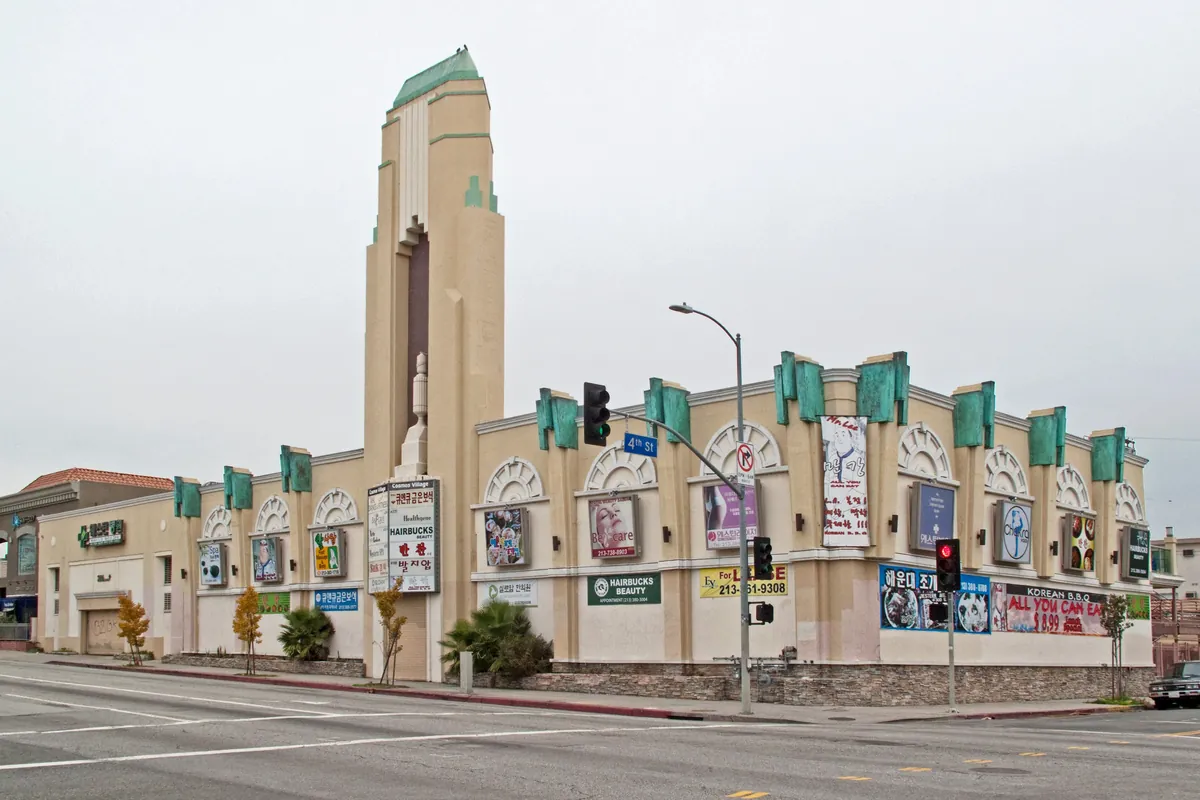
Photo at the top of the page: Wilshire Boulevard at Wilton Place in Koreatown, by Downtowngal, CC BY-SA 4.0, via Wikimedia Commons, cropped.
1031 Exchange Blog


Set up your Los Angeles 1031 exchange
Call Now For A Free Consultation · (424) 469-8111