Understanding The 1031 Exchange Depreciation Recapture
Quick answer
A 1031 exchange defers depreciation recapture rather than erasing it. The depreciation you claimed on the property you sold carries forward and reduces the basis of the replacement property, so the recapture is paid later, when a property is finally sold outside an exchange.
A 1031 exchange is a real estate investing strategy which involves exchanging ownership of a property for suitable replacement properties while deferring capital gains tax and depreciation recapture on the sale.
Depreciation recapture comes into play when you are selling an asset (most likely a property) that you have previously deducted taxes on. The government wants to make sure that you don’t get a tax benefit by deducting the full cost of an asset’s depreciation and then selling it for a profit without paying taxes on the deducted amount. However, depreciation recapture taxes can be deferred with a 1031 exchange.
At Universal Pacific 1031 Exchange, our licensed CPA professionals have handled 1031 exchanges for more than 35 years. We have guided real estate investors through the depreciation recapture rules on every property type, from rental property to commercial property. You can contact us today for a free case evaluation.
In this article, we’ll discuss everything you need to know about 1031 exchanges and depreciation recapture so that you can successfully defer paying any capital gains taxes or depreciation recapture when exchanging your property.
How Depreciation Recapture Works in a 1031 Exchange

Depreciation recapture is the part of your gain that comes from prior depreciation deductions. When you sell an investment property outright, the IRS taxes that portion first, before regular capital gains. A 1031 exchange changes the timing. If you reinvest into a like-kind replacement property of equal or greater value, both the capital gains and the depreciation recapture are deferred. In short, the taxpayer defers capital gains and depreciation recapture until a future sale.
Deferral is not forgiveness. The recapture does not disappear. It carries over to the replacement property and waits until you eventually sell without another exchange. What triggers recognition is cashing out, receiving boot, or buying down in value. Any cash you pull out becomes a recognized gain in that tax year. What preserves deferral is a fully reinvested exchange that is structured correctly.
Consider two investors who each own a rental property with $200,000 of prior depreciation. The first sells outright and pays the recapture tax now. The second rolls the gain into a like-kind replacement property through a 1031 exchange and keeps that money working. The IRS shows how recapture is figured in an exchange in its Form 8824 instructions. In one example, $35,000 of prior depreciation becomes $35,000 of ordinary-income recapture.
Section 1245 Depreciation Recapture Explained
The tax code splits recapture by asset type. IRC Section 1250 covers real property, such as buildings, and its recaptured depreciation is called unrecaptured Section 1250 gain. Section 1245 covers personal property and certain improvements, like equipment, fixtures, and assets pulled out through a cost segregation study.
The difference matters because the rates differ. Section 1245 property is recaptured as ordinary income, which can reach the top ordinary rate. Section 1250 real property is taxed at a lower maximum rate, covered below. Recaptured depreciation adds to your taxable income in the year of an outright sale. In a 1031 exchange of real property, both types of recapture can be deferred. The split still affects what you would owe if you sold outright.
Lower Depreciation Basis on Replacement Property
When you acquire a replacement property in a 1031 exchange, its tax basis is adjusted to reflect the accumulated depreciation from the relinquished property. This means that the replacement property will have a lower depreciation basis and you will not be able to deduct as much from the property compared to having acquired it directly without a 1031 exchange.
Calculating Depreciation After a 1031 Exchange
After the exchange, your depreciation does not simply start over. The IRS splits your replacement property basis into two parts under the depreciation carryover rules. Under Treasury rules, the exchanged basis keeps its old schedule, and any excess basis starts a new one.
The first part is the carryover basis, equal to the adjusted basis of the relinquished property. It keeps depreciating on the original schedule, over the time that remains. The second part is any extra cash you invest above the old property’s value. That excess basis is treated as new property and depreciates on a fresh schedule.
Residential rental property depreciates over 27.5 years. Commercial and other nonresidential real property depreciates over 39 years. Knowing which schedule applies helps you plan your future deductions and your eventual tax bill.
Step-by-Step Depreciation Basis Calculation
Follow these steps to estimate your basis on the replacement property.
1. Start with the original purchase price of the relinquished property, plus any improvements.
2. Subtract your prior depreciation deductions to find the adjusted basis.
3. Add any additional cash you invest above the relinquished property’s value.
4. The result is your carryover basis on the replacement property.
The table below shows a simple example of how the numbers flow.
| Item | Amount |
|---|---|
| Original purchase price (relinquished) | $1,000,000 |
| Prior depreciation deductions | $200,000 |
| Adjusted basis at exchange | $800,000 |
| Carryover basis on replacement (keeps the original schedule) | $800,000 |
| Extra cash invested in replacement (excess basis, new schedule) | $150,000 |
| Total basis on the replacement property | $950,000 |
Calculation of Depreciation Recapture

Two figures drive the math. Your adjusted basis is the original purchase price plus improvements, minus your prior depreciation deductions. Your recapture is the depreciation you claimed, up to the amount of your gain when the property is sold.
Here is the sequence in plain terms.
1. Find the adjusted basis. Take the original cost, add capital improvements, then subtract prior depreciation deductions and any casualty adjustments.
2. Add up the total depreciation deductions claimed over the years. This is the cumulative depreciation deducted from the owner’s basis.
3. The recaptured amount is that depreciation, up to your total gain. It is taxed first, before the rest of the gain.
Understanding the recaptured amount and its impact on taxable gain

The resulting amount from the formula represents the depreciation recapture, which is the portion of the accumulated depreciation that will be subject to taxation upon the sale or disposition of the property. If the calculation process still seems a bit confusing, here’s an example:
Suppose you purchased a property for $1,000,000 and claimed $200,000 in depreciation deductions over the years. With no capital improvements, your adjusted basis is the original cost minus that depreciation, so $800,000. If you sell for $1,100,000, your total realized gain is $300,000. Of that gain, $200,000 is depreciation recapture, and the remaining $100,000 is capital gain. This tax deferral lets you defer taxes on both parts as the property value grows. A 1031 exchange can defer both.
Tax Implications of Depreciation Recapture
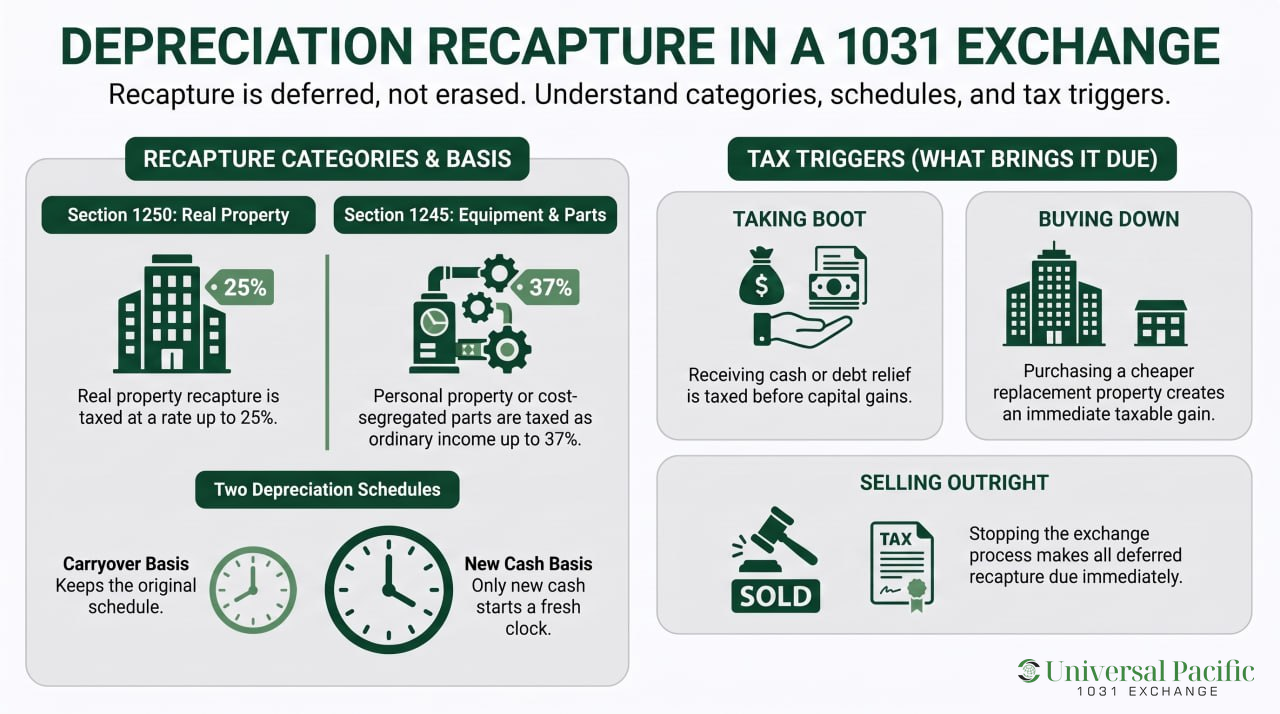
The rate depends on the type of property. For real estate held longer than a year, the recaptured depreciation is unrecaptured Section 1250 gain.The IRS taxes it at a maximum rate of 25%. For Section 1245 property, such as equipment or cost-segregated components, the recapture is taxed at ordinary-income rates, currently up to 37%.
These figures explain why it could be so beneficial to defer these taxes by using a 1031 exchange. In fact, the most popular method of deferring depreciation recapture tax is through 1031 exchanges.
If you or anyone you know is looking to do a 1031 exchange, you can contact us at Universal Pacific 1031 Exchange. Our team of experienced professionals is ready to assist and guide you every step of the way.
Common Issues and Considerations with Depreciation Recapture in 1031 Exchanges
Depreciation recapture is one of the key considerations in any 1031 exchange. The strategy defers the tax, but a few situations can still trigger it. The most common is buying a replacement property of lower value. If the new property costs less, or carries less debt, the shortfall is treated as taxable gain. To keep full deferral, the total value and the fair market value of the replacement must match or beat the old property. Recapture is taxed before capital gains, so a partial exchange often triggers recapture first.
The table below compares the main rates so you can see what is at stake. These are federal figures, and your state may add its own tax.
| Tax Type | Typical Rate | When It Applies |
|---|---|---|
| Unrecaptured Section 1250 gain | Up to 25% | Depreciation recaptured on real property held over a year |
| Section 1245 recapture | Ordinary income, up to 37% | Depreciation or expensing recaptured on non-real-property assets |
| Long-term capital gains | 0%, 15%, or 20% | Gain above depreciation, asset held over a year |
| Short-term gains | Ordinary income, up to 37% | Asset held one year or less |
Impact of Boot on Depreciation Recapture
Boot is any non-like-kind value you receive in an exchange, such as cash or debt relief. When you receive boot, the IRS taxes it, and recapture is recognized before capital gain. So if you take $50,000 in cash out of an exchange, that boot can be taxed as depreciation recapture first. To keep full deferral, reinvest all the net proceeds and match or exceed your old debt. A partial exchange keeps part of the deferral but exposes the boot to tax.
Reporting Depreciation Recapture
Before we get into the steps of reporting depreciation recapture, it’s important to note that it is required by law to report all recaptured depreciation to the IRS.
Steps To Take

Follow these steps to report depreciation recapture correctly.
Report the Sale on IRS Form 4797: Start by reporting the sale or disposition of the property on IRS Form 4797, “Sales of Business Property.” This form is used to report the depreciation recapture and capital gains or losses from the sale of rental property.
Gather property information: Collect all relevant information about the property, including the original cost, date of acquisition, date of sale, and the amount of accumulated depreciation claimed over the years.
Determine the adjusted basis: Calculate the adjusted basis of the property, which is the original cost plus any improvements or adjustments, minus any previous depreciation deductions. This adjusted cost basis will be used to determine the depreciation recapture amount.
Calculate depreciation recapture, equal to the depreciation claimed, up to your total gain
Consult IRS publications: Refer to IRS publications, specifically Publication 946, “How to Depreciate Property,” and Publication 544, “Sales and Other Dispositions of Assets,” for detailed instructions and examples on reporting depreciation recapture.
Keep supporting documentation: Maintain accurate records and documentation to support your depreciation recapture calculations. This includes records of the original cost of the property, improvements made, depreciation deductions claimed, and any adjustments or relevant transactions related to the property.
Consult atax advisor or professional: Given the complexity of depreciation recapture and tax reporting, it’s advisable to consult a tax professional or accountant who can guide you through the process, ensure compliance with IRS regulations, and help you accurately report depreciation recapture.
If you complete a 1031 exchange, you also report it to the IRS on Form 8824, which tracks the deferred gain.
Other Exceptions and Exemptions to Depreciation Recapture

There are other exceptions and exemptions to depreciation recapture that can provide tax relief in certain situations.
One exemption is Section 179 expensing and bonus depreciation that let businesses deduct the full cost of qualifying assets upfront, or take accelerated depreciation. These deductions increase your write-off in the year of purchase, but they also increase the recapture you may owe on a later sale. The 2025 One Big Beautiful Bill restored 100% bonus depreciation for qualified property acquired after January 19, 2025.
The primary residence exclusion under Section 121 can also help. If you convert a rental into your primary home and meet the ownership and use tests, you may exclude part of the gain. Even then, prior depreciation is still recaptured. Holding a property until death can give heirs a stepped-up basis, which can wipe out the deferred recapture. Note that the Qualified Small Business Stock exemption applies to stock, not to real estate, so it does not shelter real property recapture.
Specific eligibility rules and limits apply to each of these, so consult a tax professional to see what fits your situation.
Planning Strategies to Manage Depreciation Recapture
Proactive tax planning is crucial when it comes to managing depreciation recapture. If you are considering a 1031 exchange, it’s important to engage in comprehensive tax planning to minimize the impact of depreciation recapture tax.
One effective strategy is to utilize cost segregation studies, which involve identifying and classifying various components of a property to accelerate depreciation deductions. This allows for more accurate tracking of depreciation and can potentially reduce the amount subject to recapture.
However, it’s essential to balance the short-term benefits of increased depreciation deductions with the long-term tax implications. As Michael Bergman, CPA, president of Universal Pacific 1031 Exchange, puts it, “the recapture never vanishes, it just moves to the next property. Investors who plan for that, instead of ignoring it, keep far more of their money.”
Evaluating the potential recapture tax liability upon the eventual sale of the property is important to ensure the overall tax strategy aligns with your financial goals. By carefully planning and considering these factors, you can effectively manage depreciation recapture and optimize your tax outcomes.
Professional Guidance for Depreciation Recapture
Qualified intermediaries play a vital role in facilitating 1031 exchanges and can provide guidance on the specific rules and requirements related to depreciation recapture. They can help structure the exchange transaction and ensure that the necessary documentation and forms are properly prepared.
Additionally, tax advisors who specialize in 1031 exchanges can provide valuable insights and strategies to manage depreciation recapture effectively. When selecting professionals, it is important to identify reputable individuals or firms with experience in 1031 exchanges, a strong understanding of tax laws, and a track record of providing reliable guidance. Consulting with professionals at Universal Pacific 1031 exchange is highly recommended for personalized guidance and planning when it comes to depreciation recapture.
Should You Defer Depreciation Recapture with a 1031 Exchange?
Depreciation recapture is a significant consideration when engaging in a 1031 exchange. While this strategy allows for the deferral of capital gains tax and depreciation recapture, it is important to understand the implications and plan accordingly. Proper planning, including the use of cost segregation studies and evaluating long-term tax implications, can help minimize the impact of recaptured depreciation.
Seeking professional guidance from tax and legal professionals, is highly recommended. These experts can provide valuable insights, ensure compliance with IRS regulations, and help structure successful 1031 exchanges with minimal tax implications.
For more than 35 years, Universal Pacific 1031 Exchange has helped real estate investors complete successful 1031 exchanges. Our experienced team guides clients through every step of the process while helping them meet IRS requirements and important deadlines. Call us today to start an exchange.
Frequently Asked Questions
These are common questions about depreciation recapture and 1031 exchange.
Can You Avoid Depreciation Recapture with a 1031 Exchange?
A 1031 exchange defers depreciation recapture, it does not erase it. The recapture carries over to the replacement property. You keep deferring as long as you keep exchanging, and heirs may avoid it entirely through a stepped-up basis at death.
How Does Depreciation Work After a 1031 Exchange?
Your basis splits in two. The carryover basis keeps depreciating on the relinquished property’s original schedule. Any extra cash you invest is treated as new property and depreciates on a fresh 27.5-year or 39-year schedule.
What Is the 2-Year Rule for a 1031 Exchange?
The main 2-year rule applies to related-party exchanges under Section 1031(f). If you exchange with a related party, both sides must hold the property for at least two years. Selling sooner can disqualify the exchange and trigger the deferred tax.
How Do You Avoid Paying Back Depreciation Recapture?
You defer it by reinvesting through a 1031 exchange into a like-kind property of equal or greater value. Reinvest all the net proceeds and avoid boot. Holding until death can pass the property to heirs with a stepped-up basis.
Does a 1031 Exchange Avoid Depreciation Recapture?
It defers the recapture rather than avoiding it. As long as you keep exchanging and never cash out, you never pay it. The moment you sell without an exchange, the deferred recapture becomes due.
This page was reviewed by Michael Bergman, CPA, California CPA #56113. Verify license.
Disclaimer: This article is for general informational purposes only and is not tax or legal advice. Depreciation recapture and 1031 exchange rules are complex, and their application depends on your specific facts. Tax laws and rates change, and each situation is different. Consult a qualified intermediary and a licensed tax professional before acting.
Editorial Policy
All articles are reviewed for accuracy by licensed tax professionals and sourced from official government publications. Read our Editorial Policy →
About The Author
 Michael Bergman is a California licensed CPA and Real Estate Broker with over 35+ years of CPA-supervised 1031 exchange experience in commercial real estate. Specializing in 1031 tax-deferred exchanges and financial oversight, his expertise covers complex real estate transactions. Michael’s unique blend of financial acumen and real estate knowledge positions him as a trusted advisor in the industry, offering sound advice and strategic insights for successful property management and investment.