

Qualified Intermediary for 1031 Exchanges in Houston
In a Houston 1031 exchange, a qualified intermediary takes the sale proceeds from the title company and pays them out for the replacement, which keeps the money away from you and the tax deferred. Most Houston renters live in apartment buildings, and this page covers what that brings into an exchange: appliances and furniture that the exchange does not cover and that can be taxed, tenant deposits and prorated rent on the closing statement, Texas flood notices, and a 30-day wait for new flood insurance when no loan closes.
Houston’s massive and diverse real estate market — spanning energy sector commercial properties, suburban multifamily developments, and medical district investments — makes it an active market for 1031 exchanges. With no state income tax in Texas, investors strategically use 1031 exchanges to defer federal capital gains while repositioning assets across the Houston metro.
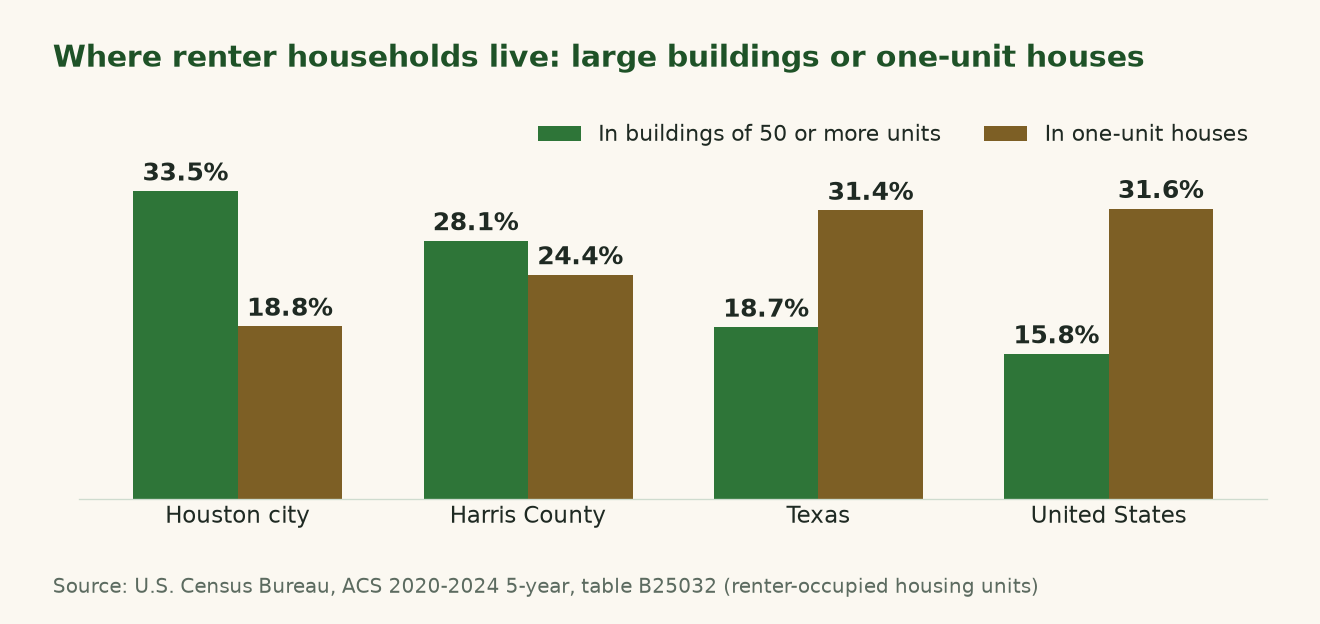
Seven in ten Houston renter households live in buildings with five or more units, according to the Census figures on this page. The sections below follow that market: rental and apartment owners trading up, combining properties or buying into larger buildings, and the Harris County, flood and closing details that come with each step.
Reviewed by Michael Bergman, CPA
Last updated 9 November 2026 · Sources for this page


Welcome to Universal Pacific 1031 Exchange! Our deep knowledge of Texas real estate transactions and tax-deferred exchange strategies positions us to handle the intermediary side of every stage of a Houston 1031 exchange.
With a professional history managing transactions ranging in price from $100,000 to over $100M, our company combines genuine business acumen, real estate insight, and financial literacy.
Houston Rents More Than It Owns, and Mostly in Large Buildings
Houston is a city of renters. In the Census Bureau's 2020-2024 survey, 57.9% of the city's occupied homes were rented, against 37.4% across Texas. Most of those renters live in apartment buildings rather than rented houses. Each row of the table pairs a figure with what it changes when a Houston owner exchanges.
| Figure | Why it matters when you exchange | Source |
|---|---|---|
| 57.9% of occupied homes are rented (Texas 37.4%, United States 34.8%) | Much of the investment property in the city is rental housing, which can be exchanged for any other U.S. real estate held for business or investment | Census ACS 2020-2024, table B25003 |
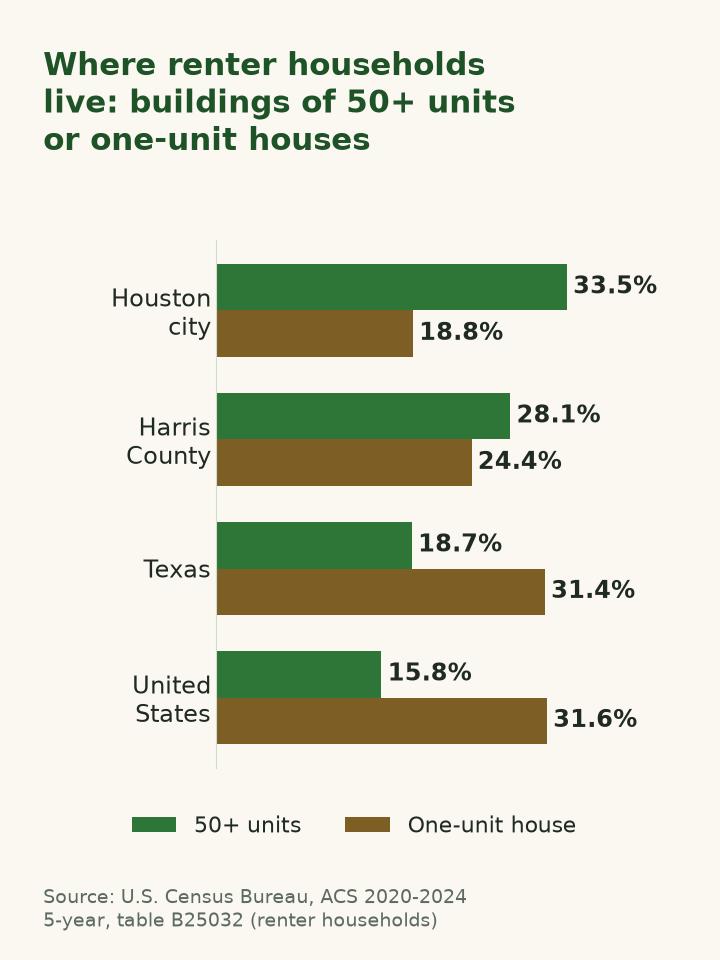
| 69.6% of renter households live in buildings with 5 or more units; 18.8% rent a one-unit house (Texas 51.3% and 31.4%) | Apartment sales and purchases usually include appliances, furniture or laundry equipment. They are not real estate, so their value falls outside the exchange and can produce taxable gain | ACS B25032; 26 U.S.C. 1031(a)(1) and (b); Treas. Reg. 1.1031(k)-1(g)(7)(iii) |
| 33.5% of renter households live in buildings of 50 or more units (Harris County 28.1%, Texas 18.7%) | Large complexes are often owned by groups. A direct co-ownership share can be replacement property; a partnership interest cannot | ACS B25032; Treas. Reg. 1.1031(a)-3(a)(5) |
| 27.4% of renter households in buildings of 5 or more units live in buildings put up between 1960 and 1979 (Texas 19.2%) | Older buildings often need work after a purchase, and work in a floodplain needs a City permit | ACS B25127; Houston Floodplain Management Office |
| Rental vacancy rate 10.0% (Texas 7.7%, United States 5.5%) | Vacant units appear in the rent roll you take over; the occupied ones come with Texas landlord duties for deposits and flood notices | ACS B25004, B25032; Texas Property Code ch. 92 |
| City-wide zoning: none | Recorded deed restrictions, not zoning, often decide what a lot can be used for | City of Houston zoning letter, January 2026 |
| Atlantic hurricane season: 1 June to 30 November | For a sale that closes between January and May, the 180-day exchange period ends during the season, and new flood insurance bought without a loan takes 30 days to start | NOAA National Hurricane Center; 44 CFR 61.11 |
On this page:
Houston 1031 Exchange Intermediary Services for Apartment, Office and Rental Owners
Whether you’re considering a Delayed, Simultaneous, Reverse, or Improvement Exchange, we offer dedicated support tailored to your unique investment needs. Our 1031 exchange process ensures secure handling of your funds, alignment with applicable IRS requirements, and strategic optimization of your tax benefits. Navigate your real estate transactions with the confidence that comes from partnering with an industry expert who puts your interests at the forefront of every exchange.
Our 1031 Exchange Intermediary Services Include:
Delayed exchange: the usual structure for Houston sellers
Houston’s large inventory and active transaction volume make delayed exchanges the most common structure for local investors. After selling your relinquished property, you have 45 days to identify replacement properties and 180 days to close. We coordinate with Houston-area title companies and work within Texas’s attorney-optional closing process to keep your exchange on schedule.

Simultaneous exchange: two closings, one date, funds moved between them
A simultaneous exchange in Houston involves closing on both properties the same day. Given the metro’s size and the number of active deals, timing coordination is essential. We prepare exchange agreements in advance and manage the fund flow between closings so the transaction qualifies under Section 1031 without delay.
Reverse exchange: secure a high-demand Houston property before you sell
Houston’s dynamic market means replacement properties — especially in high-demand areas like the Energy Corridor, Montrose, or The Woodlands — can require immediate action. A reverse exchange lets you secure the replacement property first. An Exchange Accommodation Titleholder holds the new asset while you sell the relinquished property within 180 days.
Improvement exchange: renovate a Midtown strip or build out in Katy
Houston investors often use improvement exchanges to renovate or develop replacement properties. Whether you are upgrading an older retail strip in Midtown or building out a commercial space in Katy, we track construction timelines, draw schedules, and documentation against IRS requirements. Only the work finished by the time the property is deeded to you, no later than day 180, counts toward the value you exchange into.
Why Houston Investors Choose Universal Pacific as Their 1031 Exchange Company
Transparent and Reliable
As your 1031 Exchange Company, we prioritize clear, open communication and reliability. We keep you updated throughout the exchange process and work to keep every transaction within IRS regulations. We have in place internal controls to protect your funds against potential fraud or theft.
Tailor-Made Solutions
No two clients or transactions are alike. Recognizing this, we offer customized solutions to align with your unique needs and objectives. Our role goes beyond standard Qualified Intermediary functions, providing end-to-end guidance to ensure each transaction is properly structured.
Secure and Insured
We keep your funds safe in an Exchange Trust. Furthermore, our operations are underpinned by a comprehensive Errors & Omissions (E&O) insurance policy.
A Commitment to Satisfaction
Your satisfaction is our benchmark for success. At Universal Pacific 1031 Exchange, we take our fiduciary duties seriously and strive to exceed your expectations with every transaction.
At Universal Pacific 1031 Exchange, we do more than handle 1031 transactions – we leverage decades of industry expertise to guide you through a process that’s as seamless as it is successful. Reach out today and discover the benefits of partnering with us.

Discover the benefits of a seamless 1031 exchange with our experienced team at Universal Pacific. Don’t let tax complications hinder your property investment decisions. Connect with us today for a complimentary, no-obligation 1031 exchange consultation. Let us help you navigate the complexities and unlock new opportunities. Secure your financial future – your journey to tax-efficient investing starts here.
Start an ExchangeEight Steps of a 1031 Exchange in Houston, From Sale Contract to New Deed

The exchanger signs a contract to sell a relinquished property to the buyer.

Universal Pacific 1031 Exchange and the exchanger enter into an exchange agreement to retain Universal Pacific 1031 Exchange as the Qualified Intermediary and the exchanger then assigns the exchanger’s rights in the sale contract to Universal Pacific 1031 Exchange.

At the closing of the relinquished property the exchange funds are wired to Universal Pacific 1031 Exchange who then instructs the settlement officer to transfer the deed directly from the exchanger to the buyer.

The exchanger must identify possible replacement properties in writing to Universal Pacific 1031 Exchange within the 45-day identification period.

The exchanger has a maximum of 180 days in the exchange period (or until the tax filing deadline, including extensions, for the year of the sale of the relinquished property, if that comes first), to acquire all replacement property.

The exchanger signs a contract to purchase the replacement property with the seller and the exchanger assigns the exchanger’s rights in the purchase contract to Universal Pacific 1031 Exchange.

At the closing of the replacement property, Universal Pacific 1031 Exchange wires the exchange funds to complete the exchange and Universal Pacific 1031 Exchange instructs the settlement officer to transfer the deed directly from the seller to the exchanger.

Congratulations!
Your 1031 exchange is complete!
Houston and Harris County Details for Your 1031 Exchange
What a Houston seller defers: the federal tax
A Houston sale adds nothing to a Texas tax return. In a 1996 letter kept in its tax research database, the Texas Comptroller wrote that "wages, interest, dividends, capital gains, and other sources of income received by an individual are not subject to any Texas state or local income tax" (Comptroller letter 9610803L). The tax a Houston exchange puts off is therefore federal: capital gains tax on the rise in value, plus the tax on depreciation you claimed on the building, which the IRS calls unrecaptured section 1250 gain and taxes at a rate of up to 25% (IRS Topic 409). The federal rates for a Texas sale are set out in our Texas capital gains guide.
Office buildings and apartments: like-kind, and the furniture that is not
Commercial and multifamily property can be exchanged for each other. The IRS gives the example that "an apartment building would generally be like-kind to another apartment building" (IRS like-kind exchange tax tips). The match does not have to be that close: like-kind refers to "the nature or character of the property and not to its grade or quality" (Treas. Reg. 1.1031(a)-1(b)), so an office condominium in ZIP 77002 can generally be exchanged for a fourplex or a warehouse. For exchanges after 2017, though, Section 1031 covers real property only.
That matters in Houston office and apartment deals, which often include furniture, appliances or laundry machines. Under Treas. Reg. 1.1031(k)-1(g)(7)(iii), such items do not upset the intermediary arrangement if they normally come with that kind of property and are worth no more than 15% of the replacement real estate. They are still taxable: in the regulation's own example, an investor who buys an office building with $100,000 of furniture is taxed on $100,000 of gain as boot. Ask for the personal property to be priced on its own line in the purchase contract, so you and your CPA know the number.
Recording the deeds with the Harris County Clerk
About 98% of Houston's residents live in the Harris County part of the city; small parts of Houston lie in Fort Bend and Montgomery counties (Census Bureau 2025 population estimates). The Harris County Clerk's Real Property Department records documents for real estate in Harris County, and ZIP 77002 lies wholly inside the county (Census ZIP-to-county file). Harris County's recording fee is $25 for a one-page deed, plus $4 for every extra page. Each deed needs a mailing address for every grantee, in the deed itself or in a signed page attached to it, or a penalty fee applies: $25 or twice the recording fee, whichever is greater (Texas Property Code 11.003, quoted on the Clerk's real property page).
A delayed exchange normally adds no deed, because the deed runs from you to your buyer. Reverse and improvement exchanges are different. The exchange accommodation titleholder has to hold "qualified indicia of ownership" of the parked property, usually legal title (Rev. Proc. 2000-37). So the deed to the titleholder and its later deed to you are separate documents, each with its own fee and grantee address, and the titleholder appears as owner in the Harris County records while it holds the property.
The Clerk also runs a free Property Alert System that emails you when a real property document is recorded under a name you register (Harris County Clerk). Registering your own name and your LLC's means you see the deed that brings the property back to you once it is on record. The Clerk notes that alerts match names only and do not stop a document from being recorded.
No city zoning: read the recorded deed restrictions instead
Houston has no city-wide zoning. The City's official zoning letter for 2026 says that "the City of Houston does not have a city-wide comprehensive zoning ordinance" and names the exceptions: land-use and height rules around Bush Intercontinental, Hobby and Ellington airports, and zoning inside Tax Increment Reinvestment Zone No. 1, St. George Place (City of Houston zoning letter). The same letter adds that it "does not address any separately filed restrictions."
Those separately filed deed restrictions do much of the work zoning does elsewhere. Under Chapter 212 of the Texas Local Government Code and Chapter 10 of its own code, the City can sue to enforce subdivision restrictions that limit how property is used, how far buildings sit from lot lines, lot size, and the size, type and number of structures on a lot (City Attorney, deed restrictions). Before you name a Houston lot or house for an improvement exchange, ask the title company for copies of the recorded restrictions. A plan to add units or change the use is easier to drop before day 45, while the identification list can still change.
Searching Harris County 1031 exchange properties for sale
We are not a real estate brokerage, and we have no listings to offer or recommend. You find the replacement yourself, through a broker or directly, whether it is in Houston, elsewhere in Harris County or in another state. What counts for the exchange is the written list you send us within 45 days of your sale: only property on that list, or property you have already received by day 45, can complete it (Treas. Reg. 1.1031(k)-1(c)). For an apartment building, naming the building also covers the furniture and laundry machines sold with it, as long as they are worth no more than 15% of the building. Our page on identification rules explains how many properties you can name.
This section is general information, not tax or legal advice. Check the numbers for your own sale with your CPA or attorney.
Selling or Buying a Houston Apartment Building in an Exchange
The furniture rule in the Harris County section is one of three things that set an apartment exchange apart from trading one house for another. The other two are the depreciation study many owners commissioned on the building they are selling, and the rent and deposits that change hands at closing.
A cost segregation study on the building you sell
Owners of larger Houston complexes may have a cost segregation study, which splits a building into parts depreciated over shorter lives. That split does not decide what can be exchanged. The 2020 regulations define real property for section 1031 on their own terms, listing walls, wiring, plumbing, central air conditioning and heating and other structural components as real property. They also state that "no inference is intended" for depreciation or for sections 1245 and 1250 (Treas. Reg. 1.1031(a)-3(a)(2)(iii) and (a)(7)).
The same paragraph warns that part of a building can be section 1245 property for depreciation even though it is real property for the exchange, and the seller then follows the section 1245 gain rules. Under 26 U.S.C. 1245(b)(4), the section 1245 gain taxed in an exchange is capped at the gain you recognize plus the value of any property you receive that is not section 1245 property. So the cap can be high when the replacement is mostly land and building shell, and low when it carries short-life components of its own. Give the study to your CPA before you choose the replacement, because it can change which building makes sense. Our guide to 1031 exchange depreciation recapture works through the numbers.
Rent, deposits and the closing statement
An apartment closing moves money that is not part of the price. Texas law makes the buyer liable for the tenants' security deposits from the day title passes, and the seller stays liable for them until the buyer has received the deposits or assumed the liability for them, unless a written contract between the two says otherwise (Texas Property Code 92.105).
For the exchange, Treas. Reg. 1.1031(k)-1(g)(7) lists items that can pass without upsetting the intermediary arrangement: things a seller receives that are not part of the amount realized, such as prorated rents, and closing items that local closing statements charge to a buyer or seller, such as commissions, prorated taxes, recording or transfer taxes, and title company fees. Security deposits are not named in that list. Whether a deposit credit counts as cash to you is a question for your CPA before the closing statement is final.
Taking over the leases
When you buy a Houston building with tenants in place, the same statute requires you, as the new owner, to give each tenant a signed statement saying that you have acquired the property and are responsible for the deposit, with its exact dollar amount (Texas Property Code 92.105(b)). Ask the seller for a deposit ledger by unit before closing, so your statements match what you were credited. New leases you sign also need the flood notice described in the next section.
Selling a Houston complex that had a cost segregation study? Get the study and your depreciation schedule to your CPA early, so the replacement can be planned around them, and we will set the exchange timeline to match. Start an exchange.
Floodplains and Flood Insurance in a Houston 1031 Exchange
A floodplain location does not change what can be exchanged. It does add a notice on each side of a Houston exchange, and a waiting period that can catch a buyer paying with exchange funds and no loan.
Selling a Houston house: the flood questions on the seller's notice
A Texas seller of residential property with no more than one dwelling unit has to give the buyer a written notice of the property's condition (Texas Property Code 5.008). Its flood questions ask whether the seller knows of present flood insurance, of past flooding from a reservoir breach or release, or of water entering a structure in a natural flood, whether the seller has ever filed a flood-damage claim with an insurer or the National Flood Insurance Program, and whether the property lies wholly or partly in a 100-year floodplain, a 500-year floodplain, a floodway, a flood pool or a reservoir. The notice is due on or before the date the contract binds the buyer. Section 5.008(e) lists the transfers that are exempt, such as foreclosures, sales by an estate's fiduciary, transfers between co-owners and sales of new homes nobody has lived in. Being a rental, or the first half of an exchange, is not one of them. A duplex or fourplex is outside the section, because it has more than one dwelling unit.
Leasing the replacement: the landlord's flood notice
Since 1 January 2022, a Texas landlord has had to give each tenant a written notice saying whether the landlord is aware that the dwelling is in a 100-year floodplain. If neither box is checked, the notice tells the tenant to assume that it is. A second notice is required when the landlord knows that flooding damaged the dwelling at least once in the five years before the lease begins. The notices go in the lease, in an addendum or in a separate document that both sides sign at or before signing the lease; leases shorter than 30 days are exempt. If a landlord skips them and a tenant's belongings suffer substantial flood damage, meaning repairs or replacement costing 50% or more of their market value, the tenant can end the lease (Texas Property Code 92.0135). Before you close on a Houston rental, ask the seller which flood notices the current leases carry.
Flood insurance: a 30-day wait unless a loan closes
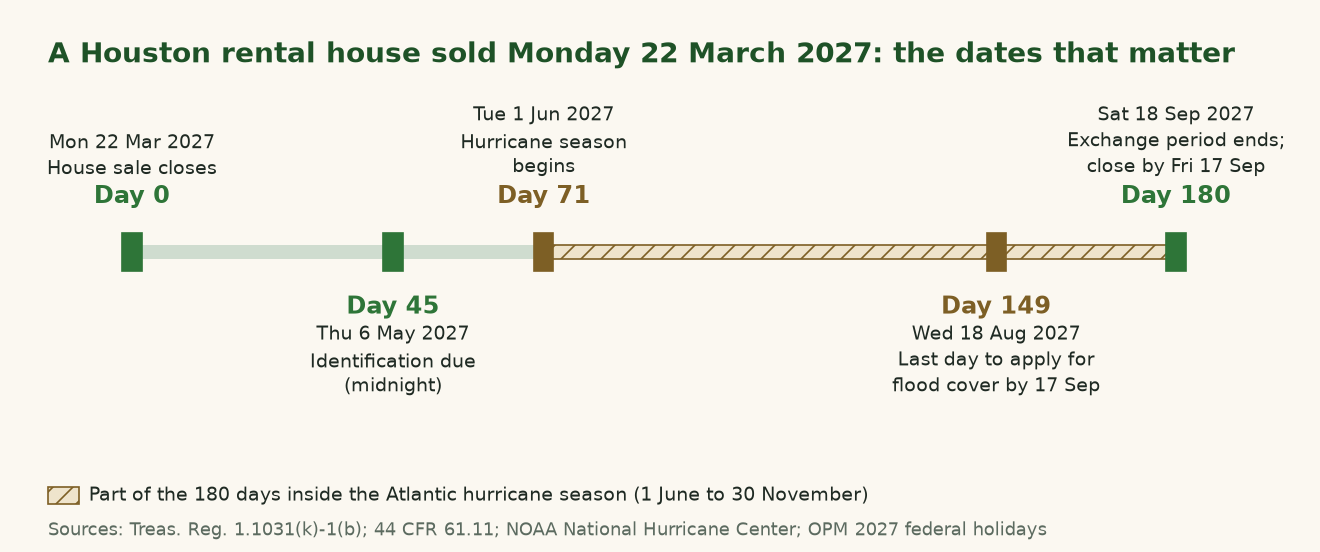
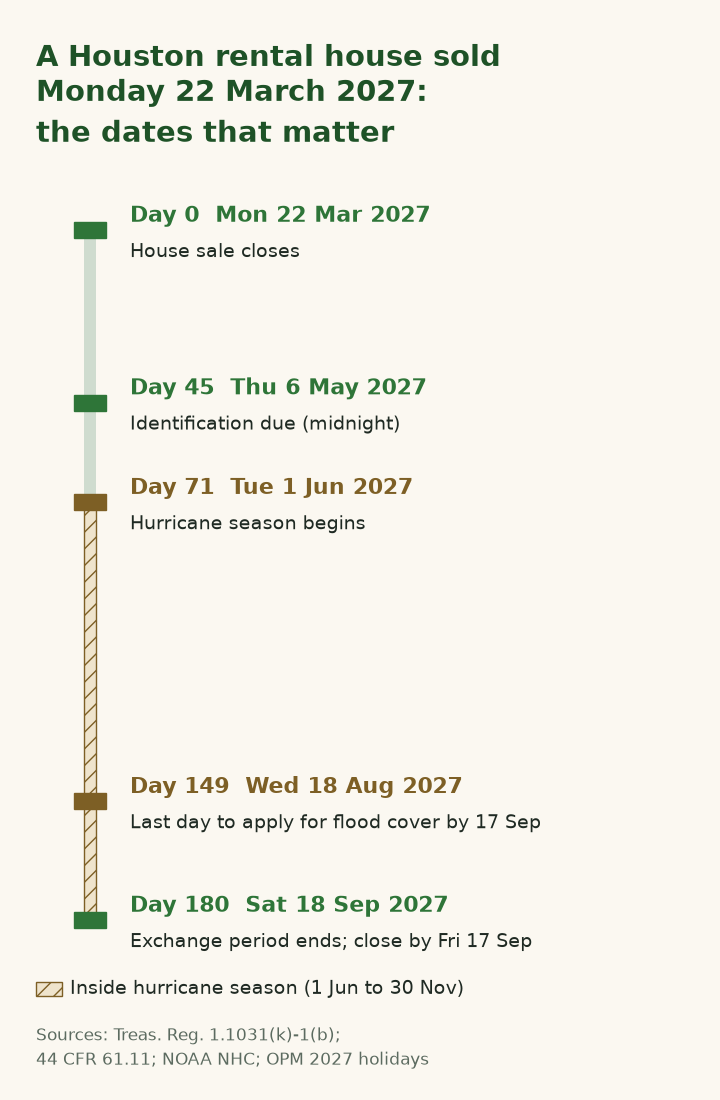
A new National Flood Insurance Program policy generally starts at 12:01 a.m. on the 30th day after you apply and pay the premium. The federal rule has two exceptions that matter here. When the policy is bought in connection with making a loan, cover starts at the loan closing, provided you apply and pay at or before it. During the 13 months after a revised flood map takes effect in your community, cover starts the day after you apply (44 CFR 61.11). A buyer who pays for the replacement with exchange funds and takes no new loan is under the 30-day rule, so apply at least 30 days before the purchase closes if you want cover from the day you take title. The other route is the seller's existing policy: the standard NFIP dwelling policy says "you may assign this policy in writing when you transfer title of your property to someone else" (44 CFR part 61, appendix A(1)), so ask whether the seller has one and will assign it at closing. These rules are for NFIP policies; a private flood policy follows its own terms. The dated example below shows where that day falls in a 180-day exchange.
Renovating in the floodplain after you buy
Houston's Floodplain Management Office issues floodplain development permits for construction in the 500-year floodplain, the 100-year floodplain and the floodway. The City requires new construction in high flood-risk areas to sit at least 2 feet above the 500-year elevation, or 3 feet for critical facilities and buildings in the floodway (Houston Floodplain Management Office). Under FEMA's definitions, work costing 50% or more of a building's market value before construction starts is a "substantial improvement" (44 CFR 59.1). Federal rules then require the community to hold a substantially improved residential building in Zones A1-30, AE and AH to the new-construction standard, with the lowest floor at or above the base flood level (44 CFR 60.3(c)(2)); Houston's own elevation rule above is stricter. For an improvement exchange on an older Houston building, get the elevation certificate and a contractor's estimate before day 45, while you can still change the list.

From a March Sale to a September Deadline: A Houston Exchange in Hurricane Season
Picture a Houston owner who sells a rental house on Monday 22 March 2027 and plans to buy a fourplex with exchange funds and no new loan. Because the sale falls early in the year, the 2027 tax return is not due until April 2028, so day 180 is the deadline that applies. Both periods end at midnight (Treas. Reg. 1.1031(k)-1(b)(2)), and the regulation does not move a deadline that lands on a weekend.
| Date | Day | What happens | What to watch |
|---|---|---|---|
| Mon 22 Mar 2027 | 0 | The house sale closes; the proceeds are wired to the intermediary | As a one-unit house, it needed the seller's notice, flood questions included, before the contract bound the buyer |
| Thu 6 May 2027 | 45 | Identification deadline (midnight) | The list can name the fourplex and two backups under the three-property rule |
| Tue 1 Jun 2027 | 71 | Atlantic hurricane season begins | The purchase will now close during the season |
| Wed 18 Aug 2027 | 149 | Last day to apply and pay for an NFIP policy that starts on Friday 17 September | With no loan, cover starts on the 30th day after the application |
| Mon 6 Sep 2027 | 168 | Labor Day, a federal holiday | Leave it out of the closing plan for the last two weeks |
| Fri 17 Sep 2027 | 179 | Last weekday before the deadline | The date to aim for when closing the fourplex purchase |
| Sat 18 Sep 2027 | 180 | Exchange period ends (midnight) | A Saturday; the regulation does not move it |
Two things set this example apart. The identification list for a late-summer purchase has to be fixed in early May, so naming backups matters more than usual. And because no loan is involved, flood cover has to be bought a month ahead or taken over from the seller by assignment; a buyer taking a new mortgage would have cover from the loan closing instead. The fourplex also brings the deposit statements owed to each tenant once the buyer takes title, and the landlord's flood notice for every new lease the buyer signs.
A weekend does not move day 180, but an IRS disaster postponement can. When IRS guidance grants relief after a federally declared disaster, section 17 of Rev. Proc. 2018-58 postpones 45-day and 180-day deadlines that fall on or after the disaster date, for property transferred on or before that date, and never past the return due date or by more than one year (26 U.S.C. 7508A(a)). Check the IRS announcement for your county before counting on it.
For a different sale date, the 1031 exchange deadline calculator counts the days for you.
These are Census figures for the city of Houston from the 2020-2024 American Community Survey, next to the U.S. figure.
Source: U.S. Census Bureau, American Community Survey 2020-2024 5-year estimates. The rent-to-value figure compares median rent with median home value; it is not a property yield. See the table for all 51 cities.
Houston 1031 Exchange Questions: Accommodators, Companies and Apartment Deals
For a delayed exchange, almost always, though the IRS does not require one by name. What the rules require is that you never receive or control the sale money before you buy the replacement. A Qualified Intermediary (QI) is one of the safe harbors that keeps the money out of your hands, next to a qualified escrow account or qualified trust (Treas. Reg. 1.1031(k)-1(g)(3) and (g)(4)). The QI holds the proceeds from your relinquished property and uses them to acquire the replacement property on your behalf. With a qualified escrow account or trust, the cash only backs up your buyer's promise to deliver the replacement property, so your Houston buyer has to agree to take that on. That is why most delayed exchanges use an intermediary. At Universal Pacific 1031 Exchange, we serve as your experienced Qualified Intermediary.
No. They do separate jobs, though both touch the money. The Houston title company runs the closing: it takes in the buyer's funds, records the deed and, following your closing instructions, wires the net proceeds out. The accommodator, which the regulations call a qualified intermediary, receives that wire and holds it under an exchange agreement that bars you from receiving, pledging or borrowing against the money until the exchange ends (Treas. Reg. 1.1031(k)-1(g)(6)). In a reverse exchange, people also use the word for the company that takes title to the parked property; that role comes up in the reverse-exchange question below.
Finding a suitable qualified intermediary (QI) for a 1031 exchange requires some research, but the search does not have to stay in Houston. Your 45-day identification can reach the intermediary by hand delivery, mail, fax or other means (Treas. Reg. 1.1031(k)-1(c)(2)), and everything else it does is paperwork and wires. The local parts stay local: a Houston title company closes the sale, and the deed is recorded in the county where the property is. Check their credentials and experience with 1031 exchanges, then get three answers in writing before your sale closes: whether the exchange agreement restricts your access to the money as Treas. Reg. 1.1031(k)-1(g)(6) requires, whether the firm is clear of the ties listed in the next answer, and whose name and what type of account the proceeds will sit in.
No. You cannot be your own qualified intermediary, and neither can a disqualified person (Treas. Reg. 1.1031(k)-1(g)(4)(iii) and (k)). That rules out anyone who, in the two years before your relinquished property transfers, has worked for you as an employee, attorney, accountant, investment banker or broker, or real estate agent or broker, along with close relatives and companies you own more than 10% of. Two exceptions keep some firms eligible: work done only on your 1031 exchanges, and routine title insurance, escrow, trust or banking services from a title company, escrow company or bank. In a Houston deal, the title company closing your sale can stay on, but the broker who listed the property cannot hold the money.
The fees charged by Qualified Intermediaries for a 1031 exchange can vary widely. The cost often depends on the complexity of the transaction. A standard delayed exchange typically costs $600 to $1,500, and a reverse or improvement exchange generally $3,000 to $7,500, since a separate company has to hold title to one of the properties. In Harris County, the titleholder's two deeds (one taking title, one passing it to you) are separate recordings, each charged the County Clerk's fee of $25 for the first page plus $4 for each additional page (Harris County Clerk fee schedule). Get the quote for your exchange type in writing before the Houston closing.
All four structures: delayed, simultaneous, reverse and improvement exchanges, as set out in the cards near the top of this page. We prepare the exchange agreement and the contract assignments, hold the sale proceeds, receive your identification list and send the funds to the purchase closing. Houston title and escrow officers who want the exchange paperwork handled end to end can use our concierge services. We don't give tax or legal advice, act as your broker or sell property.
Yes. Several relinquished properties can go into one replacement property as part of the same exchange. The deadlines do not restart with each sale, though: when the houses close on different dates, the 45-day and 180-day periods both run from the earliest sale (Treas. Reg. 1.1031(k)-1(b)(2)(iii)). Sell the houses close together, or plan the purchase around the first closing. Our page on exchanging several properties into one covers the identification side.
It can if what you buy is real estate: an undivided co-ownership share held in your own name or through a single-member LLC that is disregarded for tax (the structure Rev. Proc. 2002-22, section 6.01 describes). Co-ownership is on the regulations' list of interests that count as real property for section 1031, and interests in a partnership are on the list of those that don't (Treas. Reg. 1.1031(a)-3(a)(5)). So a share of the LLC or partnership that owns the complex is a different asset. For sponsored tenancy-in-common offerings, Rev. Proc. 2002-22 sets the conditions under which the IRS will consider a ruling, among them no more than 35 co-owners and unanimous approval for any sale or lease of the property, any negotiation or renegotiation of debt secured by a blanket lien, and the hiring of a manager. See how a tenant-in-common exchange works.
On paper, the accommodator. Rev. Proc. 2000-37 lets an exchange accommodation titleholder hold title to the parked property, with the combined holding period capped at 180 days. It also allows the titleholder to lease the property to you and lets you manage it, so the tenants, rents and repairs can stay with you in practice (Rev. Proc. 2000-37, sections 4.02 and 4.03). Spell out in that lease who signs new tenant leases while the titleholder owns the building, and who holds the deposits. More on the structure is on our reverse exchange page.
No. The like-kind test and the 45-day and 180-day deadlines are the same wherever the replacement is, and the statute draws no line at the Texas border, so a Houston sale can buy a warehouse in Arizona or a rental building in Ohio. The limit is the border: real property in the United States and real property outside it are not like-kind (26 U.S.C. 1031(h)). See 1031 exchanges and foreign property.
Yes, as long as you hold it for use in a business or for investment and not mainly to resell it (26 U.S.C. 1031(a)). A condominium unit is fee ownership, which the regulations list as real property for section 1031, so it can be exchanged for a building, land or another unit. If your own firm works out of the office, it still counts as held for use in your business.
Yes. Flood risk is a matter of condition, not of the kind of property, so a house or apartment building in a 100-year floodplain trades on the same terms as one on higher ground. Where the floodplain matters is in the paperwork and the timing: the seller's notice when you sell a one-unit house, the landlord's notice when you lease the replacement, and the 30-day wait on new flood insurance. The floodplain section above explains each one.

Real Estate, Tax and Finance Experience Behind Your Houston Qualified Intermediary
At Universal Pacific 1031 Exchange, our unique blend of extensive real estate, financial, and tax expertise sets us apart in the field of 1031 exchanges. With our commitment to personalized service, meticulous attention to detail, and decades of experience managing complex transactions, we work to give our clients a seamless, reliable exchange process.
Start an ExchangeSources: 26 U.S.C. 1031; Treas. Reg. 1.1031(k)-1; Treas. Reg. 1.1031(a)-1; Rev. Proc. 2000-37; IRS Topic 409; IRS: Like-kind exchanges, real estate tax tips; Texas Comptroller letter 9610803L; Harris County Clerk, Real Property; Harris County Clerk, Property Alert System; Texas Property Code 11.003; U.S. Census Bureau, 2025 population estimates; U.S. Census Bureau, 2020 ZIP-to-county relationship file; Treas. Reg. 1.1031(a)-3; 26 U.S.C. 1245; Rev. Proc. 2002-22; Texas Property Code 5.008; Texas Property Code chapter 92 (92.0135, 92.105); Rev. Proc. 2018-58; 44 CFR 61.11; 44 CFR part 61, appendix A(1); 44 CFR 59.1; 44 CFR 60.3; City of Houston Floodplain Management Office; City of Houston official zoning letter, January 2026; City of Houston Legal Department, deed restrictions; NOAA National Hurricane Center; U.S. Office of Personnel Management, 2027 federal holidays; U.S. Census Bureau, American Community Survey 2020-2024 5-year estimates (tables B25003, B25004, B25032, B25127).
Photo at the top of the page: Houston skyline from the Rosemont pedestrian bridge over Buffalo Bayou, by Tony Webster, CC BY-SA 2.0, via Wikimedia Commons, cropped.
1031 Exchange Blog

Set up your Houston 1031 exchange
Call Now For A Free Consultation · (424) 469-8111