
Texas Capital Gains Tax on Real Estate
Sell a rental house in Plano or a duplex in East Austin and the first question is usually the same: how big is the tax bill? The short answer for Texas is friendlier than most sellers expect. Texas does not levy a state income tax, and because a capital gain is a form of income, there is no separate Texas capital gains tax on a property sale. What you owe is federal — and only federal. That single fact changes the math compared with a sale in California or New Jersey, where a state tax stacks on top of the IRS bill.
At Universal Pacific 1031 Exchange, we help Texas investors defer the full federal capital gains bill on a property sale through a properly structured 1031 exchange. As your Qualified Intermediary in Dallas and across Texas, we handle the 45- and 180-day deadlines for you. Ready to defer? Contact us to start an exchange today.
This guide walks through how capital gains work on Texas real estate in 2026, the federal rates that apply, the quirks that come with living in a no-income-tax state (higher property taxes, no state withholding at closing), and how a 1031 exchange lets investment-property owners push the federal bill down the road.
Does Texas Have a Capital Gains Tax on Real Estate?
No. Texas is one of a handful of states with no personal income tax, and the state constitution makes it genuinely hard to add one. Since there is no state income tax, there is nothing for a capital gain to plug into at the state level. Whether you sell a primary home in Frisco, a fourplex in San Antonio, or raw acreage outside Waco, the state of Texas takes zero cut of the profit.
That does not mean the sale is tax-free. The federal government still taxes the gain, and for investment property the depreciation you claimed over the years comes back into the picture too. So the accurate way to say it: a Texas property sale owes federal capital gains tax, not Texas capital gains tax. For a lot of sellers coming from higher-tax states, that is the whole reason Texas real estate pencils out the way it does.
How Capital Gains Work on a Property Sale
A capital gain is simply what you sold for minus what you had in the property. The number that matters is your adjusted basis, not just the original purchase price. Basis starts at what you paid, goes up for capital improvements like a new roof, an addition, or a foundation repair — and, for rentals, goes down by the depreciation you deducted each year. Sell above that adjusted basis and you have a gain; sell below it and you have a loss.
How long you owned the property decides which rate applies:
• Short-term gain (held one year or less): taxed as ordinary income at your regular federal bracket, which can run up to 37%.
• Long-term gain (held more than a year): taxed at the preferential 0%, 15%, or 20% federal rates. Most real estate falls here, because investors and homeowners rarely flip inside twelve months.
Because Texas has no income tax, the short-term vs. long-term distinction only affects your federal bill; there is no parallel state calculation running alongside it the way there is in California.
The Texas Tradeoff: No Income Tax, But High Property Taxes
Texas does not give the money up for free. The state funds its public schools and local governments largely through property tax, and Texas carries one of the highest effective property-tax rates in the country, roughly 1.2% of a home’s value on average, close to the ninth-highest nationally and well above the U.S. average of about 0.9%. Once school district, county, city, and special-district levies stack up, plenty of Texas owners write a much larger annual property-tax check than a neighbor in a state that leans on income tax instead.
For a seller, that tradeoff cuts an interesting way. You paid more in property tax while you held the asset, but the exit is lighter: no state income tax on the gain when you sell. It is worth keeping the two straight. Property tax is an annual cost of ownership, and capital gains tax is a one-time event at the sale. Improving the property to lower a protest-worthy appraisal does not change your capital-gains basis unless the work is a genuine capital improvement.
The other piece of Texas color is growth. Austin, Dallas–Fort Worth, Houston, and San Antonio have seen years of strong appreciation, which is great for net worth and rough on the tax return — a bigger gain means a bigger federal capital-gains bill. An investor who bought a Round Rock rental in the mid-2010s can be sitting on a six-figure gain today, and that is exactly the situation where a 1031 exchange earns its keep.
Federal Capital Gains Rates for 2026

Long-term gains are taxed at 0%, 15%, or 20% depending on your total taxable income for the year. These are the IRS thresholds for 2026:
| Rate | Single | Married filing jointly | Head of household |
|---|---|---|---|
| 0% | Up to $49,450 | Up to $98,900 | Up to $66,200 |
| 15% | $49,451 – $545,499 | $98,901 – $613,699 | $66,201 – $579,599 |
| 20% | $545,500 and above | $613,700 and above | $579,600 and above |
A couple of things sellers miss. First, the gain itself counts toward the income that decides your bracket, so a large sale can push part of the gain from the 15% band into the 20% band. Second, these brackets are for long-term gains only. A property held a year or less is taxed at ordinary rates instead.
The 3.8% Net Investment Income Tax
On top of the base rate, higher earners owe an extra 3.8% Net Investment Income Tax (NIIT) on gains from investment property. It kicks in when your modified adjusted gross income passes $200,000 (single or head of household) or $250,000 (married filing jointly). Those thresholds are fixed and have never been indexed for inflation — so more sellers drift into NIIT territory every year, especially in a year when a big Texas sale inflates their income. In practice, a high-income investor in the 20% bracket can face an effective federal rate of 23.8% on a long-term real estate gain.
Depreciation Recapture on Rentals
If you rented the property out and took depreciation deductions, the IRS wants some of that benefit back at sale. The depreciation you claimed (or were allowed to claim) is taxed as unrecaptured Section 1250 gain at a federal rate of up to 25%, separate from and often higher than the rate on the rest of your gain. This catches a lot of long-time Texas landlords off guard: even if the market gain is modest, years of depreciation can create a meaningful recapture bill. A 1031 exchange defers this recapture along with the capital gain, which is a big part of why exchanges are so common on rental exits.
The Primary-Residence Exclusion
If the Texas property is your main home, Section 121 lets you exclude a large chunk of the gain from federal tax: up to $250,000 if you file single, or $500,000 if you are married filing jointly. To qualify, you generally need to have owned and lived in the home for at least two of the five years before the sale. Sell your Houston primary residence for a $220,000 gain as a married couple and, in most cases, you owe nothing federally, and being Texas, nothing to the state either.
The exclusion is for homes you actually live in, not rentals. If you converted a former rental into your residence, part of the gain tied to the rental period and to depreciation can still be taxable. And the exclusion does not stack with a 1031 exchange on the same slice of gain; one is for primary residences, the other for investment property.
Selling Texas Property as an Out-of-State or Foreign Owner
Here is a real Texas advantage that rarely gets mentioned: no state withholding at closing. States like California make the title or escrow company withhold a percentage of the sale price from a nonresident seller and send it to the state, money you only get back after filing a return. Texas has no state income tax, so there is no state withholding to deal with. An investor in New York or Illinois selling a Texas rental walks away from the closing table without a state clawback on the proceeds.
Two caveats. Out-of-state owners still owe federal capital gains tax and any depreciation recapture, and that part does not change with your home state. And foreign sellers are subject to FIRPTA, a federal (not Texas) rule that requires the buyer to withhold a portion of the sale price on a sale by a non-U.S. person. FIRPTA is a federal mechanism and applies to Texas property just as it does anywhere else in the country.
Texas vs. a State-Income-Tax State: A Side-by-Side
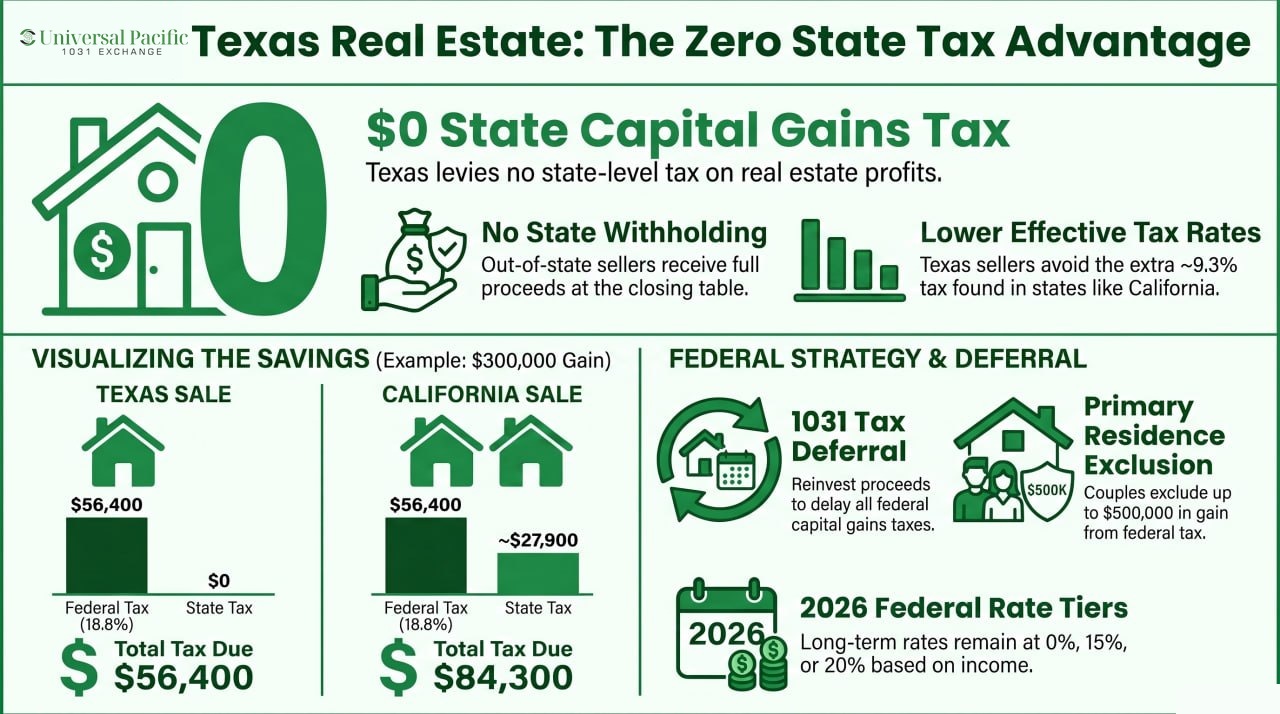
The clearest way to see what “no state capital gains tax” is worth is to run the same sale in two states. Take an investor with a $300,000 long-term gain on a rental, whose income lands them in the 15% federal bracket plus the 3.8% NIIT (an 18.8% effective federal rate). The state-tax figures below are illustrative — California taxes capital gains as ordinary income at rates up to 13.3%.
| Texas | California (for comparison) | |
|---|---|---|
| Federal capital gains (18.8%) | $56,400 | $56,400 |
| State capital gains tax | $0 | ~$27,900 (approx. 9.3%) |
| Total tax on the gain | ~$56,400 | ~$84,300 |
| Effective total rate | ~18.8% | ~28.1% |
Same property, same federal bill — the roughly $28,000 gap is entirely the state layer that Texas simply does not have. On a large commercial sale, that difference climbs into six figures, which is why so many investors either hold Texas assets or route out-of-state gains into Texas replacement property through a 1031 exchange.
How a 1031 Exchange Defers the Federal Bill

Since Texas takes nothing at the state level, the whole tax-deferral question for Texas investors is about the federal side — and that is exactly what a 1031 exchange addresses. Under Section 1031 of the tax code, when you sell an investment or business property and reinvest the proceeds into a like-kind replacement property, you can defer the federal capital gains tax and the depreciation recapture. The gain is not erased; it rolls into the new property and stays deferred until you sell without exchanging again.
“Like-kind” is broad for real estate. You can trade a San Antonio rental house for a retail strip center, or raw Hill Country land for an apartment building — as long as both are held for investment or business use. The rules are strict on timing, though: you have 45 days from the sale to identify replacement property and 180 days to close on it, and the proceeds must be held by a neutral third party the entire time. You cannot touch the money in between.
That neutral third party is a Qualified Intermediary, and that is where Universal Pacific 1031 comes in. We act as the QI on the exchange — holding the sale proceeds in a secure account, preparing the exchange documents, and keeping the transaction inside the IRS timelines so the deferral holds up. For a Texas investor sitting on a large gain from a hot market, a properly structured 1031 exchange can defer the entire federal bill and keep that capital working in the next property instead of going to the IRS. If you are weighing a sale, the earlier you loop in a QI — ideally before you close — the smoother the exchange goes.
How to Reduce or Defer Capital Gains Tax on a Texas Sale
Because Texas takes nothing at the state level, all of your tax planning on a property sale points at one target: the federal bill. A Texas seller keeps the full benefit of every strategy below, with no state tax quietly eating into it. Here are the levers that matter, roughly in order of how much they move the number.
Run a 1031 exchange (investment property)
For a rental, a commercial building, or land held for investment, a 1031 exchange is the heaviest lever there is. Roll the entire proceeds into a like-kind replacement and the federal capital gains tax and the depreciation recapture are both deferred — not reduced by a sliver, deferred in full. Like-kind is generous for real estate: a Katy rental can be swapped for a medical office, a self-storage facility, or farmland, as long as both are held for business or investment. The mechanics are unforgiving on two points, though. You have 45 days after closing to formally identify replacement property and 180 days to close on it, and you can never take possession of the cash in between. That is the job of a Qualified Intermediary — a neutral party like Universal Pacific 1031 that holds the funds, drafts the exchange paperwork, and keeps the clock honest. Miss a deadline or touch the money and the whole gain becomes taxable that year.
Use the Section 121 exclusion (your home)
If you are selling the house you actually live in, the primary-residence exclusion is often enough to erase the tax on its own: up to $250,000 of gain tax-free for a single filer, $500,000 for a married couple filing jointly. The test is ownership and use — you need to have owned and lived in the home as your main residence for at least two of the five years before the sale, and those two years do not have to be consecutive. The exclusion also resets every two years, so a couple who moves periodically can claim it more than once over a lifetime.
Spread the gain with an installment sale
If you carry the financing yourself and let the buyer pay over several years, an installment sale lets you report the gain as you receive it rather than all at once. That can keep you from spiking into the 20% long-term bracket or tripping the 3.8% NIIT threshold in a single year — a seller who would land in the 20% band on a lump sum might stay in the 15% band by collecting the money across three or four tax years. Depreciation recapture is the exception, since the IRS makes you report that portion up front, but the rest of the gain can be smoothed out.
Raise your basis before you sell
Every dollar of basis is a dollar the IRS cannot tax. Basis starts at your purchase price and climbs with genuine capital improvements — a new roof, a room addition, a foundation repair — so pull your records together before you calculate the gain. Selling costs count too: the real estate commission, title fees, and other closing expenses come off the sale price. Owners who never tracked their improvement receipts often overstate their gain and overpay, so this step alone can be worth real money.
Mind the calendar
Holding a property for more than a year is what unlocks the long-term 0%, 15%, or 20% rates instead of ordinary income rates that top out at 37%, so if you are close to the one-year mark, waiting a few extra weeks to cross it can cut the rate roughly in half. Timing also works across tax years: closing in January rather than December pushes the gain into a year you may be able to plan around, especially if you expect lower income or have capital losses to harvest against it.
Reinvest through an Opportunity Zone
For investors who realize a gain but do not want to run a full 1031, rolling it into a Qualified Opportunity Fund is a narrower alternative. Reinvesting a capital gain into a designated Opportunity Zone project defers the tax, and holding the new investment long enough can reduce or eliminate tax on the Opportunity Zone gains themselves. It is more specialized than a 1031 and worth walking through with a tax advisor, but it belongs on the list for larger gains.
How to Report a Texas Real Estate Sale on Your Taxes
Even though Texas asks nothing of you, the IRS still expects the sale on your federal return the following spring. The paperwork trail usually starts at the closing table, where the title company issues a Form 1099-S reporting the gross proceeds — and the IRS gets a copy, so the sale does not slip by unnoticed. Here is the sequence for a typical Texas seller:
1. Confirm your 1099-S. Check that the gross proceeds figure matches your closing statement before you file.
2. Calculate the gain on Form 8949. List the property, your sale price, and your adjusted basis (purchase price plus improvements plus selling costs) on Form 8949, then carry the total to Schedule D, where long-term and short-term gains are sorted and taxed.
3. Report a rental sale on Form 4797. If the property was a rental or other business-use asset, the sale generally runs through Form 4797, which is also where the depreciation recapture — that unrecaptured Section 1250 gain taxed up to 25% — gets calculated.
4. File Form 8824 for a 1031 exchange. If you deferred the gain through an exchange, Form 8824 reports the like-kind exchange and the deferred gain to the IRS for the year the sale closed.
5. Skip the state return. Here is the Texas payoff: there is no state income tax return to file on the gain, because Texas does not have one. Sellers relocating from California or New York are often surprised there is simply no state form to chase down.
A real estate sale touches several forms at once, so a CPA — or the Qualified Intermediary on a 1031 — will make sure the numbers on Form 8824 tie out to the exchange documents.
Common Mistakes Texas Sellers Make
Most of the expensive errors on a Texas sale come from the same place: assuming the state’s tax-friendliness stretches further than it does. A few show up again and again.
Thinking “no state tax” means “no tax.” This is the big one. Texas charges nothing, but the federal capital gains tax, the 3.8% NIIT for higher earners, and depreciation recapture all still apply. A seller who budgets for zero and gets a federal bill in the tens of thousands has a rough April.
Forgetting depreciation recapture on a rental. Landlords tend to remember the market gain and forget the years of depreciation they deducted. That comes back at up to 25% at sale, and on a long-held rental the recapture alone can be substantial.
Blowing the 1031 deadlines — or touching the money. The 45-day identification window and the 180-day closing window are hard cutoffs with no extensions. And if the proceeds ever land in your own bank account instead of the Qualified Intermediary’s, the exchange is dead and the full gain is taxable. Set the QI up before you close, not after.
Missing the two-of-five-year residence rule. The Section 121 exclusion requires you to have lived in the home as your main residence for two of the previous five years. Sellers who move out early, or who try to claim it on a pure rental, can lose a $250,000 or $500,000 break they assumed was automatic.
Not tracking basis and improvements. Without receipts for the new roof, the addition, or the remodel, those dollars never make it into your basis, and you end up taxed on a bigger gain than you actually earned.
Selling a few weeks too soon. Closing at eleven months instead of twelve turns a long-term gain taxed at 15% or 20% into a short-term gain taxed as ordinary income up to 37%. When you are near the one-year line, the calendar is worth real money.
Frequently Asked Questions
Does Texas have a state capital gains tax on real estate?
No. Texas has no state income tax, so there is no state-level tax on the gain from selling real estate. A Texas property sale owes federal capital gains tax only.
I live out of state and I’m selling a Texas rental. Do I owe Texas anything?
You owe no Texas state tax and there is no state withholding at closing. You do still owe federal capital gains tax and, if you depreciated the property, federal depreciation recapture — those apply regardless of where you live.
How much is capital gains tax on a home sale in Texas?
For a primary residence, the federal Section 121 exclusion often wipes out the tax entirely — up to $250,000 of gain for single filers or $500,000 for married couples. Above that, or for a property that isn’t your main home, you’ll pay the federal 0%, 15%, or 20% long-term rate (plus 3.8% NIIT for higher earners), and nothing to the state.
Does Texas’s high property tax affect my capital gains bill?
No — they are separate. Property tax is an annual cost you pay while you own the property; capital gains tax is a one-time federal event when you sell. Property taxes you paid don’t reduce your capital gain, and capital improvements (not routine repairs) are what raise your basis.
Can I avoid federal capital gains tax when I sell a Texas investment property?
You can defer it — not avoid it outright — with a 1031 exchange, by reinvesting the proceeds into like-kind replacement property within the 45-day and 180-day IRS windows. This defers both the capital gain and the depreciation recapture. A Qualified Intermediary like Universal Pacific 1031 is required to hold the funds and structure the exchange.
My Austin rental has appreciated a lot. Is that gain taxed differently?
No special rate applies to hot-market gains; the same federal long-term rates apply. The catch is size: a larger gain can push part of it into the 20% bracket and can trigger the 3.8% NIIT. That’s precisely the scenario where a 1031 exchange makes the most sense.
Do I pay capital gains tax if I sell my Texas home?
You pay no Texas capital gains tax, because Texas has no state income tax. Federally, the Section 121 exclusion often erases the tax on a primary residence — up to $250,000 of gain for single filers or $500,000 for married couples — as long as you owned and lived in the home for two of the last five years. Any gain above the exclusion, or on a second home or rental, is taxed at the federal 0%, 15%, or 20% long-term rate.
How do I avoid capital gains tax on Texas investment property?
The cleanest route is deferral rather than outright avoidance. A 1031 exchange defers the full federal gain and the depreciation recapture when you reinvest in like-kind property inside the 45-day and 180-day windows. Other levers help too: an installment sale spreads the gain across several years, documented improvements and selling costs raise your basis, and holding for more than a year locks in the lower long-term rates. Texas adds no state tax on top of any of it.
Does Texas tax the sale of inherited property?
No. Texas has no state income tax and no estate or inheritance tax, so the state takes nothing. Federally, inherited property gets a stepped-up basis — its fair market value on the date of the previous owner’s death — so you are only taxed on appreciation that happens after you inherit it. Sell soon after inheriting and the taxable gain is often small or zero. Inherited property is also treated as long-term no matter how briefly you hold it.
This page was reviewed by Michael Bergman, CPA, California CPA #56113. Verify license.
Disclaimer: This article is for informational purposes only and is not legal, tax, or financial advice. Tax laws change and every situation is different. Please consult a qualified attorney, CPA, or tax advisor before making decisions about your property, sale, or 1031 exchange.
Editorial Policy
All articles are reviewed for accuracy by licensed tax professionals and sourced from official government publications. Read our Editorial Policy →
About The Author
 Michael Bergman is a California licensed CPA and Real Estate Broker with over 35+ years of CPA-supervised 1031 exchange experience in commercial real estate. Specializing in 1031 tax-deferred exchanges and financial oversight, his expertise covers complex real estate transactions. Michael’s unique blend of financial acumen and real estate knowledge positions him as a trusted advisor in the industry, offering sound advice and strategic insights for successful property management and investment.