1031 Exchange Rules Texas
Quick answer
Unlike states like California or New York, where federal and state capital gains taxes are applicable, Texas is one of the few states that does not levy a state income tax on individuals. So, a 1031 exchange for real estate investors in Texas helps in deferring federal capital gains taxes on investment properties.
As part of the rules guiding a 1031 exchange in Texas, both relinquished and replacement properties must be held for investment and business purposes, a Qualified Intermediary (QI) must facilitate the exchange, and you must adhere to the IRS stipulated timeline for the transaction.
With 35+ years of professional experience, Universal Pacific 1031 Exchange stands as one of the best Qualified Intermediary for 1031 exchanges in San Antonio, Texas. We have a track record of helping our clients carry out successful 1031 exchanges and defer taxes. We go the extra mile to ensure our exchanges are smooth and devoid of any IRS penalty. Fell free to book a free consultation session with us today to get started.
This article explains the importance of 1031 exchanges to real estate investors in Texas, the relevant IRS rules and requirements, and the numerous advantages and disadvantages of 1031 exchanges.
What Is a 1031 Exchange in Texas?

Named after Section 1031 of the Internal Revenue Service (IRS) Code, the Texas 1031 exchange allows real estate investors to defer taxes when they sell an investment property and reinvest the proceeds into like-kind properties.
1031 exchanges have been operational in the US for over 100 years and remain a reliable real estate investment for Texas investors. Once you understand the rules guiding it and you secure the services of experts in the field, you’ll realize it’s a hack to real estate wealth building.
1031 Exchange Rules and Requirements in Texas
The IRS has a list of rules and requirements guiding the safe and successful execution of a Texas 1031 exchange. They include the following:
1. Like-Kind Property Requirement
For a Texas 1031 exchange to be termed valid, the replacement property purchase must be of the same nature as the relinquished asset. This means that both properties must be real estate assets held for investment or business purposes. So you can sell a single-family rental home in Houston and buy an office building in Dallas or an industrial and manufacturing facility in Austin with a similar fair market value (FMV).
2. Investment or Business Use Only (Not Personal Property)
You can exchange one real property for another on the account that both are utilized for business or investment purposes only. Personal properties, residences, or vacation homes of the buyer or seller are not eligible for this transaction. In the same vein, fix-and-flip properties do not qualify. They are considered inventory, not investments.
3. 45-Day Identification Rule
Based on the 1031 exchange timeline rules, you have 45 days from the close of the relinquished property to identify your potential replacement property options. The replacement property must be formally identified, written down, and transferred to a QI who checks and confirms they comply with the IRS rules.
Most 1031 exchange deals in Texas fail because of a lack of proper planning and failure to find a replacement property before the due date. So, it is advisable that before you close the deal on your relinquished property, you should have started searching for and identifying potential replacement properties.
Also, ensure you work with only experienced QIs, real estate agents, and tax and legal advisors who are experts in 1031 exchanges. This would go a long way in ensuring you do not make taxable mistakes or waste time on non-eligible properties. A QI helps with drafting the relevant documentation and ensures all transactions are IRS compliant.
Furthermore, the tax code provides three different rules that guide the replacement property identification process, which are the 3-property rule, 200% rule, and the 95% rule. The 3-property rule allows you to identify up to three properties, irrespective of how high their combined fair market value can be.
The 200% rule is more flexible in the number of properties you can identify, but their combined FMV must not exceed 200% of the value of the relinquished property. The last rule comes into play when you flaunt the first two rules.
So, in a situation where you identified three or more potential replacement properties and their combined worth exceeds 200% of the sold asset, the 95% rule states that you must purchase at least 95% of the combined value of the assets to remain IRS-compliant. You don’t have to abide by all these rules. You just have to choose one.
4. 180-Day Exchange Period
Once the sale of the relinquished property has been completed, the IRS gives you a 180-day timeline to purchase one or more of your identified properties for the transaction to be termed a 1031 exchange and defer capital gains taxes.
5. Equal or Greater Value Rule

Another paramount requirement for a Texas 1031 exchange is that the market value of a replacement property must be equal to or greater than that of the relinquished property.
Going for a replacement property with FMV less than the sold one may mean that you won’t reinvest all the proceeds from the sale into the new property. Any taxable gain not invested into the exchange is known as boot and will impact your full tax deferral status.
6. Qualified Intermediary Requirement
A Qualified Intermediary is an individual or entity that facilitates a 1031 exchange on behalf of an investor. You cannot do a 1031 like-kind exchange without a QI. Some of the core responsibilities are preparing relevant documentation for the sale of the relinquished property and the purchase of the replacement property, holding the sales proceeds in escrow, and purchasing the new property.
Pursuant to the IRS regulation, if a taxpayer directly accepts money or property from the buyer for the relinquished property, the IRS will void the exchange and consider it a taxable transaction. That is why the service of a QI is very important: it protects the integrity of the exchange, ensuring that the investor does not have possession of the funds, which could trigger capital gains liability.
Per the IRS rules, the QI must not be related to you, either through family or employment. However, there’s a clause that allows you to hire a QI that you’ve once had a business or employment relationship with, as long as it’s been more than two years since the termination of such a relationship.
These rules and other risk factors make the choice of the right Texas-based QI one of the most important decisions an investor has to make in a 1031 exchange. The QI you eventually opt for will be in custody of your relinquished property sale proceeds during the exchange and is also saddled with the responsibility of making the transaction smooth and IRS-compliant.
Hence, you should work with a QI like Universal Pacific 1031 Exchange with 35+ years of experience in 1031 exchanges. They are familiar with the Texas markets, have qualified and licensed CPA professionals, and offer free consultations.
Depreciation Recapture in 1031 Exchanges
To have a comprehensive understanding of depreciation recapture in a 1031 Exchange, you should know what depreciation is all about. Depreciation is a legal way of writing off the worth of a rental property, excluding the land value. The IRS agrees to this on the terms that the building loses value over its useful life, even if it increases in market value.
A depreciation recapture in a 1031 Exchange refers to the taxes you owe on all depreciation deductions you claimed over the years. This happens when you sell a property at a higher value than the purchase price.
The good thing here is that, even if you have been deducting depreciation on your properties, the moment you decide to sell via a 1031 exchange, all your depreciation recapture taxes are deferred. This means you don’t have to pay immediate taxes on the depreciation deductions you took on the original property.
Reporting to the IRS in a 1031 Exchange
When you complete a 1031 exchange, the IRS expects you to report the transaction on your income tax return for the year the original property was sold. You can do this using the IRS Form 8824.
The IRS Form 8824 is divided into four sections with different required information that must be duly filled out. The first section includes information such as the description of the like-kind exchange—what property was sold, what property was acquired, the properties exchanged dates, and if a related party was involved in the exchange.
The second section, which only applies if a related party was involved, includes the name and tax ID of such entity, a report on whether the property was disposed of within 2 years, and whether the transaction avoids tax liability.
Section three of Form 8824 includes the fair market value of the replacement property received, any adjusted basis of the relinquished property, the net cash received (boot), gain or loss realized on the exchange, gain recognized, and gain deferred. This section is used to calculate whether you owe any tax now or if it was a full tax-deferral exchange.
The last section of Form 8824 applies only to government employees and officials and is not required of most 1031 investors.
Advantages of 1031 Exchanges in Texas
Texas provides unique advantages for investors seeking full tax deferral and the luxury of reinvesting into new opportunities with its no state income tax, a strong real estate market, and investor-friendly policies.
Deferral of Capital Gains Taxes
The most obvious benefit of a Texas 1031 exchange is that it allows you to defer gain taxes when selling business or investment properties. Generally, the IRS charges capital gains taxes on the profit realized during the sale of an investment or business property.
However, if you reinvest all the sale proceeds into a like-kind property using a 1031 exchange, you can defer those taxes legally. This will allow you to accumulate profits, generate a higher net cash flow, and exponentially grow your real estate investment.
Opportunity to Reinvest in Real Estate
We’ve established that a 1031 exchange gives investors the ability to reinvest all the proceeds from the sale of an investment and business property into another income-generating property without an immediate obligation to pay tax. This makes it easier to upgrade to a larger and potentially greater cash flow property.
You can also leverage it to shift to a different type of real estate, such as from traditional properties held for business or investment purposes, like apartment buildings and residential multifamily properties, to commercial properties, such as retail stores and office complexes.
Diversification of Investment Portfolio
Diversification of investment portfolio allows investors the freedom of reallocating capital into multiple properties or different sectors of real estate. For example, an investor could sell a single commercial property and reinvest in several residential rental units across growing Texas suburbs.
Ability to Leverage Equity for Future Investments
All tax deferred is an opportunity to accumulate equity for any other kind of investment, whether in real estate or any other industry. It’s a strategy that supports compounding investment gains while preserving capital, one of the most compelling reasons investors embrace 1031 exchanges.
No Limit on Number of Exchanges
Another significant advantage of a 1031 exchange in Texas is that there is no limit on the number of times an investor can utilize this tax-deferral strategy. This means you can continue reinvesting proceeds into like-kind properties repeatedly, deferring taxes with each transaction.
Disadvantages of 1031 Exchanges in Texas
1031 exchanges have their fair share of challenges, which may discourage anyone trying it out for the first time. They include the following:
Strict Timeline for Completing the Exchange
One of the primary disadvantages of a 1031 exchange in Texas is the strict timeline that must be followed. The IRS mandates that from the original property sale date, the investor has only 45 days to identify potential replacement properties and 180 days to complete the purchase.
These deadlines can sometimes create pressure on investors, forcing them to settle for less desirable properties just to meet up. This is because failure to meet these deadlines disqualifies the exchange, resulting in immediate tax liability.
Potential for Depreciation Recapture
Over time, investors typically claim depreciation deductions on their investment properties to reduce taxable income. However, when the property is eventually sold—even in a 1031 exchange—the IRS may require the repayment of some of those tax benefits. Even though a 1031 exchange defers capital gains taxes, it does not eliminate the liability for depreciation recapture when you eventually decide to sell for profit.
In Texas, where property values often appreciate significantly, the impact of depreciation recapture can be substantial. This can result in an unexpected tax if the exchange is not properly structured. This is why the service of a renowned QI is necessary when carrying out a 1031 exchange.
Complex Process and Paperwork
A 1031 exchange involves complex rules, documentation, and compliance requirements that can overwhelm investors. From identifying replacement properties to working closely with a QI, every process for this exchange must be carried out meticulously to ensure the transaction remains valid.
Missing a single detail can disqualify the entire exchange and trigger immediate tax liability. In Texas, while the real estate market offers many opportunities, navigating the legal and logistical requirements of a 1031 exchange can be challenging without experienced tax and legal advisors.
Limited to Like-Kind Property
One of the limitations of a 1031 like-kind exchange is that it only applies to “like-kind” properties, meaning both the relinquished and replacement properties must be held for investment or business purposes. This restriction limits the flexibility investors have in choosing new properties.
For example, an investor cannot exchange a rental property for a personal residence or a vacation home intended for personal use.
No Cash or Debt Relief in the Exchange
In a 1031 exchange, investors are not permitted to receive cash or reduce their mortgage liability without facing tax consequences.
This means that when a property is exchanged for a lesser-value property, the extra funds are considered as taxable gain, of which the taxpayer must pay immediate capital gains tax. 1031 like-kind exchange essentially forces full reinvestment of both equity and debt, limiting liquidity and financial flexibility.
Risk of Failed Exchange
The risk of a failed exchange is a serious concern when executing a 1031 transaction. If the investor is unable to identify suitable replacement properties within the 45-day window or cannot close on the chosen property within the 180-day limit, the exchange fails.
In such cases, the sale of the original property becomes a taxable event, and the investor may face unexpected capital gains taxes. This in turn reduces the investor’s ability to quickly pursue alternative real estate investments.
1031 Exchange Structures for Investors in Texas

There are different types of 1031 exchanges, depending on their structure and timeline for execution. They include the following:
- Standard 1031 Exchange (Simultaneous Exchange): A simultaneous exchange is a straightforward type of 1031 exchange in which the sale and purchase of the relinquished property and the replacement property respectively, are done on the same day. Facilitating this type of exchange requires careful planning and execution due to its complexities. As such, it’s not common among Texas real estate investors.
- Delayed 1031 Exchange: The delayed exchange is one of the most common 1031 exchange structures used by investors in Texas. This type of exchange grants an investor a 45-day period from the sale of the relinquished property to identify the potential replacement assets. Also, you have up to 180 days from the sale to close the deal on the new property and complete the 1031 exchange.
- Reverse 1031 Exchange: A reverse exchange occurs when an investor purchases a replacement property before selling the relinquished property. This structure is more useful, especially in a competitive real estate market like Texas, where desirable properties may not be available in the market for long. However, the reverse 1031 exchange is a more complicated and expensive structure due to additional financial requirements. Moreover, it is important to know that an investor cannot hold onto both the relinquished and replacement properties at once. A third-party entity, often called an Exchange Accommodation Titleholder (EAT), holds title to one of the properties, and a Qualified Intermediary handles all the structuring.
- Build-to-Suit 1031 Exchange (Improvement Exchange): The build-to-suit exchange, also known as an improvement exchange, allows investors to use exchange proceeds to improve the replacement property. This structure is suitable for a 1031 exchange of a lesser-value property, where the extra funds can be used for improvements on the property. The goal is to ensure that all improvements and constructions are completed before the 180-day timeline in compliance with the IRS rules.
How to Start a 1031 Exchange in Texas
Initiating and successfully completing a 1031 exchange in Texas involves several important steps. Each of these steps is compulsory and should be facilitated by seasoned professionals, without which the exchange will be disqualified.
Step 1: Determine Eligibility for 1031 Exchange
Before you proceed with a 1031 exchange, it is important that you determine whether your property is eligible for such a transaction. One of the core conditions for eligibility is that the property being sold and the one to be acquired must be real estate properties used for investment or business purposes only and not for personal use.
Step 2: Choose a Qualified Intermediary
A Qualified Intermediary is a neutral third-party entity that facilitates a 1031 exchange. The QI holds the proceeds from the sale of the relinquished property in an escrow, prepares relevant documentation for the transactions, and guides you properly to prevent tax liabilities.
Based on the existing tax law, you cannot do a 1031 exchange without a QI. Hence, you need to hire one before you commence with the transaction.
Step 3: Sell the Relinquished Property
The next step is to sell your relinquished property to a buyer and ensure that you do not have direct access or control over the sale proceeds. The QI is expected to create a segregated escrow account where the buyer will send the sale proceeds. From there, it’s to be transferred to the seller of the new property when the time comes.
Step 4: Identify Replacement Property
As we’ve stated earlier, once the original property has been sold, you have 45 days to identify potential replacement properties. The IRS provides some flexibility on how you can identify properties. You can use any of the three identification rules we explained above, which are the 3-property rule, the 200% rule, and the 95% rule.
Step 5: Purchase the Replacement Property
Once the replacement property has been identified and verified by the QI, the purchase process will begin, wherein all the necessary documents, such as Purchase and Sale Agreement (PSA), 1031 Exchange Addendum, Assignment of Rights Agreement, Escrow Instructions, Title Insurance Policy, and many more, are filled out correctly.
After that, the QI who has been in charge of the proceeds from the relinquished property makes the payment for the new property. Everything must be done within 180 days from the sale of the relinquished property.
Step 6: Report the Exchange to the IRS
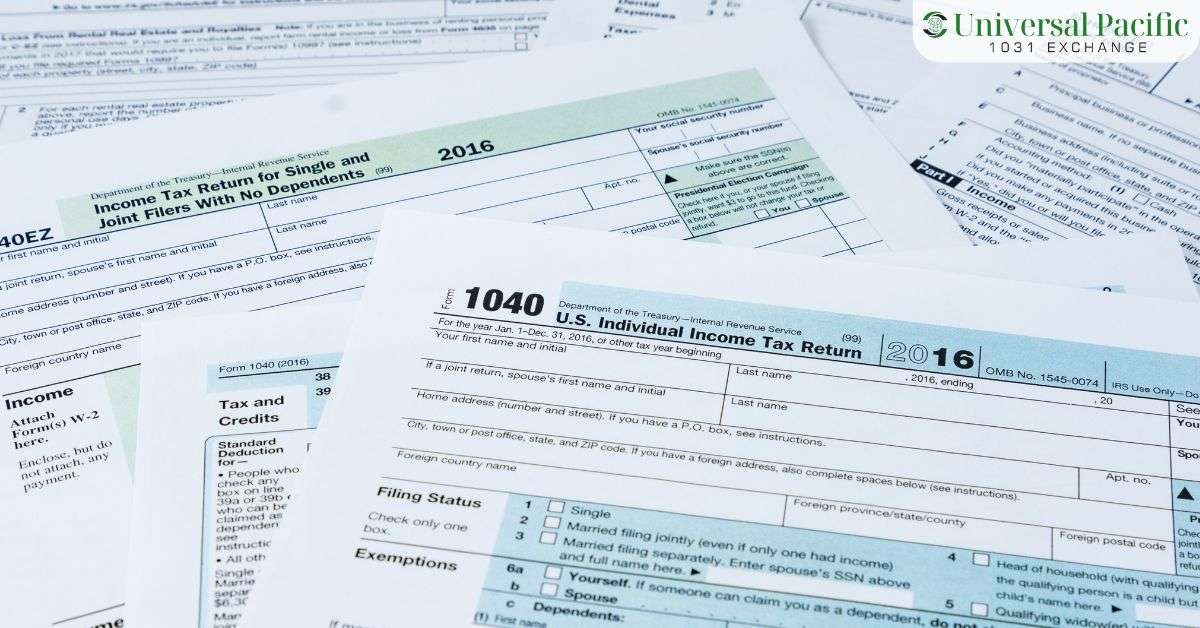
After completing the 1031 exchange, it is expedient that you report to the IRS using the IRS Form 8824 with your tax return for the year of the exchange. Filing this form ensures that the tax deferral is properly accounted for.
Need a QI to Assist With a 1031 Exchange in Texas?
Transacting a 1031 exchange in Texas requires a broad understanding of the rules in order to support available tax-deferral benefits and ensure compliance with IRS guidelines. The process can be complex, from ascertaining eligibility to identifying like-kind properties and meeting strict timelines.
In fact, most people end up making costly mistakes that open them up to regrettable and avoidable tax liabilities. That’s why you should be extremely careful when choosing a Qualified Intermediary. The experience of your QI may be the difference between whether you will successfully defer taxes or suffer a tax penalty.
Having been in the business of helping clients execute countless 1031 exchanges for over three decades, you can count on Universal Pacific 1031 Exchange as one of the most reliable QI service providers in Texas and beyond.
We will guide you through the entire process, ensuring it’s hassle-free while protecting you from common and not-so-obvious pitfalls of 1031 exchanges. Contact us now and let’s help you start a 1031 exchange and bring your real estate dreams to life.
FAQ
1. Can I Exchange Property Between Texas and Another State?
Yes, you can exchange property between Texas and another state using a 1031 exchange, provided that the properties of exchange are considered like-kind and meet the IRS requirements.
2. What Happens if I Don’t Complete the 1031 Exchange in Time?
If you don’t complete the 1031 exchange in time, the IRS will disqualify the exchange and treat it as a taxable sale. Hence, you will lose your tax deferral benefits.
3. Is There a Limit on How Many Times I Can Do a 1031 Exchange?
No, there is no limit to how many times you can do a 1031 exchange, nor is there a limit to how many properties you can identify as a replacement, on the condition that you adhere to all applicable rules.
4. What Are the Costs Involved in a 1031 Exchange in Texas?
The exchange costs involved in a 1031 exchange in Texas can vary depending on the complexity of the transaction, the value of the property, and the professionals you hire.
This page was reviewed by Michael Bergman, CPA, California CPA #56113. Verify license.
Disclaimer: This article is for informational purposes only and is not legal, tax, or financial advice. Tax laws change and every situation is different. Please consult a qualified attorney, CPA, or tax advisor before making decisions about your property, sale, or 1031 exchange.
Editorial Policy
All articles are reviewed for accuracy by licensed tax professionals and sourced from official government publications. Read our Editorial Policy →
About The Author
 Michael Bergman is a California licensed CPA and Real Estate Broker with over 35+ years of CPA-supervised 1031 exchange experience in commercial real estate. Specializing in 1031 tax-deferred exchanges and financial oversight, his expertise covers complex real estate transactions. Michael’s unique blend of financial acumen and real estate knowledge positions him as a trusted advisor in the industry, offering sound advice and strategic insights for successful property management and investment.