

Qualified Intermediary for 1031 Exchanges in San Diego
Searching for an experienced, qualified 1031 exchange intermediary in San Diego? Universal Pacific 1031 Exchange helps San Diego investors defer capital gains taxes while reinvesting in like-kind properties. We manage your exchange from start to finish, protect your funds, and check every step against IRS requirements, so you can focus on growing your real estate portfolio.
Much of this page is written for one kind of San Diego seller: the owner who kept a house here as a rental after military orders or a job moved them away, and who now wants to sell it and defer the tax on the gain.
Reviewed by Michael Bergman, CPA
Last updated 6 November 2026 · Sources for this page


With a professional history managing transactions ranging from $100,000 to over $100 million, our company offers a unique combination of business acumen, real estate insight, and financial expertise.
San Diego Sellers at a Glance: Who Exchanges Here and What a Mistake Costs
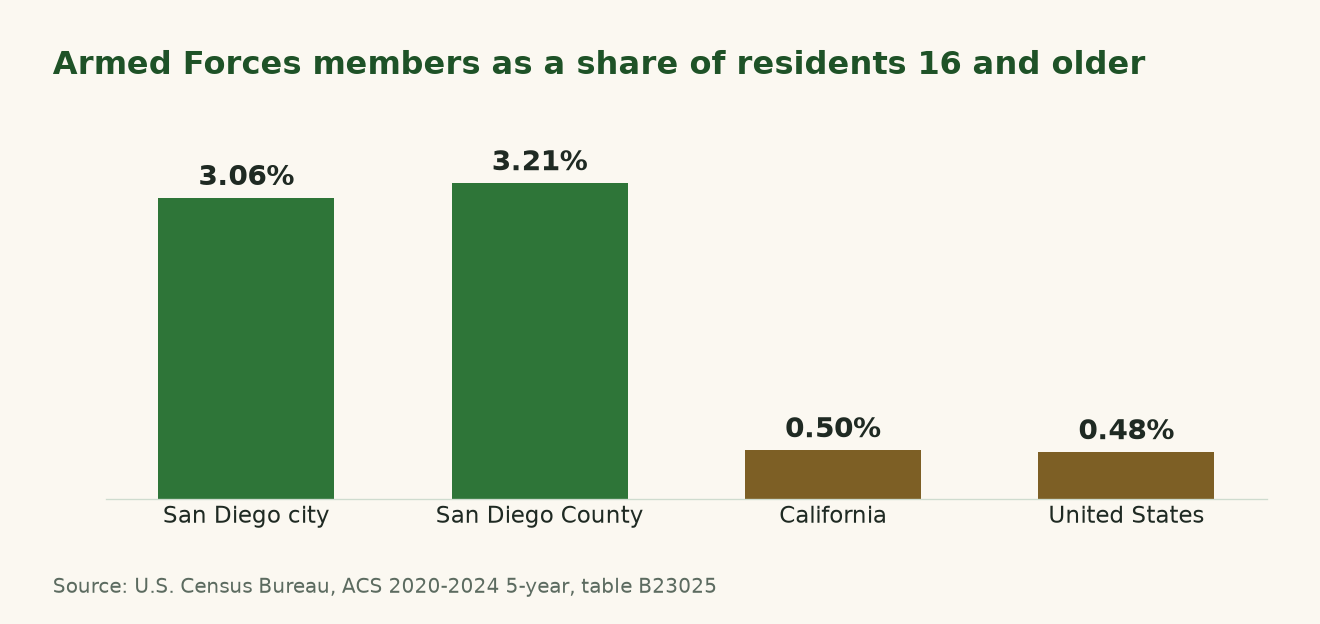
Among the California cities this site covers, San Diego has a seller you won't find in the same numbers anywhere else: the owner who bought a house, got orders or a new job somewhere else, kept the house as a rental, and now wants to sell it from another state. The Census figures below come from the 2020-2024 American Community Survey, the same survey as the housing panel further down this page. The last two rows are the state withholding and the county transfer tax on a $906,700 sale, the city's median home value in the 2020-2024 survey.
| Figure | What it means for an exchange | Source |
|---|---|---|
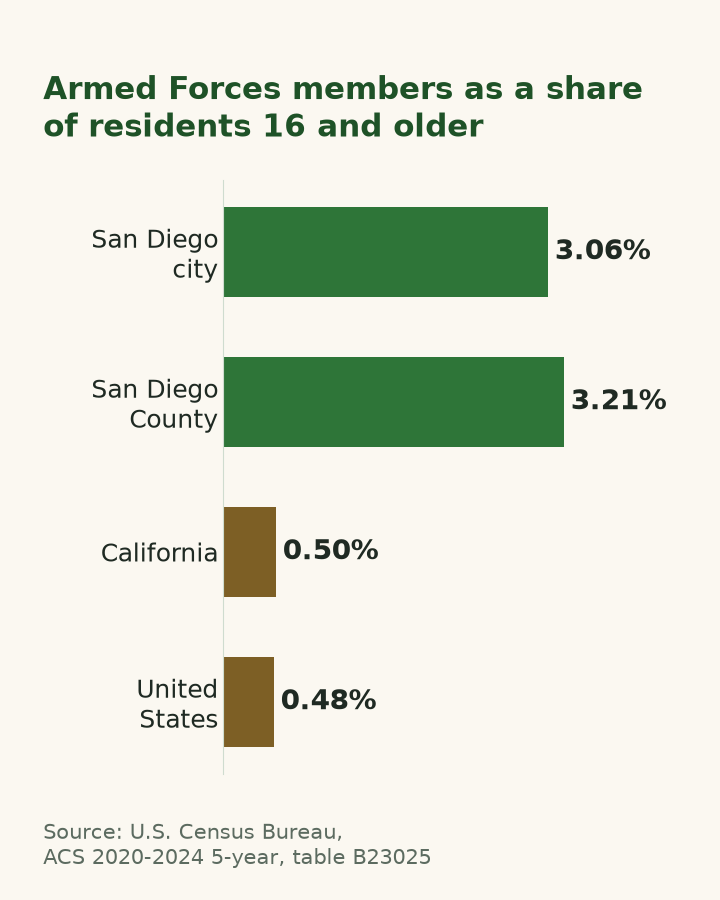
| 3.06% of city residents 16 and older are in the Armed Forces (35,497 people). California: 0.50%. | About six times the state rate. Military orders move people on a schedule they don't set, and that is how a home turns into a rental. | ACS table B23025 |
| 53.8% of California's Armed Forces members counted by the survey live in San Diego County (86,043 of 159,833). | More than half the state's service members live in one county, so a large share of the California homes left behind on PCS orders are likely to be here. | ACS table B23025 |
| 52.7% of city households rent (279,312 households, 2020-2024). | A majority-renter city, so there is a steady market of tenants for a house you leave behind. | ACS table B25003 |
| 112,955 renter households live in buildings with 1 to 4 units. | Houses, duplexes and fourplexes. This is the size of rental an individual owner usually holds. | ACS table B25032 |
| Median home value $906,700 (2020-2024). County: $854,700. California: $734,700. | A house bought a decade ago can carry a large gain, and California taxes that gain as ordinary income. | ACS table B25077 |
| 3 1/3% of the sales price withheld for the Franchise Tax Board: $30,193 on a $906,700 sale. | What escrow sends to the state by default if no exemption is certified on Form 593. | FTB Form 593 instructions |
| Documentary transfer tax $0.55 per $500 of value: $997.70 on a $906,700 sale with no loan assumed. | Charged when the deed records. A 1031 exchange does not reduce it. | San Diego County Recorder |
The sections below, in order:
- Exchange types and how your money is held
- Selling a San Diego house you rented out after a move
- California Form 593 and Form FTB 3840
- Finding replacement property, including ZIP 92110
- What happens at the County Recorder and in escrow
- A dated timeline for a seller who is moving
- Questions from San Diego searches
1031 Exchange Intermediary Services in San Diego for Sellers, Buyers and Builders
Executing a delayed, simultaneous, reverse, or improvement exchange usually follows a complicated process and often requires proper planning and guidance to stay compliant. At Universal Pacific 1031 Exchange, we offer tailored support and guidance that aligns with your specific needs. During the process, we hold your exchange funds and work with escrow on both closings so the real estate transaction flows as smoothly as possible. With our help, you can navigate any type of exchange regardless of its complexity.
Our 1031 Exchange Intermediary Services Include:
Delayed exchange: the San Diego sale closes first
A Delayed Exchange is the most common type of 1031 exchange, providing you with the opportunity to sell an existing property in San Diego and then purchase a replacement property within 180 days. We help navigate the complexities of this process, ensuring the secure handling of your funds and strict compliance with IRS timelines and regulations.

Simultaneous exchange: sale and purchase record together
A Simultaneous Exchange occurs when the transfer of your relinquished property and receipt of your replacement property happen at the same time, all in one transaction. We manage the logistics of these time-sensitive transactions, facilitating a smooth and successful exchange that adheres strictly to IRS guidelines.

Reverse exchange: purchase now, San Diego sale later
A Reverse Exchange offers you the time and flexibility to acquire a replacement property before selling your relinquished property. It is the most complex of like-kind exchanges, hence working with an experienced QI matters more here than in any other exchange type. We help ensure a secure and efficient process in compliance with IRS guidelines, protecting your investment and the tax deferral.
Improvement exchange: exchange money pays for construction
An improvement exchange lets exchange money pay for work on the replacement property, such as an ADU behind a house or a remodel of a small apartment building. An exchange accommodation titleholder holds title while the work is done, and only the improvements in place when the property is transferred to you count as part of the replacement.
Where are my sale proceeds held between the two closings?
Not with you. If you have actual or constructive receipt of the money before the replacement is bought, the exchange can fail, and any part you receive is taxed. The regulations solve this with a qualified escrow account, a qualified trust or a qualified intermediary, and in each case the written agreement has to limit your right to receive, pledge or borrow the funds until the exchange ends (Treas. Reg. 1.1031(k)-1(g)).
At Universal Pacific the net proceeds from your San Diego closing are wired to us and held in an Exchange Trust. Release of that money sits behind internal controls meant to protect it against fraud or theft, the real risks while funds wait between two closings. The firm also carries a $2 million Errors & Omissions insurance policy. You get updates on the account and the deadlines as the exchange moves along.
What should I ask 1031 exchange companies in San Diego before signing?
Picking the exchange company is your decision, not escrow's or your agent's. Questions that separate one firm from another:
- Where will my money sit, in what kind of account, and whose name is on it?
- Who can release funds, and does it take more than one person's approval?
- What insurance or bond covers the funds, and for how much?
- Who prepares the Form 593 exchange certification with my San Diego escrow, and who files it with the Franchise Tax Board if the exchange leaves cash?
- If I identify property outside California, will you explain the yearly FTB 3840 filing before I commit?
- What is the fee, and is any interest on the account paid to me? Our own pricing is laid out on the qualified intermediary fee page.
A longer checklist is in our guide on how to vet a qualified intermediary.
Can the agent who lists my house, or my CPA, hold the exchange money?
Usually not. Your agent at the time of the exchange is a disqualified person, and so is anyone who acted as your employee, attorney, accountant, investment banker or broker, or real estate agent or broker in the two years before the first property transfers (Treas. Reg. 1.1031(k)-1(k)). People related to you under the tax code's related-party rules, such as a spouse, parent, child or sibling, are disqualified as well (paragraph (k)(3)). The regulation carves out routine work: a title company or escrow officer handling only the closing, or a bank providing routine financial services, does not become disqualified for that. So the San Diego agent who lists your house can't hold your proceeds, and neither can the CPA who has prepared your returns for the past two years. They stay on your team. They just can't be the intermediary.
Orders Out of San Diego: Exchanging the House You Rented Out After a Move
Here is the pattern those figures suggest. A sailor, Marine or defense-industry employee buys a house near the base. Orders arrive. Selling in a hurry would mean a weak price, so the house gets rented out instead. Years later, from Norfolk or Okinawa or Colorado Springs, the owner decides to sell. The questions below are the ones that decide whether that sale can be exchanged, how much of the gain can be excluded outright, and which state gets to tax it.
Does a home I moved out of on military orders qualify as investment property?
It can, once it is really held as a rental. The statute looks at how you use the house, and the phrase it uses is "held for productive use in a trade or business or for investment" (26 U.S.C. 1031(a)). A home you live in is personal-use property and is not eligible. The day you move out does not change that by itself. What usually shows the change is renting the house to a tenant at a market rent and treating it as a rental on your return.
The Code sets no minimum number of months the house must be rented before you sell. The question is how you held it. A signed lease at market rent, rent reported on Schedule E and depreciation claimed each year are the ordinary records of a landlord, and they are what you would show if the exchange were ever questioned. A house left empty, lent to a relative rent-free or used on visits home looks much less like an investment. If you are thinking about the other direction, moving back into a rental later, our page on turning a rental into a primary residence covers it.
Can I exclude part of the gain under Section 121 and exchange the rest?
Yes, and for owners who moved out recently this is often the strongest result. Section 121 lets you exclude up to $250,000 of gain ($500,000 for most married couples filing jointly) on a home you owned and lived in for at least two of the five years before the sale. When a former home is now a rental, the IRS allows both breaks on one sale. Rev. Proc. 2005-14 says to apply Section 121 first and Section 1031 to the gain that is left.
Two details from that revenue procedure matter on a San Diego sale. First, gain from depreciation you claimed after May 6, 1997 can't be excluded under Section 121, but the exchange can defer it. Second, cash you take out of the exchange counts as taxable boot only to the extent it is more than the gain Section 121 excluded. Put together, an owner can sometimes take out a good part of the equity and still defer the depreciation gain by buying a replacement rental. Our page on 1031 exchanges and a primary residence goes further, and depreciation recapture explains the 25% piece.
How does the 10-year suspension for service members change the math?
The two-of-five-year test is where military owners usually lose the exclusion. Rent the house out for four years on a tour away and the five-year window no longer holds two years of living there. Section 121(d)(9) fixes that for members of the uniformed services, the Foreign Service and the intelligence community. You can elect to suspend the five-year period for any time you or your spouse spend on qualified official extended duty, for up to 10 years (26 U.S.C. 121(d)(9)).
Qualified official extended duty means a call or order to active duty for more than 90 days or for an indefinite period, at a duty station at least 50 miles from the home, or while living in government quarters under government orders. So a Navy family that lived in a Clairemont house for three years and then left on a five-year set of orders can, in many cases, still meet the test when they sell. IRS Publication 523 walks through the election and notes that the suspension and the five-year test together can reach back no more than 15 years. The suspension also matters for the California form covered further down: a sale that still qualifies under Section 121 may be exempt from state withholding on that ground.
If I exchange into a house and later move in, when can I sell it with the home-sale exclusion?
No sooner than five years from the day you acquire it. Section 121(d)(10) denies the home-sale exclusion on property acquired in a 1031 exchange if you sell it within the five-year period that starts on the acquisition date. That catches owners who plan to retire into the replacement. Say you exchange a San Diego rental for a house in Oceanside, rent it out, then move in when you leave the service. The 121 exclusion on that house is off the table until five years after the exchange closed, however long you have lived there. Even then, the years it was a rental before you moved in count as nonqualified use under Section 121(b)(5), and the gain allocated to them can't be excluded. By contrast, rental time after you move out of a former home, within the five-year window, doesn't count against you, and neither do up to 10 years of qualified official extended duty.
Which state taxes the sale if I am stationed outside California?
The Franchise Tax Board's guide for military personnel, FTB Publication 1032, sets out the rules. A service member whose domicile is California is treated as a nonresident while stationed outside the state on permanent change of station orders. Nonresidents still pay California tax on California-source income, and gain on a San Diego house is California-source income because of where the property sits. The publication's own worked example includes the sale of a California rental. A service member who is domiciled in another state and stationed in San Diego is treated as a nonresident for California tax purposes while stationed here on PCS orders, but a gain on San Diego real estate is still California-source. The answer turns on your domicile and filing history, so take your PCS orders and past returns to your tax adviser before the sale closes. If California does tax the gain, the exchange postpones that bill on the same terms as the IRS one.

Orders already in hand? Set up the exchange before escrow closes. Your sale contract has to be assigned to the intermediary, with written notice to the other parties, on or before the closing, and that step can't be added afterwards. Call us and we will tell you what to send your San Diego escrow officer.
Start an ExchangeCalifornia Forms on a San Diego 1031 Exchange: FTB 593 and FTB 3840
A San Diego seller deals with two state forms that a seller in Nevada or Texas never sees. Form 593 decides whether escrow sends part of your sale price to the Franchise Tax Board at closing. Form FTB 3840 follows you for years if the replacement property is outside California. Both are filed whether or not you live in California.
How much does escrow withhold if no exchange is certified?
California requires withholding on sales of California real estate under Revenue and Taxation Code section 18662. The default is 3 1/3% (.0333) of the total sales price. The seller can instead elect an alternative amount based on the gain, figured on the form. Withholding does not apply when the sales price is $100,000 or less, when the property is in foreclosure, or when the seller certifies one of the full exemptions on the form (2026 Instructions for Form 593). Money withheld is a prepayment: after closing, the only way to recover it is to claim it as a credit on your California return. But on a large sale it is real cash that never reaches your intermediary, and a replacement purchase priced around the full proceeds can come up short.
How does Form 593 exempt a deferred exchange from withholding?
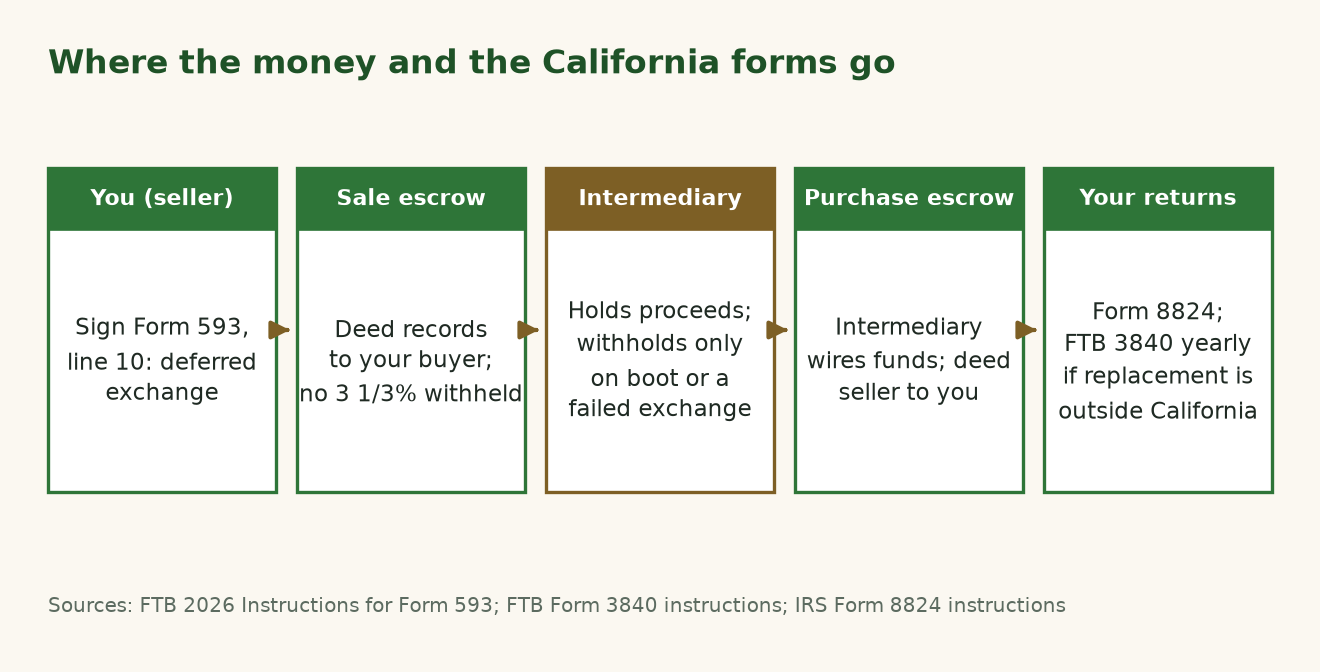
Part IV, line 10, is the box for a simultaneous or deferred exchange. For a deferred exchange the FTB instructions say the sale is exempt from withholding at the time of the initial transfer. You, as seller, sign the perjury statement on Side 3 of the form. The buyer does not sign on an exchange. The duty to withhold later, if it comes to that, moves to the intermediary. The FTB says the seller must submit the form before the close of escrow to prevent withholding; without it, escrow withholds the 3 1/3%.
Does the principal residence exemption still apply after I rented the house out?
It depends which line you mean. Form 593 has two residence exemptions in Part III. Line 1 applies when the property qualifies as your principal residence under Section 121, meaning you generally owned it and lived in it for two of the five years before the sale, and the instructions point military and Foreign Service sellers to Publication 1032. Line 2 covers property last used as your principal residence, and the FTB says plainly that if the last use was as a rental you do not qualify for it. So a house you rented out after moving can't use line 2. It may still use line 1 if you meet the Section 121 test, with the 10-year suspension counted. When only part of the property qualifies, such as the one unit of a duplex you lived in, the instructions call for a second Form 593 for the rest, and that second form is where a line 10 exchange certification would go.
What does the intermediary withhold if the exchange fails or leaves cash?
- Cash or other property over $1,500. If you receive money or other non-like-kind property worth more than $1,500 from the exchange, the intermediary must withhold 3 1/3% of that boot.
- A failed exchange. If the exchange doesn't happen or doesn't qualify, the intermediary or accommodator withholds 3 1/3% of the sales price, not just of the cash returned.
- The date and the year. The form records the date boot was paid out or the date it became clear the exchange would fail. Withholding uses that year's forms, so a sale in late 2026 that fails in 2027 is reported on 2027 forms, and the gain can be reported as an installment sale.
- When the intermediary is short of funds. Since 1 January 2022 a qualified intermediary's withholding is limited to the funds it has available in two situations: when it did not receive enough from escrow, or when it had already paid money out to complete the exchange. The form calls this a "cash poor" transaction.
- Notice to the FTB. When an exchange misses the 45-day or 180-day requirement, R&TC 18662 requires the intermediary to notify the Franchise Tax Board in writing within 10 days after those periods expire and then remit the withholding, to the extent it still holds exchange funds it has not paid out.
Our page on boot in a 1031 exchange explains how cash and debt relief create taxable gain on the federal side.
I bought the replacement in another state. Do I file Form FTB 3840 every year?
Yes. Revenue and Taxation Code section 18032 requires an information return when California property is exchanged for property outside California, for exchanges in tax years beginning on or after 1 January 2014. Form FTB 3840 is filed for the year of the exchange and for every later year until the deferred California-source gain is recognized, usually when you sell the replacement in a taxable sale (FTB 3840 instructions). It goes with your California return, so individuals file by 15 April, or 15 October with an extension. If you hold the property through a disregarded entity, such as a single-member LLC, the owner files. Each exchange gets its own form. If you skip the 3840 and also file no California return, the FTB can estimate your income and assess the tax, plus penalties and interest.
That last point catches the owner who left San Diego on orders and bought the replacement near the new duty station. You may never file a California resident return again, and the 3840 is still due every year, whatever your residence status. Our page on exchanging into another state covers what happens when the out-of-state property is finally sold.
How much federal and California tax is postponed on a San Diego sale?
Federal and California tax together, which is why the numbers are large here. On the federal side, long-term capital gain is taxed at 0%, 15% or 20% depending on income, the part of the gain from depreciation (unrecaptured Section 1250 gain) at up to 25% (IRS Topic 409), and the 3.8% net investment income tax applies above $200,000 of modified adjusted gross income for single filers or $250,000 for joint filers (IRS Topic 559). California has no lower rate for capital gains. The FTB taxes them as ordinary income, with a top bracket of 12.3% and a further 1% Behavioral Health Services Tax on taxable income over $1 million. For 2025 that tax was renamed from the Mental Health Services Tax. At the top brackets the rates stack to 20% federal, 3.8% net investment income tax and 13.3% California on the same dollar of gain. A full exchange with no cash taken out puts all of it off. Rate tables by income are on our California capital gains tax on real estate page, and the California capital gains tax calculator runs your own figures.
Selling in San Diego and buying in another state? Ask us about the FTB 3840 before you name the replacement, so the yearly filing is a known cost and not a surprise in your first April.
San Diego 1031 Exchange Properties for Sale in 92110 and County-Wide: How the Search Works
Searches for San Diego County 1031 exchange properties for sale, and for ZIP 92110 in particular, bring a lot of people to this page. Here is what an intermediary can and can't do for that search.
Does Universal Pacific sell or list property in San Diego County?
No. This page does not list properties, and Universal Pacific has no inventory to offer you. A qualified intermediary holds the exchange money and the exchange documents. It does not choose your replacement or recommend one building over another. You find replacement property the way any buyer does, through your own real estate broker, a commercial broker for larger assets, or the listing sites.
How do I name San Diego replacement properties within 45 days?
In writing, signed by you, and delivered by midnight of day 45 to the intermediary or another person involved in the exchange who is not a disqualified person (Treas. Reg. 1.1031(k)-1(c)). Each property needs an unambiguous description. For a San Diego house, the street address and the assessor's parcel number together leave no doubt. The regulation limits how many properties you can name:
- Three-property rule. Up to three properties of any value.
- 200-percent rule. No cap on the count, provided the combined fair market value of everything named is at most twice the value of the property you gave up.
- 95-percent rule. More than that is allowed only if you actually buy at least 95% of the total value you identified.
A property you actually acquire before day 45 counts as identified without a letter. More detail is on the identification rules page, and the deadline calculator gives you both dates from your closing date.
What the 92110 ZIP code looks like in Census data
Census figures for the ZIP code tabulation area 92110 (ACS 2020-2024 5-year) describe a renter-heavy area with home values above the city median:
- 12,339 households, of which 7,812 rent, or 63.3%. That is well above the city-wide share.
- Median home value $1,006,800 (margin of error $66,378).
- Median gross rent $2,398 a month (margin of error $124).
These are survey estimates of the existing housing stock, not sale prices or a forecast. A price around $1 million also shows how quickly California withholding adds up if an exchange in this ZIP fails: about $33,500 at 3 1/3%.
Where can I check a San Diego property's recorded documents and assessed value?
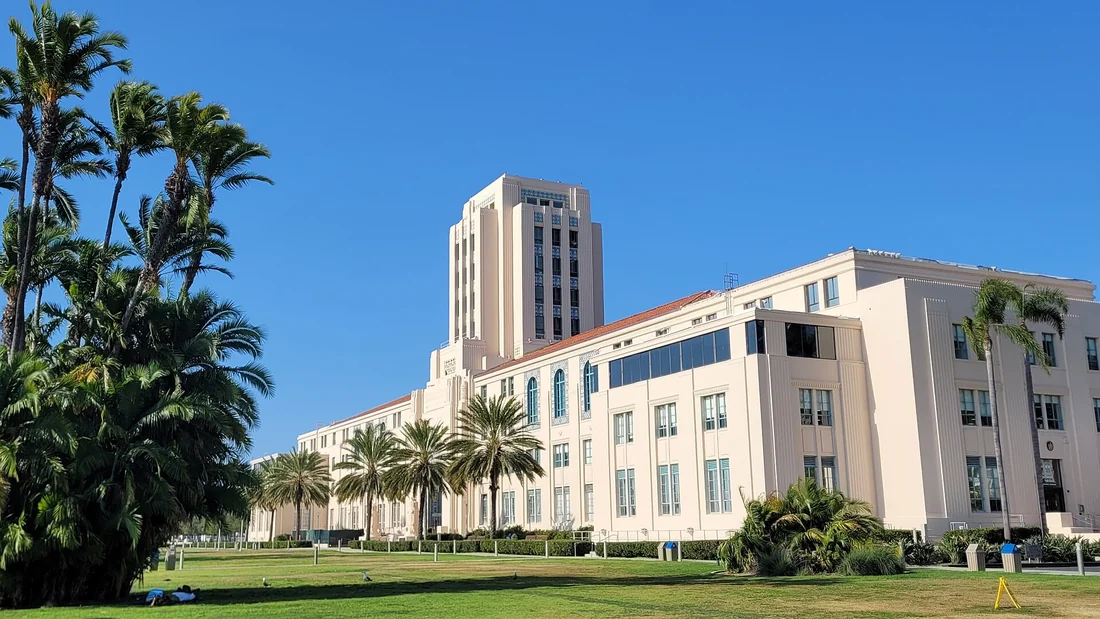
The San Diego County Assessor/Recorder/County Clerk explains its property records options. Assessor's parcel numbers, property characteristics and assessor's maps are online through ParcelQuest, the Assessor's public information line is (619) 236-3771, and copies of recorded deeds can be ordered by mail through the Official Records Index, at $2 for the first page and $0.05 for each additional page. Before you name a San Diego replacement, pull the parcel number and the current owner of record. The parcel number goes on your identification letter, and the owner of record should match the seller on your purchase contract.
Recording a 1031 Exchange in San Diego: County Recorder, Assessor and Escrow
A San Diego sale usually closes through escrow with a title company, and the deed is recorded with the County Recorder. An exchange adds a few documents to that routine but does not change who records what. Here is the order things happen in, with the San Diego costs that come with each step.
- Exchange agreement and assignment. Ahead of the sale closing, you and Universal Pacific sign the exchange agreement, and the sale contract is assigned to us. The other parties to the contract get written notice of the assignment on or before the closing.
- Form 593 to escrow. You sign Form 593 with the deferred-exchange certification on line 10 before closing, so nothing is withheld; escrow then sends the form to the Franchise Tax Board by the 20th day of the following month.
- Deed straight to your buyer. The deed runs from you to the buyer. The intermediary usually does not take title in a standard delayed exchange.
- Documentary transfer tax at recording. The Recorder collects $0.55 for each $500 of value, or fraction of $500, not counting any loan the buyer takes over (R&TC 11911). It is due on the deed whether or not the sale is part of an exchange.
- Preliminary Change of Ownership Report. A PCOR goes with every deed under R&TC 480.2. Record without one and the Recorder may charge an extra $20.
- No SB2 fee on the sale deed. The $75 Atkins Building Homes and Jobs Act fee (capped at $225 per transaction) is not charged on a document recorded with a transfer that pays documentary transfer tax, so the taxable deed in an exchange doesn't carry it.
- Proceeds wired to the intermediary. Net proceeds go from escrow to us, never to your own account.
- Replacement closing. Your purchase contract is assigned to us, we wire the exchange funds to the replacement escrow, and the deed runs straight from the seller to you.
- Reassessment of a California replacement. Buying is a change in ownership, so the county assessor reassesses the replacement to its current market value (Board of Equalization). Your old Proposition 13 assessed value does not carry over in a 1031 exchange, and the reappraisal usually brings a supplemental assessment for the rest of the tax year (BOE Publication 29).
From Orders to Day 180: A Dated Timeline for a San Diego Seller Who Is Moving
A worked example, in the conditional. An owner who rented out a San Diego house after a PCS move would close the sale on Monday 16 November 2026. Every date below follows from that one. The right-hand column is what would go wrong at each step.
| When | What happens | If it is missed |
|---|---|---|
| When the house becomes a rental | Lease at market rent, rent and depreciation on your return each year. | A house that was never really rented may not count as investment property. |
| Before the sale closes | Exchange agreement signed; sale contract assigned to the intermediary; Form 593 line 10 signed for escrow. | Proceeds paid to you can't be put back into an exchange, and escrow withholds 3 1/3%. |
| 16 Nov 2026 (day 0) | Deed records in San Diego; transfer tax paid; proceeds wired to the intermediary. | No second chance at this step. |
| 31 Dec 2026 (day 45) | Signed identification delivered to the intermediary by midnight. | The exchange fails; the intermediary withholds 3 1/3% of the sales price for the FTB. |
| 15 Apr 2027 | Your 2026 return is due today. Extend it (federal Form 4868) if the purchase may close later. | Without an extension the exchange period ends today, 30 days before day 180 (1031(a)(3)(B)). |
| 15 May 2027 (day 180) | Last day to close on the replacement, if the return was extended. It is a Saturday and the deadline does not move, so plan to close and record by Friday 14 May. | Anything not acquired by this day is out of the exchange. |
| By 15 Oct 2027 | File the 2026 returns: federal Form 8824, and California Form FTB 3840 if the replacement is outside California. | No 3840 and no California return lets the FTB estimate your income and assess the tax. |
| Every year after | FTB 3840 again, every year until the deferred California gain is taxed. | Same as above, one year at a time. |
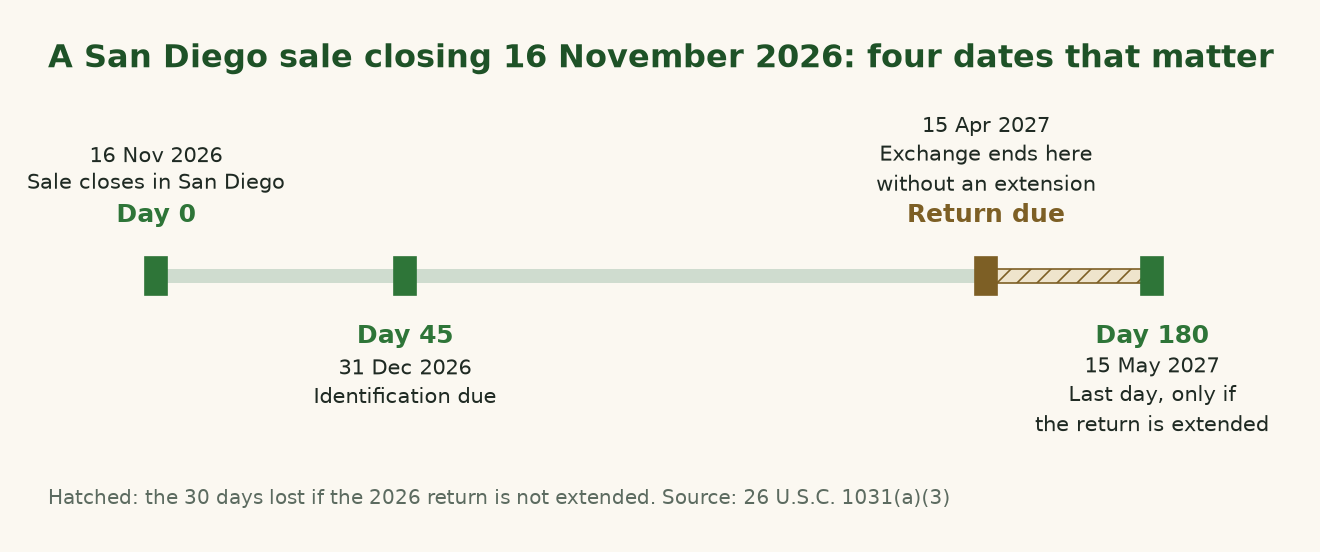
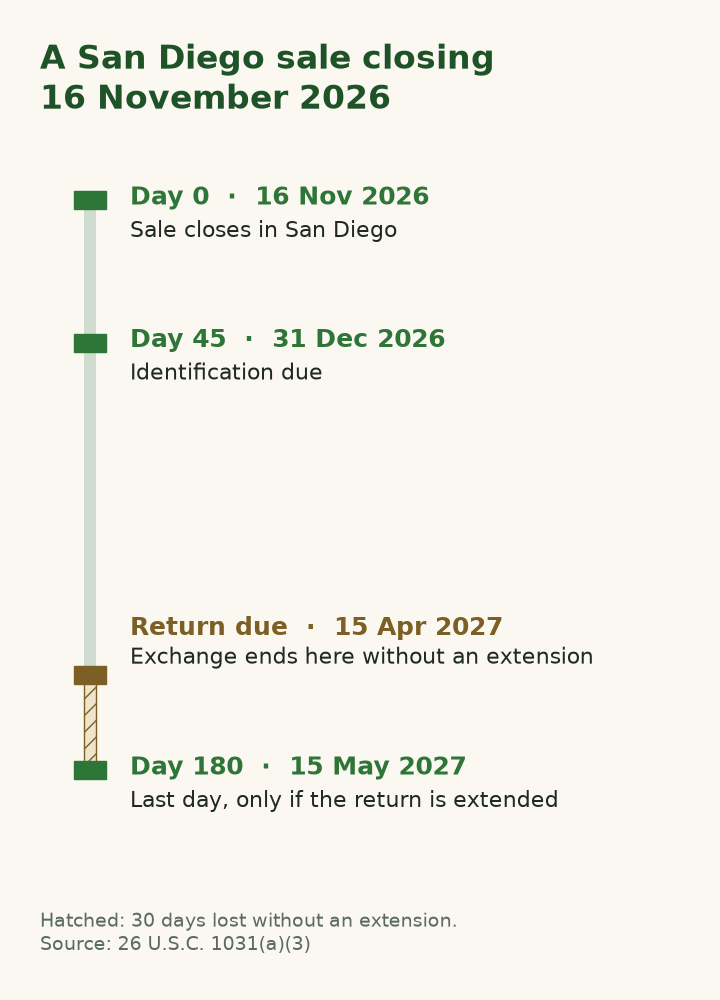
One more thing the example shows: the 45 days sit inside the 180, not before them. There is no 225-day exchange.
These are Census figures for the city of San Diego from the 2020-2024 American Community Survey, next to the U.S. figure.
Source: U.S. Census Bureau, American Community Survey 2020-2024 5-year estimates. The rent-to-value figure compares median rent with median home value; it is not a property yield. See the table for all 51 cities.
San Diego 1031 Exchange Questions From Local Searches
They are the same job under two names. Federal regulations use "qualified intermediary" (Treas. Reg. 1.1031(k)-1(g)(4)). California's withholding statute, R&TC 18662, speaks of the "intermediary or accommodator" in a deferred exchange, so both words are in use here. Whichever word a San Diego firm uses, ask the same thing: will it sign the exchange agreement, take the assignment of your sale contract and hold the proceeds? A firm that does those three things is acting as your intermediary.
No. California law, R&TC 18662, requires the withholding form itself to say so: "Title and escrow persons and exchange accommodators are not authorized to provide legal or accounting advice for purposes of determining withholding amounts. Transferors are strongly encouraged to consult with a competent tax professional for this purpose." An intermediary can explain what Form 593 asks and what the instructions say. Choosing between the 3 1/3% default and the gain-based alternative, or deciding whether a residence exemption applies, belongs with your CPA or tax attorney. If you searched for a 1031 exchange advisor in San Diego, that is the person to look for, alongside the intermediary.
Not an intermediary specifically. As the section on where your sale proceeds are held explains, the regulations also accept a qualified escrow account or a qualified trust. The difference is who carries the exchange. With an escrow account or a trust, the cash only secures your buyer's promise to deliver the replacement property (Treas. Reg. 1.1031(k)-1(g)(3)), so your buyer has to agree to take on that role. An intermediary takes an assignment of the sale and purchase contracts instead, which is a big reason it is the usual choice. A direct swap, where you and the other owner deed your properties to each other at the same closing, needs none of the three.
Yes. The 45-day and 180-day periods come from the federal statute, 26 U.S.C. 1031(a)(3), and apply to a San Diego sale the same way they apply in any other state. Both are counted in calendar days from the day the sale closes. The one thing that can move them is federal disaster relief. When the IRS announces relief for a disaster area, Rev. Proc. 2018-58 lists the exchange periods among the deadlines that can be postponed. San Diego County received that kind of relief after the January 2024 storms and flooding (IRS news release IR-2024-51). Relief covers only the dates and taxpayers named in the notice, so check it against your own closing date.
As long as 180 days, and often less. The limit is day 180, but the due date of your return for the sale year, extensions included, cuts it short if that date arrives sooner. A sale that closes after mid-October has its day 180 after 15 April, so file an extension if the purchase may close after the due date.
Yes. Real property in the United States is generally like-kind to other real property in the United States, whatever the type (IRS). A Kearny Mesa industrial building can be exchanged for apartments in Phoenix, and a retail strip in Escondido for raw land in Texas. Two limits apply. Property outside the United States is not like-kind to U.S. property, and since 1 January 2018 only real property qualifies for a federal exchange, so equipment and other personal property sold with a business building don't.
It can, if it is run mostly as a rental. Rev. Proc. 2008-16 gives a safe harbor for a dwelling you sell: you owned it for the 24 months right before the exchange, and in each of the two 12-month periods in that time you rented it at a fair rent for at least 14 days and used it yourself for no more than 14 days or 10% of the days it was rented, whichever is greater. A replacement cabin has to meet the same test for the 24 months after you acquire it. A cabin used mainly by the family fails it. Our page on the vacation home exchange has more.
Start with the floor California sets. Every exchange facilitator doing business in the state has to meet at least one of three requirements in California Financial Code section 51003: a fidelity bond of at least $1 million; a deposit of at least $1 million in cash, securities or letters of credit; or holding all exchange funds in a qualified escrow account or qualified trust that releases money only with both the firm's and your written authorization. If a facilitator's failure to follow these rules costs you money, section 51005 lets you file a claim on that bond or deposit. Section 51001 also requires the firm to tell you within 10 business days if more than half of it changes hands. Ask each San Diego firm you compare which of the three options it uses, and get the answer in writing. The checklist in the services section above covers the rest.
Real estate you hold for investment or use in a business: a rented house in Clairemont, a fourplex in North Park, an industrial unit in Otay Mesa or a lot in Ramona held as land. The statute leaves out real property "held primarily for sale" (26 U.S.C. 1031(a)(2)). A house bought to renovate and resell usually falls on that side, and so do lots you subdivide to sell to builders. What decides it is why you held the property, so the same building can qualify for one owner and not for another. Your own home doesn't qualify while you live in it. The military-orders section above explains when a former home counts as a rental, and our page on what disqualifies a property covers the other exclusions.
No. Our office is at 1180 S. Beverly Drive, Suite 500, Los Angeles, CA 90035, and the firm lists all 50 states as its service area. A San Diego exchange still closes through your own San Diego escrow and title company, and the deed is recorded with the San Diego County Recorder, so the intermediary's location doesn't change where the documents go.
$30,193, using the FTB's rate of .0333 on the full sales price. A failed exchange is withheld on the sales price, not only on the cash returned, unless the intermediary has already paid funds out toward a replacement, in which case it withholds only from what it still holds. The seller can use the alternative, gain-based calculation on Form 593 instead when it gives a lower figure.
Not the exchange deadlines. R&TC 18031 applies the federal rules on gain from the disposition of property, Section 1031 among them, to California income tax "except as otherwise provided," so the 45-day and 180-day periods are the same on your state return. What California adds is paperwork: Form 593 at the sale closing and, if the replacement is outside the state, Form FTB 3840 every year. Both are covered in the forms section above.

Talk to Us Before Your San Diego Escrow Opens
Plan your 1031 exchange in San Diego with us early. Don't let tax complications hinder your property investment decisions. Connect with us today for a complimentary, no-obligation 1031 exchange consultation.
Nearby Southern California 1031 Exchange Pages
Only two other Southern California city pages on this site sit near San Diego: 1031 exchanges in Los Angeles and 1031 exchanges in Long Beach. Orange County, Riverside and Imperial County don't have pages of their own. The Form 593 and FTB 3840 rules above apply there exactly as they do in San Diego, because they are state rules. Every other city is listed on the 1031 exchange locations page.
Sources: 26 U.S.C. 1031; 26 U.S.C. 121; Treas. Reg. 1.1031(k)-1; Rev. Proc. 2005-14; Rev. Proc. 2008-16; Rev. Proc. 2018-58; IRS Publication 523; IRS Topic 409; IRS Topic 559; FTB 2026 Instructions for Form 593; FTB 3840 instructions; FTB Publication 1032; R&TC 18662; R&TC 18031; R&TC 18032; R&TC 11911; Financial Code 51003; San Diego County Recorder; BOE Publication 29; U.S. Census Bureau, American Community Survey 2020-2024 5-year estimates.
Photo at the top of the page: San Diego skyline at dusk from Coronado, by russellstreet, CC BY-SA 2.0, via Wikimedia Commons, cropped.
From the 1031 Exchange Blog: Audits, Business Purchases and Closing Costs
Set up your San Diego 1031 exchange
Call Now For A Free Consultation · (424) 469-8111