1031 Exchange Timeline
This page was reviewed by Michael Bergman, CPA, California CPA #56113. Verify license.
For a successful exchange, the IRS requires that you adhere to a strict timeline of 180 days. After you sell a commercial property, the IRS gives you 45 days to identify potential replacement properties and submit them in writing to your QI. From then, you have 135 days to purchase the identified property and close the exchange. Failure to comply with these time requirements can disqualify your exchange and thus make your gains taxable.
Finding a reputable QI to guide you through the 1031 exchange timeline does not have to be a hassle. With 35+ years of experience behind it, Universal Pacific 1031 Exchange handles the moving parts of a compliant exchange for you. Schedule a free consultation and we will walk you through the deadlines on your own exchange.
In this article, you’ll learn everything about the 1031 exchange timeline and its recent changes to avoid potential pitfalls that can disqualify your exchange.
What Is a 1031 Exchange and How Does It Work?

A 1031 exchange is a real estate investment strategy that allows you to defer capital gains taxes when you reinvest the sale proceeds of one investment property into another like-kind property. It takes its name from Section 1031 of the U.S. Internal Revenue Code and is regulated by the IRS. For a successful exchange, investors are required to understand and comply with the IRS regulations guiding the 1031 exchange.
For example, both the relinquished and replacement properties must be held for business or investment purposes. That means that you cannot use personal property, such as a primary residence. The properties must also be like-kind. You can purchase multiple properties as long as you follow the 1031 exchange identification rules.
You must also reinvest ALL the sale proceeds to fully defer taxes, unless you’re running a partial 1031 exchange where only the reinvested portion is tax-deferred. More importantly, you must complete the exchange transactions within the various deadlines that make up the 180-day timeline. Let’s look at a breakdown of the exchange timeline to help you stay on track.
Note that how these rules apply may vary depending on the 1031 exchange types. There are generally four types of exchange: the forward exchange, the simultaneous exchange, the reverse exchange, and the construction or improvement exchange. For example, reverse exchanges allow you to purchase the replacement property before selling the relinquished property. Therefore, you’ll be required to hand over the title to the replacement property to the Exchange Accommodation Titleholder until you sell the original property.
Breakdown of the 1031 Exchange Timeline

Since missing any of the 1031 exchange deadlines in the 180-day timeline disqualifies your exchange, you need a proper understanding of the timeline so you can plan your transactions to align properly. Below, we’ve provided a summary of the key deadlines and dates in the 1031 exchange process.
Day 0: Sale of the Relinquished Property
The 1031 exchange timeline starts ticking on the day you sell your relinquished property. You must transfer the proceeds to a Qualified Intermediary (QI), who will hold the funds until you purchase your replacement property. You are not allowed to receive or control the exchange funds at any point. If you do, the IRS will consider the sale as a taxable event, and the exchange will be disqualified. That’s why it’s important to learn how to find a qualified intermediary with the right experience and expertise to run a successful and compliant exchange.
Day 1 – 45: 45-Day Identification Period
From the day after you sell your relinquished property, you have exactly 45 calendar days to identify potential replacement properties. This deadline is strict, even if the 45th day falls on a weekend or holiday. You must submit your identified replacement property in writing to your QI before the deadline. Verbal agreements or informal notes do not count as official identification.
For a 1031 exchange with multiple properties, you can identify up to three properties or even more than three properties, provided that you follow either the three-property rule, 200% rule, or the 95% rule. For example, you can identify a single-family rental property, raw land, an apartment building, or any other commercial property. Each rule interacts differently with the equal or greater value requirement. Note that you’re not mandated to purchase all the identified properties, but you must purchase at least one of them.
During the identification period, you’ll need to work with real estate agents within the properties’ location to help find suitable listings. It’s recommended to also work with other professionals to help you evaluate the market value of the properties to be sure they align with your targets.
Day 45 – 180: Purchase the Replacement Property
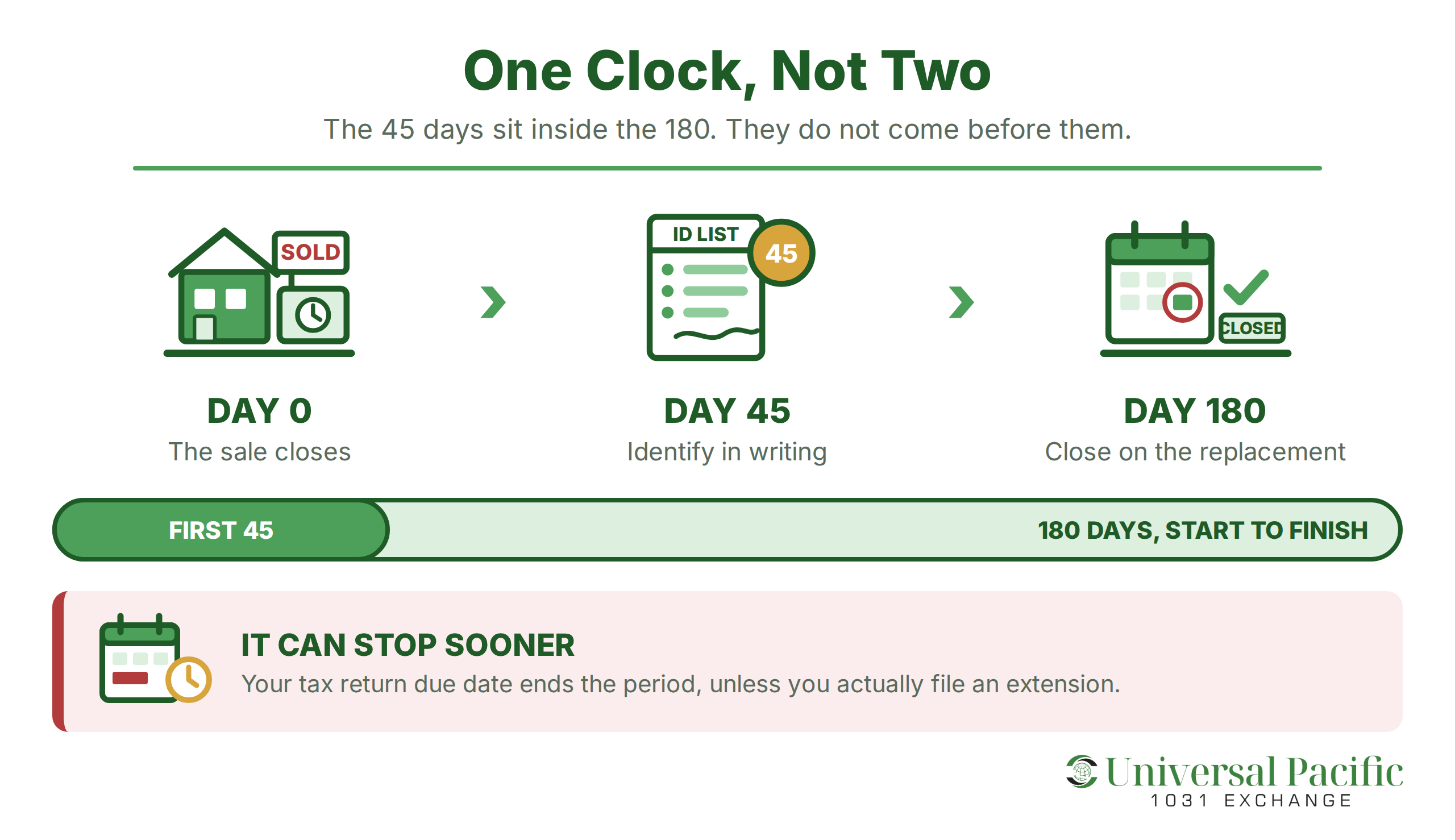
After submitting your property identification, you have an additional 135 days to close on the purchase. The total timeframe is 180 days from the sale of your relinquished property, or the due date of that year’s tax return including extensions, whichever comes first. The closing process must be fully completed within this period, including transferring ownership, recording the deed, and finalizing all payments.
Remember that any portion of the sale proceeds that is not reinvested is known as boot in a 1031 exchange and is subject to capital gains tax. Additionally, if the replacement property has a lower mortgage balance than the relinquished property, the difference in debt will also be taxable. To avoid last-minute issues, it’s best to secure financing and conduct due diligence on the replacement property as early as possible. Many investors begin negotiating and arranging financing before the 45-day identification period ends to be sure they can close within the 180-day deadline.
File IRS Form 8824
Once your exchange is complete, you must report it to the IRS when filing your tax return for that year, using IRS Form 8824. The form provides details about the properties involved, the timeline, and how the exchange complies with 1031 rules. You can read our blog on how to file a 1031 exchange.
Filing incorrectly or missing required details can trigger IRS audits or penalties. To be sure everything is reported accurately, it’s best to work with a tax professional who has experience with 1031 exchanges. They can help you complete Form 8824 and verify that your exchange meets all legal requirements.
Consequences of Missing the 1031 Exchange Timeline

Missing the 1031 exchange timeline can have serious consequences, primarily resulting in the loss of the tax-deferral benefits that the exchange provides. The most significant consequence is immediate tax liability. This is the primary consequence of missing the 1031 exchange deadlines. You will owe capital gains tax on the profit from the sale of the relinquished property. If you claimed depreciation on the relinquished property, you must pay depreciation recapture taxes on the recaptured depreciation. These taxes can significantly reduce the proceeds available for reinvestment.
Another major consequence is loss of tax deferral opportunity. A 1031 exchange is designed to defer capital gains taxes, allowing you to reinvest the full sale proceeds into a new property. Missing the deadlines forfeits this opportunity, forcing you to pay taxes upfront.
Missing the deadline can also create financial strain or delays. Paying taxes immediately after the sale may strain your finances, especially if you were relying on the full proceeds for reinvestment. It may also delay your ability to close on a replacement property, particularly in competitive markets where quick action is often required.
A failed 1031 exchange could lead to additional costs, such as legal or qualified intermediary fees already paid for the exchange process, tax penalties, or interest charges if you don’t pay taxes promptly after disqualification.
Below is a table illustrating the key 1031 exchange deadlines and their implications.
| Deadline | Duration | Description | If you miss it | How to make it |
|---|---|---|---|---|
| Exchange start date | Day 0, the day the original property closes | The exchange begins when the property you are selling closes. This date starts both the 45-day identification period and the 180-day exchange period. | If the exchange is not set up before that closing, the sale does not qualify at all. | Choose your qualified intermediary and set the exchange up before the sale closes. |
| 45-day identification | 45 days after the sale closes | You must choose and list the property or properties you plan to buy, in writing, and send the list to the qualified intermediary. | No identification inside 45 days and the exchange fails. The gain becomes taxable. | Start searching before the sale closes, and list backups in case the first choice falls through. |
| 180-day exchange period | 180 days after the sale closes, the first 45 included | You must complete the purchase of the replacement property. The closing has to happen before the 180th day. | The exchange is invalid and you may owe capital gains tax. | Line up lenders, agents and inspectors early so the purchase can move quickly. |
| Tax return due date | Usually 15 April of the following year, unless you file an extension | If your filing deadline arrives before day 180, the exchange period ends there instead. An extension you actually file restores the full 180 days. | Filing your return before the exchange closes ends the exchange period early. | File the extension if the 180 days run past your return due date. |
| Identification documentation | Inside the 45-day period | The list must be written, signed, and delivered to the qualified intermediary. | A late or improperly described identification can sink the exchange even when you have found the property. | Prepare it early and confirm the intermediary received it. |
How to Avoid Missing the 1031 Exchange Deadlines
Careful planning is what keeps an exchange inside the IRS deadlines. Here are some ways you can manage your tax-deferred exchange to minimize time-related challenges.
First, work with a qualified tax advisor and other experienced professionals, and an experienced intermediary. Learn the deadlines yourself as well, and watch them.
Second, conduct proper research, such as property inspections, title searches, etc., to assess the property. You should also identify backup replacement properties in case your primary choice falls through.
If you’re looking to finance the potential replacement property, secure financing before the 180-day deadline to avoid delays. Finally, maintain an accurate record of all transactions and communications related to the 1031 exchange. This will help with tax reporting so your reporting holds up.
How a Qualified Intermediary Helps You Avoid Missing Exchange Deadlines
The intermediary does more than hold the money. To start with, the QI helps make sure the exchange remains valid by holding the proceeds from the relinquished property sale in a secure escrow account. The QI also reviews the investor’s property identification list to confirm it meets IRS requirements, reducing the risk of errors that could lead to disqualification.
Once the investor selects a replacement property, the QI coordinates with the seller, title company, and escrow agents to complete the purchase within the 180-day deadline. The QI releases the exchange funds only when all conditions are met. That is what keeps the transaction inside IRS guidelines. This structured process prevents delays that could cause the investor to miss the final deadline.
Many property owners face unexpected challenges during a 1031 exchange, such as financing delays, failed property inspections, or changing market conditions. A good QI will talk you through the options: advising on backup property options, potential delays, and alternative strategies to stay within the 1031 exchange timeline.
After the exchange is completed, the QI provides documentation and records to help the investor or their tax advisor properly complete the form, ensuring IRS compliance and avoiding audit risks.
Potential Pitfalls and Delays in the 1031 Exchange Timeline
Finding a investment property that both qualifies as like-kind and aligns with the investors’ goals. Market conditions and property availability can also make it difficult to find a suitable replacement property within the 45-day identification period.
The 2017 Tax Cuts and Jobs Act narrowed Section 1031 to real property, and that change never carried an expiry date. The One Big Beautiful Bill Act, signed in July 2025, left Section 1031 alone. Earlier proposals to cap the deferral at $500,000 were not enacted.
Curious how the wider market moved while these deadlines stayed fixed? Our 1031 exchange research lines up the tax-deferred gains through exchanges against commercial property prices from 2022 through 2025.
When the IRS Does Extend the Deadlines
There is one situation where the deadlines move. Under Revenue Procedure 2018-58, taxpayers affected by a federally declared disaster can get extra time on the 45-day and 180-day deadlines. The IRS publishes the relief notice for each disaster, and it sets out who qualifies and how long they get. It is not something you apply for in advance, and it does not cover an exchange that is simply running late. If a declared disaster lands in the middle of your exchange, tell your intermediary and your CPA straight away rather than assuming the dates are fixed.
What Happens If You Miss a 1031 Exchange Deadline?
A 1031 exchange has strict IRS deadlines that must be followed to preserve tax deferral. You generally have 45 days to identify replacement properties and 180 days to complete the purchase after selling the relinquished property.
Planning early, working with a qualified intermediary, and tracking each deadline can help prevent costly mistakes. You should also complete due diligence, arrange financing, and prepare backup properties before time runs out.
Universal Pacific 1031 Exchange has 35+ years of experience in facilitating 1031 exchanges and helping investors navigate the process while complying with IRS requirements. Our team works with your tax professional rather than around them. Book a call with us today for a free consultation.
FAQ
Below are answers to common questions about the 1031 exchange timeline.
What Is the 2-Year Rule for 1031 Exchanges?
The 2-year rule generally applies to certain related-party 1031 exchanges. If you exchange property with a related party, both parties generally must hold the properties for at least two years. Selling or disposing of the property too soon can cause the exchange to lose its tax-deferred status.
What Is the Timeframe for a 1031 Exchange?
You generally have 45 days after selling your property to identify potential replacement properties. You then have 180 days from the sale to complete the purchase, or until your return due date with extensions if that comes first.
How Long Can You Hold Money in a 1031 Exchange?
You cannot personally hold or control the sale proceeds during the exchange. A qualified intermediary holds the money until it is used to purchase the replacement property. The funds generally must be used within the 180-day exchange period.
What Is the Completion Period of a 1031 Exchange?
The exchange must generally be completed within 180 days of selling the relinquished property, or by your tax return due date including extensions if that falls sooner. The replacement property must be acquired within this period for the exchange to qualify for tax deferral.
What Happens If I Don’t Spend All of My 1031 Exchange?
Any money left over after purchasing the replacement property may be considered boot. This amount may be taxable, even though the rest of the exchange qualifies for tax deferral.
What Is the 2-Year/5-Year Rule?
The 2-year rule generally applies to certain related-party exchanges. The 5-year rule commonly applies when a property is acquired through a 1031 exchange and later converted into a primary residence. For a property converted to a main home, special rules generally require you to own it for at least five years before selling it to qualify for the Section 121 home-sale exclusion.
Disclaimer: This article is for general informational purposes only and is not tax or legal advice. The 1031 exchange deadlines are strict and their application depends on your specific facts. Tax laws change, and each situation is different. Consult a qualified intermediary and a licensed tax advisor before acting.
Editorial Policy
All articles are reviewed for accuracy by licensed tax professionals and sourced from official government publications. Read our Editorial Policy →
About The Author
 Michael Bergman is a California licensed CPA and Real Estate Broker with over 35+ years of CPA-supervised 1031 exchange experience in commercial real estate. Specializing in 1031 tax-deferred exchanges and financial oversight, his expertise covers complex real estate transactions. Michael’s unique blend of financial acumen and real estate knowledge positions him as a trusted advisor in the industry, offering sound advice and strategic insights for successful property management and investment.