

Qualified Intermediary for 1031 Exchanges in Long Beach
Between the sale of your Long Beach rental and the purchase of the next one, the qualified intermediary keeps the proceeds out of your reach, which is what lets the gain stay tax-deferred. For owners of duplexes, fourplexes and courtyard buildings, this page covers the 45 and 180 days, California's Form 593 at closing, the tenant rules that come with a rented building, and replacements in Orange County and the South Bay.
If you own a small apartment building and need a qualified 1031 exchange intermediary in Long Beach, Universal Pacific 1031 Exchange handles 1031 tax deferred exchanges in California and the rest of the country, led by Michael Bergman, CPA.
Reviewed by Michael Bergman, CPA
Last updated 18 November 2026 · Sources for this page
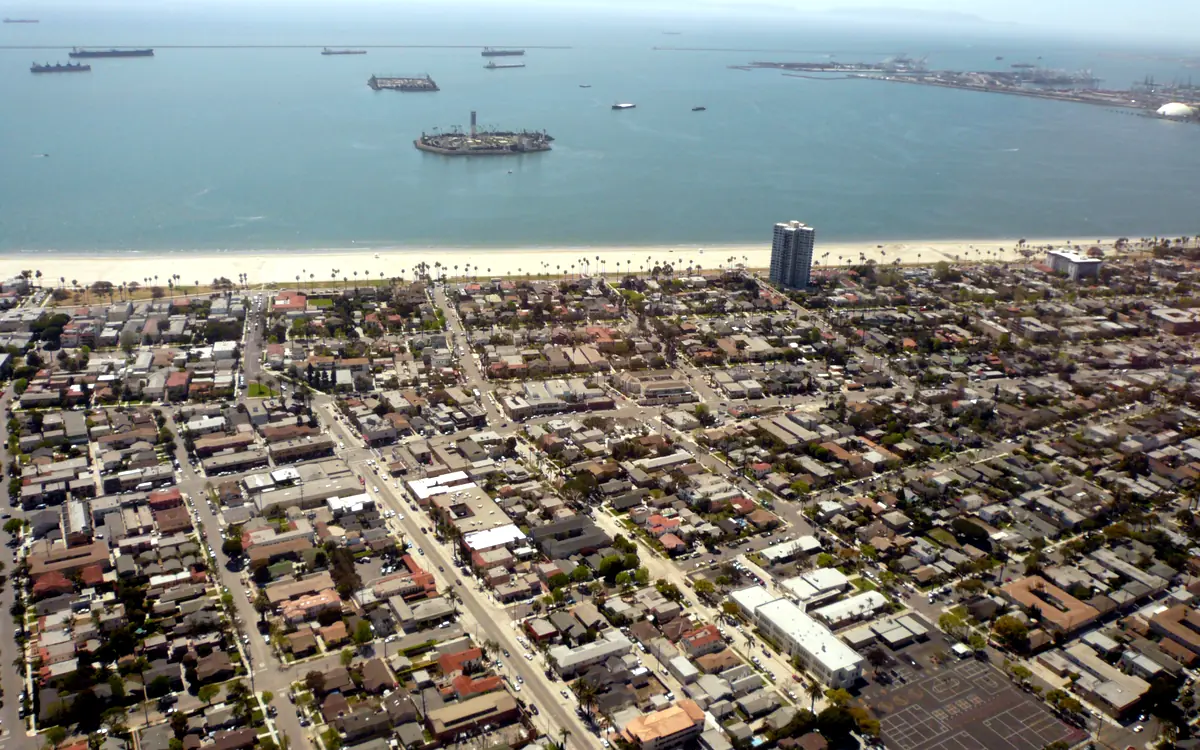

Most Long Beach owners who call us are selling a duplex, a fourplex or a courtyard building with tenants in it. We run the exchange from Suite 500 at 1180 S. Beverly Drive in Los Angeles; there is no Long Beach office, and the sale still closes at the Long Beach escrow or title company you choose.
With a professional history managing transactions ranging in price from $100,000 to over $100M, our company combines genuine business acumen, real estate insight, and financial literacy.
1031 Exchange Intermediary Services in Long Beach for Owners of Small Apartment Buildings
Here is what our 1031 exchange services cover for a Long Beach owner, start to finish. As your qualified intermediary, Universal Pacific signs an exchange agreement with you while the building is in escrow, takes an assignment of the sale contract, receives the net proceeds when the sale closes and releases them only to the escrow that is buying your replacement. Documents, signatures and wires all move by email and phone, so you don't need to visit Los Angeles at any point. The first call is a free consultation, and it is the right moment to tell us how many buildings you plan to buy and in which counties.
Delayed Exchange for Most Long Beach Fourplex and Courtyard Sales
Most Long Beach owners exchange this way. The building sells first, the money goes to your exchange account with us, and the identification and purchase clocks start that day; the dates section below works through a real calendar. Tenants stay in place through both escrows, so nobody has to move out for the exchange to work. Our delayed exchanges page sets out the paperwork in full.
Reverse Exchange for a Sixplex That Won't Stay Listed
A small building that suits you rarely stays listed for long. So an exchange accommodation titleholder, often called a parking company, buys the sixplex now and holds it for you; your own building then has up to 180 days to sell (Rev. Proc. 2000-37). The purchase money has to come from a loan or your own funds, because the sale proceeds don't exist yet. See reverse exchanges.
Simultaneous Exchange With Both Escrows Closing Together
When you already have a signed contract on the next building, both escrows can close on the same date. We still sit between them: your sale contract and your purchase contract are assigned to us, and the escrow officers deed each property directly to the right party. This works for owners trading between two buildings they know well, such as a neighbor's sixplex on the same block.
Improvement Exchange for a Building That Needs Work
When the replacement needs plumbing, wiring or a roof before you take it, a titleholder can own it while contractors are paid from exchange funds; how that works and what it costs is on our improvement exchange page.
Guarding the Long Beach Proceeds Until the Next Closing
From the day your Long Beach sale closes, its proceeds sit in an Exchange Trust: a segregated trust account at a major institutional bank, kept apart from the money we run the business on. Internal controls stand between that account and any release, to protect the funds against fraud or theft, and you can ask for daily reconciliation reports and audit trails. Behind the account there is cover of two kinds as well: our fidelity bond, and the Errors and Omissions (E&O) policy our operations carry. As your qualified intermediary we owe you fiduciary duties and take them seriously, which in practice means you can ask at any point where the money is, what has been paid out and what is still due to happen before day 180. California's Financial Code adds its own protection for clients of any exchange company; our Los Angeles page explains that rule and why a qualified intermediary is not the only safe harbor.
What to Have Ready When You Open the File
Opening an exchange takes a short phone call and a few documents. Most of what we ask for is what the exchange agreement and California's Form 593 need anyway:
- The signed sale contract, so we can prepare the assignment and give the buyer written notice of it.
- The escrow company, escrow number and the escrow officer's contact details.
- The names exactly as they appear on title, and each seller's taxpayer identification number for Form 593.
- Each owner's share of the building, if more than one person or entity owns it.
- The expected closing date, so the 45 and 180 days can be put on the calendar before they start.
- Any loan that will be paid off at closing, and whether you plan to borrow on the replacement.
How to Compare 1031 Exchange Companies Across California and Orange County
Search for a 1031 exchange company in California or in Orange County and you will find firms using different names for one job. The Treasury regulations say qualified intermediary. California's Financial Code says exchange facilitator, and the Franchise Tax Board's Form 593 instructions say "intermediary or accommodator" in the same sentence. A firm that calls itself a California 1031 exchange specialist or accommodator works under the same federal and state rules as one that calls itself a qualified intermediary. What separates exchange companies is how they hold the money and who answers for it, and these are the questions that bring that out:
- Is my money in a segregated account, or pooled with other clients' funds, and at which bank?
- Who has to sign before a wire leaves the account, and will I see each release?
- Does the quote match the fees the company publishes?
- Has anyone at the company acted for me in the last two years? If so, that person can't serve, for the reasons in the FAQ on being your own qualified intermediary.
Advisor, Consultant or Intermediary
Owners who search for a 1031 advisor or consultant in California often want two things at once: someone to tell them what to buy and someone to hold the money. Those are separate roles. What to buy, how to finance it and how the gain will be taxed are questions for your broker, lender, attorney and CPA. The intermediary's job is written into the regulation: it signs an exchange agreement with you, acquires and transfers the property you sell and the one you buy, and does so by taking an assignment of your rights in each contract, with the other parties told in writing (Treas. Reg. 1.1031(k)-1(g)(4)(iii) to (v)). Universal Pacific is led by a CPA, but on your exchange we act as the qualified intermediary, and your own CPA prepares your return. That split keeps your CPA free to advise you, because advice on the exchange itself doesn't disqualify an advisor, while years of tax-return work would disqualify the same person from holding your funds.
Listing a Long Beach building this season? We can't be added once the deed has recorded, so the paperwork with us happens during escrow. Phone us at (424) 469-8111 while the sale is still open, or open the exchange online.
Counting the Days, Certifying Form 593 and Paying Our Fee in a 1031 Exchange in Long Beach
Every 1031 exchange in Long Beach runs on two federal deadlines and passes through one California form at the sale closing. This section follows the file in the order things happen, from the signed sale contract to the replacement deed, with the amounts that leave the sale along the way.
Before the Long Beach Deed Records
Once a buyer has signed, we prepare two papers for you to sign during escrow. The first is the exchange agreement that hires Universal Pacific as your qualified intermediary for this job. The other assigns the sale contract to us, which is how we step into the deal without ever taking title. Tell the escrow officer from the first day that an exchange is planned, because the assignment and our closing instructions have to be in escrow before the sale closes. When the sale closes, escrow records your deed to the buyer at the Los Angeles County Registrar-Recorder, with no stop in our name, and sends the net proceeds by wire to the exchange account. That direct deed is normal: the regulations treat the qualified intermediary as acquiring and transferring the property through the assignment, without ever holding title (Treas. Reg. 1.1031(k)-1(g)(4)(iv)). After the deed records it is too late to bring us in, because the money has already reached you or your account.
The 45 and 180 Days, Including Extensions
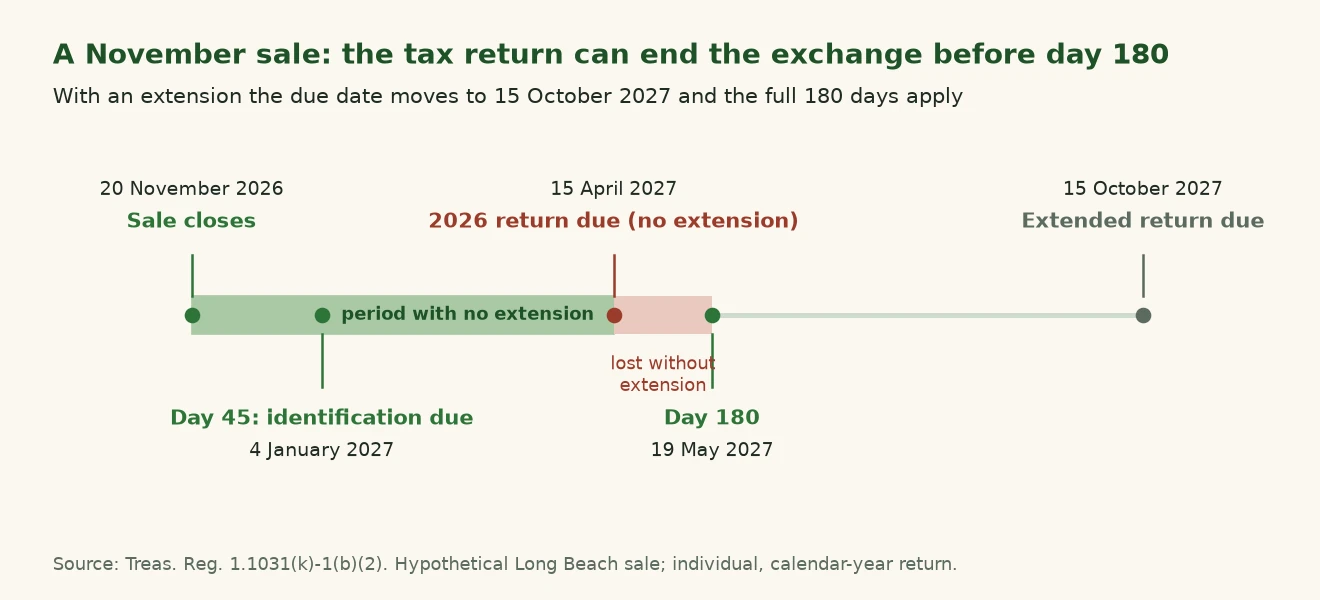
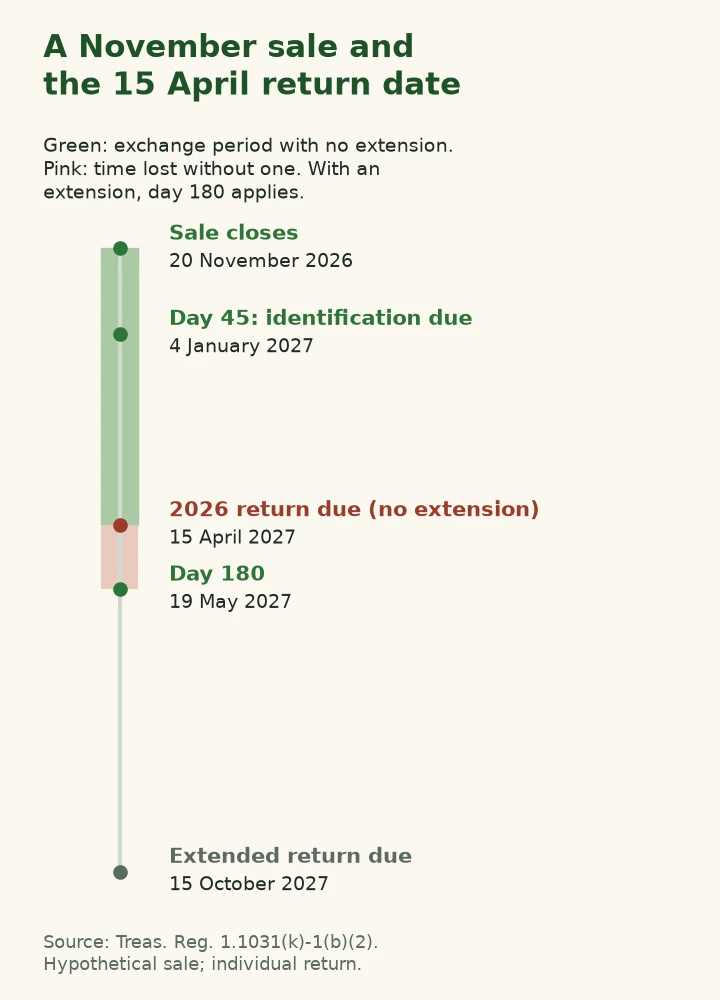
Two periods start the day the sale closes. You have until midnight on the 45th day to identify replacement property in a signed writing delivered to us. The purchase gets a later outside date, day 180. A late-year seller gets less time, because the window also shuts when that year's tax return falls due, unless an extension is on file; the regulation's words are the due date "including extensions" (Treas. Reg. 1.1031(k)-1(b)(2)(i) and (ii)). The second half of that rule catches owners who sell late in the year. Picture a Long Beach fourplex whose sale records on 20 November 2026. Day 45 is 4 January 2027 and day 180 is 19 May 2027. Its owner, filing as an individual, owes the 2026 return on 15 April 2027, five weeks ahead of day 180; unless that return is extended, the purchase must record by 15 April. File an extension and the return isn't due until 15 October 2027, so day 180 governs again. When the purchase could slip past mid-April, the extension request is the cheapest protection the exchange has, and your CPA files it.
The purchase half mirrors the sale. Your rights under the replacement contract are assigned to us as well; when that escrow is ready we send the exchange money to it, and the seller deeds the building straight to you. Your CPA then reports the exchange on Form 8824 with the return for the year of the sale, using the closing statements and the exchange account record we send at the end.
The Loan on the Building You Sell, and Borrowing for the Next
Most Long Beach buildings that sell carry a loan, and escrow pays it off from the price. The exchange rules treat that payoff as if you had been handed cash (Treas. Reg. 1.1031(d)-2). It stops being taxable when it is offset, and the regulation's second example shows how the offsets work in both directions. An owner who gives up an apartment house with an $80,000 mortgage and takes one with a $150,000 mortgage is taxed only on the $40,000 cash he was paid, because the bigger loan he took on cancels the smaller one he shed. The owner on the other side, who shed $150,000 of debt and took on $80,000, could count the $40,000 cash he paid against the difference and was taxed on $30,000. The rule runs one way only: cash you receive is never cancelled by a larger loan on the replacement. So the plain way to keep the whole gain deferred is to buy at least as much as you sold, put every dollar of the exchange account into the purchase, and let new borrowing or your own cash cover the rest. Tell your lender early that the purchase is part of an exchange, because the loan has to fund into the same escrow that receives our wire.
Form 593 at the Long Beach Closing
California collects tax on real estate sales at the closing table. Unless an exemption applies, the escrow holder withholds 3 1/3% of the sales price, or an amount figured on the gain if the seller elects the alternative calculation, and sends it to the Franchise Tax Board (Cal. Rev. & Tax. Code 18662). No withholding applies to a sale of $100,000 or less. A deferred 1031 exchange is exempt at the initial transfer: you certify the exchange on Form 593 and get the signed form to the escrow officer, or to us as your qualified intermediary, before the sale closes, and the whole of the net proceeds comes to your exchange account (FTB Form 593 instructions, 2026). Escrow files the certified form with the FTB anyway; the deadline is the 20th of the month following the close. On a hypothetical $2,400,000 ten-unit sale, the standard withholding at the FTB's factor of .0333 would be $79,920, money that would otherwise sit with the state until you file, instead of going toward the replacement building.
Cash Taken Out of the Exchange Is Withheld On
The exemption covers only what stays in the exchange. Take out more than $1,500 in cash or other non-exchange property and the qualified intermediary has to withhold on that amount. Should the exchange fall apart or fail to qualify, withholding is 3 1/3% of the whole sales price. On boot, the withholding is figured on the cash you received. The Form 593 instructions add a few details that matter on Long Beach files:
- The withholding on boot or a failed exchange is reported with the forms for the year the cash was paid out, not the year of the sale, because the gain can be reported as an installment sale.
- When co-owners sell a building and only some of them exchange, each seller's withholding is figured on that seller's ownership percentage.
- Since 1 January 2022 the qualified intermediary's obligation is limited to the funds it actually holds, for example when escrow sent less than expected or the money already went to the replacement purchase. The instructions call this a cash poor transaction, and the intermediary has to document it.
- If boot was already withheld on at the original sale and the exchange later fails, the withholding due on the failure is reduced by the amount already sent to the FTB.
If Your Buyer Asks You to Carry a Note
Some buyers of small Long Beach buildings ask the seller to carry part of the price. A note from the buyer is not like-kind real property, so if it comes to you at closing it is boot, and the gain is taxed up to its value (26 U.S.C. 1031(b)). California treats seller financing as an installment sale for withholding: escrow withholds 3 1/3% of the down payment, and the buyer then withholds on the principal portion of each later payment, unless the FTB has approved a different method (FTB Form 593 instructions). Carrying a note therefore brings tax and withholding into an exchange that was meant to defer both. If a buyer's offer depends on seller financing, settle with your CPA and with us how the note will be handled before you accept it, not at the closing table.
Closing Charges, State Withholding and Our Fee Side by Side
The table puts the closing charges and withholding for a Long Beach building in one place, with our own fee. Escrow, title and lender charges come on top and appear on the escrow closing statements.
| Item | Amount for a Long Beach sale | Source |
|---|---|---|
| County documentary transfer tax | $1.10 per $1,000 of value conveyed, less any lien that stays on the property: $2,640 on a hypothetical $2,400,000 sale with no lien left in place. Collected at recording; exchanging instead of selling changes nothing here | Los Angeles County Registrar-Recorder/County Clerk |
| City transfer tax | None. Long Beach is not one of the five Los Angeles County cities that add a rate of their own | Same county table |
| California withholding at closing | Not withheld on a deferred 1031 exchange certified on Form 593; without that certification, 3 1/3% of the price, or a gain-based figure if the seller elects it | FTB Form 593 instructions |
| Boot paid out to you | The qualified intermediary withholds when it exceeds $1,500 | FTB instructions for Form 593, deferred exchange rules |
| Universal Pacific's delayed-exchange fee | $600 to $1,500 | Our fee page |
| Universal Pacific's fee with a titleholder in the deal | $3,000 to $7,500; a second company holds the deed while a reverse or improvement exchange runs | Our fee page |
Selling a Long Beach Apartment Building of 2 to 19 Units
More than half of Long Beach's renter households, 54.8%, live in buildings of 2 to 19 units (Census ACS 2020-2024, table B25032), so the property given up in a Long Beach exchange is usually a small building with tenants in place. Selling one is slower and more paper-heavy than selling a vacant house, and most of that paper is set by California's rent cap, the city's just-cause ordinance, a federal lead rule and the city's rental registration. None of these decides whether your exchange qualifies. Each can move a closing date, though, and once the sale closes your 45 and 180 days run without pause.
The Buyer Will Ask Whether the Rents Are Capped
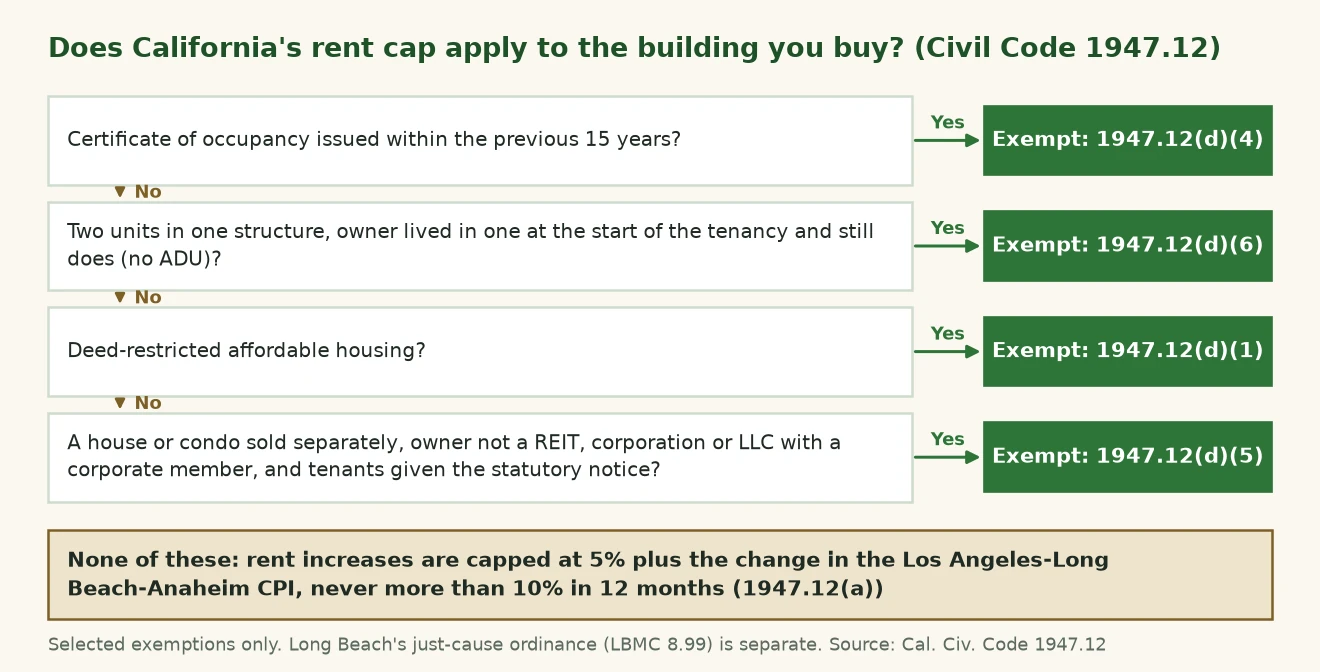
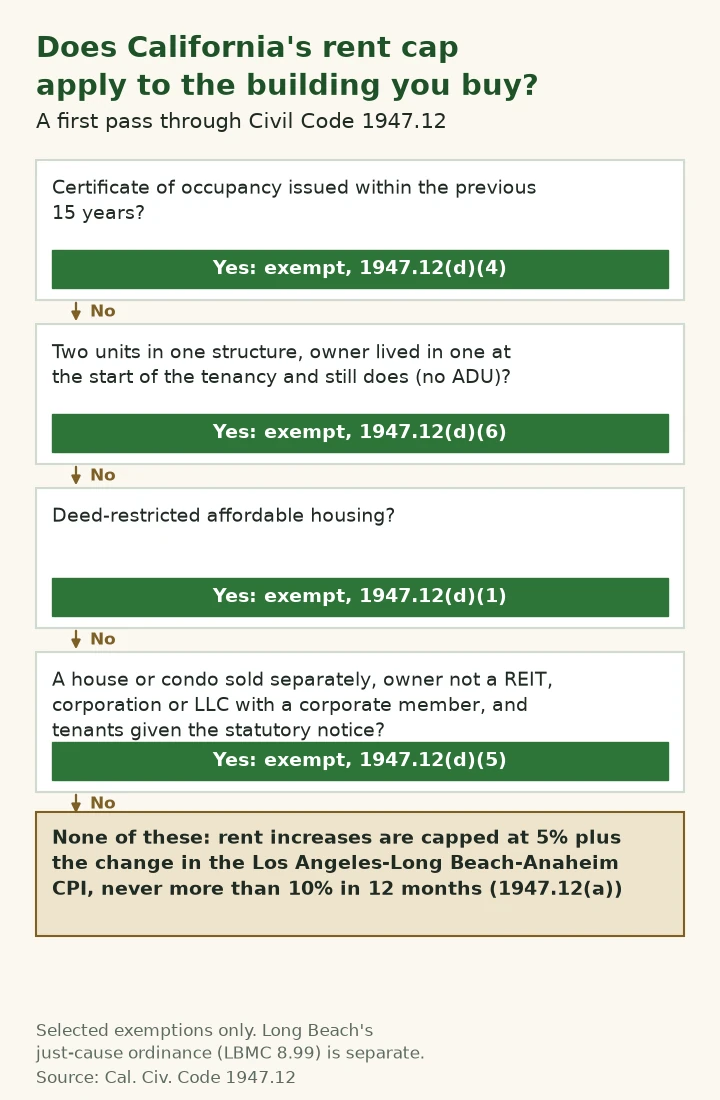
California limits rent increases on most residential units to 5% plus the change in the regional consumer price index, or 10%, whichever is lower, over any 12 months. For Long Beach the index is the one for the Los Angeles-Long Beach-Anaheim area, which covers Los Angeles and Orange counties (Cal. Civ. Code 1947.12(a) and (g)). A buyer pricing your fourplex on its rent roll will want to know whether that cap applies and when each tenant last had an increase. Buildings with a certificate of occupancy issued within the previous 15 years are exempt, and so is a two-unit building where the owner lived in one unit at the start of the tenancy and still does. The section as now written is set to expire on 1 January 2030 (1947.12(o)). Have your property manager put together the rent history before the building is listed, so the buyer's questions don't stretch the contingency period.
Emptying Units Before the Sale Costs Time and Money
Some sellers think a building with vacant units will sell faster. In Long Beach, ending a tenancy is governed by the Just Cause for Termination of Tenancies Ordinance, LBMC Chapter 8.99, which protects tenants who have lived in a unit for 12 months or more and works alongside the state's just-cause law (Civ. Code 1946.2). For a no-fault termination, the city says the tenant is owed relocation help equal to one month's rent, paid directly or by waiving the last month. A notice that doesn't follow the ordinance is void (City of Long Beach, Tenant and Landlord Resources). Nothing in the exchange rules requires you to deliver the building empty. The buyer takes the leases, and their value is already in the price.
Lead-Paint Papers on a Building From Before 1978
Housing built before 1978 is "target housing" under the federal lead rule (40 CFR 745.103), and that takes in most of the courtyard buildings and walk-ups that trade in Long Beach. Before the buyer is bound by the contract, you hand over the EPA pamphlet, disclose any lead-based paint you know about and give copies of any reports, including reports on common areas (40 CFR 745.107). The buyer also gets 10 days to test for lead unless the parties agree in writing to a different period or the buyer waives it (40 CFR 745.110). On the replacement side the roles reverse: when you buy an older building, those 10 days are yours, and they fall inside your 180-day exchange period. Plan the inspection into the purchase timeline instead of waiving it for speed.
Balcony Inspection Reports on Buildings of Three Units or More
Many Long Beach courtyard buildings and walk-ups have wooden balconies, decks or outside stairs, and a buyer will ask for the report the state now requires on them. Under Health and Safety Code 17973, the owner of a property with three or more dwelling units must have its exterior elevated elements inspected by a licensed professional before 1 January 2026 and every six years after that. The term covers load-bearing parts that stick out past the walls more than six feet above the ground and are supported mainly by wood: balconies above all, and also decks, porches, walkways and stairways. Buildings whose permit application was filed on or after 1 January 2019 get six years from the certificate of occupancy instead. If the inspector finds an immediate hazard, the report goes to the city's Code Enforcement Bureau within 15 calendar days (City of Long Beach, Balcony Hazard Reporting). For the sale, have the report and any repair invoices in the disclosure package. On the replacement side, ask for the seller's report before day 45, because repairs the report calls for become your cost once you own the building.
The City's Rental Registration Moves to the New Owner
Long Beach inspects residential rental buildings on a schedule under its Proactive Rental Housing Inspection Program, on the authority of LBMC 18.30.120 (City of Long Beach, PRHIP). The registration form asks for the owner, a local contact, the parcel number and the number of units. A registration lasts one year, renewals are due 1 November and must arrive by 30 December, and changes have to be reported to the city within 60 days (PRHIP registration form). A change of owner is one of those changes. If your replacement is another Long Beach building, put the update on your closing checklist, and ask the seller for recent inspection results along with the leases.
Depreciation Already Taken Stays With the Next Building
A building owned for decades has been depreciated for decades. In a full exchange that history is not taxed at the sale. It carries over: the replacement takes your old basis, and if both properties are residential rentals, the carried-over basis keeps depreciating over what is left of the old 27.5-year schedule, the same recovery period and method you were already using (Treas. Reg. 1.168(i)-6(c)(3)(ii); 26 U.S.C. 168(c)). Any extra price you pay above the carried-over basis starts a new schedule of its own. Your CPA keeps both schedules, and our closing statements give the figures for each.
Sifting Long Beach 1031 Exchange Properties for Sale Until a Signed List Reaches Us at Midnight
Owners who search for Long Beach 1031 exchange properties for sale are usually 30 days into a 45-day clock. The search itself runs through your broker or your own research. Our part is to receive your written identification by the deadline, check that it describes each property clearly enough, and fund the purchase when escrow is ready. These are the Long Beach points we see most often in that window.
Check the Certificate of Occupancy Before You Count on Raising Rents
A replacement building is exempt from California's rent cap only if its certificate of occupancy was issued within the previous 15 years, and in older Long Beach neighborhoods such buildings are hard to find. Ask the listing agent for the certificate of occupancy date, not just the year built. The exemption counts from the certificate, and the 15 years roll forward each year, so a building that is exempt when you identify it may come under the cap a few years after you buy it. If your purchase price assumes rents well above the current roll, that date is worth checking before day 45, because once a building is off your list you can't add another.
Naming Several Smaller Buildings by Day 45
Many Long Beach sellers split one building into two or three. Your list may hold three buildings whatever they cost, or a longer list whose total, valued at day 45, stays at or under double the price of the building you sold (Treas. Reg. 1.1031(k)-1(c)(4)). Take a hypothetical sale of a 10-unit building for $2,400,000: three fourplexes at any price are fine, and so are five duplexes as long as the five together are listed at no more than $4,800,000. Most owners name a backup or two in case one escrow falls through. The guides on the 200% rule and the identification rules go into the edge cases.
Historic Districts and Mills Act Contracts on Older Buildings
Long Beach has 18 designated historic districts, among them Bluff Park, Bluff Heights, Belmont Heights, California Heights, Rose Park, Wrigley Area and Drake Park/Wilmore City (City of Long Beach, Historic Districts). Buying in one doesn't affect your exchange. It does affect what you can change afterwards, which is covered in the next section. Some historic buildings also carry a Mills Act contract, which can lower the property tax: the Los Angeles County Assessor compares three values each year, the Proposition 13 base, current market value and an income-based Mills Act value, and taxes the lowest (City of Long Beach, Mills Act FAQ). State law makes the contract binding on every later owner and sets a minimum term of 10 years (Cal. Gov. Code 50281). So a building that has one brings both the lower tax and the restoration duties to you. Ask the seller for the contract and the list of work still owed before you identify the building.
Writing Up a Courtyard Building With Several Street Numbers
Day 45 ends at midnight, and the signed list must be in our hands by then. An address is enough in most cases; a legal description also works. For buildings with more than one address, such as a courtyard building with a separate number for each unit, we suggest adding the parcel number from the property tax bill so there is no doubt which lot you mean. The regulation's word is "unambiguous" (Treas. Reg. 1.1031(k)-1(c)(3)), and on a corner lot with three addresses that clarity matters.
A Replacement Near the Beach Bought to Rent by the Night
Some owners picture a unit near Belmont Shore or Alamitos Beach rented to visitors instead of tenants. A unit rented in short stays can still be held for investment, but in Long Beach the city's rules decide whether you can run it that way. The city treats stays of 30 consecutive days or less as short-term rentals, registers them by type (primary or non-primary residence, hosted or un-hosted), keeps a list of buildings where they are prohibited and collects Transient Occupancy Tax from guests. Two points from the city's own page matter before you identify such a unit: state and local law forbid evicting tenants to re-list a unit as a short-term rental, and at the time of writing the city was moving to a new registration system and not accepting new registrations or renewals (City of Long Beach, Short-Term Rentals). Price a beach-area replacement on long-term rents unless the city has confirmed it can be registered.
Buying From a Sibling, a Parent or a Shared Family LLC
Sometimes the obvious replacement belongs to a sibling, a parent or an LLC you share with them. The exchange rules allow that only with conditions, because a relative counts as a related person for these purposes (26 U.S.C. 1031(f)(3)). If you buy the replacement from a related person through a qualified intermediary and that person takes cash for it, the IRS has ruled that the exchange fails, because the arrangement gets around the related-party rule (Rev. Rul. 2002-83, applying 1031(f)(4)). The reverse case, where your relative buys your building, can work. The catch is a two-year hold on both sides: a disposition by either of you within two years after the last transfer brings the deferred gain into tax in that year, with exceptions such as a death (1031(f)(1) and (f)(2)). Tell us at the first call if any party to either contract is related to you, and have your CPA look at it before you identify the property. More detail is in our guide to the rules for related parties.
Changing a Historic or Coastal Long Beach Building After You Buy It
Owners who buy an older Long Beach building usually plan work on it. The first question is when the work happens. Work finished before the deed passes to you can be part of an improvement exchange, which is set up through a titleholder and explained on our improvement exchange page. Anything later is ordinary owner's work, paid with your own money after the exchange is over. In Long Beach the city approvals below usually decide which of the two is realistic, because they take longer than the work itself.
A Certificate of Appropriateness Comes First in a Historic District
Exterior remodeling, additions and alterations in a Long Beach historic district need a Certificate of Appropriateness before a building permit is issued. City staff can approve minor requests that follow the district guidelines. Larger projects go to a Cultural Heritage Commission meeting. Demolition is harder still: the city lists an environmental review, a hearing at which the Commission can delay action by six months to a year, and an approved permit for the replacement structure (City of Long Beach, Historic Preservation). The review covers exterior changes and new construction, so interior work such as replumbing or rewiring falls outside it. If you hope to finish work before taking title, a plan built on interiors is far easier to schedule than one that depends on a new facade.
Near the Water, the Coastal Permit Comes First
All development in the city's Coastal Zone needs approval from the city or the state. Depending on the project, the city issues either a Local Coastal Development Permit or a Coastal Permit Categorical Exclusion. In the appealable area, a permit can be appealed to the city and to the California Coastal Commission, and an aggrieved person has 10 days after a decision to file an appeal. Some areas are under the Commission's own permit jurisdiction, and those projects are approved by the Commission (City of Long Beach, Coastal Planning). The city's page also points to the Mello Act, which protects low- and moderate-income housing in the Coastal Zone. That matters to anyone who plans to combine or remove units in a Belmont Shore or Alamitos Beach building. Before you identify a coastal building you mean to change, have the planner confirm which permit applies and how long its review takes.
Remodeling With Tenants in the Building
If the work requires tenants to leave, LBMC 8.99 has its own track for substantial remodels and demolition. The owner tells the city at the permit application that tenants will be displaced, gives 60 days' notice to tenants of 12 months or more, and pays $4,500 or two months' rent, whichever is greater. An owner who intentionally serves an invalid notice can face a $15,000 civil penalty (City of Long Beach, Substantial Remodel Tenant Displacement). If a titleholder owns the building while the work is done, the notices and payments come from the titleholder, so they have to be written into that arrangement from the start, with your attorney.
A Mills Act Contract Takes Longer Than the Exchange
Long Beach takes Mills Act applications once a year. The 2026 period closed on 20 March, with Commission review over the summer, Council action before October, and contracts sent to the County Recorder by the end of the year. The next period opens in January 2027 (City of Long Beach, Mills Act Program). That calendar is longer than any 180-day exchange period, so budget the purchase on the building's current tax bill. Only a contract already on the building can help during the exchange; a new one is something to apply for in the January after you own it.
Orange County, the South Bay and Exchanges Beyond Los Angeles County
Long Beach sits in the southeast corner of Los Angeles County, on the Orange County line, and a good share of our Long Beach sellers buy south and east of it, or west toward Torrance. The federal rules stay the same on both sides of the line. What changes is the recording office, the transfer tax and, in a few cities, the rent rules.
Buying a Replacement in Orange County
A deed for an Orange County building is recorded with the Orange County Clerk-Recorder, which has offices in Santa Ana, Anaheim and Laguna Hills (Orange County Clerk-Recorder). Escrow arranges the recording, and we wire the purchase funds to the escrow holder there just as we would in Long Beach. California's rent cap uses the same Los Angeles-Long Beach-Anaheim price index in both counties, so a building in Huntington Beach or Fullerton follows the same increase formula as one on Ocean Boulevard. The just-cause ordinance and rental inspection program described above are Long Beach's own, so for an Orange County building ask the seller which city rules, if any, apply to its leases.
Redondo Beach Charges a City Rate; Torrance Doesn't
Every deed recorded in Los Angeles County pays the county documentary transfer tax, and the county's table lists five cities that add a rate of their own (Los Angeles County Registrar-Recorder/County Clerk). Long Beach and Torrance are not among them. Redondo Beach, in the South Bay, is: it adds $2.20 per $1,000 of value. On a hypothetical $1,800,000 Redondo Beach sixplex that is $3,960, on top of the county tax, so ask escrow to show you which side the purchase agreement puts it on. Buying in the City of Los Angeles brings its own tax, covered on our Los Angeles page.
From Apartments to a Building Near the Port
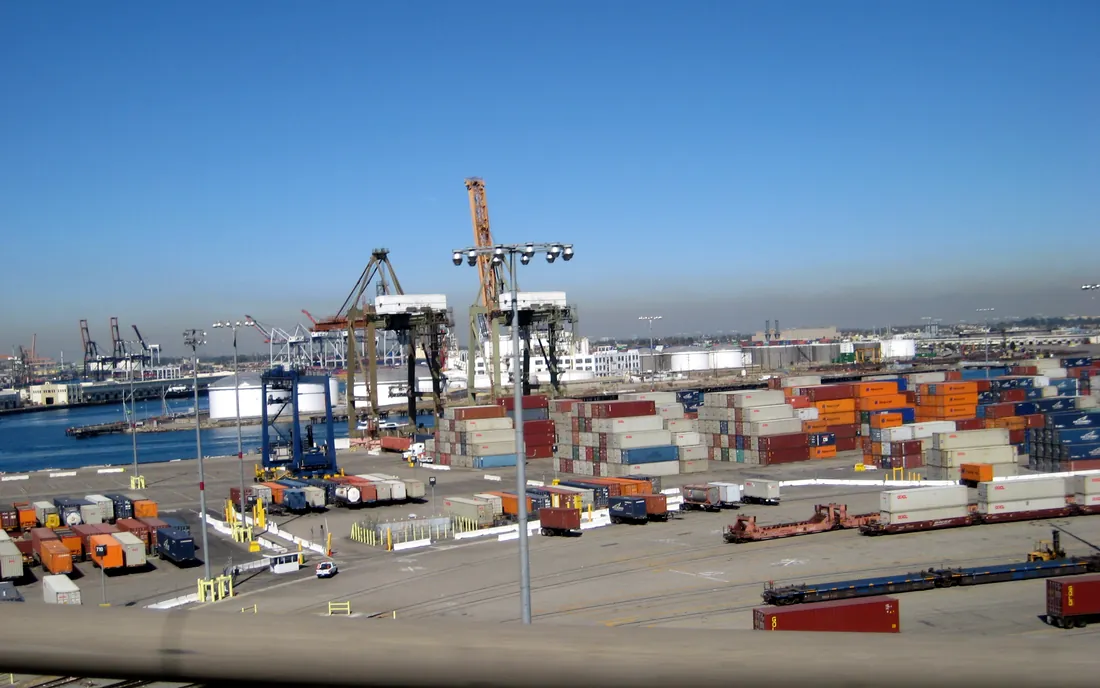
Some owners who work in the port's freight business trade a small apartment building for a small industrial or flex building near the harbor. The regulation looks at what the property is, real estate, rather than how good it is or whether it has been built on, so the swap works (Treas. Reg. 1.1031(a)-1(b)). Where the two differ for tax is depreciation. An apartment building is 27.5-year property and a warehouse is 39-year property (26 U.S.C. 168(c)). When the replacement has the longer period, the carried-over basis is depreciated over the rest of the 39-year period, as if the warehouse had been placed in service when you first placed the apartment building in service (Treas. Reg. 1.168(i)-6(c)(4)(i)). You can elect out and start the whole basis fresh instead (1.168(i)-6(i)). Your CPA runs both and picks one. See also our article on commercial real estate depreciation.
Cabins in Big Bear, Homes in Palm Springs and Buildings in Santa Barbara
This page also gets searches from owners selling or buying in Big Bear, Palm Springs and Santa Barbara, and we take those exchanges on the same terms as a Long Beach one. Two things change. A cabin or vacation home qualifies only if it is held for investment, and your own use of it is what puts that in doubt; the IRS safe harbor for homes with limited personal use is explained on our Colorado Springs page. And the deed records in another county, San Bernardino for Big Bear, Riverside for Palm Springs and Santa Barbara for Santa Barbara, where local short-term rental rules can limit how the property may be rented, so check them before you identify a vacation property. Form 593 applies to those California sales exactly as it does in Long Beach.
Leaving California With the Proceeds
If the replacement is outside California, the exchange still defers the California tax, but the state keeps track of the gain. You must file an information return, form FTB 3840, for the year of the exchange and for every later year in which the gain has not been recognized (Cal. Rev. & Tax. Code 18032(a)). The rule reaches every taxpayer who trades California real property for property elsewhere, resident or not, and an owner with no other California filing signs the form and mails it on its own. California also keeps its claim on the gain. Its source is fixed when the gain is realized, so a later taxable sale of the out-of-state building brings the deferred Long Beach gain back into California's reach (FTB 3840 instructions, 2025). Each exchange gets its own form, and an LLC that is a disregarded entity is reported by its owner. Missing the form is not a small slip when you have no California return on file either: the statute lets the FTB work out an income figure from whatever it has, the deferred gain included, and propose an assessment with interest and penalties (18032(b)). Under the 2025 instructions an individual files by 15 April 2026, or 15 October 2026 with an extension. California's own rates on a taxable sale are in a separate article on California capital gains tax on real estate; our locations page lists the other cities we write about.
When a Long Beach Building Exchange Runs Into Trouble
We don't negotiate your sale or inspect the buildings. We hold the money, keep the documents in order and watch the dates. This is what happens on our side when a Long Beach exchange hits a problem.
| What happens | Effect on the exchange | What we do |
|---|---|---|
| Your buyer's lead inspection or rent-roll questions push the sale closing back | None yet. The 45 and 180 days start only when the sale closes | Update the expected dates and keep the exchange agreement and assignment ready for the new closing date |
| Escrow is about to withhold 3 1/3% because no signed Form 593 is on file | That slice of the price is sent to Sacramento instead of being reinvested | Send you the form to certify the exchange and confirm with escrow that it arrived before the close |
| A tenant notice served before the sale turns out not to follow LBMC 8.99 | The notice is void, so the unit stays leased and the buyer may renegotiate | Nothing changes on our side. The exchange works the same with tenants in place |
| One of three identified fourplexes falls out of escrow after day 45 | You can only buy from the list you sent by day 45 | Check the backup properties on your letter and fund the next escrow when it is ready |
| A seller discloses a Mills Act contract with restoration work still owed | No effect on the exchange; the contract binds you as the next owner | Hold the funds while you and your attorney decide, then fund or release as your instructions say |
| The replacement won't close before 15 April and the sale was late in the year | Without an extension filed, 15 April becomes the cutoff | Flag the date to you and your CPA in time to file the extension |
| Day 180 arrives with money left over | Unspent cash is paid out to you and is taxable, and California withholding applies if it is more than $1,500 | Pay out the balance on the dates the regulations allow, file Form 593 for the withholding and send the figures your CPA needs for Form 8824 |
These are Census figures for the city of Long Beach from the 2020-2024 American Community Survey, next to the U.S. figure.
Source: U.S. Census Bureau, American Community Survey 2020-2024 5-year estimates. The rent-to-value figure compares median rent with median home value; it is not a property yield. See the table for all 51 cities.
What Long Beach Sellers and Orange County Buyers Want to Know
Yes. A 1031 exchange in Orange County runs under the same federal rules, and the same qualified intermediary can take a sale in Long Beach and fund a purchase in Irvine, Costa Mesa or Anaheim, or the other way round. One exchange can also buy in both counties, for example a fourplex in Long Beach and a small retail building in Orange County, as long as both are on your identification letter by day 45. Whichever Orange County escrow or title company you pick handles that closing, and the exchange money is wired there on the day. We don't have an Orange County office, and we don't need one to run the exchange.
No law makes you hire one, but almost every Long Beach seller uses one, because the exchange fails if you receive or control the sale money before the replacement closes (Treas. Reg. 1.1031(k)-1(f)(1)). A qualified intermediary is the safe harbor built for a sale now and a purchase later from a different seller; the other safe harbors, and why a qualified intermediary is not mandatory, are set out on our Los Angeles page. What you can't do is let an ordinary Long Beach escrow pay the proceeds out to you at closing and hope to reinvest them.
Through a local broker, the commercial listing services and owners you approach directly. Nothing in the rules requires the replacement to be listed for sale, only that it is unambiguously described in your signed identification by day 45 (Treas. Reg. 1.1031(k)-1(c)(3)). Some Long Beach owners identify a building whose owner has agreed to sell but has not yet listed it. If you do, get the price and terms in writing before day 45, because a building you can't buy by day 180 doesn't help the exchange. We don't recommend specific properties; we check that the letter is complete and fund the purchase.
No. If you hold the sale money yourself, even in a separate account, you have received it, and the exchange becomes a sale (Treas. Reg. 1.1031(k)-1(f)(1)). The same goes for the people who act for you. The regulation's list of disqualified persons, who can't serve as your qualified intermediary, starts with whoever acts for you now; a property manager who collects your rents and signs leases is the common Long Beach example. It then looks back over the two years before the sale and takes in the people who worked for you in that time: the CPA who did your returns, your lawyer, an employee, the broker or banker who handled your investments, and the agent who listed or bought property for you. Close relatives and companies you control are on the list too (Treas. Reg. 1.1031(k)-1(k)). Help with the exchange itself doesn't count against a person, and neither do routine title, escrow or banking services, so a title company that only handled escrow can still serve. Your manager and your CPA stay on the file; the one job they can't take is holding the funds.
Three things. A cooperation clause in the purchase or sale agreement, so the other side agrees in advance to the exchange. The assignment of the contract to us, with every party told about it in writing no later than the closing date, because without that timely notice the regulations don't treat us as stepping into the contract (Treas. Reg. 1.1031(k)-1(g)(4)(v)). And our escrow instructions, which tell the escrow officer to deed the property directly between the real buyer and seller and to wire the funds to or from our exchange account. We prepare the assignment and the escrow instructions; the cooperation clause goes into the contract when it is drafted.
Our only office is in Los Angeles, and distance changes less than people expect: a qualified intermediary never needs to visit the building, and every step from the exchange agreement to the final wire can be done remotely with your local escrow officer. The question worth asking any firm near you or far away is what protects the money. Our own answer: your proceeds sit in an Exchange Trust, a segregated trust account at a major institutional bank, apart from our operating funds; the firm is covered by an E&O policy and a fidelity bond; and reconciliation reports for the account are available on request. Ask the same of any qualified intermediary you compare us with, and see our checklist for vetting an intermediary for the documents to request.
Yes, on the same terms as Long Beach. Owners looking for a 1031 exchange consultant in Torrance usually need the qualified intermediary role described on this page, plus a CPA for the tax return. Torrance deeds record with the Los Angeles County Registrar-Recorder, just like Long Beach deeds, and Torrance has no city transfer tax of its own, so a Torrance sale pays only the county rate. The rent cap applies there under the same price index, and a Torrance building from before 1978 carries the same federal lead disclosure as a Long Beach one.
Expect $600 to $1,500 if you sell first and buy later, and $3,000 to $7,500 if a titleholder has to own a building for a while; both ranges come from our fee page. Two things move a Long Beach quote within those ranges. Selling one building and buying two or three adds a closing, an assignment and a wire for each extra purchase, so ask for the quote with the number of replacements you expect. And a reverse exchange needs a titleholding company that owns the property for a time, which is why it costs more than a delayed one. Escrow, title, lender and transfer-tax charges are separate and appear on the escrow closing statements.
Yes. The Orange County Clerk-Recorder's fee schedule lists the documentary transfer tax at $0.55 per $500 of value, the same as the $1.10 per $1,000 county rate on a Long Beach deed (Orange County Clerk-Recorder fee schedule). A hypothetical $1,500,000 building in Orange County would carry $1,650 of it. When you are the buyer in Huntington Beach or Irvine, check which side the purchase agreement puts it on. Exchanging rather than selling outright leaves this tax unchanged for buyer and seller alike.
A rented condo or house is real property held for investment, so it can be the property you sell or the one you buy. The rules for tenants depend on who owns it. Long Beach's just-cause ordinance doesn't cover single-family homes or condominiums owned by a natural person rather than a REIT, corporation or LLC (City of Long Beach, LBMC 8.99 summary). The state rent cap has a similar exemption, but it only applies if the tenants were given a specific statement in writing, and for tenancies that began or renewed on or after 1 July 2020 that statement has to be in the rental agreement (Civ. Code 1947.12(d)(5)). When you buy a rented house, check the lease for that statement before you count on raising the rent.
The accommodator does. Under the IRS safe harbor the parked building is titled to an exchange accommodation titleholder, bound by a written agreement, until your Long Beach property sells. The building you are giving up has to be identified within 45 days after the titleholder takes title, and the parking has to end within 180 days (Rev. Proc. 2000-37, section 4.02). The qualified intermediary's part is the usual one: it takes the sale of your Long Beach building and holds the proceeds until they go to end the parking arrangement. Because the titleholder actually owns the property for a time, this structure costs more than a delayed exchange.
All of them. We handle exchanges for owners anywhere in California and in other states, and besides this page we have city pages for Los Angeles, San Diego, Fresno, Sacramento, San Francisco, Oakland and San Jose. The federal rules are the same everywhere. What changes from one California county to the next is the recorder, the transfer tax and local tenant ordinances, which is why each page covers its own city.
The answer turns on your identification letter. If you identified nothing by day 45, the exchange agreement can let us release the funds to you after day 45. Once you have named property, the money normally sits until day 180. Early release is allowed only after you've closed on everything you named, or after a written contingency outside your control comes up after day 45 (Treas. Reg. 1.1031(k)-1(g)(6)). Money released to you is taxable in the normal way.

Who Works on Your Long Beach File at Universal Pacific
Each Long Beach file is overseen by Michael Bergman, CPA, who also reviewed this page. The rest of the people who work on your file are on the team page. The questions we hear most often from Long Beach owners are about rent rolls, old buildings, Form 593 and county lines, so most of this page is about them.
Start an ExchangeSources
Federal law and regulations
- 26 U.S.C. §1031Exchange of real property held for investment; (f) related persons
- Treas. Reg. §1.1031(k)-145 and 180 days including extensions, identification, qualified intermediary, disqualified persons, release of funds
- Treas. Reg. §1.1031(a)-1(b)Like-kind refers to the nature of the property, not its grade or quality
- Treas. Reg. §1.168(i)-6Depreciation of replacement property after an exchange; election out
- 26 U.S.C. §168(c)Recovery periods: 27.5 years residential rental, 39 years nonresidential
- 40 CFR Part 745, Subpart FLead-based paint disclosure on sale of housing built before 1978 (745.103, 745.107, 745.110)
IRS guidance
- Rev. Proc. 2000-37, 2000-40 I.R.B. 308Reverse and improvement exchanges through an exchange accommodation titleholder
- Rev. Rul. 2002-83Replacement property bought from a related party who receives cash
California tax and exchange law
- Cal. Rev. & Tax. Code §18662Withholding on sales of California real property; like-kind exchange exemption
- FTB, 2026 Instructions for Form 5933 1/3% withholding, $100,000 threshold, exchange exemption, boot over $1,500, failed exchanges, cash poor transactions
- Cal. Rev. & Tax. Code §18032Annual information return for California property exchanged for out-of-state property
- FTB, 2025 Instructions for Form FTB 3840Who files, when, source of the deferred gain, failure to file
- Cal. Fin. Code, Division 20.5 (§§51000-51013)Exchange facilitators; the client-protection rule in §51003 is explained on our Los Angeles page
California housing law
- Cal. Civ. Code §1947.12Rent increase limit, exemptions, regional price index, 2030 sunset
- Cal. Civ. Code §1946.2State just-cause rules for ending a tenancy
- Cal. Gov. Code §§50280-50290Mills Act contracts: 10-year minimum, binding on later owners
City and county
- City of Long Beach, Tenant and Landlord ResourcesJust Cause for Termination of Tenancies Ordinance, LBMC 8.99
- City of Long Beach, Substantial Remodel Tenant DisplacementNotice to the city, 60-day notice, $4,500 or two months' rent
- City of Long Beach, Proactive Rental Housing Inspection ProgramInspections under LBMC 18.30.120; registration form
- City of Long Beach, Historic PreservationCertificates of Appropriateness, demolition review
- City of Long Beach, Historic DistrictsThe 18 designated districts
- City of Long Beach, Mills Act Program2026 application cycle; FAQ on assessment and transfer to new owners
- City of Long Beach, Coastal PlanningCoastal Zone, LCDP and CPCE, appeals, Mello Act
- Los Angeles County Registrar-Recorder/County ClerkDocumentary transfer tax and the five cities with their own rates
- Orange County Clerk-RecorderRecording offices in Santa Ana, Anaheim and Laguna Hills; fee schedule with the documentary transfer tax
Data and fees
- American Community Survey 2020-2024, 5-year estimatesU.S. Census Bureau; table B25032 (renter households by units in structure), and B25077, B25064, B25003 for the housing panel
- Universal Pacific, 1031 exchange feesFee ranges quoted on this page
Photos
- Photo at the top of the pageBluff Park and Bluff Heights, looking southwest, by Darkest tree, CC BY-SA 4.0, via Wikimedia Commons
More Reading on Multiple Replacements, Related Sellers and Commercial Depreciation
Set up your Long Beach 1031 exchange
Call Now For A Free Consultation · (424) 469-8111