

Qualified Intermediary for 1031 Exchanges in San Antonio
For a San Antonio sale, the qualified intermediary holds the sale money between your two closings, so it never reaches your hands, which is one of the conditions for keeping the gain deferred. Texas has no personal income tax, which means everything you defer is federal: capital gains tax, the up-to-25% tax on past depreciation and, above certain incomes, the 3.8% net investment income tax. A family company or a December closing can end the exchange earlier than the usual 180 days.
Looking for a reliable 1031 exchange intermediary in San Antonio? Universal Pacific 1031 Exchange can help! We handle exchange transactions for real estate investors across different states. We track the paperwork and the deadlines on 1031 tax-deferred exchanges in San Antonio.
This page is written for owners who have held San Antonio property for a long time, and for the spouses, heirs and family companies who end up owning it.
Reviewed by Michael Bergman, CPA
Last updated 9 November 2026 · Sources for this page


Universal Pacific works from 1180 S. Beverly Drive, Suite 500, Los Angeles. Your San Antonio sale still closes locally, at a San Antonio title company, and the purchase closes wherever the replacement property is.
With a professional history managing transactions ranging from $100,000 to over $100 million, our company combines genuine business acumen, real estate insight, and financial expertise.
How Long San Antonio Owners Hold On, and Why It Shapes the Exchange
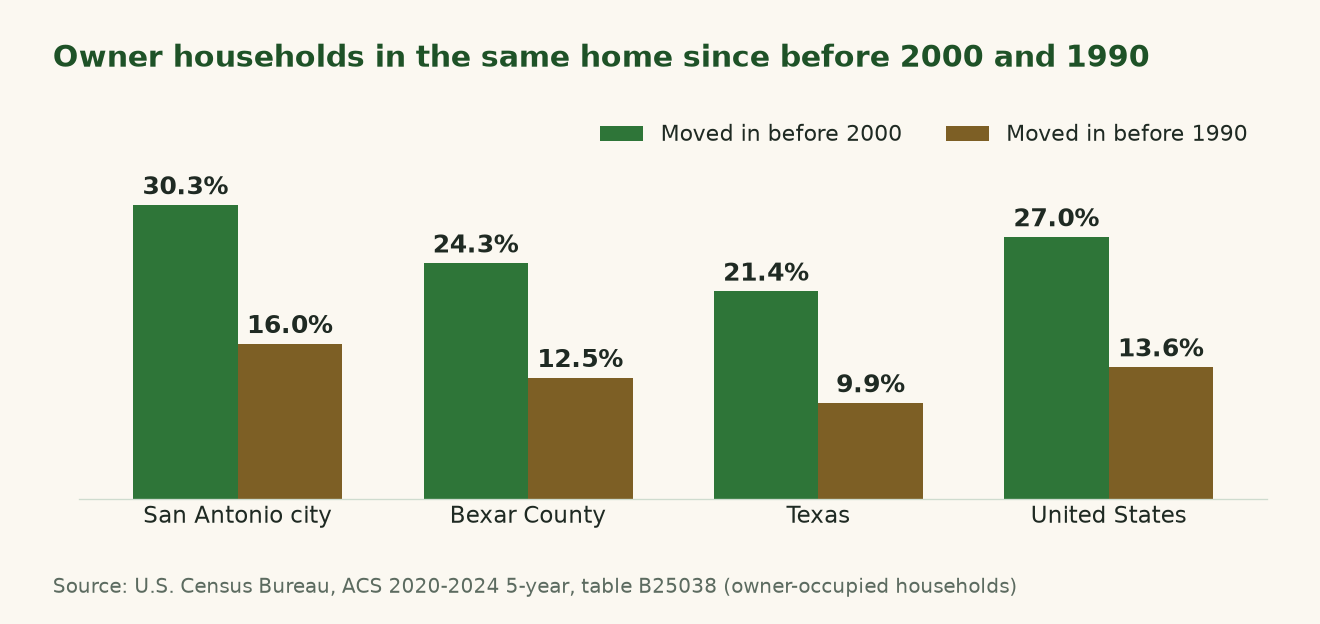
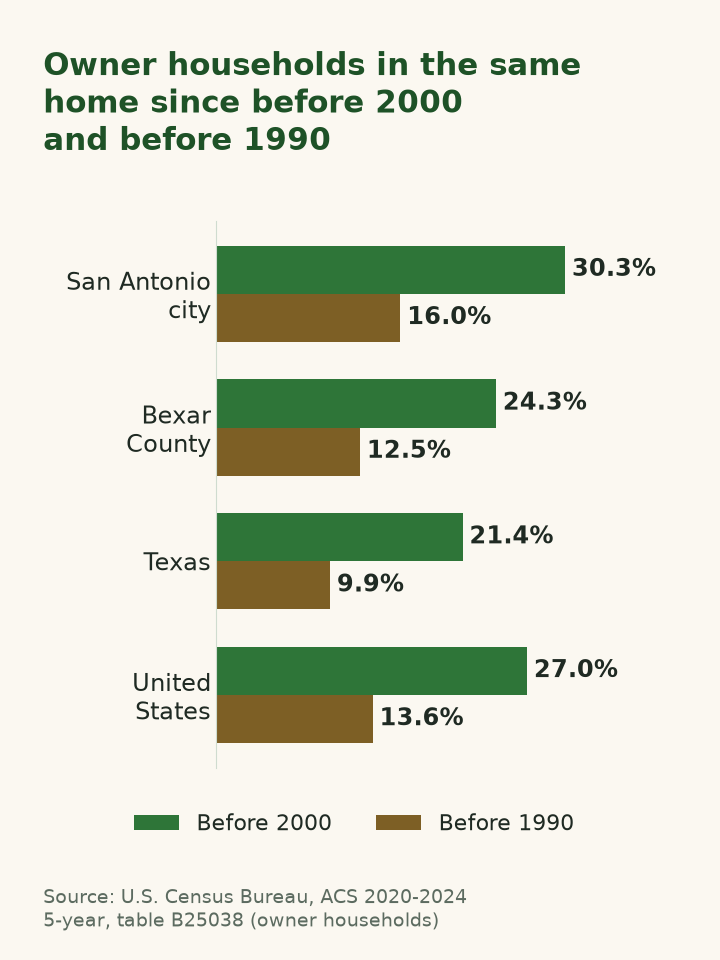
San Antonio homeowners stay put, more so than Texans as a whole. The Census figures below describe the people who own here. Each row says what the figure changes about an exchange.
| Figure | What it means for a San Antonio exchange | Source |
|---|---|---|
| 30.3% of owner households moved in before 2000 (Texas 21.4%) | Long ownership usually means a low purchase price on the books, so most of today's sale price is gain | Census ACS 2020-2024, table B25038 |
| 16.0% moved in before 1990 (Texas 9.9%) | A rental bought that long ago has been fully depreciated for years; that depreciation is taxed at up to 25% on a sale | ACS B25038; IRS Pub 527 |
| 32.1% of owner households are headed by someone 65 or older (Texas 28.1%) | Property can pass to a spouse or to heirs, and Texas community property rules can change the basis | ACS B25007; IRS Pub 551 |
| Median home value $235,700; 47.8% of households rent (ACS 2020-2024, the same figures as the housing panel below) | The worked tax example on this page uses a $235,700 sale | ACS B25077, B25003 |
| Texas personal income tax: none | The tax you defer is federal only | Texas Constitution, Art. 8, Sec. 24-a; Texas Comptroller |
| Texas real estate transfer tax: the constitution bars any new one (since 2016) | The Bexar County Clerk's published real property fees are recording fees | Texas Constitution, Art. 8, Sec. 29; Bexar County Clerk fee schedule |
| Federal rates on a sale: 0%, 15% or 20% on capital gain; up to 25% on unrecaptured section 1250 gain; 3.8% NIIT above $200,000 (single) or $250,000 (joint) | These are the pieces an exchange postpones | IRS Topic 409, Topic 559 |
On this page:
- Exchange services for San Antonio sellers
- What the intermediary does with your money
- Long-held property and family owners
- What a San Antonio seller owes and defers
- Contracts, deeds and the Bexar County Clerk
- Properties for sale and ZIP 78263
- A closing on 2 December 2026, counted day by day
- Questions about accommodators, advisors and companies
1031 Exchange Services in San Antonio: Delayed, Simultaneous, Reverse and Improvement
Whether you’re considering a delayed, simultaneous, reverse, or improvement exchange, we offer dedicated support tailored to your unique investment needs. Our 1031 exchange process covers how your sale money is held, the documents the IRS rules call for, and the timing of both closings.
Our 1031 Exchange Intermediary Services Include:
Forward exchange: sell in San Antonio, then buy within 180 days
A Delayed Exchange, commonly known as a forward exchange, is the most common type of 1031 exchange. It provides you with the opportunity to sell an existing property in San Antonio and then purchase a replacement property within 180 days. We hold your funds during this process and track each of the IRS timelines and regulations that apply to it.

Simultaneous exchange: one closing day, two deeds to record
Here the old property and the new one change hands on one date, and each deed is recorded in the county where that property sits (the Bexar County Clerk for the San Antonio one). The regulations treat an exchange as "deferred" as soon as the replacement property arrives after the relinquished property leaves, so if the purchase slips by even a day, the delayed-exchange rules apply. That is why the exchange agreement and the contract assignments are best signed before closing day, in case the dates move.

Reverse exchange: buy the next property before the San Antonio sale
A Reverse Exchange offers you the time and flexibility to acquire a replacement property before selling your relinquished property. This structure helps to address unique timing challenges that can occur in a 1031 real estate exchange in San Antonio. Someone other than you has to hold title to one of the two properties while you wait, so it takes more documents and more deeds than a delayed exchange.

Improvement exchange: build or renovate before you take title
An Improvement Exchange allows you to use your 1031 funds to improve a replacement property, thereby increasing its value and your potential return on investment. Only the work finished by the day you take title counts as replacement property, so the build schedule has to fit inside the 180 days.
What Does a Qualified Intermediary Do in a San Antonio 1031 Exchange?
A Qualified Intermediary is a neutral third party responsible for holding exchange funds and facilitating a 1031 real estate exchange in San Antonio from start to finish. Their role involves preparing the required 1031 exchange documents, working with other professionals, such as your CPA and real estate brokers, receiving and safeguarding the sale proceeds, and then using those funds to acquire the replacement property on your behalf.
A Qualified Intermediary also keeps the exchange documents in line with the IRS rules and prevents you from taking constructive receipt of the funds. Without a Qualified Intermediary, or the regulations' other safe harbor for holding the money (a qualified escrow account or qualified trust), the sale money in a delayed 1031 exchange in San Antonio could count as within your reach, and if it does, the IRS treats the deal as a sale.
When can you get the money back out?
The exchange agreement has to say that you cannot receive, pledge, borrow or otherwise benefit from the money before the exchange period ends. The regulations allow only three ways out, and the agreement can provide for them:
- You named no replacement property by day 45. The money can then be released after the identification period ends.
- You have received every replacement property you were entitled to under the agreement. Whatever is left is released.
- After day 45, a material and substantial contingency stops the purchase (for example, a seller who cannot deliver title). The agreement has to provide for it in writing, and it has to be beyond the control of you, your agents and related parties; the seller's own control doesn't count against it.
Outside those three, the money stays with the intermediary until the exchange period ends, even if you change your mind in week three. Plan the cash you need for repairs or moving before the sale closes, because it cannot come out of the exchange account (Treas. Reg. 1.1031(k)-1(g)(6)).
Where the money is kept, and the insurance behind it
Universal Pacific keeps exchange funds in an Exchange Trust and carries an Errors & Omissions policy. We also keep internal controls against fraud and theft, and we send you updates as the exchange moves.
Selling a San Antonio rental this year? Sign the exchange agreement before your title company sets the closing date. Start an exchange.
Long-Held San Antonio Property: Old Prices, Used-Up Depreciation and Family Owners
The Census figures above describe homeowners, not landlords; nobody publishes how long San Antonio rentals are held. They do describe a city where property is kept for decades and then passes within families. That pattern changes three numbers in an exchange: the basis, the depreciation left to take, and who the taxpayer is.
What a 1990s purchase leaves you as basis
Your gain is the sale price minus your adjusted basis, and adjusted basis is what you paid, plus capital improvements, minus the depreciation you took or could have taken. Land is never depreciated, so it keeps its original cost.
Take one house we use throughout this page. It was bought in January 1999 for $95,000, of which $20,000 was the land and $75,000 the building, and it has been rented out ever since. Residential rental buildings are depreciated over 27.5 years, so the building's $75,000 is used up by the middle of 2026. By a late-2026 sale, the adjusted basis is the land alone: $20,000. Any improvement records you kept (a new roof, an addition) raise that figure, which is why the receipts matter.
When the depreciation has run out
A fully depreciated rental gives no more deductions, and all of the depreciation already taken is taxed when the house is sold. An exchange postpones that tax, but it also carries the old basis into the new property: the basis of property received in an exchange generally equals the basis of the property given up, plus any extra money you put in. So if that house is exchanged into a $300,000 duplex, the duplex starts with a basis of about $100,300 ($20,000 carried over plus $80,300 of new money or new loan), not $300,000. Depreciation on the duplex is figured from the building's share of that smaller basis. Commercial buildings placed in service after 12 May 1993 follow a 39-year schedule instead of 27.5, so a shop or office bought in the mid-to-late 1990s may still have depreciation left.
A surviving spouse and Texas community property
Texas is one of the nine community property states. When a spouse dies, the IRS generally treats the total value of community property, including the surviving spouse's half, as the new basis of the whole property, provided at least half of it is included in the deceased spouse's estate. For the 1999 house, that would replace the $20,000 basis with the house's value at the date of death. A surviving spouse who sells soon afterward may have little or no gain, and in that case an exchange may not be needed at all.
Texas adds nothing at death either: since November 2025 the constitution bars a state estate, inheritance or death tax (Art. 8, Sec. 26). The rule above depends on how the property was owned. A house one spouse owned before the marriage, or one titled in an LLC, can come out differently. The estate's CPA should confirm the title and the date-of-death value before you decide whether to exchange or sell.
Heirs who inherit a San Antonio rental together
Each heir's basis in inherited property is generally its fair market value on the date of death. When three siblings inherit a rental in equal undivided shares, once the shares are in the heirs' names, each share is that heir's own real estate. (If the estate sells during probate, the estate is the seller and only the estate can exchange; the estate's attorney can confirm which applies.) One sibling can sell for cash, another can exchange their share into other property, and a third can keep theirs, as long as they hold the shares directly and have not been running the house as a partnership.
Two traps catch families:
- Trading with each other. Brothers, sisters, parents and children are related persons. If you exchange property with a relative and either of you disposes of what you received within 2 years, the deferred gain becomes taxable as of that later sale. Exceptions include a disposition caused by the death of either person.
- Putting the house in a family LLC first. Exchanges of partnership interests do not qualify. Once title sits in an LLC taxed as a partnership, only the LLC can exchange, and the members can't each choose separately.
The general steps for an inherited-property exchange are on our inherited property page.
Family companies: when the LLC is the taxpayer
If the property is titled in a partnership or an LLC taxed as one, that entity sells, that entity must buy the replacement, and the entity's own return decides the deadline. A single-member LLC is usually disregarded for federal tax, so its owner is the taxpayer and the owner's own return sets the date. A partnership's calendar-year return is due on 15 March, a month before an individual's, and the exchange period ends on the return due date if that comes before day 180. The calendar section below shows what that does to a December sale.
Texas taxes neither the individual nor the individual's share of partnership income: the constitution bars a tax on "an individual's share of partnership and unincorporated association income." An LLC or limited partnership doing business in Texas is still a taxable entity for the Texas franchise tax. Each May it files a franchise tax report with the Comptroller or, with revenue at or below $2,650,000 (2026 and 2027 reports), just an information report. That is a separate filing from the federal exchange.
Inherited a San Antonio rental with your brothers or sisters? Talk to us before anyone signs a listing agreement. Each heir who wants to exchange needs their own exchange agreement in place before their share closes.

What a San Antonio Seller Owes and Defers: Federal Tax Only
Why Texas adds nothing to the bill
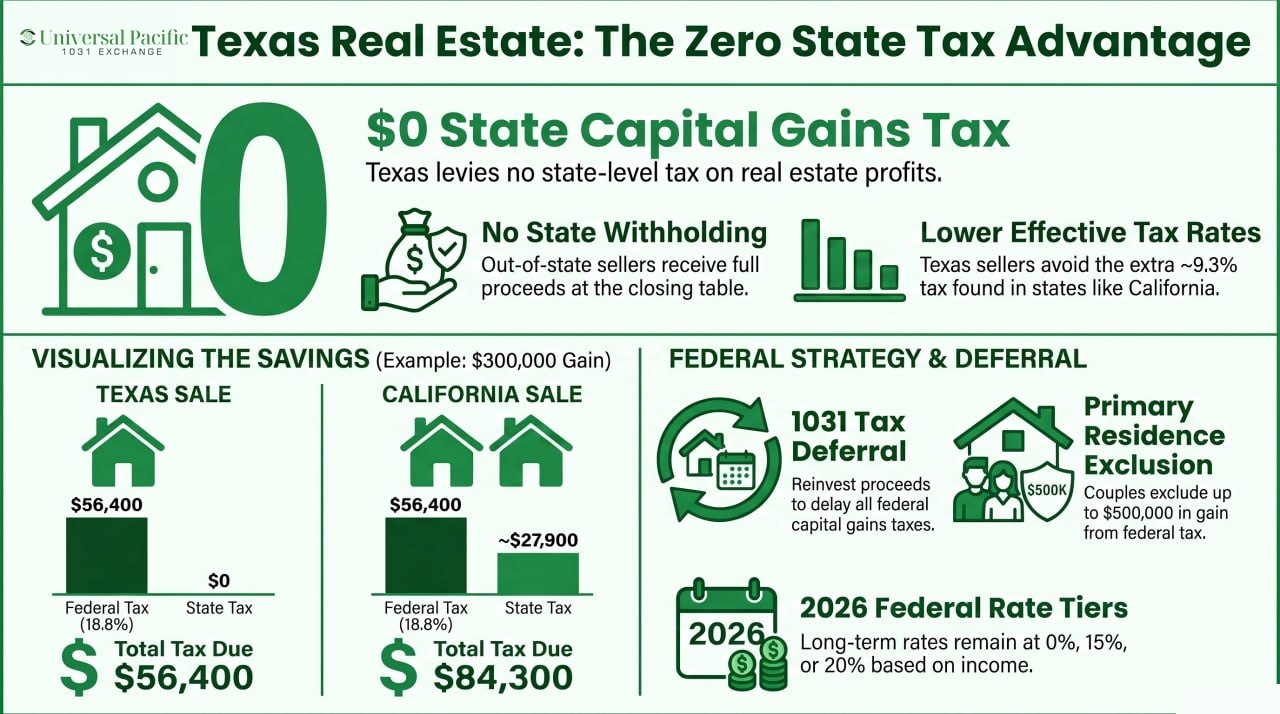
Texas has no personal income tax ("Texas has no state income tax," in the Comptroller's words). The Texas Constitution bars the legislature from imposing a tax on the net incomes of individuals (Art. 8, Sec. 24-a), and since November 2025 it also bars a tax on an individual's capital gains, including a tax on the sale of a capital asset (Art. 8, Sec. 24-b). A San Antonio seller files no state income tax return for the sale. So the whole deferral is a federal number. For the full 2026 bracket tables, see our post on Texas capital gains tax on real estate.
How does a 1031 exchange work when selling a rental property in San Antonio, Texas?
The rental's buyer pays the title company, and the title company wires your net proceeds to the intermediary rather than to you, under an agreement signed before that closing. You then pick the next property, the intermediary pays for it out of the exchange account, and the seller deeds it to you. On your federal return for the year the San Antonio property was sold, you file Form 8824, which shows the gain you deferred and the basis you carry into the new property. The rest of this page covers each step for a Bexar County sale, and the dated example shows when the 45 and 180 days actually end.
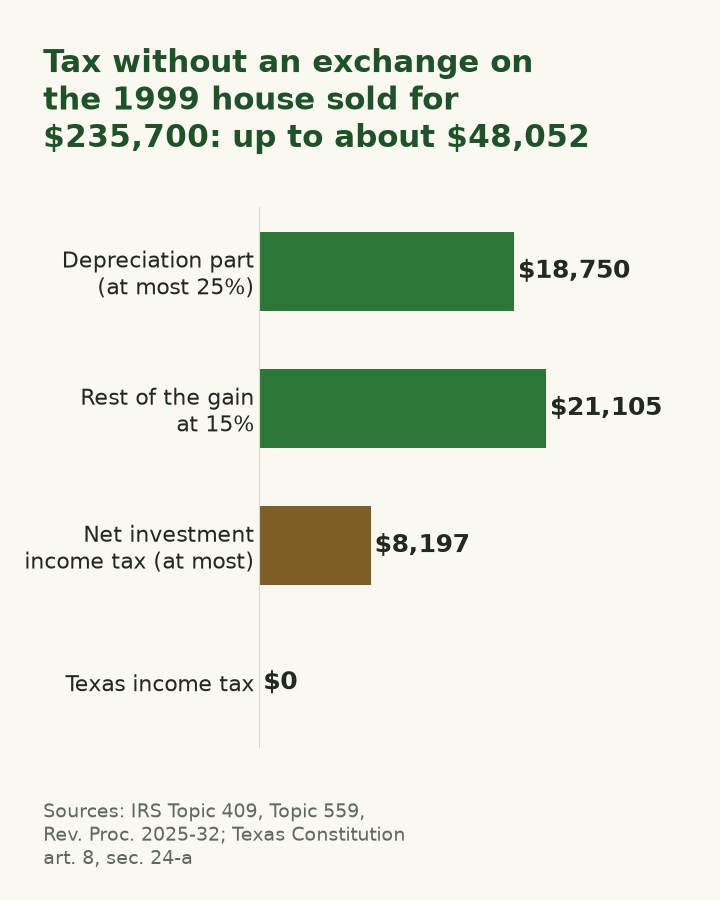
The 1999 house sold for $235,700: the federal bill without an exchange
Here is the house from the section above, sold for $235,700 (the city's median home value in the housing panel on this page), before closing costs. The owner is single, and their taxable income for 2026, including this gain, stays under $545,500, the top of the 15% capital gains band for a single filer ($613,700 for a married couple filing jointly).
| Line | Amount |
|---|---|
| Sale price | $235,700 |
| Adjusted basis (land only; building fully depreciated) | $20,000 |
| Gain | $215,700 |
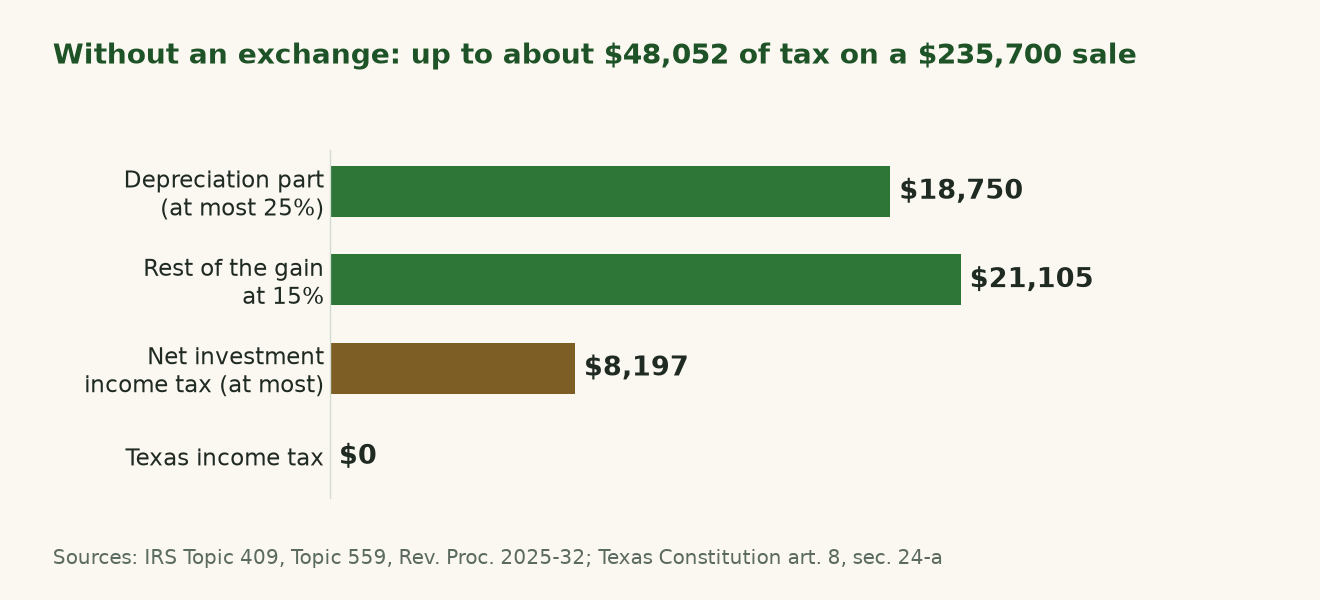
| Part of the gain from depreciation (unrecaptured section 1250 gain): taxed at the owner's income tax rate, but never above 25% | $75,000, so at most $18,750 |
| Rest of the gain ($140,700) at the 15% capital gains rate | $21,105 |
| Net investment income tax: 3.8% on the smaller of the investment income or the amount by which modified adjusted gross income passes $200,000 (single) | at most $8,197 |
| Texas income tax | $0 |
| Federal total without an exchange | up to about $48,052 |
The depreciation line can come out lower if part of it falls in an income tax bracket below 25%, and the NIIT line is zero if total income stays under $200,000. Either way, more than a third of the gain ($75,000 of $215,700) comes from depreciation, and that is the part long-held rentals carry most heavily. Run your own figures with our depreciation recapture calculator.
What the exchange postpones, and what is still taxed
An exchange postpones the whole federal bill above, including the depreciation part and the NIIT, as long as all of the value goes into the replacement. Anything you take out is taxed up to the amount of your gain. That includes cash you keep, and also debt that is paid off at the sale and not replaced on the new property by new debt or cash you add, because the IRS treats a liability taken off your hands as money received. If the owner of the 1999 house kept $30,000 from the sale, $30,000 of the gain would be taxed in the year of the sale and the rest would stay deferred. More on this is in our guide to boot in a 1031 exchange.
Selling a rental you have owned since the 1990s? Bring your depreciation schedule to the first call. It decides how much of the gain is taxed at up to 25%.
Completing a 1031 Exchange in San Antonio: Contracts, Deeds and the Bexar County Clerk
A San Antonio exchange runs on two contracts and at least two deeds. These are the steps in the order they happen:
- Before the sale closes: you sign an exchange agreement with Universal Pacific and assign your rights in the sale contract to us. Your buyer is told in writing about the assignment on or before the closing date.
- At the sale closing: the deed goes straight from you to your buyer, and the title company wires the exchange funds to us instead of paying you.
- Recording: the title company records your deed with the Bexar County Clerk.
- Within the identification period: you send us your signed list of replacement properties (rules in the next section).
- Under contract on the replacement: you assign your rights in the purchase contract to us, with written notice to the seller.
- At the purchase closing: the money for the new property comes from the exchange account, and the seller signs the deed over to you directly.
- Your next federal return: Form 8824 reports the exchange.
Which Bexar County office records the deeds, and what it charges
Deeds in Bexar County are recorded by the County Clerk's Office. The walk-in recording counter is in the Paul Elizondo Tower, 101 W. Nueva, Suite 103, San Antonio 78205, with a second counter at the Southside Annex, 3505 Pleasanton Rd. Title companies can record electronically through one of the six providers the Clerk accepts. Paper documents must be originals with original signatures; the Clerk will not record a copy, and it does not prepare deeds.
The fee is $25 for the first page and $4 for each additional page (schedule effective 1 January 2024), so a three-page deed costs $33 to record. Once a deed is recorded, you can find it in the Clerk's free Official Records Search at bexar.tx.publicsearch.us. The site itself notes it is not the official repository, so order a certified copy if a lender or court needs one.
If the replacement property is in Texas, its title insurance premium is also fixed by the state: the Texas Department of Insurance sets the premium rate, and every title company in Texas charges the same premium for the same policy. Other closing fees can still differ between title companies.
Why the county charges recording fees, not a transfer tax
Since 2016 the Texas Constitution has barred any new law that "imposes a transfer tax on a transaction that conveys fee simple title to real property," and the Bexar County Clerk's published real property fees are recording fees. So at the county, the deeds in a San Antonio exchange cost the per-page recording fee. That matters most in a reverse or improvement exchange, where the property is deeded twice.
The extra deeds in a reverse exchange
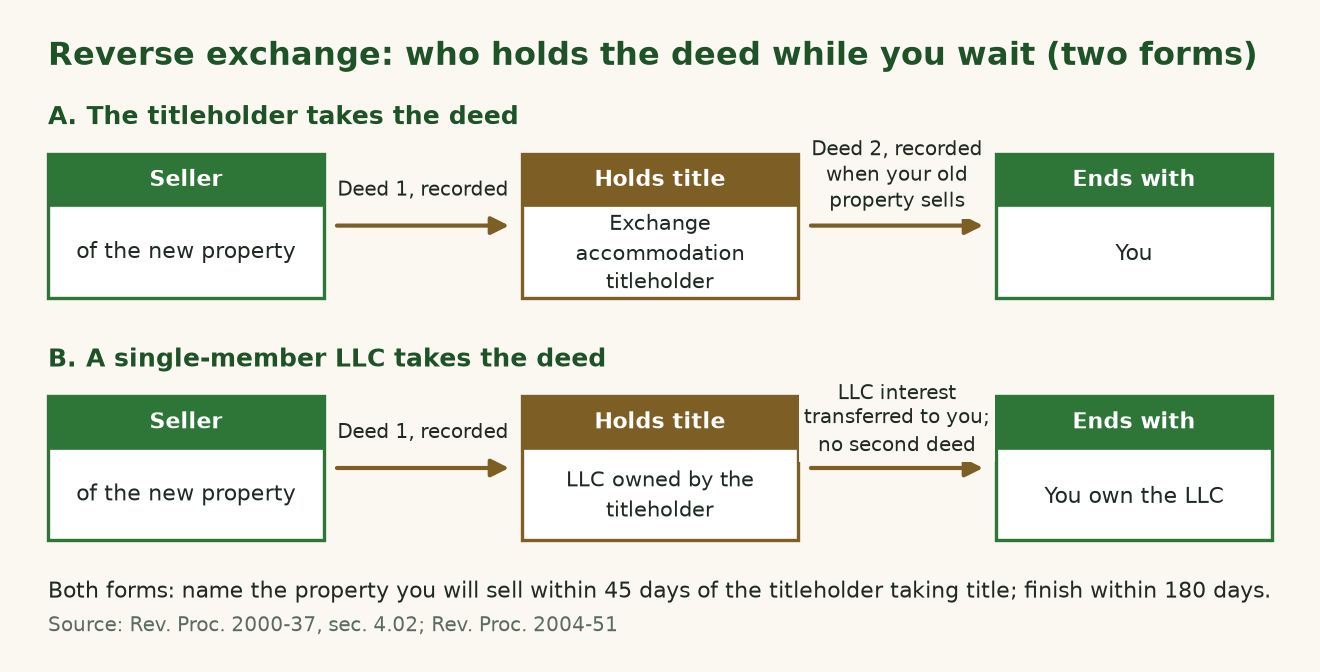
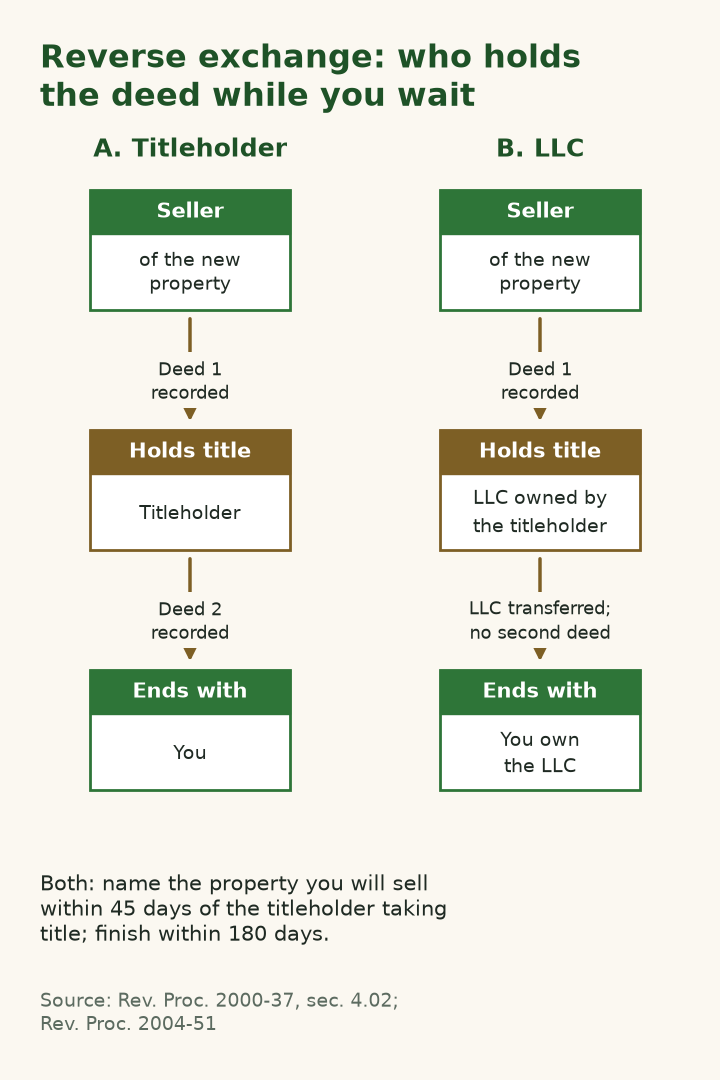
In a reverse exchange you buy before you sell, but you can't exchange into a property you already own. So an exchange accommodation titleholder, often a company affiliated with the intermediary, holds title to one of the properties under Rev. Proc. 2000-37. That takes one of two forms:
- The titleholder takes the deed itself. The seller deeds the new property to the titleholder, and that deed is recorded. When your old property sells, the titleholder deeds the new property to you, and a second deed is recorded.
- The titleholder holds a single-member LLC that takes title. The deed into the LLC is recorded once. At the end, the titleholder transfers the LLC to you, so the county record keeps the LLC as the owner.
Either way, the IRS clock is the same: the property you plan to sell has to be identified within 45 days of the titleholder taking title, and the whole arrangement has to finish within 180 days. You cannot use this route for a replacement property you owned at any time in the 180 days before it went to the titleholder (Rev. Proc. 2004-51).
Improvement exchange deeds and the build schedule
For a build or renovation, the titleholder owns the new property while contractors work on it, pays them with exchange money, and conveys it to you no later than day 180. Only the improvements in place on the day you receive the property count toward the replacement value. Work done after that is treated as services, not property. When you name a property that is still to be built, the identification gives the legal description of the land and as much detail about the planned work as you have at that time (Treas. Reg. 1.1031(k)-1(e)(2) and (e)(4)).
Property tax on the replacement: the Bexar Central Appraisal District
The Bexar Central Appraisal District values property in the county for every local taxing unit, at market value as of 1 January each year. You don't have to file anything to change the owner's name: once the deed is recorded with the County Clerk, the appraisal district receives and processes the ownership transfer. The Bexar County Tax Office then collects the tax for the county and 73 other taxing units; it does not set values or rates.
Don't budget on Texas's temporary appraisal cap. The "circuit breaker" in Tax Code section 23.231 limits yearly increases in appraised value to 20%, plus new improvements, for non-homestead real property valued at $5,320,000 or less (the 2026 figure). It starts only on 1 January of the year after the first 1 January you own the property, and as the law reads today it expires on 31 December 2026. So a replacement bought now would not reach a capped year unless the Legislature extends it. Land under agricultural or timber appraisal is not covered at all.
San Antonio and Bexar County 1031 Exchange Properties for Sale, Including ZIP 78263
Does Universal Pacific have San Antonio properties for sale?
No. This page lists no properties for sale, and as your intermediary we don't pick your replacement property. Choosing the next property is your call; you find the replacement through your own agent, a listing service or a direct seller, and you decide what to buy. Searches like "San Antonio 1031 exchange properties for sale" often come from owners who have sold, or are about to, and need to line up their next property inside the 45 days.
Naming replacement property in writing within the 45 days
Your list has to be on paper, carry your signature, and be sent before day 45 is over, to us, to the seller of the replacement property, or to another non-disqualified party to the deal, such as the title company. Hand delivery, mail, fax or any other way of sending it counts. The property must be described without ambiguity; for real estate, a street address, a legal description or a distinguishable name works. You can name:
- three properties, whatever they are worth; or
- a longer list whose combined value stays at or below twice the value of what you sold; or
- a list worth more than twice that, which works only if 95% or more of its value is actually purchased.
You can revoke or change the list with another signed document, delivered the same way, before day 45 ends. After day 45, the list is fixed. More detail is on our identification rules page.
ZIP 78263 in Census figures: who lives there
ZIP 78263 is a lightly populated area southeast of downtown San Antonio, and all of it lies inside Bexar County. The Census Bureau's 2020-2024 survey counts 4,253 residents in 1,676 households over 38.2 square miles of land, about 111 people per square mile. 75.8% of households own their home, three in four homes are single detached houses, the median home was built in 1995, and the median resident is 51 years old. The median home value is about $332,000, with a wide margin of error (plus or minus $33,386). These are facts about who lives there, not a forecast of what land or houses will sell for.
Can acreage near 78263 be exchanged for a rental house in the city?
Yes, if both are held for investment or business use. The IRS says real properties are generally like-kind whether they are improved or unimproved, so raw land can be exchanged for a building, and a building for land. The limits are use and location: your own home does not qualify, property held mainly for resale (a lot you subdivide and sell, for example) does not qualify, and a house in Mexico can't replace one in Bexar County, because U.S. and foreign real property are not like-kind.
Already under contract on a San Antonio property? Send us the address or legal description now, so the signed identification reaches us well before day 45.
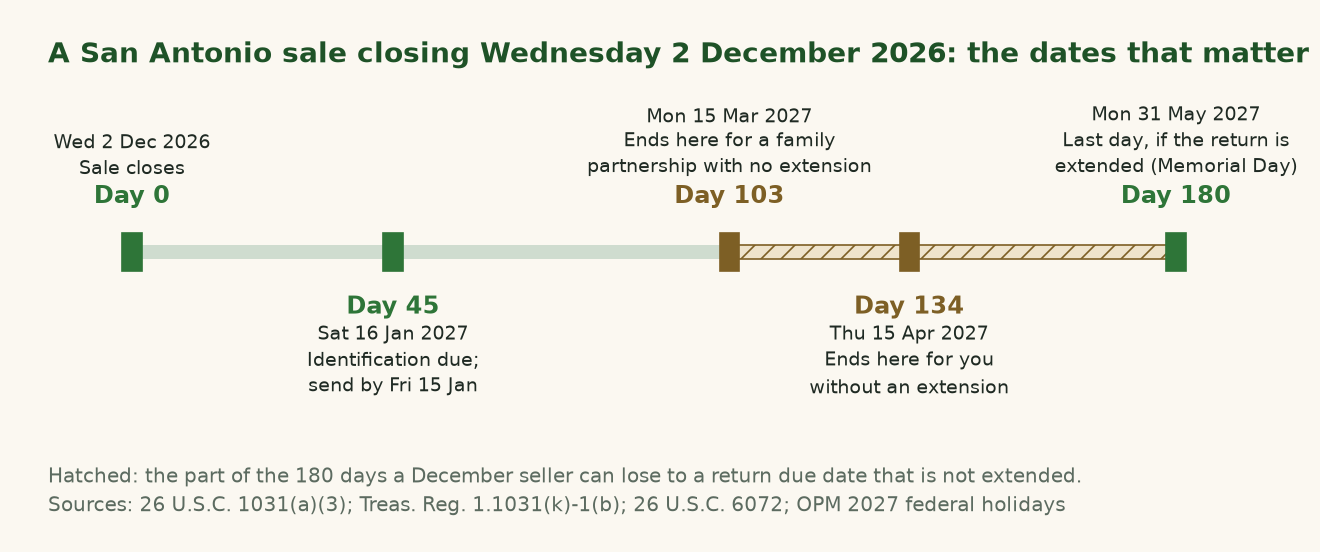
A San Antonio Closing on 2 December 2026, Counted Day by Day
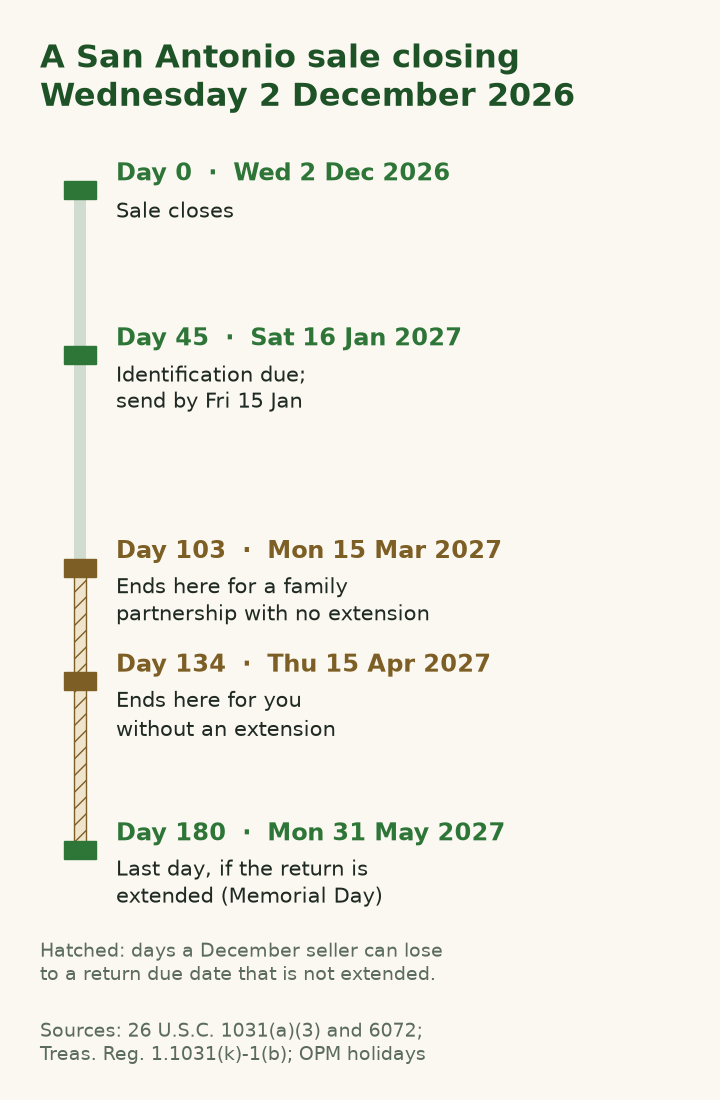
Take a San Antonio rental whose sale closes on Wednesday, 2 December 2026. The two federal clocks start that day: midnight on day 45 for the identification, and midnight on the earlier of day 180 or the due date of your tax return for 2026, including extensions. The regulation counts days with no exception for weekends or holidays.
| Date | Day | What happens | What to watch |
|---|---|---|---|
| Wed 2 Dec 2026 | 0 | Sale closes; proceeds go to the intermediary | The exchange agreement and assignment were signed before this date |
| Sat 16 Jan 2027 | 45 | Identification deadline (midnight) | A Saturday, and Monday 18 January is Martin Luther King Jr. Day. Aim to send the list by Friday 15 January |
| Mon 15 Mar 2027 | 103 | Due date of a calendar-year partnership return for 2026 | If the property was sold by a family LLC taxed as a partnership and the LLC does not extend its return, the exchange period ends here |
| Thu 15 Apr 2027 | 134 | Due date of an individual's 2026 return | If you file your 2026 return on time without an extension, the exchange period ends here, 46 days short of day 180 |
| Mon 31 May 2027 | 180 | Exchange period ends (midnight), if the return was extended | Memorial Day, a federal holiday. Plan the purchase closing for Friday 28 May or earlier |
What this means for a December sale: file an extension for 2026 (Form 4868 for an individual, which gives you until 15 October 2027 to file) if the replacement purchase might close after 15 April. A family partnership needs its own extension, filed by 15 March. An extension of time to file is not an extension of time to pay, so pay any tax you owe for other income by the original date.
Don't count on disaster relief to stretch these dates. The 1031 postponement in Rev. Proc. 2018-58 covers only property transferred on or before the date of the disaster, so it would not reach a sale closing on 2 December 2026, even though Bexar County is among the 62 Texas counties in the IRS relief announced on 27 October 2026 for the July storms.
Run your own dates with the 1031 exchange deadline calculator.
These are Census figures for the city of San Antonio from the 2020-2024 American Community Survey, next to the U.S. figure.
Source: U.S. Census Bureau, American Community Survey 2020-2024 5-year estimates. The rent-to-value figure compares median rent with median home value; it is not a property yield. See the table for all 51 cities.
1031 Exchange Accommodator, Advisor and Company Questions in San Antonio
No law names an intermediary as the only route. What the regulations require in a delayed exchange is that you never receive or control the sale money, and they give safe harbors for holding it: a qualified intermediary, or a qualified escrow account or qualified trust (Treas. Reg. 1.1031(k)-1(g)(3) and (g)(4)). A two-party swap, where you and the other owner trade deeds at one closing, leaves no sale money to hold.
In everyday use, yes: "accommodator", "facilitator" and "qualified intermediary" are names for the same job in a delayed exchange. The tax rules use "qualified intermediary" (Treas. Reg. 1.1031(k)-1(g)(4)). Rev. Proc. 2000-37 uses a longer name, "exchange accommodation titleholder", for a different role: the company that owns a property for you during a buy-first or build-first exchange. That company, or a single-member LLC it owns, is named on the deed. A delayed-exchange intermediary usually doesn't appear in the deed records, because the deeds normally go straight from seller to buyer.
Whether to exchange at all, and what it will do to your own tax return. Universal Pacific acts as a qualified intermediary and does not give legal, tax or real estate advice on your transaction. Your CPA or tax attorney is the person to run your depreciation history, your NIIT exposure and the step-up questions on this page against your own return. A "1031 advisor" who also sells you the replacement property, such as a broker offering investments, has an interest in the answer.
No. The regulations let you send your identification by hand, mail, fax or other means (Treas. Reg. 1.1031(k)-1(c)(2)), and the intermediary's work is documents and wires. What stays local is the San Antonio side: the title company handling your sale and the deed recording in Bexar County. When comparing intermediaries, ask who holds the money and in what kind of account, what insurance covers it, and what the fee is for your exchange type. Get the answers in writing and compare them before you sign.
You are out, and so is anyone on your payroll or on your side of a deal during the 2 years before your first property transferred. The regulation names employees, attorneys, accountants, investment bankers or brokers, and real estate agents or brokers (Treas. Reg. 1.1031(k)-1(k)). Help with 1031 exchanges doesn't count against them. Close family (your spouse, brothers and sisters, parents and grandparents, children and grandchildren) and companies you own more than 10% of are also out. So the agent listing your San Antonio rental and the CPA who prepared last year's return can't hold the money, though both can, and should, stay involved in the deal.
Your bank isn't disqualified just because you bank there. The regulations ignore routine financial, title insurance, escrow and trust services by a financial institution, title insurance company or escrow company when they test who counts as your agent (Treas. Reg. 1.1031(k)-1(k)(2)(ii)). So the useful question is not whether a bank is involved, but which company signs your exchange agreement and in whose name the account is held.
The fees charged by Qualified Intermediaries for a 1031 exchange can vary widely, typically ranging from $600 to $1,500 for a standard delayed exchange and $3,000 to $7,500 for a reverse or improvement exchange. The cost often depends on the complexity of the transaction.
In Bexar County a reverse or improvement exchange can also add a recording fee. When the titleholder takes title itself, its deed in and its deed out to you are each recorded at the County Clerk's fee of $25 for the first page and $4 for each additional page (Bexar County Clerk recording fees). When it holds the property through an LLC that is later transferred to you, there is no second deed. Ask for a written quote for your exchange type before your sale closes.
A 1031 exchange in San Antonio must follow certain stipulated federal IRS rules. First, the properties must be like-kind in nature, meaning that both must be held for business or investment purposes. Next, you must identify replacement property within 45 days and complete the exchange within 180 days (26 U.S.C. 1031(a)).
You also cannot receive or control the sale proceeds; a Qualified Intermediary or another safe-harbor arrangement must hold the funds (Treas. Reg. 1.1031(k)-1(g)). To defer all of the gain, buy replacement property worth at least as much as the property you sold and put all of the sale cash into it. A cheaper replacement is allowed, but the cash you keep, and any debt you shed without replacing it, is taxed (26 U.S.C. 1031(b) and (d)). The IRS also requires that the same taxpayer who sells the relinquished property must be the same as the one who purchases the replacement property.
There is no official IRS “75% rule”. The IRS identification rules for 1031 exchanges are the Three-Property Rule, the 200% (aggregate value) Rule, and the 95% Exception (Treas. Reg. 1.1031(k)-1(c)(4)). The so-called “75% rule” is just a helpful guideline some professionals make use of.
It suggests that if a replacement property (or group of properties) is at least 75% of the value of the property you sold, it might be close enough in value to work for your exchange goals. But this guideline has no legal authority. Hence, the only rules you should follow are the Three-Property Rule, 200% Rule, and 95% Rule.
You can defer capital gains tax on real estate by using a 1031 exchange, which allows you to reinvest the sale proceeds into another like-kind property (26 U.S.C. 1031(a)). To qualify, follow IRS timelines and keep the sale money out of your hands, which is what a Qualified Intermediary is for. Primary homeowners may also avoid capital gains taxes using the Section 121 exclusion. For a San Antonio seller, the tax an exchange defers is federal only, because the Texas Constitution bars a tax on the net incomes of individuals (Art. 8, Sec. 24-a).
Yes, if the trust is set up like the one in Rev. Rul. 2004-86. That ruling holds that a taxpayer may exchange real property for an interest in a Delaware statutory trust of that kind without recognizing gain, if the other requirements of section 1031 are met. The ruling turns on the trustee having no power to vary the investment, so a trust that lets the trustee buy and sell freely is a different case. DST interests are offered by sponsor companies; as intermediary, we can send the exchange funds to the purchase of an interest you have chosen. Our DST page explains how these interests work.
Not for income tax. Texas has no personal income tax (Texas Constitution, Art. 8, Sec. 24-a), so there is no state return on which to report the exchange. The federal report is Form 8824, filed with your return for the year you transferred the San Antonio property. If you exchanged with a related person, you also file Form 8824 for each of the 2 years after the year of the exchange (Instructions for Form 8824).
Three things. First, the sale contract, plus a signed notice telling your buyer that we have taken over your rights under it; the buyer gets that notice no later than closing day (Treas. Reg. 1.1031(k)-1(g)(4)(v)). Second, closing instructions that send the net proceeds to the exchange account, not to you. Third, the final settlement statement, which shows the exchange funds and any cash or debt payoff that could become taxable. The purchase side repeats the same steps with the seller of your replacement property.
Sometimes, if an IRS announcement covers you or one of the properties in the exchange. Rev. Proc. 2018-58 lists the 45-day and 180-day exchange deadlines among the acts that can be postponed after a federally declared disaster, by 120 days or to the end of the relief period, but never past your return due date or one year. The relinquished property also has to have been transferred on or before the disaster date, and you must be an affected taxpayer (or have trouble meeting the deadline because of the disaster). On 27 October 2026 the IRS announced relief for 62 Texas counties, Bexar included, for storms that began on 14 July 2026, with deadlines moved to 1 February 2027. That announcement followed a State of Texas declaration and does not mention like-kind exchanges or section 17 of Rev. Proc. 2018-58, so if your sale closed on or before 14 July 2026 and a deadline falls in that window, confirm with your tax adviser before relying on it.

Set Up the Exchange While the San Antonio Sale Is Still Under Contract
If the sale money lands in your account, no exchange can be started afterward. Call us with your contract date and the name of your San Antonio title company, and we will prepare the exchange agreement and the assignment for that closing.
Start an ExchangeSources for This Page
Internal Revenue Code section 1031; Treasury Regulation 1.1031(k)-1; IRS: Like-kind exchanges, real estate tax tips; IRS Topic 409; IRS Topic 559; IRS Publication 527; Publication 544; Publication 551; Publication 555; Instructions for Form 8824; Rev. Proc. 2000-37; Rev. Proc. 2004-51; Rev. Proc. 2018-58; Rev. Proc. 2025-32; Rev. Rul. 2004-86; Texas Constitution, Article 8, Sections 24-a, 24-b, 26 and 29; Texas Comptroller of Public Accounts; Texas Comptroller: franchise tax; Texas Comptroller: circuit breaker; Texas Tax Code section 6.01; sections 23.01 and 23.231; Bexar County Clerk; Bexar County Clerk recording fees; Bexar Central Appraisal District; Bexar County Tax Office; Texas Department of Insurance; U.S. Census Bureau, American Community Survey 2020-2024 5-year estimates (tables B25038, B25007, B25077, B25003, B25024, B25035, B01002, B01003); 2024 Gazetteer (ZCTA 78263); U.S. Office of Personnel Management, 2027 federal holidays; 26 U.S.C. 6072; IRS: when to file; IRS: extensions; IRS news release TX-2026-05.
Photo at the top of the page: Downtown San Antonio at blue hour, by Katie Haugland Bowen, CC BY 2.0, via Wikimedia Commons, cropped.
Photo in the family-owners section: Photo: Tony Kent, CC BY-SA 2.0, via Wikimedia Commons, resized.
1031 Exchange Blog

Set up your San Antonio 1031 exchange
Call Now For A Free Consultation · (424) 469-8111