What Is a Corporate Real Estate Portfolio Strategy?
A corporate real estate portfolio strategy is a plan that helps a company manage its real estate to align with its business goals and maximize value. As real estate investing becomes more popular each year, it’s crucial to develop a strategy that not only delivers returns but also keeps your business competitive.
The goal is to make smarter, more efficient decisions, including consolidating office space, investing in new locations, or selling underperforming assets. Because this concerns your overall business output, it’s wise to consult a real estate portfolio management expert on the right steps to take.
Universal Pacific 1031 Exchange is one of the most reputable 1031 exchange intermediary firms in Los Angeles and other major cities. For 35+ years we have helped real estate investors through delayed, simultaneous, reverse and improvement exchanges, build long-term wealth, and make informed property decisions with confidence. Schedule a free consultation today for the best real estate portfolio strategy.
This article explains what a corporate real estate investment strategy is, outlines key elements of a successful CRE strategy, and discusses common challenges.
What Is a Corporate Real Estate Portfolio Strategy?

A corporate real estate portfolio strategy is a plan that a company uses to manage all the buildings and properties it owns or leases, including offices, warehouses, stores, and land. The goal of this strategy is to ensure the company’s real estate portfolio supports and enhances its business goals in the best way possible.
This strategy includes several functions such as space utilization, lease administration, property acquisition, and facilities management. With how fast the world is changing, corporate real estate portfolio strategy has become increasingly important. Companies have begun looking for ways to reduce operating costs by using their buildings more wisely and avoiding the costs associated with excess space.
They are also trying to be more flexible, especially with the introduction of hybrid work models where people work both from home and in the office. In recent times, companies have shifted their focus to sustainability practices, using energy-efficient buildings and regulations that help reduce pollution.
The rise of new technologies and real estate analytics allows companies to monitor their property usage. This enables them to make informed, data-driven decisions to enhance their real estate portfolio using this method. In light of this, commercial real estate companies are required to follow several rules that guide property use, building safety, and sustainability practices.
Combined, they all play critical roles in managing a company’s real estate portfolio. For instance, tax rules, government incentives, and lease administration shape decisions pertaining to acquiring and relinquishing assets. As such, companies need careful strategic planning to avoid problems and extra costs.
The scale involved explains why this matters. The U.S. Energy Information Administration’s Commercial Buildings Energy Consumption Survey counted 5.9 million commercial buildings in the United States holding 96.4 billion square feet of floorspace, and those buildings spent $141 billion on energy in the survey year. Energy is a significant operating expense for commercial buildings, making building efficiency and space utilization important considerations in CRE planning.
Why Is a Corporate Real Estate Portfolio Strategy Important?
A real estate portfolio strategy is important because it helps companies get more value from their real estate properties by aligning physical spaces with overall business goals. When the real estate portfolio supports what the company is trying to achieve, such as growth, flexibility, or new market entry, it becomes a powerful tool.
This kind of strategic planning ensures that every office, warehouse, or facility is used to drive the company forward. One of the biggest benefits of a corporate real estate portfolio is the ability to reduce operational costs and avoid wasted space. With the help of real estate portfolio optimization, companies can improve space utilization, streamline lease management, and make better decisions about which properties to keep, lease, or sell.
This leads to more efficient operations, fewer operating expenses, and stronger financial metrics like net operating income. A smart real estate strategy also improves the workplace experience. Well-managed spaces can boost employee satisfaction and productivity, especially when designed to support hybrid work models.
In addition, aligning the real estate strategy with sustainability practices and ESG goals helps reduce the company’s environmental footprint and supports long-term investment objectives. In today’s changing real estate market, this kind of approach also provides a competitive edge and helps businesses respond more effectively to shifts in market dynamics.
What Are the Key Elements of a Successful CRE Portfolio Strategy?
Developing a successful CRE portfolio strategy goes beyond just buying and holding properties. Some industry sources estimate average commercial real estate investment returns at about 9.5% annually, although actual returns vary widely by property type, location, market conditions, and investment strategy. However, these strong returns show the value of having a waterproof CRE strategy, one that is well-planned, flexible, and built to handle risks. Here are some key components that make a strategy effective.
Portfolio Assessment and Data Analysis
Portfolio assessment is the process by which a company reviews and evaluates all the properties it owns. It helps identify which assets are performing well and which ones may need attention. An important part of this process involves regularly conducting inventory audits. This means taking stock of every one of the company’s property locations, sizes, conditions, uses, and values. By doing this, companies can have a better picture of where and how their assets are, and this helps to support better planning.
Another important aspect involves careful evaluation of lease terms, occupancy rates, and overall portfolio costs. Many companies now use real estate management software and data analytics tools to simplify this process. These tools help to track performance and highlight trends. They also provide real-time insights across multiple properties. With access to better data, companies can make better choices, improve portfolio performance, and plan for future needs.
Space Optimization and Utilization
With the rise of hybrid work, many companies are starting to question whether they actually need all the office space they’re paying for. Envoy’s 2023 Workplace Trends Report says that about 82% of the companies it surveyed had adopted some form of hybrid work, which means that employees can now split their time between home and office. With fewer people in the office every day, it’s important to ensure that workspaces actually match the people using them.
This helps avoid wasted space while still facilitating teamwork and productivity. Many companies are also turning to optimization strategies such as flexible spaces and coworking options. These flexible spaces allow businesses to adjust their real estate quickly as their investment goals change. This approach helps reduce long-term commitments and control costs.
Another notable focus is on reducing underutilized properties. Recent XY Sense data shows that global workplace utilization remains below pre-pandemic levels, with utilization generally in the 40% range rather than the 60% to 65% levels seen before the pandemic. Companies rely on real estate analytics and occupancy data to identify underused spaces. These insights help them determine whether to repurpose, sublease, or sell those properties.
The pressure to shed space runs against a long structural trend. EIA data shows the average U.S. commercial building has grown larger over time, with the number of buildings up 6% and total floorspace up 11% between the 2012 and 2018 survey years. Portfolios built during that expansion are the ones now carrying the most surplus square footage.
By focusing on space optimization, companies can lower operating costs, improve efficiency, and better align their corporate real estate strategy with today’s way of working. This approach helps businesses save money and make better use of their real estate.
Risk Management and Scenario Planning
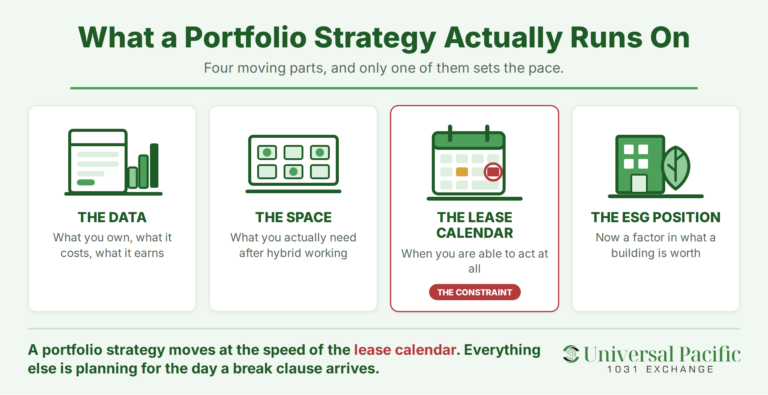
One critical focus area here is effective management of lease expirations and renewals. Without proper planning, when leases approach expiration, companies can face higher rents, relocation costs, or disruption if they have not planned whether to renew, renegotiate, relocate, or consolidate. Hence, it is important to effectively track these important dates and renew early to prevent disruptions and maintain portfolio stability.
Leveraging effective risk management strategies can help companies better anticipate potential challenges, respond to market movements, and safeguard long-term portfolio performance. In the same manner, changes in the real estate market or the economy can greatly impact property values, rents, and occupancy rates. To prepare for these changes, companies use scenario planning.
They do this to plan ahead and envision different possible futures, like economic crises or shifts toward remote work. This helps them create contingency plans to protect their investments and respond quickly to change. Overall, combining efficient lease management with thoughtful scenario planning, reducing uncertainty, and minimizing risks helps you make better strategic decisions, even at the peak of market volatility.
Technology Integration
Technology is becoming an essential part of modern corporate real estate portfolio strategy. With the rise of PropTech and artificial intelligence, companies and real estate investors can now make faster and more accurate decisions about their real estate portfolio. These tools help automate tasks like tracking lease agreements, property management, and analyzing operating costs, which reduces the administrative burden on teams.
Notably, one of the biggest benefits of technology is access to real-time data. Companies now use live dashboards to monitor different aspects of their portfolio, such as occupancy, rent collection, net operating income, and portfolio performance across multiple markets. These insights are priceless, especially when responding to changing market conditions or spotting new investment opportunities.
Incorporating the right digital tools into real estate portfolio management not only improves day-to-day operations but also helps reduce operational costs, increase asset value, and ultimately strengthen the company’s overall corporate real estate strategy.
Which Portfolio Management Strategy Fits Your Company?
Real estate investment portfolios are sometimes categorized by management approach and risk/return profile. These frameworks include active versus passive management and strategies such as core and value-add.
| Strategy | How it works | Risk and return profile | Best suited to |
|---|---|---|---|
| Active management | The portfolio is adjusted continuously to improve performance | Higher potential return, higher management burden | Companies with dedicated CRE teams and changing footprints |
| Passive management | A set portfolio is maintained with minimal changes | Lower return, lowest effort and transaction cost | Stable operations with predictable space needs |
| Core strategy | Focus on stable, income-producing properties | Lower risk, steady income, modest upside | Businesses prioritizing reliable occupancy and cash flow |
| Value-add strategy | Investment in properties needing improvement but carrying upside | Higher risk, higher potential return, capital intensive | Companies with capital to deploy and appetite for repositioning |
Many businesses run a mix rather than picking one, holding a core of stable assets while treating a smaller portion of the portfolio as value-add. Where a disposal is part of that plan, a 1031 exchange can defer the capital gains tax that would otherwise reduce the capital available for the next acquisition.
Michael Bergman, President and CEO of Universal Pacific 1031 Exchange and a California CPA licensed since 1990, sees where corporate portfolios lose value. “Companies model the consolidation carefully and then treat the disposal as an afterthought. The tax on the sale is often larger than the operating savings they spent a year engineering, and by the time we hear about it, the property has already closed.”
How to Develop a Corporate Real Estate Portfolio Strategy

A real estate portfolio strategy is essential for any business looking to grow beyond the norm. Here is a step-by-step process for developing a corporate real estate portfolio strategy.
Step 1: Define Your Business Goals and Space Requirements
Before you take any other step, you must first outline what you want to achieve through the strategy. For instance, if your company aims for growth, cost reduction, market expansion, or hybrid work models support, the strategy should be tailored to meet those needs.
Step 2: Collect and Centralize Real Estate Data
The next step is to gather all the information related to your real estate portfolio and organize it in a single, accessible system. This may include lease agreements, critical dates, rent payments, property types, operating costs, and the location of each property. When everything is organized and accessible, it’s easy to have a complete overview of your real estate assets.
Step 3: Benchmark Performance Metrics
After gathering your data, the next step is to measure how well your real estate portfolio is performing. This involves observing important performance metrics like net operating income, operating expenses, asset value, and how efficiently your space is used.
Benchmarking helps you compare properties within your portfolio against industry standards or market trends. This way, you can easily see which properties are doing well and those that need improvement. You can also track tenant satisfaction and property maintenance to understand how your assets are impacting your business goals.
Step 4: Identify Opportunities for Consolidation or Expansion
Next, carefully review your real estate portfolio to find out where you can make changes to better align with your company’s needs. This involves spotting underused spaces you can maximize to save money, or areas where you need to expand because of business growth. To do this, you can use real estate analytics and data on space utilization to better identify which properties are not being used efficiently.
Step 5: Model Financial Impacts
Before making any big changes to your real estate portfolio, it’s important to understand how those changes will affect your finances. You need to look at certain critical aspects, such as your capital expenditures, potential cost savings, and how these changes will impact your net operating income and overall asset value. To simplify the process, you can utilize certain real estate and predictive analytics tools to help you forecast how each change will impact your business.
Step 6: Implement Governance Frameworks and KPIs
The final step is to set up clear rules and processes to manage your real estate portfolio effectively. This involves creating a governance framework that outlines who is responsible for making decisions, giving approvals, and tracking progress. It is also important to establish key performance indicators (KPIs) to measure vital aspects of your company’s portfolio effectively. Doing this gives your team accurate goals to work toward, making it easier to spot problems on time.
Common Challenges in CRE Portfolio Strategy
Developing and managing real estate can be a complex experience for most company owners. Here are some of the most common challenges many companies face when building or managing an effective CRE strategy:
The basic challenge is how they store data. Many companies store property data in multiple systems, making it hard to get a full view of the portfolio or make timely decisions. A centralized data platform or integrated CRE management system can help consolidate property, lease, occupancy, financial, and operational data.
When different departments like finance, HR, and facilities make decisions separately, this can lead to misalignment, confusion, and missed opportunities. Market conditions add another layer. Unexpected changes in the real estate market, such as economic slowdowns or rent increases, can impact property values, rent prices, and investment returns.
Recently, companies have faced higher lease costs, taxes, and operating expenses, especially in major urban markets. Long-term lease agreements can limit a company’s ability to adjust its real estate footprint, especially when trying to adapt to hybrid work models or changing workforce needs.
Measurement gaps are the final category. Without key performance indicators (KPIs), businesses struggle to track portfolio performance or measure progress toward their business goals. Without proper monitoring, companies may not realize how much of their space is underused, leading to missed cost savings and poor space efficiency.
How ESG and Sustainability Influence CRE Strategies

ESG stands for environmental, social, and governance. It is a framework that helps companies assess their impact on the environment and society while ensuring strong leadership and management. Despite its growing importance, Deutsche Bank’s 2023 ESG survey of its wealth management clients found that only 15 percent believe they have a good knowledge of ESG, and just 3 percent consider themselves experts.
This shows there is still a lot to learn and improve when it comes to applying ESG principles. In response, many companies are currently focusing on obtaining green building certifications such as LEED and WELL, which provide frameworks for improving building efficiency, sustainability, and occupant well-being. These certifications ensure buildings use energy efficiently and support occupant health. The EPA runs a parallel federal program, and its ENERGY STAR resources for commercial buildings provide benchmarking tools and certification for building performance.
Reducing the carbon footprint of real estate holdings is another major focus. By using space more efficiently, companies can cut down on energy waste and lower their environmental impact. Spending less energy on heating, cooling, and lighting benefits the planet and also leads to cost savings. Additionally, investing in renewable energy like solar power is becoming critical to cutting fossil fuel use and improving property value.
The World Economic Forum’s 2020 Future of Nature and Business report put nature-positive transitions at up to $10.1 trillion in annual business value by 2030. It’s noteworthy that customers are already leaning towards making more sustainable choices. A 2024 survey found that 54 percent of consumers are willing to pay a premium for sustainable products, up from 35 percent two years earlier.
Although 96 percent of the world’s largest 250 companies report on sustainability or ESG matters, only just over half, 56 percent, have a sustainability leader. This shows the growing need for strong governance to fully integrate ESG into corporate real estate strategies, helping companies reduce risks, improve asset value, and meet business goals.
Worked Example: How Strategic Portfolio Management Drives ROI
The following is an illustration rather than a client engagement. Picture a multinational company facing rising real estate costs and inefficient use of office space spread across several locations. It could respond with a portfolio strategy built on consolidation and flexibility.
A careful review of the holdings would surface underutilised properties and offices that could be combined in key markets. Adopting hybrid working, so that employees split time between home and the office, would reduce the need for large permanent floorplates.
A company in that position could expect to take around 20 percent out of its real estate costs, across operating expenses, lease management and property maintenance. Consolidation of that kind also tends to improve space utilisation and to produce more modern, flexible work environments. The point of the example is that decisions taken against a company’s own occupancy data outperform decisions taken against a market average.
What the Future Holds for Corporate Real Estate Strategy

As the real estate industry evolves rapidly, keeping up with these changes is important to stay relevant. One such growing trend is the use of AI and data-driven tools to manage real estate portfolios more efficiently.
These technologies help companies make faster and smarter decisions based on real-time data and predictive insights. These decisions could include where to open, close, or downsize offices. There’s also a major shift toward decentralized offices, where businesses no longer have one central headquarters but instead use smaller, flexible locations closer to where employees live.
This becomes increasingly critical with the advent of hybrid work models, where employees can combine remote and in-office work. As a result, more companies are prioritizing employee well-being, sustainability, and space efficiency in their real estate plans. In recent times, this has become as important as cutting down costs.
Build a Corporate Real Estate Portfolio Strategy That Lasts
Building a lasting corporate real estate portfolio strategy involves more than just making a one-time decision about properties. It extends to your ability to continually review how well your real estate assets are supporting your business goals.
This includes monitoring key metrics such as space utilization, costs, and asset value. Working with experienced real estate advisors or CRE consultants can also be to your advantage. They can help spot problems early and suggest better ways to optimize your space.
Universal Pacific 1031 Exchange brings a depth of experience in guiding real estate investors through the nuances of building and sustaining a lasting real estate portfolio. We will work closely with you to ensure your investment choices support your long-term goals. Reach out to us today to start an exchange or visit any of our 1031 exchange offices.
FAQ
Below are answers to common questions about building and managing an effective corporate real estate portfolio strategy.
How Can I Optimize My Corporate Real Estate Portfolio?
The first step to optimizing your real estate portfolio is to gather comprehensive data on all your properties. Look for underused space, compare performance across locations, and align your portfolio with your company’s business goals. Consolidating space, adopting flexible work models, and using technology like real estate analytics and AI can also help improve efficiency and reduce costs.
What Are the 4 Types of Portfolio Management Strategies?
The four main approaches are active management, passive management, a core strategy, and a value-add strategy. Active management means continuously adjusting the portfolio to improve performance, while passive management keeps a set portfolio with minimal changes. A core strategy focuses on stable, income-producing properties, and a value-add strategy invests in properties that need improvement but have potential for higher returns. The table earlier in this article compares the four side by side.
What Is the Best Portfolio Strategy?
The best strategy depends on your company’s goals, risk tolerance, and growth plans. For many businesses, a mix of core and value-add strategies works well, providing stable returns while leaving room for future gains. A good strategy is flexible, data-driven, and aligned with long-term business needs.
What Is the Main Goal of a Corporate Real Estate Portfolio Strategy?
The main goal is to support the business by making the best use of real estate assets. This means lowering costs, improving space use, increasing asset value, and helping the company stay agile in changing market conditions.
How Often Should a CRE Portfolio Strategy Be Reviewed?
It’s recommended to review your corporate real estate strategy at least once a year, or more often if there are major changes in the business, market, or workforce. Regular reviews help keep the strategy aligned with current goals and ensure space is being used effectively.
What Tools Are Used for Real Estate Portfolio Management?
Popular tools include real estate management software, lease administration platforms, AI-powered analytics tools, and dashboard systems that track performance, costs, and key dates. These tools help facilities, teams, and decision-makers plan better, reduce risks, and manage the portfolio more efficiently.
Disclaimer: This article is for general informational purposes only and does not constitute tax, legal, financial, or investment advice. Commercial real estate portfolio strategies, including 1031 exchanges, depend on each investor’s circumstances and goals. Consult qualified tax, legal, and financial professionals before making investment decisions. Universal Pacific 1031 Exchange does not provide tax, legal, or investment advice.
This page was reviewed by Michael Bergman, CPA, California CPA #56113. Verify license.
Disclaimer: This article is for general informational purposes only and is not tax, legal or investment advice. Corporate real estate decisions depend on your own occupancy data, lease terms and tax position, and the figures cited here are drawn from published third-party research rather than from any particular company. Consult your own advisers before acting.
Editorial Policy
All articles are reviewed for accuracy by licensed tax professionals and sourced from official government publications. Read our Editorial Policy →
About The Author
 Michael Bergman is a California licensed CPA and Real Estate Broker with over 35+ years of CPA-supervised 1031 exchange experience in commercial real estate. Specializing in 1031 tax-deferred exchanges and financial oversight, his expertise covers complex real estate transactions. Michael’s unique blend of financial acumen and real estate knowledge positions him as a trusted advisor in the industry, offering sound advice and strategic insights for successful property management and investment.