
How to Use Advanced Tax Strategies for Real Estate Investors
If you want to build your portfolio and preserve capital without losing a chunk to the IRS, you should consider advanced tax strategies for real estate investors. Approaches, such as 1031 exchanges, Opportunity Zone investments, and cost segregation studies, can significantly reduce or defer taxes, freeing up more capital to reinvest.
While the rewards can be substantial, the rules are detailed, deadlines are strict, and one mistake can lead to unexpected tax bills. That is why many investors turn to trusted professionals for personalized investment advice.
Universal Pacific 1031 Exchange has acted as a Qualified Intermediary since 2015, helping clients navigate these strategies with precision and stay compliant with IRS regulations while building long-term wealth. We have served real estate investors in all 50 states across delayed, simultaneous, reverse, and improvement exchange structures. Feel free to reach out to us to start an exchange today.
This article covers why advanced tax planning matters in real estate, the best advanced tax strategies for real estate investors, and certain tax deductions every real estate investor should be aware of.
Why Advanced Tax Planning Matters in Real Estate

Advanced tax planning is one of the most effective ways for real estate investors to protect and increase their returns. Without proactive tax planning, you can lose your ROI and limit your portfolio growth through capital gains tax, depreciation recapture, and ordinary income tax on rental properties.
Savvy real estate investors use advanced tax strategies to reduce overall tax liability and increase cash flow from both residential and commercial properties. Understanding the tax code and taking advantage of tax cuts are practical ways to turn investment properties into long-term, tax-saving machines with each transaction.
Engaging in strategic tax planning, as opposed to simply meeting tax requirements, could result in savings of hundreds of thousands of dollars over years of property ownership. Most real estate investors use well-timed depreciation deductions to offset passive income from rental income and keep more money working for them.
Tax loss harvesting is also a good way to minimize capital gains taxes and reinvest property sales proceeds into better real estate investments while upgrading your portfolio. When you utilize these advanced tax strategies, they not only improve tax efficiency but also reduce your tax burden in ways that are beneficial in any market cycle.
Best Advanced Tax Strategies for Real Estate Investors

When you own or trade investment properties, the way you handle taxes can mean the difference between compounding wealth and paying a large share to the IRS. The right moves can reduce your tax burden, free up cash for new investments, and keep your real estate portfolio growing yearly.
Utilize a 1031 Exchange to Defer Capital Gains Taxes
One of the most powerful tax planning strategies is the 1031 exchange, which allows real estate investors to defer capital gains taxes. It involves swapping one property for another of equal or greater value. Notably, this exchange process is guided by strict IRS rules and timelines. Both clocks start on the day the relinquished property transfers, and they run at the same time. You have 45 days to identify replacement properties, and the exchange must close by the earlier of the 180th day or the due date of that year’s tax return, including extensions.
Beyond the common delayed exchange, other types of 1031 exchanges, such as reverse exchanges and improvement exchanges, give seasoned investors flexibility when timing purchases or upgrading properties before finalizing the swap. Essentially, a 1031 exchange empowers you to sell a commercial property or rental and roll the proceeds into a higher-performing asset without triggering immediate taxes.
Cost Segregation Studies for Accelerated Depreciation
A cost segregation study breaks down a property into its individual components, such as flooring, fixtures, or parking areas, allowing them to be depreciated more quickly under IRS guidelines. This can accelerate depreciation deductions, boost early-year tax savings, and increase available capital for reinvestment. Properties such as warehouses, office buildings, and large multifamily units often see the biggest gains.
The value of this strategy changed substantially in 2025. Under the One Big Beautiful Bill Act, the IRS confirms that businesses can deduct 100 percent of the cost of qualifying property with a recovery period under 20 years, which excludes the building itself, in the first year for property acquired after January 19, 2025, and that this treatment is now permanent rather than phasing down. Because a cost segregation study is what identifies which components qualify for that shorter recovery period, the study and the bonus depreciation rules work together. Reclassifying a portion of a building into five-, seven-, and fifteen-year property is worth far more when that reclassified portion can be written off entirely in year one.
By reallocating components to shorter asset lives, investors can pull deductions forward, improving tax efficiency and freeing capital for additional real estate investments without increasing their tax burden in later years. Working with a qualified engineer or CPA ensures the study meets IRS standards and stands up under review. Bear in mind that accelerating deductions increases the amount subject to depreciation recapture later, which is why the exit plan matters as much as the study.
Real Estate Professional Status (REPS) for High Earners
For high earners, real estate professional status (REPS) can be a great strategic tool for tax savings. The tests are set out in IRS Publication 925, which requires that more than half of the personal services you performed in all trades or businesses during the year were performed in real property trades or businesses in which you materially participated, and that you performed more than 750 hours of services in those businesses during the tax year. Meeting both allows you to use rental property losses, such as expenses or depreciation, to reduce the tax you owe on other income, like your regular paycheck.
For example, if a doctor starts managing their own properties and meets the stipulated time rules, they could use paper losses from depreciation to reduce taxes on their medical income. But the IRS will only allow it if you have good records showing exactly how much time you spent on real estate work.
Investors who do not qualify still have a smaller allowance available. Publication 925 provides a special allowance of up to $25,000 in rental real estate losses for taxpayers who actively participate, though it is reduced by 50 percent of modified adjusted gross income above $100,000 and disappears entirely at $150,000. That phaseout is precisely why high earners pursue full professional status in the first place.
Optimize Tax Exposure with the Right Business Entity
Choosing the right business setup, such as an LLC, S Corp, LP, or C Corp, affects both your level of protection from lawsuits and your tax obligations. Some setups, like a series LLC or holding company, can put all your properties under one umbrella for easier management and better protection.
But each state has its own rules and costs; for example, California charges a high yearly tax, while Delaware’s rules are more forgiving. Picking the right business entity with a smart tax plan can lower taxes for years, protect your properties, and make it easier to grow your real estate business.
How to Offset Income Using Passive Loss Rules
The IRS treats income as either active or passive, which is important to consider when determining which losses are deductible. Active income comes from the work you do, like a salary, self-employment, or running a business you materially participate in. On the other hand, passive income comes from activities you don’t actively manage daily, such as most rental properties or limited partnerships.
The IRS permits passive losses, such as rental property losses from expenses or depreciation, to be used only to offset passive income, not active income. However, you can improve your deductions through a strategy known as a “grouping election” under IRS Reg. §1.469-9. This simply means that if you own more than one rental, the IRS allows you to treat all of them as one single activity.
This makes it easier to meet the rules for deducting more losses. Another uncommon approach involves short-term rentals. If your rentals average seven days or less, and you’re actively involved, the IRS might view this income as non-passive. This means that any losses could reduce your regular income, not just other rental income.
Many investors don’t fully understand these rules, so they make costly tax mistakes. Some assume that all rental losses can offset any income, but without qualifying as a real estate professional or using the short-term rental exception, those losses usually can’t touch active income. Others forget to keep track of the hours they spend working on their rentals.
Without those records, you won’t be able to prove active involvement in the case of an audit. Therefore, it is important to understand the rules, keep good records of your time, and structure your activities in a way that maximizes your allowable deductions.
Depreciation Recapture Planning When Selling Properties
When you own rental properties or other investment properties, the IRS lets you take depreciation deductions each year to reduce your taxable income. This lowers your overall tax liability while you own the property. But when you sell, the IRS takes back some of that benefit through what is known as the depreciation recapture tax.
It applies to the portion of gain tied to the depreciation you claimed over the years, and it’s usually taxed at up to 25%, which can be a big hit if you’re not prepared. You can plan for this by knowing your adjusted basis (original cost plus improvements minus depreciation taken) before selling, so you can estimate how much will be recaptured. One of the most effective ways to avoid paying it immediately is through a 1031 exchange.
By selling your property and reinvesting the full proceeds into another qualifying property, you can defer depreciation recapture tax, along with capital gains tax, and keep that money working for you in the new investment. This strategy is especially useful for savvy real estate investors looking to maintain cash flow, grow a real estate portfolio, and manage tax exposure over time.
Advanced Gifting and Estate Planning for Real Estate Portfolios

For investors with large real estate portfolios, passing wealth to the next generation without a heavy estate tax bill takes careful planning. Techniques like an estate freeze can lock in the current value of holdings for tax purposes, so future appreciation passes to your heirs free of additional estate tax.
A Grantor Retained Annuity Trust (GRAT) is another great tool. Here, you transfer property (or ownership interests in an entity) into the trust, receive fixed payments for a set term, and allow the remaining value to pass to your heirs with minimal or no gift tax.
You can also gift LLC membership shares tied to rental properties or commercial property directly to heirs over time. You can do this by giving assets each year up to the tax-free limit and by reducing their appraised value through discounts for limited control or difficulty in selling the asset. This reduces the taxable value of your estate while keeping management centralized.
Shift Income Strategically With a Family Management Company
A family management company is a business you set up to handle tasks for your real estate portfolio. This includes tasks such as bookkeeping, tenant communication, marketing, or maintenance coordination. Instead of doing all these tasks yourself, you pay family members, including adult children, a reasonable wage for their work. These wages become a business expense for you, lowering your taxable income.
When structured correctly, this approach shifts income from your higher tax bracket to lower brackets, resulting in greater financial retention within the family. It’s important to make sure the payments are for real, documented work and that you follow all payroll and tax rules. When done right, this can be both a legitimate tax-saving opportunity and a way to involve your family in running the real estate business.
Utilize Opportunity Zones for Tax Deferral and Elimination
Opportunity Zones are special areas the government wants to encourage investment in, often neighborhoods that need development. If you sell an asset (like property or stock) and reinvest the capital gain into a qualified Opportunity Zone Fund within 180 days, you can defer tax on that gain. Hold the fund investment for at least ten years, and any appreciation on the Opportunity Zone investment itself may be permanently excluded from tax. That is the double benefit: deferring tax you already owe while potentially eliminating tax on new gains.
This is the strategy on the tightest clock right now, and the rules changed in 2025. Under the original program, deferred gain must be included in income no later than the tax year that includes December 31, 2026. For most investors holding a pre-2027 Opportunity Fund position, that recognition event lands on this year’s return, so the cash to pay it needs to be planned for now rather than discovered next spring.
The program did not end there. The 2025 tax act created a permanent system of rolling ten-year Opportunity Zone designations beginning in 2027. Zones designated in 2018 keep their original term and run through the end of 2028. Deferral remains available for investments made on or after January 1, 2027, but the structure differs, with deferred gain recognized at the earlier of a sale or exchange of the investment, or five years after the investment date.
The Act also lowered the substantial improvement threshold from 100 percent to 50 percent for property located entirely in rural Opportunity Zones, effective July 4, 2025. The IRS Opportunity Zones FAQ is the place to confirm the current position before committing capital, and the IRS has issued transitional guidance covering the handover between the two regimes.
Invest Tax-Free with Self-Directed Retirement Accounts
A Self-Directed IRA (SDIRA) or Solo 401(k) allows you to use retirement savings to invest in things beyond stocks and bonds, like real estate, precious metals, or private businesses, while keeping your profits sheltered from taxation. For traditional accounts, you can delay taxes until you eventually take the money out.
However, in a Roth account, qualified withdrawals of your gains come out tax-free provided you adhere to the IRS rules governing such accounts. Most self-employed investors prefer a Solo 401(k) because it allows higher yearly contributions and affords them the option to borrow from the account. Although beneficial, these accounts come with strict IRS rules.
One of these rules is that you cannot use the property purchased from this account yourself or make real estate deals with close family members. In addition, some investments, such as collectibles, are prohibited. Regardless of this, these accounts are a powerful way to grow wealth without losing part of it to annual taxes.
How These Strategies Compare
No single strategy suits every investor or every property. The table below sets the main options side by side.
| Strategy | What it does to the tax | Timing pressure | Best suited to | Main limitation |
|---|---|---|---|---|
| 1031 exchange | Defers capital gains and depreciation recapture indefinitely | 45 days to identify, 180 days to close | Investors trading up who intend to stay in real estate | Proceeds must stay in real property, and a QI must hold the funds |
| Cost segregation | Accelerates depreciation into early years | None, though a study is most valuable soon after acquisition | Owners of warehouses, offices, and larger multifamily assets | Increases recapture exposure on a later taxable sale |
| Opportunity Zone fund | Defers gain, and can eliminate tax on fund appreciation after ten years | 180 days to invest, and the pre-2027 deferral ends with the 2026 tax year | Investors with a large one-off gain and a ten-year horizon | Program rules changed in 2025, with a new regime from 2027 |
| Real estate professional status | Converts passive losses into an offset against active income | Ongoing, hours must be logged contemporaneously | Full-time operators, or a spouse who can meet the tests | 750 hours plus the more-than-half test, and audit exposure without records |
| Self-directed IRA or Solo 401(k) | Shelters income and gains inside the account | None | Self-employed investors building long-term positions | Prohibited transaction rules bar personal or family use |
Michael Bergman, President and CEO of Universal Pacific 1031 Exchange and a California CPA licensed since 1990, sees the sequencing mistake more than any single strategy error. “Investors treat these as a menu and pick one. They are a sequence. Run cost segregation on the wrong property before an exchange, and you have simply built a larger recapture bill for the day you finally sell outside a 1031.”
A Worked Example: Sequencing Two Strategies
The following is an illustrative scenario rather than an actual client matter, and the figures are rounded for clarity. Your own numbers will differ, so confirm any calculation with your CPA.
An investor buys a suburban office building for $3 million, with $500,000 allocated to land. Straight-line depreciation over 39 years on the remaining $2.5 million yields roughly $64,000 a year in deductions.
A cost segregation study reclassifies about 25 percent of the building’s basis, or $625,000, into five-, seven-, and fifteen-year property covering fixtures, flooring, and site improvements. Because the property was acquired after January 19, 2025, that reclassified portion is eligible for 100 percent first-year bonus depreciation. Instead of $64,000 in year one, the investor claims the reclassified $625,000 plus regular depreciation on the balance.
Six years later, the building has appreciated to $4.2 million. Selling outright would trigger capital gains tax on the appreciation plus recapture on every dollar of depreciation claimed, including the accelerated portion, at rates up to 25 percent. The accelerated deductions that helped in year one have now enlarged the recapture base.
Instead, the investor exchanges into a larger industrial property. Both the gain and the recapture are deferred, the deferred depreciation carries into the new asset’s basis, and a fresh cost segregation study can be performed on the replacement property. The lesson is not that acceleration is wrong. It is that acceleration and an exit strategy have to be planned together.
How to Sequence Your Tax Strategy, Step by Step
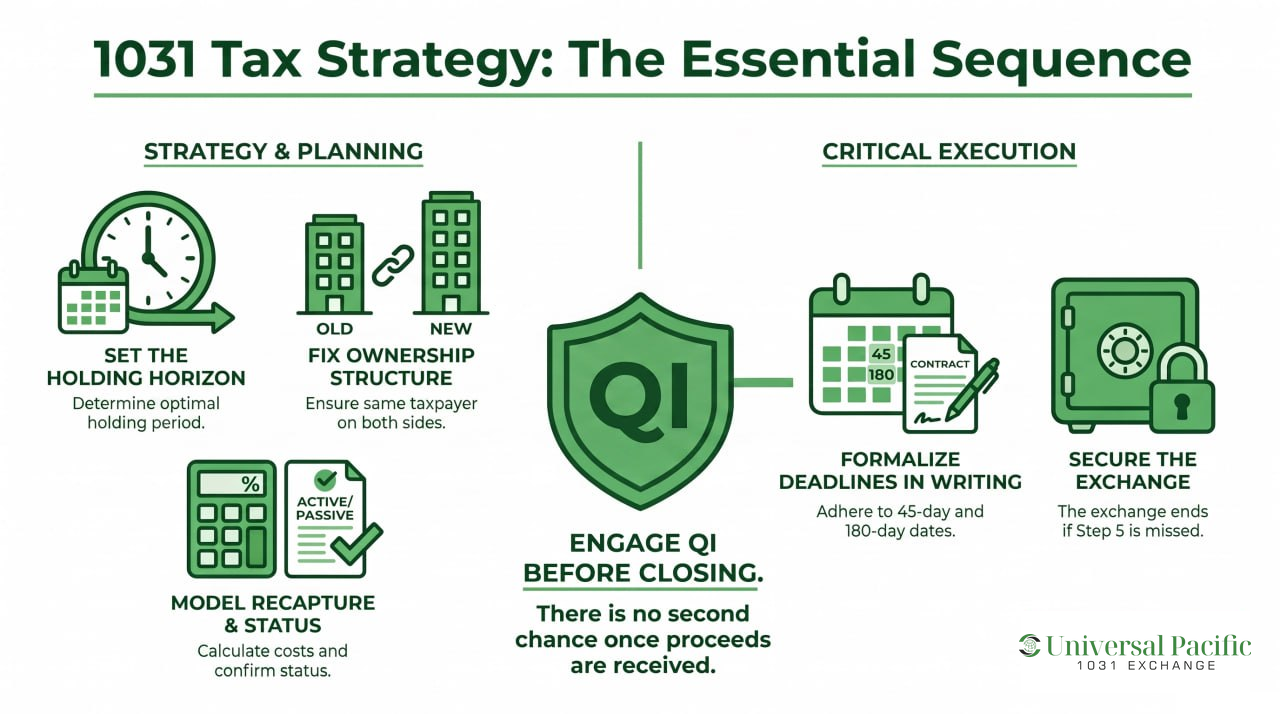
Because these strategies interact, the order in which you apply them matters as much as which ones you choose.
Step 1: Establish Your Holding Horizon
Decide whether this asset is a five-year trade or a multi-decade hold before anything else. A 1031 exchange suits investors who intend to remain in real estate. An Opportunity Zone fund assumes a ten-year commitment. Acceleration strategies suit holders who will exchange rather than cash out.
Step 2: Fix the Ownership Structure Early
Entity choice determines who the taxpayer is, and the same taxpayer must appear on both sides of an exchange. Restructuring after a property is in escrow is where most exchanges fail.
Step 3: Model the Recapture Before You Accelerate
Run the cost segregation numbers alongside a projected exit. If the likely exit is a taxable sale, accelerated depreciation front-loads a benefit you will hand back at up to 25 percent.
Step 4: Confirm Your Passive and Active Position
Determine whether you qualify as a real estate professional, whether a grouping election helps, and whether the $25,000 special allowance applies. This decides whether losses shelter your other income or sit idle.
Step 5: Engage a Qualified Intermediary Before Closing
If an exchange is part of the plan, the Qualified Intermediary must be in place before the relinquished property closes. Receiving the proceeds ends the exchange before it starts.
Step 6: Track the Deadlines in Writing
Identification within 45 days, closing within 180 days, and the Opportunity Zone recognition date all run on fixed calendars. Put them on one document with your CPA and your intermediary.
What Tax Deductions Should Real Estate Investors Be Aware Of?
Real estate investors can take advantage of several tax deductions to lower both taxable income and, in some cases, capital gains. For example, suppose you use part of your home exclusively for managing your real estate activities, such as keeping records, arranging repairs, or communicating with tenants.
In that case, you may qualify for a home office deduction, allowing you to write off a portion of expenses, such as utilities, insurance, and mortgage interest. Business-related travel, such as trips to inspect properties or meet with contractors, can be deducted if you keep detailed records of your expenses.
Similarly, certain education costs, such as real estate seminars or training courses, may qualify as deductible if they directly relate to your investment activities. Another valuable strategy involves using self-directed retirement accounts, such as a Solo 401(k) or a self-directed IRA (SDIRA), to purchase real estate. These accounts allow profits from rental income or property sales to grow either tax-deferred or tax-free, depending on the account type.
However, investors should also be aware of depreciation recapture rules. While depreciation can reduce taxable income during ownership, it also lowers the property’s tax basis, potentially increasing the taxable amount when you sell. Planning ahead for this recapture tax can help you avoid unwelcome surprises and preserve more of your investment gains.
1031 Exchange Rules You Can’t Afford to Miss

A 1031 exchange is a powerful tax-deferral tool with strict compliance rules. Missing even one of these rules can mean forfeiting your tax-deferral benefit. The first rule is that the sale proceeds must go to a Qualified Intermediary (QI). When conducting a like-kind exchange, the Qualified Intermediary holds the funds and keeps the exchange compliant, and you cannot take receipt of the money yourself.
The second is the 45-day identification period, which gives you exactly 45 calendar days after the old property sale to identify potential replacement properties, which must be submitted to your QI in writing. The third is the 180-day closing window, within which the exchange must be completed, measured from the sale of your original property.
Beyond the deadlines, the like-kind requirement means that both the relinquished and replacement properties must be primarily held for investment or business purposes. The equal or greater value rule means that to fully defer taxes, you must reinvest all proceeds in a property of equal or greater value than the one sold and never less.
Finally, the IRS allows flexibility in how you identify replacement properties. These include the three-property rule, the 95 percent rule, and the 200 percent rule. It is critical to note that these deadlines are non-negotiable, and missing even a single date can disqualify the entire exchange.
Maximize Tax Deferral with a 1031 Expert
Using advanced tax strategies can significantly benefit real estate investors by preserving capital, increasing investment power, and growing portfolios. However, some of these approaches, like combining exchanges with estate planning, Opportunity Zones, or the passive loss rule, require precision to comply with IRS guidelines and avoid costly missteps.
A skilled 1031 specialist can guide you through every step so deadlines are met, properties qualify, and all paperwork is correct. With the right help, you can make the most of each deal and keep your money working in your investments instead of going to taxes.
Universal Pacific 1031 Exchange brings a deep wealth of experience in guiding investors through complex real estate transactions. From handling strict 1031 exchange timelines to structuring deals that align with estate planning or Opportunity Zone strategies, our team knows how to protect your gains and keep your investments compliant. You can visit any of our 1031 exchange offices or contact us directly.
FAQs
Below are frequently asked questions about advanced tax strategies for real estate investors, along with concise, practical answers.
How to Avoid Capital Gains Tax on Investment Real Estate?
You can defer paying capital gains tax by using tools like a 1031 exchange, which lets you reinvest sale proceeds into another qualifying property without immediate tax. Other strategies, such as Opportunity Zone investments or charitable trusts, can also reduce or delay the tax bill.
What Is the Most Tax-Efficient Way to Buy Property?
Many investors use legal entities such as LLCs or self-directed retirement accounts to hold properties. These structures can offer liability protection, potential tax savings, and better control over future real estate planning.
How Are Real Estate Investors Taxed?
Taxes depend on the type of income. Rental income is typically taxed as ordinary income, while profits from selling a property may be subject to capital gains tax. Depreciation rules, deductions, and holding periods can all affect the final amount owed.
Can I Combine Multiple Tax Strategies at Once?
Yes, it is common to combine multiple strategies, such as pairing a 1031 exchange with estate planning tools or passive loss rules. The key is to ensure each step meets IRS requirements so you don’t lose significant tax benefits.
What’s the Difference Between Passive and Active Real Estate Income?
Passive income typically comes from rental activities, where you’re not heavily involved day-to-day, while active income comes from property flips or short-term sales where you materially participate. Note that tax rules differ for each.
Do I Need a CPA or Tax Advisor to Use These Strategies?
While not legally required, a qualified tax professional can help you avoid mistakes, enjoy significant tax savings, and ensure your strategies stay within IRS rules, especially when dealing with larger or more complex portfolios.
This page was reviewed by Michael Bergman, CPA, California CPA #56113. Verify license.
Disclaimer: This article is for informational purposes only and is not legal, tax, or financial advice. Tax laws change and every situation is different. Please consult a qualified attorney, CPA, or tax advisor before making decisions about your property, sale, or 1031 exchange.
Editorial Policy
All articles are reviewed for accuracy by licensed tax professionals and sourced from official government publications. Read our Editorial Policy →
About The Author
 Michael Bergman is a California licensed CPA and Real Estate Broker with over 35+ years of CPA-supervised 1031 exchange experience in commercial real estate. Specializing in 1031 tax-deferred exchanges and financial oversight, his expertise covers complex real estate transactions. Michael’s unique blend of financial acumen and real estate knowledge positions him as a trusted advisor in the industry, offering sound advice and strategic insights for successful property management and investment.