
Does 1031 Exchange Apply to Foreign Property?
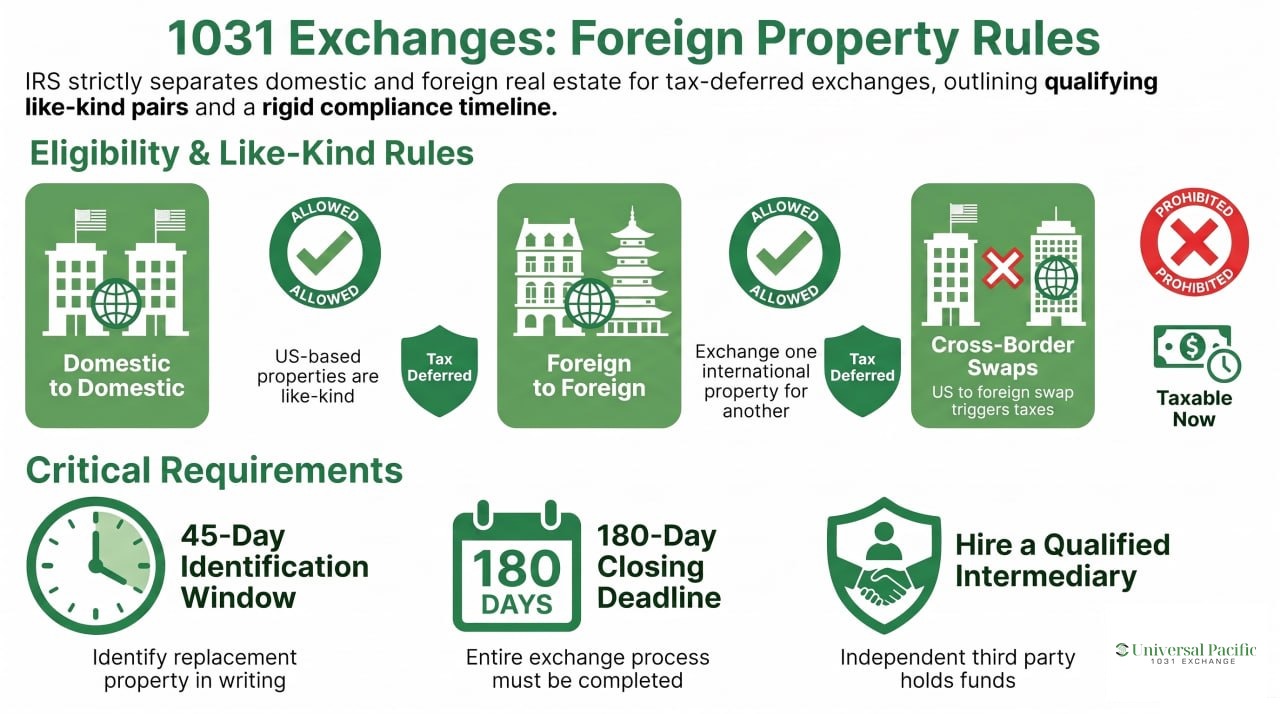
No. A 1031 exchange does not apply when you exchange U.S. real property for foreign real property, or foreign real property for U.S. real property. Under IRS rules, these properties are not considered like-kind. However, an exchange of one foreign investment property for another foreign investment property may still qualify if it meets all other Section 1031 requirements.
At Universal Pacific 1031 Exchange, we serve real estate investors across all 50 states as a Qualified Intermediary led by licensed CPAs. We handle delayed, simultaneous, reverse, and improvement exchanges, holding your funds in segregated accounts backed by $2 million in errors-and-omissions coverage. Contact us today to start your exchange with a team that treats your deferral like its own.
This article explains a 1031 exchange for foreign property, common problems with a foreign 1031 exchange, and how a Qualified Intermediary can be of help.
Understanding 1031 Exchange Rules for Foreign Property
A 1031 exchange lets you sell one investment property and buy another like-kind property without paying capital gains tax right away. The name comes from Section 1031 of the Internal Revenue Code. Instead of writing a check to the IRS, you roll your gain into the replacement property. This tax deferral is why real estate investors use it to grow wealth over time.

So does a 1031 exchange apply to foreign property? The honest answer has two parts, and most articles only tell you one. Under Section 1031(h), real property located in the United States and real property located outside it are not like-kind. That means you cannot swap your U.S. property for foreign real estate and defer the tax. The IRS states the same rule in plain terms on its like-kind exchange page.
Here is the part the top pages gloss over. You can still use a 1031 exchange when both properties sit abroad. Exchanging one foreign property for another is allowed because foreign real property is like-kind to other foreign real property. One more rule matters since 2018. After the Tax Cuts and Jobs Act, Section 1031 covers only real property, so foreign equipment, aircraft, or collectibles no longer qualify.
The table below sums up what works and what does not.
| Exchange scenario | Like-kind under Section 1031? | Result |
|---|---|---|
| U.S. property for U.S. property | Yes | Capital gains tax deferred |
| Foreign property for foreign property | Yes | Capital gains tax deferred |
| U.S. property for foreign property | No | Gain is taxable now |
| Foreign property for U.S. property | No | Gain is taxable now |
These exchanges are a major force in the economy. A 2022 EY study found like-kind exchanges supported 976,000 jobs and added $97.4 billion to U.S. GDP in 2021.
Challenges with International 1031 Exchanges
Cross-border deals add friction that a domestic exchange never sees. Foreign real estate transactions can involve unfamiliar title systems and local lawyers. Certain countries limit how foreign buyers take ownership. You may also face capital controls that restrict moving money, which can stall the exchange process.
Currency is another hurdle. Most deals abroad settle in a foreign currency, not dollars. The exchange rate can move between your sale and your purchase. These currency fluctuations, plus foreign exchange fees and currency conversion costs, can quietly shrink your gain if you do not plan for them.
Taxes get more tangled too. A 1031 exchange defers your U.S. tax, but the foreign country is not bound by U.S. rules. That country may still tax the sale in the year it happens. Since a U.S. citizen pays tax on worldwide income, you could face tax in two places on the same income. Many countries also add their own transfer taxes, such as stamp duties. Foreign property sales often trigger local tax before you ever file in the U.S..
The foreign tax credit exists to help you avoid double taxation. It lets you offset U.S. tax with foreign tax you already paid. The timing rarely lines up, though. If the foreign country taxes you now while your U.S. tax is deferred, there may be no U.S. tax to credit against yet.
A tax treaty between two countries can shift some of these rights. Treaties do not override Section 1031, but they can change how and when each country taxes you. Foreign tax laws vary widely across foreign jurisdictions. Deals that touch multiple countries face more than one country’s rules. Other countries treat gains differently, so the outcome depends on where the property is located.
None of this means a foreign-for-foreign exchange is a bad idea. It means careful planning matters. You need to understand the tax consequences, the reporting duties, and the deadlines before you sell. Michael Bergman, President and CEO of Universal Pacific 1031 Exchange, puts it plainly: “People assume they can sell in California and buy in Costa Rica tax-deferred. They cannot. But if you already own abroad, a foreign-for-foreign exchange can still save you a great deal, as long as the paperwork is right.”
Exchanges of Foreign Property
To qualify, the property held on each side must serve an investment or business use. A foreign rental property can be exchanged for another foreign rental or a commercial building. A personal vacation home you use yourself does not qualify unless you hold it for investment purposes. The property types can differ, since raw land, apartments, and retail all count as real property. Property values move with market conditions in every country. An exchange compares the fair market value of each side, so a current appraisal helps.
United States territories create a special case, and the rules surprise people. For Section 1031, the United States means the 50 states and the District of Columbia. Some territories are treated as foreign, while three fall under special rules closer to domestic property. The table below shows how the main territories line up.
| Property location | Treated as, for Section 1031 | Can it exchange with U.S. mainland property? |
|---|---|---|
| Puerto Rico | Foreign | No |
| American Samoa | Foreign | No |
| U.S. Virgin Islands | Special rules, domestic-style | Sometimes, under strict conditions |
| Guam | Special rules, domestic-style | Sometimes, under strict conditions |
| Northern Mariana Islands | Special rules, domestic-style | Sometimes, under strict conditions |
The Virgin Islands, Guam, and the Northern Mariana Islands may qualify only when you owe tax in both the U.S. and that territory. Puerto Rico, despite being a U.S. territory, counts as foreign for this rule.
Here is a practical example. Suppose you own a rental apartment in Portugal that has grown in value. You sell it, then reinvest the full amount into a rental property in Spain. Because both properties are foreign, you can defer the U.S. capital gains tax through a 1031 exchange. If Spain taxes the sale, you would look to the foreign tax credit to soften the blow. You can confirm the rule yourself in the statute and on the IRS website, rather than taking any firm’s word for it.

Strategies for Leveraging 1031 Exchange for Global Investments
A foreign property exchange rewards good structure. The mechanics mirror a domestic deal, with a few extra steps. Here is the process in order.
1. Hire a Qualified Intermediary
You cannot touch the money between deals. A qualified intermediary holds your sale proceeds as exchange funds, so you avoid what the IRS calls constructive receipt. Without this step, the sale becomes fully taxable.
2. Identify Your Replacement Property in 45 Days
The clock starts when you close on your relinquished property sale. You then have 45 days to name your replacement property in writing. Miss that window, and the exchange fails.
3. Close within 180 Days
You have 180 days from the sale to buy the replacement property. That deadline can shrink if your tax return is due sooner. These same IRS rules apply whether the property is located in Ohio or overseas.
4. Report the Exchange on Your Tax Return
You report the deal on Form 8824 with your tax return. Larger foreign assets may also require Form 8938 for specified foreign financial assets. A foreign bank account over $10,000 usually needs an FBAR filing. If you hold the property through a foreign entity or foreign partnership, the reporting grows more complex.
Global exchanges are not a do-it-yourself project. Work with financial advisors, a cross-border tax professional, and a qualified intermediary from the start. Good advice on foreign tax laws usually costs far less than the tax and penalties you avoid. Budget for legal fees on both sides of the border, since two legal systems are involved.
How Do You Make the Right Move on Foreign Property?
The rule is simpler than it looks once you split it by direction. A U.S.-to-foreign swap will not defer your tax, but a foreign-to-foreign exchange often will. The details of timing, currency, and foreign tax laws decide whether the deal actually pays off. Getting those details right is where good guidance earns its keep.
At Universal Pacific 1031 Exchange, we guide investors through delayed, reverse, and improvement exchanges across all 50 states, with funds secured in segregated accounts. Our CPA-led team maps the deadlines, the reporting, and the qualified intermediary steps so nothing slips. If you are weighing a move on your next property, call us before you sign, not after the gain is already taxable.
Frequently Asked Questions
This section provides answers to common questions about a 1031 exchange for foreign property.
Does a 1031 Exchange Apply to Foreign Property?
It depends on the direction. You cannot exchange a U.S. property for a foreign one, or the reverse, because Section 1031(h) says they are not like-kind. You can exchange one foreign property for another and defer the U.S. capital gains tax. So the rule is not a flat no. It is a no across the border and a yes within foreign real estate.
Can I Defer Tax on a Property Located Outside the United States?
Yes, if your replacement property is also outside the United States. Selling foreign real estate and buying other foreign real estate can qualify for tax deferral. Selling that foreign property to buy inside the U.S. does not qualify. The gain on the U.S. purchase would be taxable.
Is It Possible to Exchange a Foreign Property for a Domestic Property?
No. A foreign property and a domestic property are not like-kind under the Internal Revenue Code. The moment one leg is U.S. real estate and the other is foreign, the deferral is lost. This is the most common mistake investors make with cross-border plans.
Are There Alternatives if a Cross-Border Swap Will Not Work?
Yes, a few exist. You might use an installment sale to spread the gain over several years. You could invest the gain through a Qualified Opportunity Fund. Some investors simply pay capital gains tax and reinvest what is left. A tax professional can match the option to your goals.
What Reporting Do Foreign Holdings Require?
You report the exchange itself on Form 8824. Larger foreign assets may trigger Form 8938 for specified foreign financial assets. Foreign bank accounts over $10,000 usually require an FBAR. Skipping these filings can bring steep penalties, so track your compliance requirements early.
Does This Rule Affect Foreign Sellers of U.S. Property?
That is a separate tax rule. Foreign sellers of U.S. real estate face FIRPTA withholding, not the Section 1031(h) foreign bar. Non-citizens who live abroad and sell foreign property usually have no U.S. tax to defer. If you are a foreign person selling U.S. property, ask about FIRPTA before you close.
Attorney Advertising: This article is general information, not legal or tax advice. Tax rules change, and every situation differs. Talk with a qualified tax professional or attorney before starting an exchange.
Editorial Policy
All articles are reviewed for accuracy by licensed tax professionals and sourced from official government publications. Read our Editorial Policy →
This page was reviewed by Michael Bergman, CPA, California CPA #56113. Verify license.
About The Author
 Michael Bergman is a California licensed CPA and Real Estate Broker with over 35+ years of CPA-supervised 1031 exchange experience in commercial real estate. Specializing in 1031 tax-deferred exchanges and financial oversight, his expertise covers complex real estate transactions. Michael’s unique blend of financial acumen and real estate knowledge positions him as a trusted advisor in the industry, offering sound advice and strategic insights for successful property management and investment.