Mastering the Reverse 1031 Exchange Timeline in 2026
The reverse 1031 exchange timeline typically involves a 45-day identification period and a 180-day exchange completion period. The order is the reverse of a standard exchange: you buy first and sell second. It gives the taxpayer 45 days after acquiring the replacement property to formally identify the relinquished property, and 180 days from that time to sell the old property and complete the exchange. While this structure is beneficial, it involves complex rules and therefore requires the aid of a Qualified Intermediary to avoid costly mistakes and ensure the exchange stays compliant.
At Universal Pacific 1031 Exchange, we are dedicated to guiding investors through every step of the exchange process with expertise and precision. Whether you’re navigating a traditional or reverse 1031 exchange, our Qualified Intermediaries ensure compliance with IRS rules, helping you preserve your tax-deferral benefits. Feel free to reach out for a free consultation on how to get started.
What follows walks through each stage of the reverse exchange clock, works one example through real calendar dates, and covers the delays that most often push an exchange past Day 180.
What Is a Reverse 1031 Exchange?

In a reverse exchange, the replacement property is first acquired before the relinquished property is sold. Similar to the traditional 1031 exchange, this structure adheres to a set of rules as outlined in the Internal Revenue Code. First, both the relinquished property and the replacement property must be like-kind in nature.
This means that they both must be held for business or investment purposes, so primary residences and vacation homes typically do not qualify. Additionally, a Qualified Intermediary (QI) must be consulted, who will be responsible for facilitating the exchange, holding the sale proceeds, and preparing the necessary documentation to ensure the transaction stays compliant. Other reverse exchange rules include:
- The replacement property must be of equal or greater value than the old/current property to avoid triggering tax liability.
- An Exchange Accommodation Titleholder (EAT) is required to temporarily hold title to either the relinquished property or the replacement property.
- The relinquished property must be identified within 45 days of acquiring the replacement property.
- The relinquished property must be sold and the exchange finalized within 180 days.
How Long Does a Reverse 1031 Exchange Take?
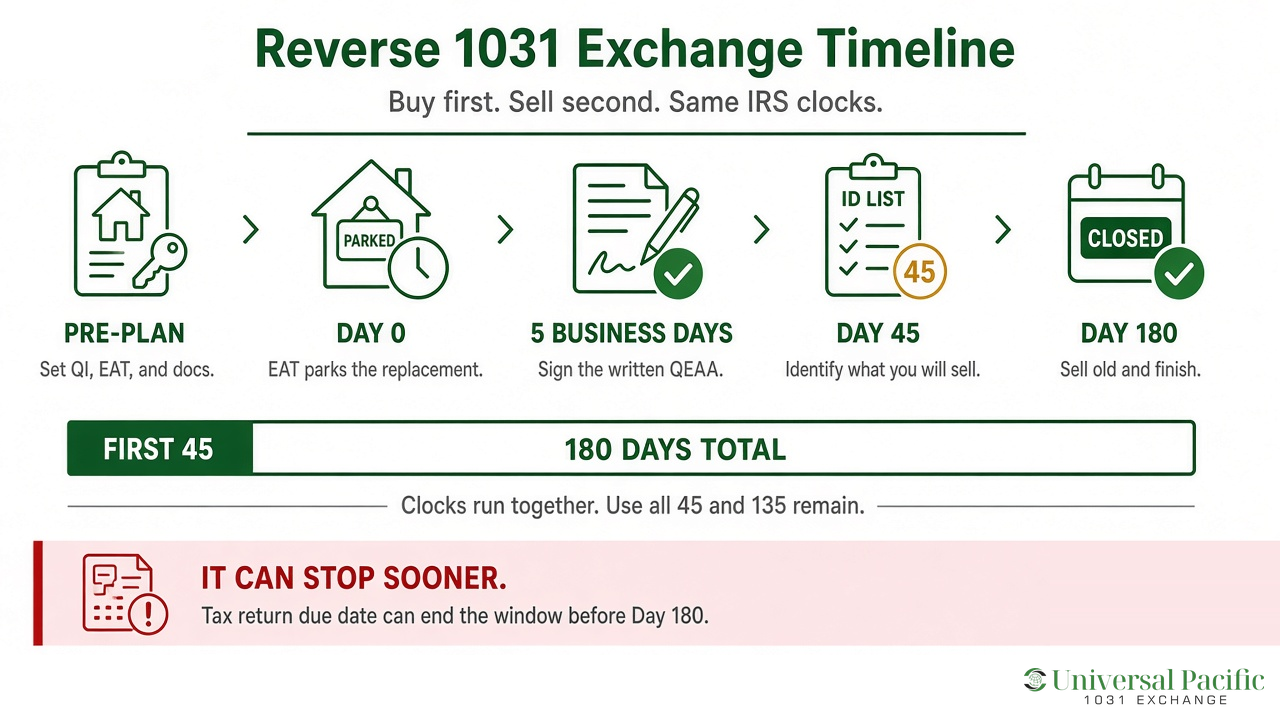
A reverse 1031 exchange differs significantly from other exchanges. Although the structure is different, the same two strict IRS timing rules that govern the forward exchange still apply. These include the 45-day identification period and a 180-day completion period. Each stage below shows what starts the clock, what has to happen by when, and which day counts as the deadline.
1. Pre-planning Stage
This stage occurs before the replacement property is acquired. It typically involves selecting an EAT or Qualified Intermediary experienced in reverse exchanges, arranging financing contingencies, preparing documents (usually referred to as the Qualified Exchange Accommodation Agreement) with the Qualified Exchange Accommodation Arrangement (QEAA) language, and confirming title and trustee arrangements. The pre-planning stage can span from a few days to several weeks, depending on the replacement property lender and the title work. Every item settled here is one less thing competing for time once the 45-day and 180-day clocks are running.
2. Day 0
Here, the real estate investor purchases the replacement property, but the title is taken in the EAT’s name under a QEAA. This is if the investor chooses to “park” the new property and not the old one. Both deadlines count from this date: Day 45 for identifying the property you will sell, and Day 180 for finishing the exchange.
No later than five business days after Day 0, the investor and the EAT must sign the written Qualified Exchange Accommodation Agreement. The deadline comes from section 4.02(3) of Revenue Procedure 2000-37. The agreement has to state that the EAT is holding the property for the investor’s benefit to facilitate a 1031 exchange, and that the EAT will be treated as the beneficial owner of the property for all federal income tax purposes. Both parties must then report the property on their tax returns in a way that matches the agreement.
This rule sets a latest date, not an earliest one. The agreement must be in place “no later than” five business days after the EAT takes title, so an agreement signed during the pre-planning stage already meets it. Missing the window takes the exchange outside the safe harbor, because section 3.04 of the same revenue procedure says it does not apply when its requirements are not met.
3. Day 1-45
This is the identification period during which the investor identifies the relinquished property they intend to sell to complete the exchange. Identification must be written and submitted to the accommodator/QI by midnight of Day 45. The standard 3-property, 200%, and 95% rules can be used during this process to identify as many properties as fit.
4. Day 46-180
During this exchange period, the investor sells the old property, sends the money through the exchange company, and then has the EAT transfer the new property back to them. All of this must be completed on or before the 180th day. Remember, the 45-day and 180-day deadlines run concurrently. Therefore, if you use all 45 days to identify the old property you want to sell, you will only have 135 days remaining to complete the exchange.
5. Post 180-Days
If the exchange is not completed by day 180, it falls outside the IRS safe harbor for reverse exchanges, and in practice it fails for IRC § 1031 purposes, so the tax deferral is lost.
Example Timeline: Parking the Property on December 1, 2026
A worked calendar makes the deadlines concrete. Assume the EAT takes title to the replacement property on Tuesday, December 1, 2026. Every date below counts from that day.
| Date | What has to happen | Where it comes from |
|---|---|---|
| December 1, 2026 (Day 0) | The EAT takes legal title to the replacement property. The 45-day and 180-day clocks start. | Rev. Proc. 2000-37, sections 4.02(1), (4) and (5) |
| By December 8, 2026 | The written Qualified Exchange Accommodation Agreement is signed (five business days). | Section 4.02(3) |
| By January 15, 2027 (Day 45) | The relinquished property is formally identified in writing. | Section 4.02(4) |
| By May 30, 2027 (Day 180) | The parked property is transferred out of the EAT to the investor as replacement property. | Section 4.02(5) |
| The whole exchange | The combined time both properties sit in the arrangement cannot exceed 180 days. | Section 4.02(6) |
Two details are easy to miss. The agreement deadline counts business days, while the 45-day and 180-day periods count every calendar day, weekends included. And Day 180 in this example, May 30, 2027, is a Sunday, so the closing that moves the parked property out should be booked for a business day before it.
Common Delays that Stretch or Threaten the Timeline and How They Impact Duration

Keeping up with the IRS timeline is usually one of the most challenging aspects of a 1031 exchange. Miss either deadline and the sale becomes taxable. The IRS does not extend them because a lender runs late or the market slows; federally declared disasters are the main exception, covered below. Four problems can push a reverse exchange past its deadlines, and each is easier to prevent before Day 0 than to fix after it.
Financing Issues
Financing delays are one of the biggest and most common threats to a reverse 1031 exchange timeline. Lender underwriting, slow appraisal reports, or delayed document reviews can all impact the investor’s ability to close on the relinquished property. If financing setbacks push the sale past Day 180, the exchange fails because there is no automatic extension. To avoid this, investors should secure bridge, equity loan, or contingency financing before Day 0. They should also pre-qualify buyers, use proper due diligence and financing deadlines in their contracts, and work with lenders who understand QEAA structures.
Market Conditions
A tight credit market can make it difficult to sell the relinquished property within the required timeline. In some cases, a buyer may withdraw from the purchase, or the market declines after Day 0. If a buyer is not found and the sale is not closed within 180 days, the exchange fails, and the investor will be required to pay capital gains tax.
To mitigate this risk, set your investment property at a fair price, work with a broker well-versed in 1031 exchanges, and have backup plans such as short-term rentals, seller financing, or closing incentives to attract buyers quickly.
Title, Survey, or Legal Problems
Issues with property records can also cause delays. If there are errors in the title, legal complications, or environmental concerns, you may not be able to close within the stipulated time. The best way to avoid this is to check the title, survey, and legal issues as early as possible before Day 0 and work with a knowledgeable title attorney.
Working With Inexperienced Accommodators or Intermediaries
Reverse exchange requires careful planning; hence, if the company or professional managing your exchange is inexperienced, they can make mistakes with paperwork, deadlines, or the reverse exchange rules. Before you sign, ask how many reverse exchanges the provider has run in the last year and who forms and manages the EAT.
The Year-End Problem: When Your Tax Return Is Due Before Day 180
Look at the example again. Day 180 falls on May 30, 2027, but a calendar-year individual’s 2026 federal tax return is due on April 15, 2027. That gap can shorten an exchange that runs across year-end.
The limit comes from the rules for the sale side of the exchange. Section 1031(a)(3) of the tax code, Treasury Regulation 1.1031(k)-1(b)(2)(ii) and the Form 8824 instructions all say the replacement property must be received by the earlier of two dates: the 180th day after you transferred the property you gave up, or the due date (including extensions) of your tax return for the year you transferred it.
Rev. Proc. 2000-37 counts its own 180 days from the parking date and does not mention the return due date. The return-date limit is tied to the year the relinquished property is transferred, so the question is which year the old property sells in. If the relinquished property closes in December 2026 and the parked property is not transferred to you until May 2027, the April 15 due date arrives first. If the sale and the transfer out of the EAT happen at the same closing, or the sale closes in 2027, the April date is not the constraint. Exactly how the two limits fit together depends on how your exchange is structured, so check it with your CPA and your intermediary early.
If the return date could come first, the fix is an extension that is actually in place. The regulation’s own example ends the exchange period on the return due date, and lets it run the full 180 days only if the taxpayer is allowed the automatic six-month extension. An extension you only plan to file does not help. For the filing side, see how to report a 1031 exchange on your tax return.
When the Deadlines Can Actually Move
Financing problems, a slow market and title issues never move the dates on their own. A federally declared disaster can. Section 17 of Revenue Procedure 2018-58 postpones 1031 deadlines when the IRS announces relief for a federally declared disaster, and it names the reverse exchange periods specifically: sections 4.02(3) through (6) of Rev. Proc. 2000-37, which cover the five-business-day agreement, the 45-day identification period and both 180-day limits.
Deadlines that fall on or after the date of the disaster are postponed by 120 days, or to the last day of the general disaster extension period the IRS announces for that disaster, whichever is later. Two limits apply. The postponement can never run past the due date (including extensions) of your tax return for the year of the transfer, and it can never exceed one year.
The EAT must already have taken title on or before the date of the disaster. Beyond that, you qualify if you are an affected taxpayer under the IRS announcement, or if the disaster makes a deadline hard to meet for reasons the revenue procedure lists, including:
- The relinquished property or the replacement property is located in the covered disaster area.
- The principal place of business of any party to the transaction is in the covered area. The revenue procedure gives the qualified intermediary, the exchange accommodation titleholder, the transferee, the settlement attorney, the lender, the financial institution and the title insurance company as examples.
Your own property can be untouched while your lender’s or title company’s office is not, and the postponement can still apply if the disaster gets in the way of your deadline. The IRS keeps the current list of covered areas on its Tax relief in disaster situations page.
Why Consider a Reverse 1031 Exchange?
One major benefit of a reverse 1031 exchange is flexibility in property acquisition. Instead of rushing to find replacement property after selling the old one, investors can secure their desired property the moment it becomes available. This is especially beneficial in competitive markets where desirable properties get taken almost as soon as they are listed.
Another important advantage is the tax deferral benefit. Just like a traditional 1031 exchange, a reverse exchange allows investors to defer taxes when they follow the IRS reverse 1031 exchange rules. This keeps more money working in their investment portfolio, supports long-term growth, and helps investors avoid taking unnecessary tax hits during busy or uncertain market periods.
Optimize Your Reverse 1031 Now!
A reverse exchange lets you close on the right property in a competitive market without waiting for your own sale. The trade-off is a stricter process, with rules like the use of an EAT, QEAA, Exchange Accommodator Titleholder agreement, and so on.
The IRS also sets the same deadlines for every type of exchange, including reverse exchanges, regardless of their complexity. So, it becomes important to not only understand the exchange process fully before venturing into it but also to have a QI/EAT with experience in this field to guide you through.
Universal Pacific 1031 Exchange has helped real estate investors and other taxpayers through reverse exchanges. From filing the correct paperwork to ensuring that the exchange stays compliant with the IRS rules, we guide clients every step of the way. If you want to master the reverse 1031 exchange timeline in 2026, contact us today or visit any of our exchange offices.
FAQs
Executing a successful reverse exchange can be quite challenging. Here are questions people frequently ask about the reverse exchange rules and timelines.
What Is the Typical Timeline for A Reverse 1031 Exchange?
A reverse 1031 exchange follows a strict IRS timeline. The clock starts the day you buy (and park) the replacement property with the EAT. From that day, you have 45 days to identify the property you plan to sell, and a total of 180 days to complete the entire exchange. Everything must be finished within that 180-day window.
How Long Does a Reverse 1031 Exchange Usually Take to Complete?
Most reverse exchanges take three to six months. Some finish faster if the old property sells quickly, but many investors use most of the 180 days to close the sale, clear title, handle financing, and finalize the transfer.
What Is the Timeline for a Reverse 1031 Exchange?
The IRS gives two fixed deadlines:
45-Day Rule: You must identify the property you plan to sell within 45 days after buying the replacement property.
180-Day Rule: You must sell the old property and finish all closing steps by Day 180.
Both timelines start on the same day, and they run at the same time.
What Are the Potential Challenges of a Reverse 1031 Exchange?
Common challenges include financing delays, market conditions that make it hard to find a buyer, title or legal issues, and working with an inexperienced accommodator. Because the IRS does not pause or extend the deadlines for ordinary delays (a federally declared disaster is the main exception), any delay, even a small one, can put the exchange at risk. That’s why planning ahead and using experienced professionals is important.
What Are the Reverse Exchange Rules and How Do They Work?
Reverse exchange rules are designed to allow a property owner to acquire a replacement property before selling the existing property. The process works through a qualified exchange accommodation arrangement, where an exchange accommodator titleholder agreement temporarily holds title to either your relinquished property or the newly purchased one. Proper documentation, including a sales agreement, ensures compliance with IRS guidelines. Following the rules carefully helps avoid a taxable event, protects equity, and creates a safe investment opportunity.
Has the Reverse 1031 Exchange Always Been in Existence, and Who Can Participate?
The reverse 1031 exchange concept has been part of U.S. tax law for decades under IRS revenue procedures, offering safe harbor protections for compliant investors. Both individuals and entities, including a limited liability company, can participate. Using the correct transfer title procedures ensures all properties involved remain eligible for deferral of taxes.
This page was reviewed by Michael Bergman, CPA, California CPA #56113. Verify license.
Disclaimer: This article is for informational purposes only and is not legal, tax, or financial advice. Tax laws change and every situation is different. Please consult a qualified attorney, CPA, or tax advisor before making decisions about your property, sale, or 1031 exchange.
Editorial Policy
All articles are reviewed for accuracy by licensed tax professionals and sourced from official government publications. Read our Editorial Policy →
About The Author
 Michael Bergman is a California licensed CPA and Real Estate Broker with over 35+ years of CPA-supervised 1031 exchange experience in commercial real estate. Specializing in 1031 tax-deferred exchanges and financial oversight, his expertise covers complex real estate transactions. Michael’s unique blend of financial acumen and real estate knowledge positions him as a trusted advisor in the industry, offering sound advice and strategic insights for successful property management and investment.