Who Handles a 1031 Exchange?
The success of a 1031 exchange depends on how well the transactions follow the rules of the exchange. If the exchange is handled by the wrong hands, it may be prone to mistakes that may disqualify the exchange and cause other costly consequences. Hence, you need to understand who handles a 1031 exchange – all the parties that work together with the investor to make the tax deferral successful.
The parties involved in the handling of a 1031 exchange include the investor, the qualified intermediary, real estate agents and brokers, attorneys, tax advisors, and title/escrow companies. It’s important to know the role, responsibilities, and requirements of each participant so you can select the right people to handle your exchange.
With 35+ years of hands-on experience, our experienced qualified intermediaries at Universal Pacific 1031 exchange have the expertise and experience to facilitate a 1031 exchange without violating any IRS requirement. We’re committed to guiding you through every step of the exchange to make sure you comply with all necessary regulations while having a smooth exchange. Schedule a free consultation with us today to get started.
In this comprehensive guide, you’ll learn about the different entities involved in a 1031 exchange, how each of them participates, and how to choose the right qualified intermediary to make your exchange smooth and compliant with the relevant regulations.
What Is a 1031 Exchange?

A 1031 exchange is a tax deferral strategy that allows you to defer capital gains taxes by reinvesting the proceeds from the sale of an investment property into another replacement property. To successfully defer capital gains tax, your transactions must follow the rules given by the Internal Revenue Service (IRS). For example, both the properties you sell and the ones you buy with the sale proceeds must be of like-kind and must be held for business or investment use. You must also complete the exchange transactions within 180 days after the sale of the relinquished property.
While the primary benefit of a 1031 exchange is to defer capital gains taxes, the exchange also offers other investment benefits. By postponing taxes, you have more capital available for investment, and you can keep deferring taxes until you sell the property without a 1031 exchange. Additionally, you get to diversify your real estate portfolio. The exchange allows you to swap a property with low or no income for one with a higher income, thereby increasing your overall cash flow. You can also acquire multiple replacement properties with the sale proceeds of one relinquished property, or sell multiple properties to acquire one larger or more valuable replacement property.
Types of 1031 Exchange
Based on the procedures, there are different types of 1031 exchanges, with each 1031 exchange option having unique requirements and benefits. Understanding these various types and how they work will help you identify the type that best suits your investment goals. The types of 1031 exchanges include:
- Delayed exchange: In a delayed exchange, you follow the traditional 1031 exchange process: sell a property and, within a specific timeline, identify and acquire a replacement property. The proceeds from the sale are held by a qualified intermediary until the replacement property is purchased.
- Simultaneous exchange: In a simultaneous exchange, the sale of the original property and the purchase of the replacement property occur at the same time, with both transactions closing on the same day.
- Reverse exchange: A reverse exchange allows you to acquire the replacement property before selling the original property. In this scenario, you buy the new property first, and the original property must be sold within 180 days to comply with 1031 exchange rules.
- Construction/Improvement exchange: In a construction or improvement exchange, the investor can use the exchange funds to make improvements on the replacement property. This type of 1031 exchange allows investors to build on a new property or enhance an existing one, provided the improvements are completed within 180 days.
Who Handles a 1031 Exchange?
Handling a 1031 exchange involves several key players who collaborate to make the exchange compliant and successful. Each of these parties has specific roles and responsibilities, as well as requirements they must meet to make sure that the exchange transactions qualify for tax deferral. Let’s look at each key player in more detail.
1. The Property Owner/Investor
This is the principal person in a 1031 exchange. The property owner initiates the process by selling an investment property with the intention to reinvest the money into a like-kind replacement property. This person must identify potential replacement properties within 45 days of the sale and must complete the purchase of the replacement property within 180 days.
The investor must make sure that both the relinquished property and the replacement property are investment properties that qualify as like-kind under the Internal Revenue Code. Additionally, the investor must file the transactions on their tax return in the appropriate tax year. Failure to comply with these legal requirements may result in the loss of the tax benefits associated with the 1031 exchange.
2. Qualified Intermediary (QI)
The Qualified Intermediary (QI) acts as a neutral third party that facilitates the 1031 exchange. The primary role of qualified intermediaries is to hold the proceeds from the sale of the relinquished property and use them to purchase the replacement property. By doing so, they ascertain that the investor does not have direct control over the exchange funds as required by the IRS.
Although the QI does not directly play a role in identifying replacement properties in a 1031 exchange, they’re responsible for receiving the identification from the investor within the 45-day identification period. The investor must provide the QI with a written list of potential replacement properties according to IRS rules. The QI then makes sure that the process adheres to the exchange timelines and requirements. They can also guide the investor on how best to go about the identification process.
As per requirements, the QI must be a neutral party. It cannot be a related party, such as a close family member, or anyone who acted as your employee, attorney, accountant, investment banker or broker, or real estate agent in the two years before the first sale, unless their only work for you was on 1031 exchanges. The exact rule is set out further down, under who can hold your funds. The QI is also responsible for preparing and managing the necessary exchange agreement to make sure that all documentation and processes comply with the rules of the 1031 exchange. Additionally, QIs often seek voluntary certifications or belong to professional organizations such as the Federation of Exchange Accommodators (FEA), which offers the Certified Exchange Specialist® (CES®) designation. This certification indicates a certain level of expertise and ethical standards in handling 1031 exchanges.
Given how important the role of qualified intermediaries is, it’s important to choose an experienced qualified intermediary like Universal Pacific 1031 Exchange with a track record of success in conducting 1031 exchanges in your jurisdiction.
3. Real Estate Agents/Brokers

Real estate agents and brokers assist the investor with both selling the relinquished property and acquiring the replacement property. Their responsibilities include marketing the original property, identifying suitable replacement properties, and negotiating the terms of both sales to ensure that the transactions meet the investor’s needs and comply with 1031 exchange requirements.
Legally, a real estate agent or broker must be licensed in the state where the property transactions occur. They also have to act in the best interests of their clients to make sure that the properties involved in the exchange meet the like-kind criteria and that all transactions are conducted within the required timelines. Additionally, real estate agents have the obligation to disclose all relevant information about the properties to the investor, including any potential issues that could affect the exchange.
4. Attorneys
Attorneys provide legal guidance throughout the 1031 exchange process. With their expertise in law-related issues, they help ensure that all aspects of the transaction comply with federal and state laws, as well as IRS regulations. Their role begins with reviewing and drafting the necessary legal documents, such as purchase and sale agreements, to protect the investor’s interests and be sure that the contracts are legally binding. Attorneys also advise the investor on potential legal risks involved in real estate transactions and how to avoid them. Note that attorneys must be licensed to practice law in the state where the exchange is taking place.
5. Accountants/Tax Advisors
Accountants and tax advisors provide financial guidance to help the investor plan for the tax deferral, maintain accurate financial records, and confirm that they met all IRS reporting requirements. Accountants must be certified (e.g., as a CPA) and in good standing with the relevant state board. They must adhere to strict ethical standards, providing accurate and honest advice while avoiding any conflicts of interest that could compromise their objectivity. They are also responsible for ensuring that all financial documentation is properly recorded and can withstand IRS scrutiny, making their role essential in preserving the tax-deferred benefits of the exchange.
6. Title/Escrow Companies
Title and escrow companies are responsible for managing the closing process in a 1031 exchange. They make sure that property titles are clear and that funds are securely held until all conditions of the transaction are met. The title company conducts a thorough search to verify that the property title is free of any liens, and this is essential for the transaction to proceed without legal complications.
Once the title is verified, the escrow company closes the sale and sends the proceeds of the relinquished property straight to the qualified intermediary. Note that title and escrow companies must be licensed and regulated by the state where they operate. They must also comply with all relevant state and federal laws governing real estate transactions, including those specific to 1031 exchanges, such as ensuring the timely and accurate transfer of titles.
Exchange Advisor vs. Qualified Intermediary: Who Can Hold Your Funds?
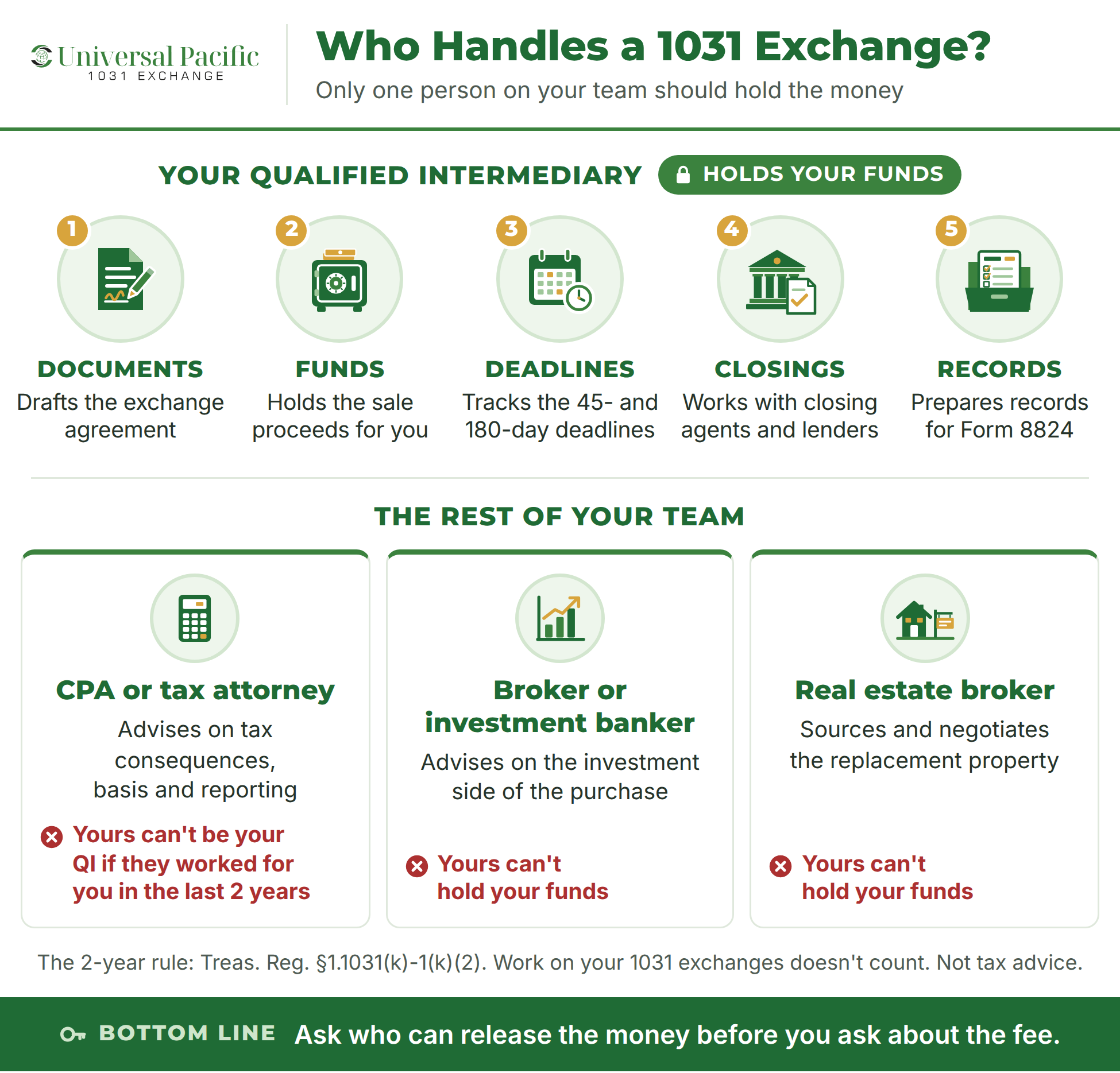
Several of the people above may introduce themselves as a “1031 exchange advisor.” That title is not a defined term and has no regulatory meaning. A qualified intermediary is a defined role with legal requirements attached, and Treasury Regulation §1.1031(k)-1(g)(4) spells out what it is. It cannot be the taxpayer or a disqualified person. It enters into a written exchange agreement with you, acquires the property you are selling and transfers it, then acquires the replacement property and transfers that to you.

The agreement must expressly limit your right to receive, pledge, or borrow against the funds the intermediary holds. That limit is what lets the deal count as an exchange instead of a sale. At least four kinds of professionals call themselves exchange advisors, and you may need more than one of them.
| Who they are | What they actually do | Can they be your QI and hold the funds? |
|---|---|---|
| Qualified intermediary (exchange accommodator) | Drafts the exchange documents, holds the proceeds, tracks the deadlines | Yes. This is the role the regulations define |
| CPA or tax attorney | Advises on tax consequences, basis, and reporting | No, if they worked for you on anything other than 1031 exchanges in the 2 years before your first sale. The rule names accountants and attorneys |
| Investment adviser or broker-dealer | Advises on replacement property as an investment, including DST interests | No, if they acted as your investment banker or broker in that window. The rule names both |
| Real estate agent or broker | Markets your property and sources the replacement | No, if they acted as your agent or broker in that window. The rule names them too |
The second row catches people off guard. Your own accountant can advise you on the exchange, and often should. But under Treasury Regulation §1.1031(k)-1(k)(2), anyone who has acted as your employee, attorney, accountant, investment banker or broker, or real estate agent or broker in the two years ending on the date you transfer the first property you are selling is treated as your agent. That makes them a disqualified person, and a disqualified person cannot be your intermediary.
Two kinds of work do not count toward that two-year rule: services on exchanges intended to qualify under Section 1031, and routine financial, title insurance, escrow, or trust services from a financial institution, title insurance company, or escrow company. So a CPA whose only work for you has been on 1031 exchanges is not disqualified by that work. The second exception is also why a title company is not ruled out automatically; see can a title company be a qualified intermediary.
When to Bring Each One In
Most of the value is tied to early decisions, so the order matters. Your qualified intermediary and your CPA do different jobs, and you may need both.
- Qualified intermediary: before the sale closes. Engage one before you accept an offer on the property you are selling, since the exchange documents have to be in place before that sale closes. An investor who calls after closing has already triggered a taxable event, and no advisor can undo it.
- CPA or tax attorney: at the planning stage, and again at tax time. They advise on the tax consequences, your basis, and reporting. A good advisor catches value-test and boot problems during planning, not at closing when nothing can be done about it. Partnerships, lease buybacks, and related party deals also have to be structured before the sale, not after.
- Investment adviser or broker-dealer: while you weigh the replacement. Whether a replacement property, or an interest in a Delaware Statutory Trust, is a good investment is their question. Choosing the right exchange structure is the intermediary’s job. Whether a property is a good buy is a question for someone else.
- Real estate agent or broker: as soon as you plan to sell. You have 45 days after the sale to identify replacement property in writing, so it helps to have candidates lined up early. The identification rules let you name alternative and multiple properties, which gives you some insurance if a deal falls apart. An investor who names one property and loses it has no backup.
How to Find The Right Qualified Intermediary for a 1031 Exchange?

Having established that the QI plays an important role in the success of a 1031 exchange, you need to understand the factors to consider when choosing a QI for your exchange, as choosing the wrong QI can cause costly mistakes that may disqualify your exchange from tax deferral. Here are some key steps to guide you on how to find the right qualified intermediary for your 1031 exchange, alongside key factors to consider.
- Confirm their experience and expertise. The IRS rules regulating 1031 exchanges can be complicated, especially for beginners. Any mistake in the process, no matter how minor it is, can disqualify the entire transaction from tax deferral. That’s why you need to choose a qualified intermediary with experience in handling 1031 exchanges. Confirm that the QI has a proven track record of successfully facilitating the type of 1031 exchange you want to do. With 35+ years of experience in handling 1031 exchanges, Universal Pacific 1031 Exchange is a qualified intermediary in California and nationwide.
- Check their reputation and references. A strong reputation in the real estate industry means that the QI is likely to have built that reputation through consistent and reliable service. We recommend that you check references and read reviews from previous clients to assess the QI’s reliability and professionalism. Additionally, consider seeking recommendations from trusted real estate professionals, such as attorneys or accountants who specialize in 1031 exchanges.
- Evaluate the security of funds. Since the IRS prohibits the investor from having actual or constructive receipt of exchange funds, the QI will be responsible for holding the proceeds from the sale of the relinquished property until you purchase the replacement property. Therefore, you should inquire about the measures the QI takes to protect your funds. Choose a QI that offers a secure escrow account and insurance protections to safeguard your exchange funds. Additionally, confirm that the QI’s financial practices are transparent and that they provide clear documentation of all transactions.
- Verify the QI’s compliance and licensing. You need to be sure that the QI is aligned with applicable legal and regulatory requirements. Some states have specific licensing requirements for QIs, making it necessary that the QI you choose is licensed to operate in the state where your transaction will take place. Additionally, confirm that the QI adheres to the guidelines set forth by the Federation of Exchange Accommodators (FEA), which is the national trade association for QIs. Membership in the FEA and adherence to its best practices can be a good indicator of a QI’s commitment to ethical and compliant operations.
- Understand the qualified intermediary fees to avoid any unexpected costs. Different QIs may have different fee arrangements, including flat fees, tiered fees based on the value of the transaction, or additional fees for specific services. You should seek a clear understanding of all potential costs upfront, including any fees for holding funds, preparing documents, or extending deadlines. Compare fee structures among several QIs to be sure that you are getting a fair deal without sacrificing the quality of service.
- Assess their customer service and communication. A good QI should be responsive, accessible, and willing to answer all your questions throughout the exchange process. With effective communication, it’s easier to ascertain that the transactions go on smoothly and that any issues are addressed promptly. Consider the availability of the QI, their response time, and their willingness to provide regular updates on the status of your exchange.
- Consider the availability of educational resources or guidance to help you understand the 1031 exchange process. A QI who provides seminars, workshops, or informational materials can be a valuable partner in ensuring that you are well informed and confident in your decisions. The availability of educational resources can also be an indication of the QI’s commitment to helping clients achieve successful outcomes.
Documents to Ask Your Qualified Intermediary For by Name
Whichever intermediary you choose, you should get specific paperwork, and you should ask for it by name: the exchange agreement, the assignment of your purchase and sale contracts, written identification forms for the 45-day deadline, a settlement statement for each closing, and a closing summary that shows exactly where each dollar went.

For tax reporting, a good intermediary works with your accountant rather than replacing them, and gives your CPA the transaction record needed to report the exchange on IRS Form 8824.
One more question belongs on that list: who can move the money? Everything else about an intermediary is a matter of preference. Our guide on how to properly vet a 1031 qualified intermediary covers how exchange funds should be held and the full checklist.
How Much Does a Qualified Intermediary Cost?
Before you go ahead with your 1031 exchange, you should find out the qualified intermediary fees and other 1031 exchange costs to help you budget effectively for the exchange. That way, you can avoid delays and out-of-budget expenses.
On average, the QI fees for a 1031 exchange fall between $500 to $8,500. This wide range is due to the fact that the exact fees you pay depend on the qualified intermediary you choose and the nature of the exchange involved.
Considering costs according to the type of exchange, you may spend between $500 to $2,500 in QI fees for a delayed exchange. Conversely, more complex exchanges such as a reverse exchange costs between $4,500 to $7,500 because of the higher risks involved. Note that if your exchange involves multiple properties, the QI may charge between $400 and $800 for each additional property.
Common 1031 Exchange Mistakes to Avoid

As you consider the various benefits that the 1031 exchange offers, you should also be aware of the common mistakes that can attract costly consequences, such as disqualification from the tax benefits. Understanding these mistakes will help you avoid them so that your 1031 exchange proceeds smoothly and that you fully benefit from the tax deferral advantages it offers.
One of the most common mistakes is missing the strict IRS deadlines. Remember that after selling your property, you have 45 days to identify replacement properties and 180 days to complete the purchase. Missing these deadlines will disqualify the exchange, resulting in immediate tax liabilities. To avoid this, set up a clear timeline and work closely with your Qualified Intermediary (QI) and real estate professionals to ensure all deadlines are met.
Another common mistake is the improper identification of replacement properties. You must properly identify potential replacement properties within 45 days. The identification must be in writing. If you’re identifying multiple properties, watch out for specific identification rules such as the three-property rule, the 95% rule, or the 200% rule. Failing to comply with these rules can nullify your exchange. To avoid this mistake, consult with your QI to ensure the identification process is handled correctly.
Undervaluing the replacement property is another mistake that may jeopardize your exchange. Recall that the replacement property must have equal or greater value than the relinquished property. If the replacement property is of lesser value, you may not be able to reinvest all the proceeds, resulting in “boot,” which is taxable. Boot in a 1031 exchange refers to any portion of the relinquished property sale proceeds that is not reinvested in the replacement property. To avoid boot, plan carefully to match or exceed the value of your original property.
Furthermore, failing to maintain accurate records throughout the exchange can lead to IRS challenges and potential disqualification of your exchange. Keep detailed records of every step and ensure all documents are complete and accurate. Additionally, make sure you maintain prompt communication with all the parties involved in the transaction. Lack of communication between the parties involved may cause delays or mistakes in the process.
Moreover, note that while a 1031 exchange defers federal capital gains taxes, other taxes on real estate sales may apply. Overlooking taxes, such as the real estate transfer tax, can lead to unexpected tax burdens. That’s why you should consult a tax advisor who understands all the tax implications of the transactions involved in a tax-deferred exchange.
Need a Qualified Intermediary for 1031 Exchange?
Your 1031 exchange is likely to fail if it is handled by the wrong or inexperienced parties. From the QI and the title and escrow company to the real estate agents and tax advisors, it’s important to make sure that anyone involved in your exchange is experienced enough for the job. This is because any mistake in the transactions or exchange processes may disqualify you from deferring capital gains tax and may even attract tax penalties.
Among all the entities involved in a 1031 exchange, you should pay special attention to the qualified intermediary as they play some important roles throughout the exchange. If you’re in California, finding the right QI does not have to be a hassle. As a qualified intermediary in Los Angeles, California, and nationwide, Universal Pacific 1031 Exchange has all it takes to make your exchange stress-free and successful. Reach out to us today to start an exchange and receive professional guidance throughout the exchange period.
This page was reviewed by Michael Bergman, CPA, California CPA #56113. Verify license.
Disclaimer: This article is for informational purposes only and is not legal, tax, or financial advice. Tax laws change and every situation is different. Please consult a qualified attorney, CPA, or tax advisor before making decisions about your property, sale, or 1031 exchange.
Editorial Policy
All articles are reviewed for accuracy by licensed tax professionals and sourced from official government publications. Read our Editorial Policy →
About The Author
 Michael Bergman is a California licensed CPA and Real Estate Broker with over 35+ years of CPA-supervised 1031 exchange experience in commercial real estate. Specializing in 1031 tax-deferred exchanges and financial oversight, his expertise covers complex real estate transactions. Michael’s unique blend of financial acumen and real estate knowledge positions him as a trusted advisor in the industry, offering sound advice and strategic insights for successful property management and investment.