1031 Exchange Benefits
The 1031 exchange is a useful strategy for investors looking to defer capital gains taxes when they sell their investment property. The strategy requires you to reinvest the sales proceeds into the purchase of a replacement property, following some strict rules defined by the IRS. Understanding the 1031 exchange benefits will help you make the most of the tax-deferred exchange beyond just deferring capital gains tax.
The most common benefits of a 1031 exchange include deferring capital gains tax, increasing cash flow, diversifying your investment portfolio, strategic property upgrades and improvements, etc. However, it’s also good to be aware of the potential drawbacks of the exchange before you decide whether the strategy is suitable for you.
At Universal Pacific 1031 Exchange, our experienced qualified intermediaries are always ready to help you make the most out of 1031 exchanges. With 35+ years of practical experience, we have all the expertise and experience you need for a successful exchange. Book a free consultation with us now to get started.
In this blog, we’ve covered what a 1031 exchange is and how it works, the benefits and drawbacks, and pro tips on how to maximize the advantages of a 1031 exchange.
What Is a 1031 Exchange and How Does It Work?

A 1031 exchange is a tax deferral strategy that enables you to postpone capital gains tax when you sell an investment property, by reinvesting the sale proceeds into a like-kind replacement property. It was named after Section 1031 of the U.S. Internal Revenue Code. The strategy is regulated by certain rules and requirements that you must fulfill in order to successfully defer paying taxes. The tax savings are significant. The Joint Committee on Taxation projects that like-kind exchanges will defer $53.6 billion in gains tax from 2025 to 2029.
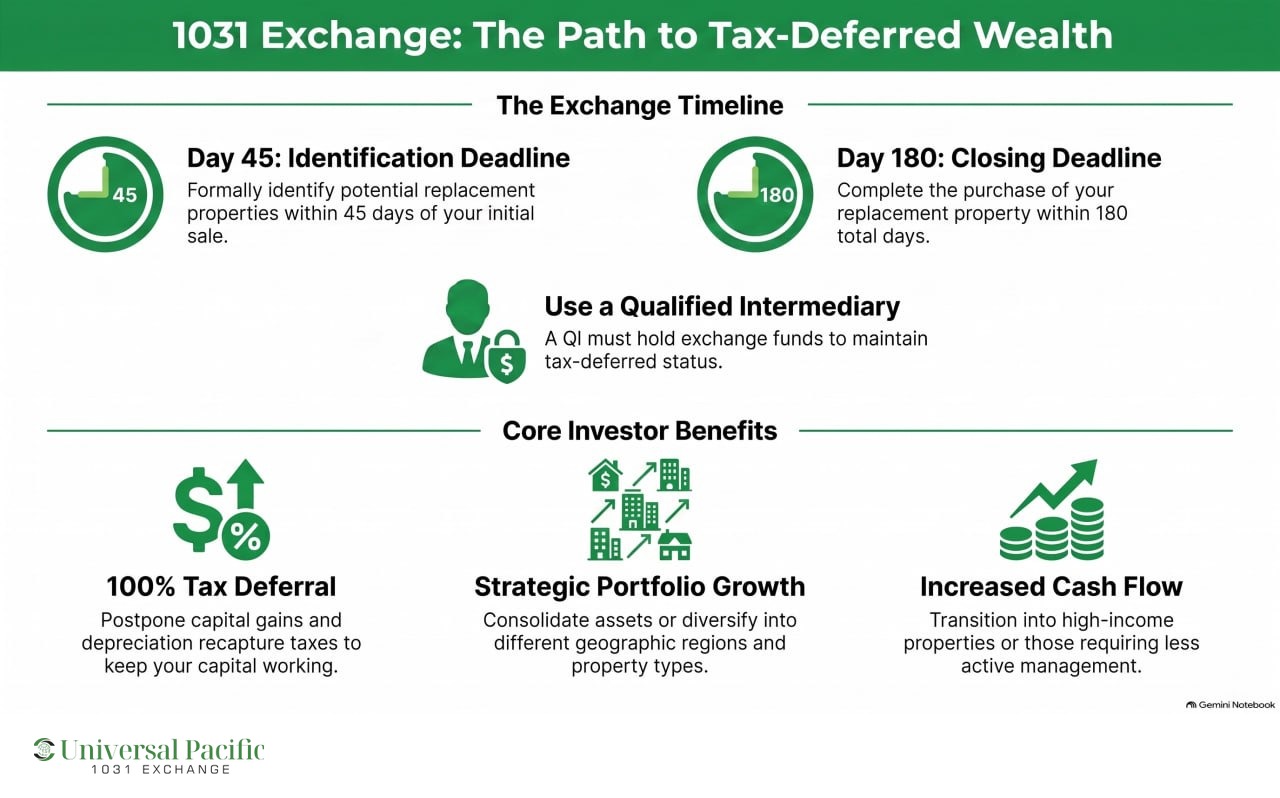
The timeline for a 1031 exchange starts counting when you sell your old property, known as the relinquished property. According to the rules of the exchange, you have 45 days from the relinquished property sale to formally identify potential replacement properties. You’re allowed to identify multiple replacement properties as long as you follow the applicable rules such as the 200% rule, the three-property rule, and the 95% rule. You’re not mandated to purchase all identified properties, but you must close at least one.
After the 45-day identification period, you have the next 135 days to close the replacement property, making a total of 180 days for the entire exchange. You must also adhere to all other rules for a 1031 exchange, such as the “equal or greater value” rule, use of a qualified intermediary, etc. Failure to comply with any of these rules disqualifies your exchange and attracts immediate tax liabilities.
Understanding 1031 Exchange Rules for Maximum Benefits
The tax benefits of a 1031 exchange only hold if you follow the IRS rules closely. Both the relinquished property and the replacement property must be held for business or investment purposes. Personal property no longer qualifies, since the Tax Cuts and Jobs Act limited Section 1031 to real property, effective January 1, 2018.
The like-kind requirement is broader than many investors expect. Like-kind means real property of the same nature, even if the type differs. You can exchange raw land for a rental building, or an apartment for commercial property. The rule does not require a similar property of the same type. The properties involved must both be held for investment or business use, not personal use.
One rule causes frequent confusion, and that is the 2-year rule. Two different concepts share that name. The first is a rule of thumb, since many advisors suggest holding both properties for one to two years to show clear investment intent. The second is a real statute for related-party exchanges under Internal Revenue Code Section 1031(f). If you exchange property with a related party, both sides must hold the property for at least two years. If either side sells within that window, the IRS can disqualify the exchange and tax the deferred gain.
For instance, in Ocmulgee Fields, Inc. v. Commissioner, the Eleventh Circuit disallowed a related-party exchange in 2010. The court found the deal was built to shift low-basis property while deferring tax. About $6.1 million in gain became taxable. Staying inside these rules protects the tax deferral and keeps every 1031 exchange benefit intact.
What Advantage Does the 1031 Tax-Deferred Exchange Offer?
Many real estate investors run the 1031 exchange for the primary purpose of deferring capital gains taxes. But apart from tax deferral, the strategy also offers a host of other significant benefits. So, what advantage does the 1031 tax-deferred exchange offer? Let’s delve into the benefits in detail.
1. Tax Benefits
The most prominent benefit of a 1031 exchange is the ability to defer capital gains taxes from the sale of an investment property. By deferring taxes, you have more capital available for reinvestment, which can help you get higher-value properties or invest in a higher number of real estate properties.
Beyond capital gains taxes, 1031 exchanges also enable real estate investors to defer depreciation recapture tax. If you’ve claimed tax deductions over the years for a property’s depreciation, selling it at a higher price might require you to pay back some of those tax benefits, known as “depreciation recapture tax.” But with a 1031 exchange, you can also defer this tax. Essentially, this means more of your profits stay with you for reinvestment, instead of going toward taxes right away.
2. Long-Term Savings on Tax Liability
As long as you continue to use the 1031 exchange each time you sell a property, you can defer the capital gains tax indefinitely. In theory, an investor could keep doing these exchanges throughout their entire lifetime. Then, if the investor passes away and leaves the property to their heirs, the property often receives a “step-up” in basis.
This means the value of the property is adjusted to its current market value at the time of the investor’s death. So, if the heirs then decide to sell the property, they’d only owe taxes on any gains that occur after they inherited it, not on all the deferred gains from the original investor’s transactions.
By continuously using the 1031 exchange, the initial investor effectively sidesteps ever paying the deferred capital gains taxes during their lifetime, and their heirs might also defer a large portion of those taxes. It’s a strategy that, when used wisely, can result in significant tax savings.
3. Increase in Cash Flow

Utilizing 1031 exchanges allows investors to strategically transition into properties that offer greater rental income possibilities. This cash flow not only bolsters your financial gain but also equips you with expanded means to venture into more real estate investment opportunities.
For those nearing retirement, the 1031 exchange presents a distinctive advantage. By transitioning into properties that demand less management or that yield higher rental returns, investors can ensure a more consistent or elevated income stream for their retirement.
4. Portfolio Diversification
The 1031 exchange allows you to broaden and diversify your investment real estate without the burden of immediate tax implications. This tool provides the flexibility you need to venture into different geographic regions, transition between market types, explore emerging markets poised for growth, and diversify across various property categories. Such strategic diversification can help you navigate and benefit from shifting market conditions and emerging trends.
5. Strategic Property Upgrades and Improvements
Through the careful use of a 1031 exchange, you have the opportunity to purposefully transition into a replacement property that holds promise for higher revenue generation. Whether it’s by choosing a property in a more lucrative location or one that offers the potential for significant value-enhancing improvements, this strategy is designed to pave the way for both long-term property value appreciation and increased rental income. This methodical approach ensures that investors not only defer taxes but also position themselves for enhanced financial gains in the future.
How 1031 Exchange Benefits Real Estate Investors Nationwide
Savvy real estate investors across the country use the 1031 exchange to grow real estate portfolios without a tax bill at every sale. Each time you sell one investment property, you roll the sale proceeds into a new property. The deferred capital gains stay invested and working for you. Over the years, that compounding is how many investors build wealth from a single starting property.
The flexibility goes beyond a simple swap. You can trade one property for several, or several for one, as long as the properties involved meet the like-kind and value rules. An investor might exchange a management-heavy apartment for a passive net-lease commercial property. Another might trade raw land near a growing city for income-producing rental properties. Each move can improve cash flow, spread risk, or set up better growth potential.
Reverse and Improvement Exchanges for Greater Flexibility
Most exchanges are delayed exchanges, where you sell first and then buy. A reverse exchange flips the order, letting you acquire the new property before you sell the old property. This helps in a competitive market when the right replacement property appears before your sale closes. An improvement exchange lets you use exchange funds to build on or renovate the replacement property. Both structures follow strict IRS rules, so a qualified intermediary is essential to ensure compliance.
Disadvantages of a 1031 Exchange
Now that you know the benefits of a 1031 exchange, it’s important you also understand the potential disadvantages of a 1031 exchange so you can make informed decisions.
One of the most notable disadvantages is the strict deadline. Sometimes, you may find it challenging to identify suitable and qualified replacement properties within 45 days, or to close the deal within 180 days. The tight timelines may pressure investors to overpay for a replacement property or settle for a less-than-ideal investment to meet IRS deadlines. Remember that missing the deadline can make you lose the tax benefits and incur immediate tax bills.
Another drawback is limited property use. You can’t use personal residences or vacation homes unless you convert them into investment properties, which takes time. Additionally, you must reinvest all the sale proceeds to avoid boot, which is taxable.
Moreover, you must also consider the transaction costs, which may be higher due to additional fees such as the qualified intermediary fees, legal and tax advisory fees, etc.
| Benefit | What It Means | Limitation | What It Means |
|---|---|---|---|
| Tax deferral | Defer capital gains and depreciation recapture taxes | Deferred, not erased | A later sale without another exchange revives the tax |
| More buying power | Full sale proceeds stay invested in a new property | Full reinvestment rule | Any cash kept back becomes taxable boot |
| Portfolio diversification | Move across markets and property types | Like-kind limit | Replacement must be real property held for investment |
| Estate planning | Heirs may receive a step-up in basis | Strict deadlines | 45-day and 180-day limits can force rushed choices |
| Better cash flow | Trade into higher-income properties | Added costs | Intermediary, legal, and closing fees apply |
To minimize these disadvantages, the best thing to do is to work with an experienced QI who understands how the exchange works and can tailor the exchange process to suit your financial condition and investment goals.
Tips for Maximizing 1031 Exchange Benefits

Maximizing the benefits of a 1031 exchange requires careful planning and execution. Here are some expert tips to help you make the most of this tax-deferral strategy:
Start Early and Plan Ahead
It’s better to start planning for your 1031 exchange before selling your relinquished property. That way, you have ample time to identify suitable potential replacement properties and carry out the exchange process smoothly.
Research Thoroughly
Research potential replacement properties to be sure they align with your investment goals. Consider factors like 1031 exchange eligibility, property location, market value, cash flow potential, appreciation prospects, and management requirements.
Understand and Adhere to the Timelines
If you do not adhere to the 45-day identification period and the 180-day exchange deadline, your exchange will not qualify for tax deferral. So, be sure you understand and keep to these strict timelines.
Diversify Your Investment
You can use the 1031 exchange as an opportunity to diversify your real estate portfolio. Explore different property types, geographic locations, and other factors that can help spread risk.
Beware of Boot
Receiving boot in a 1031 exchange, which includes non-like-kind property or cash, can trigger capital gains taxes. So, it’s best to avoid receiving boot as much as possible.
Consult with an Experienced Qualified Intermediary
Engage an experienced qualified intermediary to facilitate the exchange. The QI will hold the exchange funds so that you don’t violate IRS rules by taking constructive receipt of the sale proceeds. They can also provide professional guidance through the process. You may also have to involve other professionals such as a real estate agent, an attorney, or a tax advisor for expert legal or tax advice.
Factors Influencing Successful 1031 Exchanges
From strict timelines and IRS compliance to choosing the right QI, there are many factors that combine to make a 1031 exchange successful. Below, we provide a thorough understanding of these factors and how they apply to maximize the benefits of a 1031 exchange.
Rules for Property Identification and Eligibility

Not all properties are eligible for a 1031 exchange. Hence, you must follow 1031 exchange identification rules to be sure the properties meet the IRS requirements, as violating any of these rules puts you at risk of losing the tax benefits of the exchange.
Remember that the relinquished and the replacement properties must be like-kind to qualify. Like-kind means property of the same nature, even if it is not necessarily the same type. For example, you can exchange rental properties for vacant land or warehouses.
Both sets of properties must be held for investment purposes, and the replacement property(ies) must be of equal or greater value than the relinquished property. Remember that personal property does not qualify. Moreover, consider the rules guiding the identification of multiple properties – the 200% rule, the 95% rule, and the three-property rule.
Strict Deadlines
Besides the identification rules, the 1031 exchange process also has strict time limits. You must identify potential replacement properties within 45 days of selling the relinquished investment property. You must then close on the replacement property within 180 days of selling the relinquished property or by the due date of your tax return, whichever is earlier. Failure to follow these deadlines may disqualify your exchange and attract immediate tax liabilities.
Understanding the Tax Implications
Understand the potential tax consequences of a 1031 exchange. While it defers capital gains taxes, it doesn’t eliminate them. You will have tax obligations when you eventually sell the replacement property (if you don’t do another 1031 exchange).
Also, handling boot the wrong way can lead to unexpected tax liabilities. Boot refers to non-like-kind property or cash received during an exchange, which can trigger taxable gains. There are two types of boot: cash boot (actual cash received) and mortgage boot (debt relief). It’s important to accurately account for boot to be sure that tax deferral remains optimal.
Working With a Qualified Intermediary
To maintain the tax-deferred status of the exchange, you must use a qualified intermediary. The QI handles the exchange process, holds the proceeds from the sale of the relinquished property, and ensures that funds are used to acquire the replacement property. Under normal circumstances, proceeds from the sale of any real estate property remain taxable. Hence, the money is transferred to a QI to complete the exchange, rather than to the seller.
When choosing a QI, conduct thorough research to identify QIs with a proven track record of facilitating successful exchanges. “The QI you choose matters as much as the property you buy,” says Michael Bergman, CPA, president of Universal Pacific 1031 Exchange. “The biggest benefit of a 1031 is only real if the exchange holds up.” The QI’s expertise in handling complex regulations can significantly determine the smoothness of your exchange.
Potential Risks and Challenges of 1031 Exchanges
While 1031 exchanges offer many benefits, there are potential risks and challenges that can make the process unsuccessful. Identifying and addressing these pitfalls is crucial for making informed decisions and ensuring the success of your exchange.
Long-Term Tax Implications
When you eventually sell a replacement property without involving a 1031 exchange, you’ll have to pay capital gains tax. This is a critical consideration for investors planning their long-term strategies. Failure to account for these future tax obligations can have severe implications in the long term.
Economic and Market Fluctuations
Adverse economic situations and market fluctuations affect every sector including real estate. The value of your replacement property can rise or fall over time. So, you need to prepare for market changes and set contingency plans in place to mitigate these risks.
Non-Compliance and Legal Consequences
The IRS has strict rules governing 1031 exchanges, and violating these rules can lead to severe consequences. It’s recommended to work with professionals who are experienced in these regulations to ensure that your exchange remains within legal boundaries.
Alternatives to 1031 Exchanges

1031 exchanges may not always be the best option for you or may not be feasible for various reasons. Fortunately, there are various 1031 exchange alternative strategies and investment options you can leverage to achieve similar objectives.
Each of these alternatives presents unique advantages and considerations. You should carefully evaluate your investment goals and risk tolerance to determine which strategy is the most suitable for you. Here are some alternatives to 1031 exchanges:
Delaware Statutory Trusts (DSTs)
Delaware Statutory Trusts provide an alternative way to invest in real estate without having to manage the investment property directly. Investors can pool their resources into a DST, which then invests in various real estate assets. This option might be more suitable for you if you’re seeking a more passive investment strategy.
Opportunity Zones Investments
Opportunity Zones are economically distressed areas designated by the government where investors receive tax benefits for investing in real estate and businesses. These benefits may include deferring and reducing capital gains taxes.
Installment Sales
Installment sales involve selling a property and receiving the sale proceeds over time in installments. With this strategy, you spread out capital gains tax over several years, potentially reducing the immediate tax burden.
Need a Qualified Intermediary?
The 1031 exchange provides real estate investors with the opportunity to defer capital gain taxes and depreciation recapture tax. But that’s not all that the strategy offers. You can also leverage this tax deferral strategy to diversify your portfolio, explore new markets, take advantage of trending investment opportunities, and upgrade your properties for better return on investment.
At Universal Pacific 1031 Exchange, we’re dedicated to assisting you in achieving a successful exchange. Our professional 1031 intermediaries in Los Angeles are equipped to guide you through a seamless process, optimizing your returns while deferring taxes. Take the first step by scheduling a consultation call with us today!
Frequently Asked Questions about 1031 Exchange Benefits
What Is the Downside of a 1031 Exchange?
The main downsides are the strict 45-day and 180-day deadlines and the limit to like-kind investment property. The tax is also deferred rather than erased. Transaction costs and the risk of a disqualified exchange also weigh on the strategy. Working with a qualified intermediary reduces these risks.
Is It Better to Do a 1031 Exchange or Pay Taxes?
It depends on your goals. A 1031 exchange keeps your full sale proceeds invested and defers the tax, which helps you build wealth faster. Paying the tax gives you full flexibility and no deadlines, which suits investors who want liquidity or plan to exit real estate. A tax advisor can weigh both paths for your situation.
What Is the Biggest Advantage of a 1031 Exchange?
The biggest advantage is deferring capital gains taxes and depreciation recapture, so more of your money stays invested. Over time, repeated exchanges can defer taxes for life, and heirs may receive a step-up in basis. This is why the 1031 exchange is a valuable tool for long-term wealth building.
What Is the 2-Year Rule for a 1031 Exchange?
There are two. As a rule of thumb, many advisors suggest holding both properties for about two years to show investment intent. As a statute, a related-party exchange under Section 1031(f) requires both parties to hold the property for at least two years. Selling sooner can disqualify the exchange.
This page was reviewed by Michael Bergman, CPA, California CPA #56113. Verify license.
Disclaimer: This article is for general informational purposes only and is not tax or legal advice. The 1031 exchange rules are complex, and their application depends on your specific facts. Tax laws change, and each situation is different. Consult a qualified intermediary and a licensed tax advisor before acting.
Editorial Policy
All articles are reviewed for accuracy by licensed tax professionals and sourced from official government publications. Read our Editorial Policy →
About The Author
 Michael Bergman is a California licensed CPA and Real Estate Broker with over 35+ years of CPA-supervised 1031 exchange experience in commercial real estate. Specializing in 1031 tax-deferred exchanges and financial oversight, his expertise covers complex real estate transactions. Michael’s unique blend of financial acumen and real estate knowledge positions him as a trusted advisor in the industry, offering sound advice and strategic insights for successful property management and investment.