
1031 Exchange Alternatives
A 1031 exchange is a well-known tax deferral strategy. It is a provision within the United States Internal Revenue Code Section 1031 that offers taxpayers an opportunity to defer capital gains taxes on a property only if the proceeds from the sale of the property are reinvested in a “like-kind” property of the same value or more. However, this is not the only real estate tax deferral strategy.
For over 30 years, Universal Pacific 1031 Exchange has helped real estate investors nationwide complete successful 1031 exchanges. As an experienced Qualified Intermediary, we have guided clients through more than 1,000 exchanges, including delayed, reverse, simultaneous, and improvement exchanges. Reach out today to discuss your exchange and take the next step with confidence.
In this article, we look at alternative 1031 exchange strategies an investor can use in their real estate investment journey to defer their capital gains tax burden and maximize investment returns.
What is a 1031 exchange?

A 1031 exchange is a tax deferral strategy for capital gains taxes on investment property. Before discussing the alternatives to a 1031 exchange, let’s first start by familiarizing ourselves with the relevant information about 1031 exchanges themselves. Here are the main things you need to know:
Eligible properties: For a property to qualify for a 1031 exchange, both the relinquished property (the property being sold) and the replacement property (the property being acquired) must be for investment purposes, trade, or business. Personal property does not qualify for 1031 exchanges as of January 1st, 2018, after implementation of the Tax Cuts and Jobs Act’s (TCJA) 2017 tax law.
Qualified Intermediary (QI): To have a seamless 1031 exchange process, you must engage a neutral third party, also known as a Qualified 1031 Exchange Intermediary, who is well-versed in the IRS regulations and compliance. A QI assumes the role of coordinating the entire exchange process.
Timing requirements: The 1031 exchange is regulated by strict timelines that must be met for the exchange to succeed.
Acquisition period: Once the potential replacement property or properties have been identified, the taxpayer has 180 days from the date of selling the relinquished property or properties to close on the replacement property with the help of a QI.
Tax deferral: By undertaking this journey with the help of a QI, a taxpayer can defer capital gains tax. The tax liability remains suspended pending a future taxable event.
1031 Exchange Alternatives

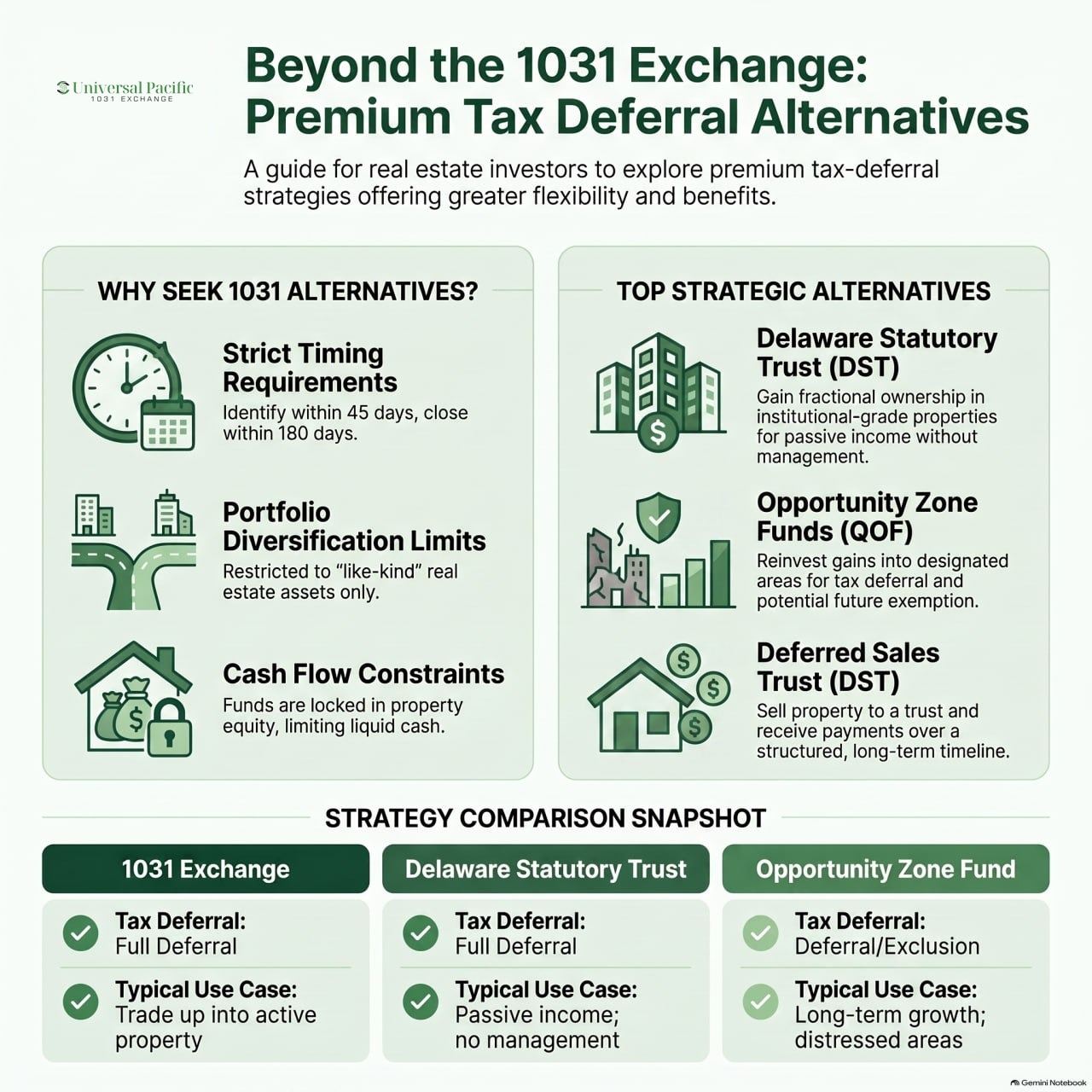
There are situations where investors can explore alternative approaches that fulfill their investment objectives while managing their tax liabilities differently. Here is a breakdown of the available 1031 exchange alternatives.
1. Deferred Sales Trust (DST)
A Deferred Sales Trust is a popular tax deferral strategy. In this scenario, a property owner chooses to entrust a trust with the property. The Trust then sells the property and holds the proceeds. The property owner agrees to a payment plan for receiving payments from the trust over time.
During this period, the trust invests the proceeds to generate income that is given to the property owner according to the payment plan. The owner pays taxes on income received, spreading out the tax payments over a long period of time.
By doing this, the property owner gains the flexibility to manage their tax liabilities more efficiently. “Investors come to us thinking a 1031 is the only way to defer,” says Michael Bergman, CPA, president of Universal Pacific 1031 Exchange. “Often a Delaware Statutory Trust or an installment structure fits their life better.”
2. Real Estate Investment Trusts (REITs)
Real Estate Investment Trusts are investment vehicles that enable individuals to participate in the real estate market without the need for direct ownership or property management responsibilities. Instead of an investor selling the relinquished property to an individual, the investor contributes the property to a REIT in exchange for shares.
This transaction is referred to as the “721 exchange”. The investor sells the property to a subsidiary of the REIT known as an Operating Partnership (OP), and in turn, the investor gets several OP units that can be converted into REIT shares. The investor then receives dividends from the shares up until the time the investor is ready to sell the property and incur capital gains taxes.
3. Opportunity Zones

The Tax Cuts and Jobs Act of 2017, which promotes development in economically distressed areas also known as Opportunity Zones, established investment vehicles called Qualified Opportunity Funds (QOFs).
Opportunity Zone investments present unique opportunities for accredited investors to contribute to the economic growth of designated low-income communities. After selling the relinquished property, an investor can reinvest their capital gains into QOFs, and by doing so, they can potentially defer or reduce their capital gains taxes. Investors are rewarded with major tax benefits and incentives for directing capital into these opportunity zones.
If an investor sells relinquished property and directs the funds into a QOF, and holds the investment for more than 10 years, the investor is likely to be exempt from the capital gains taxes. With this alternative, investors can not only defer capital gains taxes, they can potentially be exempt from paying them altogether.
4. Delaware Statutory Trusts (DSTs)
This is a trust formed under Delaware law by a professional real estate firm. The real estate firm finds a suitable property and manages the due diligence, day-to-day logistics, and management of the property. These are often institutional-quality properties, such as large commercial real estate or real estate funds. Individual investors purchase shares in the DST to gain fractional ownership of the underlying property.
The investors then get taxable income in the form of dividends. The IRS Revenue Ruling 2004-86 states that a DST investment is an eligible replacement property in a 1031 exchange. An investor could achieve tax deferral by selling a property and investing the proceeds into a DST investment instead of purchasing a suitable replacement property outright while still wanting to generate consistent income.
Charitable Remainder Trust
A Charitable Remainder Trust suits investors who also want to give. You place the property in an irrevocable trust, which sells it without an immediate tax hit. The trust pays you an income stream for a set term, and a charity receives what remains. The IRS explains how these trusts work. You also get a partial charitable deduction, and the strategy spreads the deferred gain over time.
Direct Sale and Other Options
Sometimes the simplest path is to sell, pay the tax, and reinvest with full flexibility. Direct real estate ownership gives property owners full control of a rental property or business property. You can rebuild your real estate portfolio with one or more properties on your own terms. Tenancy in common is a co-ownership structure that lets several investors share one property. An installment sale under the tax code, often documented with a promissory note, spreads the gain across future years.
Comparing 1031 Exchange Alternatives: Key Considerations

When deciding on which 1031 exchange alternatives are right for your investment strategy, there are a few factors to consider as an investor. The right choice depends on your goals, your timeline, and your tolerance for complexity. These key considerations shape the tax consequences of each path. The table below compares the main options at a glance.
| Alternative | Tax Deferral | Complexity | Liquidity | Typical Use Case |
|---|---|---|---|---|
| 1031 exchange | Full deferral | High | Low | Trade up into another investment property |
| Delaware Statutory Trust | Full deferral | Moderate | Low | Passive income without management |
| Deferred Sales Trust | Deferral over time | High | Moderate | Cash flow, no like-kind property |
| Opportunity Zone fund | Deferral and possible exclusion | Moderate | Low | Long-term, distressed-area growth |
| 721 exchange (REIT) | Deferral until you sell shares | Moderate | Higher | Diversified, hands-off real estate |
| Direct sale | None | Low | High | Full flexibility, willing to pay tax |
Beyond the table, weigh a few factors for each alternative. Consider the income each is likely to generate and whether it fits your goals. Look at the potential for growth and property appreciation over time. Check the liquidity options and how well they match your needs. Finally, ask how much management each alternative requires and how much control you keep. A financial advisor and a tax advisor can weigh these tradeoffs with you.
Tax Implications
Considering the tax implications that come with every alternative is crucial. Here are the factors to keep in mind: Does the alternative have tax deferral on capital gains, and if it does, how does a taxpayer go about it? What is the tax efficiency of each alternative? As we have seen above, tax benefits vary depending on the alternative you choose.
Liquidity and Accessibility
Evaluate the liquidity options for each alternative. What is the accessibility and investment size required for each alternative?
Investor Control and Flexibility
What level of control do you have over your potential investments as a potential investor? And how flexible is the control you have? Different alternatives have a different level of control and involvement by the investor. It is up to you to choose an alternative that has a level of control and flexibility that aligns with your investment objectives.
Potential Drawbacks of a 1031 Exchange

In investment decisions, understanding the limitations and challenges associated with a 1031 exchange plays an important role in empowering investors to make well-informed decisions. Here are some potential drawbacks of a 1031 exchange.
Property Like-Kind Restrictions
The restriction that the replacement property must be like-kind to the relinquished property limits the number of eligible properties a taxpayer or accredited investor can identify and potentially invest in. This is a potential hurdle, especially for an investor looking for real estate assets to diversify their portfolio.
Potential Tax Risks
The whole allure of the 1031 exchange is the ability to defer capital gain tax. However, this tax-deferred exchange is a very different concept from the absolute exemption from paying capital gains taxes. With tax consequences of this deferral always looming in the background, it is up to the taxpayer to monitor and navigate tax regulations. A future taxable event that entails the sale of the replaced property without executing another 1031 exchange will trigger the revival of the deferred tax liability.
Complexity and Legal Compliance
The 1031 exchange has an intricate set of rules and regulations that must be navigated with the utmost care and precision for the exchange to be successful. There must be a thorough understanding of the various applicable tax codes, laws, deadlines, procedural guidelines, and legal frameworks. Failure to comply with the guidelines can not only lead to the potential disqualification of commercial property from the exchange but can also lead to the imposition of hefty tax burdens. Also, identifying potential replacement properties that comply with the like-kind requirement can be quite a challenge.
Why Seek 1031 Exchange Alternatives?
Aside from the potential drawbacks above, there are a few other factors that can prompt a taxpayer to seek 1031 exchange alternatives.
Time constraints: The 1031 exchange process works under very strict timelines. One is the 45-day identification rule from the day of selling the relinquished property, and the other is the 180-day purchase rule from the day of selling the relinquished property. The two go hand in hand. Both the identification and the acquisition of real property can prove to be very hectic and difficult, especially when working with strict timelines in a competitive real estate market.
Cash flow needs: A 1031 exchange entails reinvesting the proceeds from the sale of a relinquished property into a replacement property. However, if liquidity and cash flow take precedence over acquiring property, then the 1031 exchange will prove to be a futile strategy.
Depreciation recapture: In a 1031 exchange, the deferred capital gains tax is typically transferred from the relinquished property to the replacement property. If depreciation is captured in the relinquished property, it must be recaptured, and therefore the taxpayer is likely to incur a depreciation recapture tax. The impact of this recaptured depreciation tax liability on the overall tax advantages of a 1031 exchange can be significant, prompting taxpayers to seek other 1031 exchange alternatives.
Diversification of Portfolio: Since the 1031 exchange helps investors defer capital gains tax on like-kind properties, this approach may limit investors when it comes to diversifying their portfolios as compared to other 1031 exchange alternatives like Real Estate Investment Trusts (REITs) and DSTs, which we break down in this article.
Latest Rules and Updates Affecting 1031 Exchange Alternatives
Tax law changes, so the best alternative today may differ from a few years ago. The biggest change is to Opportunity Zones. The original deferral ends on December 31, 2026, and a new, permanent Opportunity Zone program begins January 1, 2027, according to the IRS. For that new program, the IRS identified 25,332 eligible census tracts across the country. Section 1031 itself remains fully intact for real property as of 2026. A qualified intermediary and a tax advisor can help you track the rules and pick the right structure.
How Can Universal Pacific 1031 Help You Choose the Right Strategy?
The 1031 exchange remains a powerful tax deferral strategy, but it is not the only one. Delaware Statutory Trusts, Deferred Sales Trusts, Opportunity Zones, REITs, and Charitable Remainder Trusts each fit different goals, risk tolerances, and timelines. With the right guidance, you can pick the structure that keeps more of your gain working for you.
At Universal Pacific 1031 Exchange, our team has decades of experience helping investors defer capital gains taxes and weigh their options. We walk you through the rules, the tradeoffs, and the timing so nothing catches you off guard. Contact us today to explore the 1031 exchange alternatives that fit your investment strategy.
Frequently Asked Questions
Below are answers to common questions about 1031 exchange alternatives.
What Is Better Than a 1031 Exchange?
There is no single best option. A Delaware Statutory Trust suits passive investors, while a Charitable Remainder Trust fits those with charitable goals. A Deferred Sales Trust helps when you need cash flow instead of another property. The best choice depends on your situation.
What Is a Lazy 1031 Exchange?
A lazy 1031 exchange is an informal term. It means using depreciation and losses from new real estate investments to offset the gain on a sale. You skip the formal exchange and its deadlines. It does not defer the gain the way a real 1031 exchange does.
How Can You Legally Avoid Capital Gains Tax on Property?
Several legal tools exist. A 1031 exchange, an Opportunity Zone fund, or a Charitable Remainder Trust can defer or reduce the tax. The primary residence exclusion can erase part of the gain on a home. Holding until death can also give heirs a stepped-up basis.
What Is a Newer 1031 Exchange Alternative?
Delaware Statutory Trusts and Qualified Opportunity Funds are the newer options many investors weigh. Both let you defer capital gains without managing a property yourself. Each carries its own rules, so seek guidance from a qualified intermediary and a tax advisor.
This page was reviewed by Michael Bergman, CPA, California CPA #56113. Verify license.
Disclaimer: This article is for general informational purposes only and is not tax, legal, or investment advice. The 1031 exchange rules and their alternatives are complex, and their application depends on your specific facts. Tax laws change, and each strategy carries its own risks. Consult a qualified intermediary and a licensed tax advisor before acting.
Editorial Policy
All articles are reviewed for accuracy by licensed tax professionals and sourced from official government publications. Read our Editorial Policy →
About The Author
 Michael Bergman is a California licensed CPA and Real Estate Broker with over 35+ years of CPA-supervised 1031 exchange experience in commercial real estate. Specializing in 1031 tax-deferred exchanges and financial oversight, his expertise covers complex real estate transactions. Michael’s unique blend of financial acumen and real estate knowledge positions him as a trusted advisor in the industry, offering sound advice and strategic insights for successful property management and investment.