1031 Exchange Rules | Nevada
You are looking at a Nevada purchase, and you want to know what the rules will actually require of you. The qualification and timing rules are federal, so they do not change at the state line. Nevada adds two things of its own: it licenses the exchange facilitator who holds your money, and it taxes the deed when the property changes hands. That means like-kind investment real property, a qualified intermediary holding the sale proceeds, and the 45-day and 180-day deadlines. Your replacement property must also be of equal or greater value, carrying equal or greater debt to avoid boot.
Since 2015, Universal Pacific 1031 Exchange has acted as qualified intermediary for real estate investors across all 50 states, Nevada included. Our team brings more than 35 years of experience in the analysis, acquisition, management, brokerage, and disposition of over $100 million in commercial real estate. To find out how a Nevada purchase changes your numbers before you list your relinquished property, schedule a free consultation with us today.
In this guide, we’ll walk you through the rules of 1031 exchanges in Nevada, the state-specific advantages, and the steps to successfully complete a 1031 exchange in Nevada.
What Is a 1031 Exchange in Nevada?

Just like in other states, the 1031 exchange in Nevada allows you to defer capital gains taxes when you sell an investment property and reinvest the proceeds into a like-kind property. Like-kind here means similar in nature as defined by the IRS, regardless of the size. A 1031 exchange helps investors build wealth and upgrade their investment portfolio without the immediate tax burden. But to achieve that, you must strictly follow all the rules and requirements that regulate the 1031 exchange process.
This tax-deferred exchange is particularly useful for investors in Nevada due to some extra benefits apart from deferring capital gains taxes and other general 1031 exchange benefits. We’ll cover these benefits in detail in the following sections, but before that, let’s look at the rules of 1031 exchanges in Nevada.
1031 Exchange Rules in Nevada
The rules that decide whether your exchange qualifies are federal, and they are the same in Nevada as anywhere else. Nevada layers one requirement on top of them: under NRS Chapter 645G the exchange facilitator holding your proceeds must be licensed with the Nevada Division of Financial Institutions. That is a rule about who you hire, not about whether the exchange works. Therefore, real estate investors in Nevada must follow the general rules for a 1031 exchange, which include the following:
1. Eligibility Requirement for Properties
To have a successful 1031 exchange in Nevada, both the property you’re selling and the one you’re buying must be used for business or investment purposes. Each must be held as investment and business property rather than for personal enjoyment, and such property has to stay in that character right up to the exchange. As a result, real properties for personal use, like your personal residence, do not qualify.
Apart from personal use properties, properties held for resale (like those involved in fix-and-flip projects) also do not qualify because they are considered inventory, not investment assets. However, you can still conduct a 1031 exchange for a vacation home or even a 1031 exchange for a primary residence through certain specific procedures as we’ve covered in the respective blogs.
In addition, both properties must be like-kind, meaning that they have the same nature no matter their size or quality. Real properties in Nevada are generally like-kind, whether developed or not. For instance, you can exchange vacant land for commercial properties like shopping malls or office complexes. On the contrary, personal properties, such as vehicles or equipment, do not qualify under the current 1031 rules, which apply only to real estate. Intangible property such as stock, partnership interests, and notes is excluded for the same reason.
2. Equal or Greater Value Requirement
If you want to fully defer capital gains taxes, you must reinvest all the sale proceeds into the replacement property. That means the replacement property must be of equal or greater value than the property you sold. For example, if you sell your property for $250,000, you must reinvest at least $250,000 into the new property. If you don’t reinvest all, the portion you did not reinvest is known as “boot in a 1031 exchange” and is taxable. Additionally, the new property must also carry an equal or greater mortgage amount, or you will need to use cash to make up the difference.
You can also decide to do a partial 1031 exchange. Here, you can reinvest part of the sale proceeds in an exchange and use the remaining for non-exchange purposes. In a partial 1031 exchange, the reinvested portion qualifies for tax deferral while the uninvested portion is subject to capital gains taxes.
3. Requirements for Multiple Replacement Properties
You’re allowed to identify multiple replacement properties but under certain conditions. First, you don’t have to buy all identified properties, but you must purchase at least one of them. You must also keep to the 1031 exchange identification rules. For example, the three-property rule allows you to identify up to three properties regardless of their total fair market value.
On the other hand, you can identify any number of properties under the 200% rule as long as their combined fair market value is not more than 200% of the fair market value of the relinquished property. You can also apply the 95% rule, which allows you to identify an unlimited number of properties provided that you purchase at least 95% of their aggregate value. Whichever rule you use, each property identified has to be described unambiguously, which for Nevada real estate normally means the street address or the legal description, not a general reference to a neighborhood.
4. Deadlines for 1031 Exchange Transactions
You must follow the strict timeline for 1031 exchanges to avoid disqualification. From the day you sell the relinquished property, you have 45 days to identify potential replacement properties. You must list the properties in writing and provide the list to your qualified intermediary. After identifying the properties, you must receive them by the earlier of 180 days after transferring the relinquished property or the due date, including extensions, of your federal tax return for that year. Missing these deadlines, even by a single day, can make you lose the tax-deferral benefits.
5. Use of a Qualified Intermediary (QI)

During the exchange, you’re not allowed to handle the sale proceeds directly. If you take possession of the funds at any point, even temporarily, the exchange will be disqualified, and you will owe taxes on the business property sale. Hence, the IRS requires that you work with an exchange facilitator, known as the qualified intermediary, who holds the exchange funds in escrow until it’s time to close the replacement property.
The QI acts as a neutral third party, making sure that the proceeds are used exclusively for purchasing the replacement property. Under NRS Chapter 645G, Nevada licenses exchange facilitators, and NRS 645G.100 makes that licence a requirement rather than a credential. Ask any intermediary you are considering to confirm their standing with the Division of Financial Institutions before you sign.
6. Depreciation Recapture
When you sell a property, the IRS may require you to pay taxes on the depreciation you claimed when you owned the property. This is called depreciation recapture. In a 1031 exchange, this tax can also be deferred along with the capital gains tax. However, the accumulated depreciation carries over to the replacement property. If you sell the replacement property in the future without completing another 1031 exchange, you will owe depreciation recapture taxes.
7. Reporting to the IRS
After each exchange, you must report your 1031 exchange on Form 8824, which is submitted with your federal income tax return. This form outlines the properties involved, the timeline, and the role of the Qualified Intermediary. Since any errors or omissions can result in penalties or disqualification, you need accurate reporting to maintain the tax-deferral benefits of the exchange. We recommend that you learn how to file a 1031 exchange and work with a knowledgeable tax advisor or CPA to be sure that your documentation is complete and accurate.
Exchange Types and Their Specific Rules
While the general rules for delayed 1031 exchanges under federal law apply across all states, including Nevada, the specific process may vary depending on whether you’re running different types of exchanges.
For simultaneous exchanges, both transactions must close on the same day to qualify. Because Nevada’s real estate market can be competitive, coordinating a simultaneous exchange may be challenging, especially in high-demand areas like Las Vegas. You’ll need to work closely with your real estate agent and QI to make both transactions align perfectly.
For reverse exchanges, you’ll require significant upfront investment capital, which can be challenging in competitive Nevada markets. However, you have the opportunity to secure high-demand properties quickly, allowing you to acquire any desired replacement business property before you sell the existing one.
For construction or improvement exchanges, you must make sure that all improvements are completed within the 180-day exchange period. The replacement property’s value after improvements must also equal or exceed the value of the relinquished property. Tight deadlines and construction delays can complicate these exchanges, so working with experienced contractors and a Qualified Intermediary is critical.
There are also other 1031 exchange options, such as a DST 1031 exchange, which allows you to combine the 1031 exchange strategy with Delaware Statutory Trusts and have fractional ownership of institutional assets. These securitized real estate offerings reach property types that are otherwise out of range for individuals.
That includes residential multifamily communities, student housing properties, industrial and manufacturing facilities, and healthcare buildings. Cash flow distributions are paid out to you rather than managed by you. DST interests are commonly offered through private placements and are generally marketed to accredited investors, subject to the specific offering’s requirements. They are sold through alternative investment specialists, and they suit alternative real estate investments better than they suit someone who wants control.
What a Nevada Exchange Still Costs You
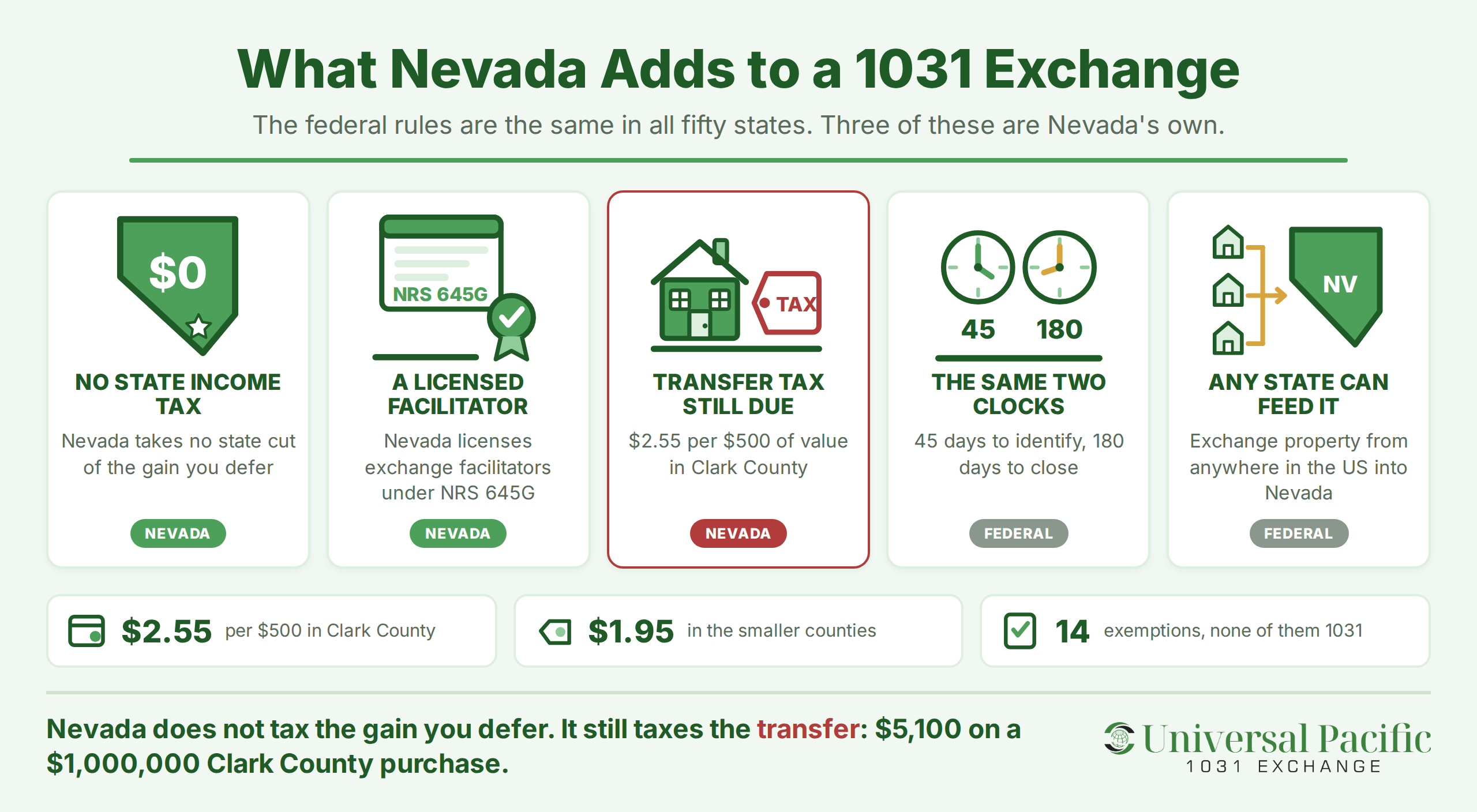
No state income tax does mean no state cost, and this is the part most guides leave out. Nevada charges a Real Property Transfer Tax on the transfer of any Nevada property. A 1031 exchange does not exempt you from it. The rate is set in two parts. NRS 375.020 charges $1.25 for each $500 of value in counties of 700,000 or more and 65 cents elsewhere, and NRS 375.023 adds $1.30 for each $500 statewide. Clark County therefore pays $2.55 per $500 and the smaller counties $1.95, with NRS 375.026 allowing those counties to add up to five cents more. On a $1,000,000 Las Vegas purchase, that equals $5,100 before any other closing costs or fees.
The exemptions are set out in NRS 375.090, and there are fourteen of them. Transfers between entities with identical ownership are exempt, as are transfers to government bodies. So are transfers that merely confirm true ownership. A property swapped under Section 1031 is not exempt. The federal deferral of your gain says nothing about a state transfer tax on the deed. Budget for it the way you budget your qualified intermediary fees and title costs.
Nevada-Specific Advantages of a 1031 Exchange

The 1031 exchange is especially attractive in Nevada for many reasons. The benefits come mainly from Nevada’s tax policies, economic environment, and dynamic real estate market. Some of the major advantages of tax-deferred exchanges in Nevada include:
No State Income Tax
Nevada does not impose a state income tax, which is a significant advantage for real estate investors running tax-deferred exchanges. Although 1031 exchanges primarily defer federal capital gains taxes, states with income taxes usually add an extra layer of taxes. Because you don’t have to pay income taxes in Nevada, you get to reinvest more of your profits, increasing your purchasing power and potential returns.
The ban is constitutional rather than merely legislative. This is not a policy that shifts with the next budget cycle. It also removes a whole layer of state income tax regulations from your holding period. Nevada does not impose an individual state income tax, although investors may still have tax obligations in other states where they own real property.
Buoyant Real Estate Market
The real estate market in Nevada is thriving, with high demand in cities like Las Vegas, Reno, and Henderson. Because of the state’s population growth and strong economy, the values of real properties have gone up, creating numerous opportunities for real estate investing. Nevada’s active real estate market can also offer investors a range of potential replacement properties, though inventory and competition vary by market and property type.
Opportunities in Commercial Real Estate
The opportunities in hospital, retail, industrial spaces, and multifamily apartments in Nevada are increasing rapidly. This makes 1031 exchanges even more profitable for investors in commercial real estate in Nevada. For example, Las Vegas is a global entertainment hub with ongoing development projects, while Reno is emerging as a tech hub with increasing demand for industrial and office spaces. These dynamics create excellent opportunities for investors to reinvest their 1031 exchange proceeds into high-growth commercial properties.
Easy Access to Growth Markets
Nevada’s geographic location provides access to several major economic regions, including California, Utah, and Arizona. That way, you can take advantage of tax deferral and other tax benefits in Nevada to diversify your portfolios across state lines. For example, you can sell an investment property in California, reinvest in Nevada’s tax-friendly environment, and enjoy the benefits of appreciation in a growing state economy.
Construction and Development Opportunities
Nevada’s active construction and development industry creates opportunities for construction or improvement exchanges. For example, you can sell an older property and reinvest through a 1031 exchange for new construction. You can also use the proceeds to improve a higher-value property. This method is particularly profitable in areas undergoing revitalization, such as parts of downtown Las Vegas or emerging suburban neighborhoods.
Lower Property Costs Compared to Neighboring States
Compared to neighboring California, Nevada often offers lower property prices and operating costs, making it an appealing destination for reinvestment. If you’re selling a property in a high-cost state, you can use a 1031 exchange to purchase a larger or more profitable property in Nevada without exceeding your budget.
How Nevada’s Opportunity Zones Compare to an Exchange
Nevada has Qualified Opportunity Zones, and they are frequently described as something you can layer on top of an exchange. You cannot. A 1031 exchange defers your gain by rolling it into replacement real property. A Qualified Opportunity Fund requires you to recognize the gain and invest that amount into the fund within 180 days. The same gain cannot generally be deferred under both Section 1031 and the Opportunity Zone rules. Investors with separate gains or transactions may have different planning options.
The Nevada numbers are worth knowing because the program is in transition. Sixty-one Nevada census tracts were designated as Opportunity Zones in June 2018, including areas in North Las Vegas and Reno, and those designations run through the end of 2028. A new round of Opportunity Zone designations will take effect on January 1, 2027. Nevada currently has 195 eligible census tracts and may nominate up to 49 of them for designation. If you are weighing the two routes, the table below sets out what each one actually gives you.
| Sell and pay the tax | 1031 exchange into Nevada real estate | Qualified Opportunity Fund | |
|---|---|---|---|
| What happens to the gain | Recognized and taxed now | Deferred for as long as you keep exchanging | Recognized, then deferred inside the fund |
| What you must reinvest | Nothing, the cash is yours | The entire sale proceeds, plus matching debt | The gain amount only, not the whole proceeds |
| Deadline to act | None | 45 days to identify, 180 days to close | 180 days from recognizing the gain |
| What you end up owning | Cash | Real property you choose and control | An interest in a fund, chosen by its sponsor |
| Long-term relief | None | Step-up in basis at death | Gain on the fund investment excluded after 10 years |
| Geographic limit | None | Any US investment real estate | Only designated zones |
How to Complete a 1031 Exchange in Nevada
The 1031 exchange process in Nevada is pretty much the same as the general process. Getting it right is all about understanding the requirements, what makes properties qualify, the deadlines for transactions, and other important details. Here’s a brief summary of the 1031 exchange process in Nevada.
Step 1: Confirm that Your Properties Qualify
The first question is the simplest one: does the property qualify? Remember that both the relinquished and replacement properties must be held for investment or business purposes. Personal residences and properties intended for resale do not qualify for a 1031 exchange in Nevada.
Step 2: Engage a Qualified Intermediary (QI)
Engage a QI to handle the proceeds from the sale and facilitate the exchange process. Your exchange will be disqualified if you have direct access to the exchange funds, so the QI acts as a neutral third party. The QI also helps you make sure you don’t violate any IRS requirements.
Step 3: Sell Your Relinquished Property
Sell your relinquished property and make sure that the contract specifies it is part of a 1031 exchange. Then the proceeds pass to the QI at closing rather than to you.
Step 4: Identify Potential Replacement Properties Within 45 Days
Identifying replacement properties is the step with the least room for error. Identify potential replacement properties within 45 days after selling the relinquished property, according to the IRS rules on the timeline for a 1031 exchange. You can identify multiple properties as long as you keep to the 200% rule and other 1031 exchange identification rules. Submit the identified replacement properties in writing to the QI within the deadline.
Step 5: Purchase the Replacement Property Within 180 Days
Purchase the replacement property within the next 135 days after the 45-day identification period. The entire exchange must be completed within 180 days of selling the exchanged property. You must reinvest ALL the proceeds if you want to defer capital gains taxes completely. If you’re running a partial 1031 exchange, only the reinvested portion will be tax-deferred.
Step 6: Keep the Right Professionals Around the Deal
Work with a team including a QI, real estate agent, and tax advisor to be sure the exchange is completed correctly. The goal is to avoid disqualification or unexpected tax liabilities.
Step 7: Report the 1031 Exchange to the IRS
Report your 1031 exchange to the IRS using Form 8824 when filing your federal income tax return for the tax year in which the relinquished property was sold. Keep the exchange agreements pursuant to Section 1031, the assignments, and the purchase documents with the return, because your carried-over basis will matter again on the next sale.
Can I Exchange Out-of-State Property for Property in Nevada?

Yes, you can exchange an out-of-state property for a property in Nevada under the 1031 exchange rules. The IRS allows like-kind exchanges between investment properties located anywhere in the United States, regardless of state lines, as long as both properties meet the eligibility criteria. Remember that all the properties involved must be like-kind and used for business or investment.
However, before you run an interstate tax-deferred exchange, consider that the 1031 exchange costs might be higher due to certain reasons. For example, you might need to work with professionals both in Nevada and in the other state, causing a potential spike in the 1031 exchange closing costs and other expenses. QIs generally charge more for out-of-state transactions; so expect to pay higher qualified intermediary fees. Moreover, other states may have state-specific taxes or fees for real estate transactions, and you should also consider the differing real estate market conditions across states.
There is one further point that matters if you are leaving a state that does tax income. Nevada’s lack of an income tax applies to you as a Nevada owner, but it does not erase the interest your former state has in the gain you deferred there. Several states, California among them, require ongoing annual reporting of a deferred gain that left the state and will tax it when you eventually cash out. If your relinquished property is a California property and your replacement is Nevada real estate held for investment, treat that as a question for your own advisors before you close, not after.
“Investors hear no state income tax and assume Nevada is free,” says Isaac Michael Bergman, CPA, President and CEO of Universal Pacific 1031 Exchange. “Then the transfer tax lands on a Clark County closing statement, and if they came out of a state that tracks deferred gains, that obligation followed them across the border. Neither one breaks the exchange. Both belong in the numbers before you sign.”
Need an Experienced Qualified Intermediary in Nevada?
With a 1031 exchange, you can take advantage of Nevada’s tax-friendly policies, robust real estate market, and diverse investment options. Whether you’re exchanging one property for one or multiple properties, upgrading to a larger property, or reinvesting from out of state, the process can help investors grow their wealth strategically. But you can only achieve any of these advantages when you carefully play by the rules guiding the exchange in Nevada.
As a reputable qualified intermediary nationwide, Universal Pacific 1031 Exchange has all it takes to make your exchange stress-free and successful. Our experts are here to guide you through every step, ensuring you maximize your tax deferral benefits while achieving your investment goals. Reach out to us today to start an exchange and receive professional guidance throughout the exchange period.
Frequently Asked Questions
This section provides answers to common questions about 1031 exchange rules in Nevada.
What Is the 95% Rule in a 1031 Exchange?
The 95% rule is an exception to the normal 1031 exchange identification rules. It lets you identify as many replacement properties as you want, but by the end of the exchange, you must actually acquire properties worth at least 95% of the total fair market value of all the properties you identified.
Is It Better to Pay Capital Gains or Do a 1031 Exchange?
Ask what the money is for. If it is staying in real estate, the exchange usually wins, because the tax you would have paid keeps working as equity in the next property and the arithmetic compounds every time you repeat it. If you want out of real estate ownership entirely, or the gain is modest, or you cannot find a replacement worth owning inside 45 days, paying the tax is the cleaner answer.
The failure case is well known to anyone who has watched it: an investor buys a property they do not want, in a market they do not know, purely to beat a deadline, and then spends five years regretting a decision that saved them one tax bill.
What Would Disqualify a Property From Being Used in a 1031 Exchange?
Personal use is the first disqualifier. A primary residence, a second home you use yourself, or any property held mainly for enjoyment rather than return falls outside Section 1031. Inventory is the second. Property bought to renovate and resell is stock in trade, so fix-and-flip projects do not qualify, no matter how the deed reads.
The third is anything that is not real property, which rules out equipment, vehicles, and intangible property such as stock, partnership interests, and notes. A property can also disqualify itself through the process rather than its nature, by being identified late, described too vaguely to be unambiguous, or bought after day 180.
How Much Does It Cost to Do a 1031 Exchange?
Qualified intermediary fees for a standard delayed exchange usually run in the high hundreds to low thousands of dollars, with additional charges for each extra property and materially higher fees for reverse and improvement exchanges, which require an exchange accommodation titleholder and its own entity.
On top of that sit the ordinary closing costs on both sides, and in Nevada the Real Property Transfer Tax described above, which on a $1,000,000 Clark County purchase is $5,100 on its own. Weigh all of it against the tax you are deferring. On a gain of any size, the exchange normally costs a small fraction of the tax bill it postpones, which is why the fee is rarely the deciding factor.
This page was reviewed by Michael Bergman, CPA, California CPA #56113. Verify license.
Disclaimer: This article is for informational purposes only and is not legal, tax, or financial advice. Tax laws change and every situation is different. Please consult a qualified attorney, CPA, or tax advisor before making decisions about your property, sale, or 1031 exchange.
Editorial Policy
All articles are reviewed for accuracy by licensed tax professionals and sourced from official government publications. Read our Editorial Policy →
About The Author
 Michael Bergman is a California licensed CPA and Real Estate Broker with over 35+ years of CPA-supervised 1031 exchange experience in commercial real estate. Specializing in 1031 tax-deferred exchanges and financial oversight, his expertise covers complex real estate transactions. Michael’s unique blend of financial acumen and real estate knowledge positions him as a trusted advisor in the industry, offering sound advice and strategic insights for successful property management and investment.