How Long Do You Have to Rent a 1031 Exchange Property?
The primary goal of a 1031 exchange is to defer capital gains tax. To enjoy the tax benefits, both properties must be like-kind, and you must follow the identification rules, meet the timelines for a 1031 exchange, and satisfy the IRS requirements for rental properties.
While the Internal Revenue Service (IRS) does not set a specific minimum rental duration for a replacement property, the property must be held for investment purposes. However, most tax advisors and Universal Pacific’s Qualified Intermediaries recommend renting and holding the rental property for at least two years to demonstrate investment intent.
Having been in this industry for 35+ years, we understand the challenges you may face trying to figure out the rules guiding the rental duration of a 1031 property. If you’re looking to facilitate a compliant, stress-free 1031 exchange, do not hesitate to reach out to our experienced qualified intermediaries at Universal Pacific 1031 Exchange. Schedule a free call with us today, and let’s discuss what you need.
This article will help you understand the IRS rules regarding rental duration, how it affects taxes, and the strategies you can employ to meet the requirements.
Understanding the 2-Year Rule for 1031 Exchange Properties
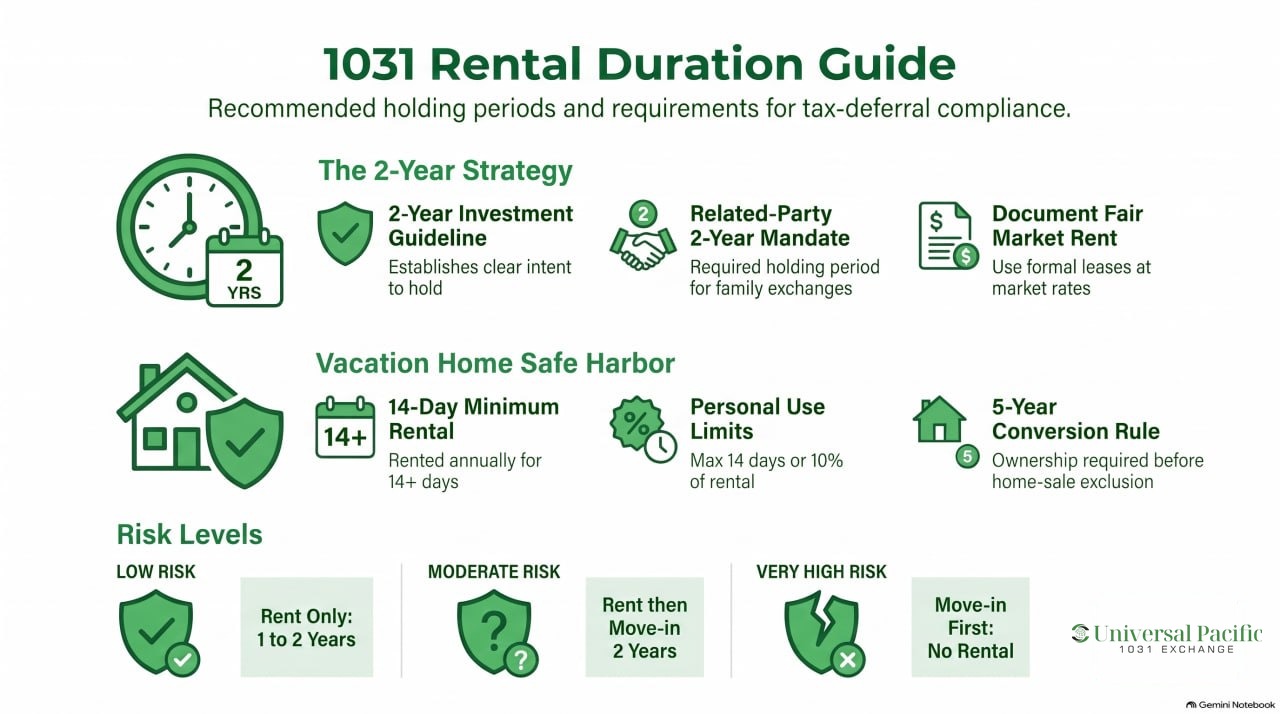
Investors often ask about a “2-year rule,” but two different two-year concepts exist. The first is a rule of thumb. Many advisors suggest holding both the relinquished and replacement properties for one to two years to show investment intent. This is a guideline, not a statute.
The second is a real statutory rule for related-party exchanges. It lives in Internal Revenue Code Section 1031(f). If you exchange property with a related party, both of you must hold the property for at least two years. If either side sells within those two years, the IRS can disqualify the exchange and tax the deferred gain.
The stakes are real. In Ocmulgee Fields, Inc. v. Commissioner, the Eleventh Circuit disallowed a related-party exchange in 2010. Case law like this shows the two-year rule has teeth. About $6.1 million in gain became taxable.
IRS Revenue Procedures and Official Guidance
The IRS backs these rules with published guidance. The safe harbor for rental and vacation properties sits in Revenue Procedure 2008-16, covered below. The related-party rule sits in Internal Revenue Code Section 1031(f). Citing the right guidance helps you and your qualified intermediary frame the exchange correctly.
How Long Do You Have to Rent a 1031 Exchange Property?

Rental property is a big part of the market. The Census Bureau counts 44.6 million renter-occupied housing units across the country. The exact number of years you have to rent a 1031 exchange property is not specified by the IRS for an investment property involved in a 1031 exchange. A common rule of thumb is to hold both the relinquished and replacement properties for at least one to two years to demonstrate investment intent.
Moreover, if you plan to perform another exchange after the first one, holding periods are examined more closely. So, it’s best to ensure longer holding periods between exchanges to help demonstrate investment intent.
What Is Intent to Hold for Investment?
The intent to hold the property for business or investment purposes at the time of the exchange is the key factor. The IRS considers the investor’s intent rather than a specific duration. To prove this intent, you may need to document your efforts to rent out the real property and the actual rental periods.
Also, recall that the properties must be held for productive use in a trade, business, or investment. The property must be held for business use, not as personal property or the taxpayer’s personal home. You cannot use the property personally beyond narrow limits. Many types qualify, from a single-family home to an office building or raw land.
Residential properties can work if you rent them, but not as your principal residence. A short-term rental can still count, as long as it is a genuine investment and not a personal residence or personal vacation home. “The IRS looks at what you did, not just how long you held it,” says Michael Bergman, CPA, president of Universal Pacific 1031 Exchange. “Rent it at a real rate, keep the records, and your investment intent speaks for itself.”
1031 Exchange Short Term Rental – a Safe Harbor for Vacation Homes
The IRS provides a “safe harbor” rule under Revenue Procedure 2008-16. The rule gives specific conditions under which a vacation home will qualify as property held for productive use in a trade or business or for investment. According to the Safe Harbor rule, the property must be rented to someone else at a fair rental for 14 days or more within two 12-month periods immediately after the exchange. Also, personal use must not exceed the greater of 14 days or 10% of the number of days during the 12-month period that the property is rented at a fair rental.
The Conversion of 1031 Exchange Properties to Personal Use
You can live in a 1031 exchange property after 2 years, but there are some conditions. For example, you must rent out the property at a fair market value for some part of the first two years, which qualifies you for the Section 121 exclusion. In the years prior to any conversion, keep it as a genuine rental. That establishes the property’s initial investment use.
To later claim the Section 121 home-sale exclusion, you must own the property for at least five years. That five-year period applies to property acquired in a 1031 exchange, under Section 121(d)(10). You must also live in the home for two of the five years before you sell. Single taxpayers can then exclude up to $250,000 of gain. A conservative plan follows the safe harbor first, then the five-year hold, before you convert.
The table below sums up common scenarios and their risk under IRS rules. It is a general guide, not legal advice.
| Scenario | Minimum Rental Period | Allowed Personal Use | IRS Risk Level |
|---|---|---|---|
| Rent only, no personal use | 1 to 2 years | None or minimal | Low |
| Rent, then move in after 2 years | 2 years at fair rental | Within safe harbor limits | Moderate |
| Rent, then move in after 1 year | 1 year | Within safe harbor limits | Higher |
| Move in with no rental first | None | Personal from day one | Very high, likely disqualified |
How Does Rental Duration Affect Taxes?

Internal Revenue Code Section 1031 allows real estate investors to defer capital gains taxes by reinvesting the proceeds from selling one property into another like-kind property within a specified time. One of the key factors that determine whether the exchanged properties qualify for tax deferral is the rental duration. This is how it works:
An extended rental duration strengthens the argument that the real estate investor holds the property for rental or investment purposes, meeting the IRS requirements for a 1031 exchange. So, the longer you hold a property for rental purposes, the more likely you will qualify for this tax deferral. On the other hand, holding a property for a short duration before selling it may incur capital gains immediately, resulting in a higher tax liability.
Usually, properties used for rental purposes allow owners to claim depreciation deductions. But that’s different for 1031 exchange properties, where the deferred gain includes the depreciation claimed. However, holding a like-kind property for a more extended rental duration allows for additional depreciation deductions, potentially reducing the depreciation recapture amount upon the eventual sale.
Finally, the IRS assesses the intent behind holding a property. In that assessment, an extended rental duration demonstrates a clear investment intent, supporting the argument for a 1031 exchange. On the other hand, holding a property for a short period may raise questions about whether the property was genuinely held for investment purposes.
Strategies for Meeting Rental Duration Requirements of 1031 Exchange

To successfully defer capital gains tax for a rental property, you need to understand what to do to satisfy the rental duration requirements. Some of the recommended strategies include:
Establish a Solid Rental Agreement
To indicate the property’s use as a rental, set up formal lease agreements with tenants. Price the rent within current market rates, since rent set far above or below market can look like a disguised personal residence. Such formal agreements add credibility to the investment intent and can be handy for references.
Set a Fair Market Rent
If you set rental prices above or way below current market rates, it may look like a primary residence disguised as a rental. So, set rents within market rates to signify real rental use.
Keep Detailed Records
Always safeguard records of rental listings, communications with potential tenants, and any property management contracts to demonstrate efforts to rent the property. Also, try to maintain detailed documentation of rental periods, including leases, payment receipts, and any other relevant transactions.
Adhere to Safe Harbor Rules
Make sure the replacement property is rented for at least 14 days at fair market value. Additionally, personal use should not exceed 14 days or 10% of the days rented to qualify under the IRS’s safe harbor rules.
Minimize Personal Use
To reinforce the property’s status as an investment, minimize personal use of the property. If you must use the property, ensure it does not exceed the safe harbor limits.
Plan for Long-Term Rental
Plan to rent the property for at least one to two years after the exchange. This duration is not a legal requirement but serves as a guideline to demonstrate investment intent.
Use a Qualified Intermediary (QI)
Handling the nitty-gritty of a 1031 tax-deferred exchange can be challenging sometimes. Especially when it involves more complex methods, such as a reverse exchange or a delayed exchange, you need some level of experience to comply with the rules. That’s why you should contact an experienced qualified intermediary to help you navigate the process successfully.
QIs also understand the tax liabilities and other consequences of potential mistakes in rental duration and the exchange in general. So, you can leverage their expertise to ensure your investment properties and transactions are all within the provisions of the IRS for a tax-deferred exchange.
Monitor and Realign Your Strategy
Continuously monitor the rental status of the investment property and make adjustments as needed to ensure compliance with 1031 exchange requirements.
Consult with Professionals
Consult with tax professionals and 1031 exchange experts, like Universal Pacific 1031 Exchange, regularly to stay informed about current laws and strategies that can affect your exchange.
Comply With the IRS Rules for 1031 Transactions
Beyond the rules that apply to rental duration, it’s also important to understand and follow the general IRS rules when swapping one investment real estate for another. Pay close attention to the replacement property identification rules, especially when you’re identifying up to three properties. Learn how to calculate the fair market value of properties so you can be sure that potential replacement properties have equal or greater value than the relinquished property.
Want to Know More About Exchanging Your Rental Property?
The key to maximizing the tax benefits of a 1031 exchange is having a proper understanding of the rules you must follow to qualify your rental property. To be sure you’re on the right track, it’s best to consult with a tax advisor and an expert qualified intermediary. Universal Pacific 1031 Exchange’s expert insight and guidance will help you stay compliant and avoid costly mistakes. Contact us today for a successful 1031 exchange for rental properties.
Frequently Asked Questions About Renting 1031 Exchange Properties
What Is the 2-Year Rule for a 1031 Exchange?
Two versions exist. As a rule of thumb, many advisors suggest holding the property for two years to show investment intent. As a statute, a related-party exchange requires both parties to hold the property for two years, or the exchange can be disqualified.
How Long Should You Rent Before Converting to a Primary Residence?
Rent it as a genuine investment first, ideally under the safe harbor for two years. To claim the Section 121 exclusion later, you must own the property for at least five years. You must also live in it for two of the five years before selling.
Can You Rent a 1031 Exchange Property to a Family Member?
You can, but be careful. The IRS treats certain family members as related parties. You must still charge a fair rental, and personal use by the family can count against you. Poorly documented family rentals invite IRS scrutiny.
Can You Rent Your Own 1031 Exchange Property?
The property must be held for investment, not personal use. You cannot treat it as your own home while claiming it as a rental. Limited personal use within the safe harbor is allowed, but you cannot live there full time.
How Long Do You Have to Rent a 1031 Property After the Exchange?
The IRS sets no exact minimum. Most advisors recommend one to two years of genuine rental use at fair market value. Longer holding periods make your investment intent easier to prove.
This page was reviewed by Michael Bergman, CPA, California CPA #56113. Verify license.
Disclaimer: This article is for general informational purposes only and is not tax or legal advice. The 1031 exchange rules are complex, and their application depends on your specific facts. Rental and holding-period requirements can change, and each situation is different. Consult a qualified intermediary and a licensed tax advisor before acting.
Editorial Policy
All articles are reviewed for accuracy by licensed tax professionals and sourced from official government publications. Read our Editorial Policy →
About The Author
 Michael Bergman is a California licensed CPA and Real Estate Broker with over 35+ years of CPA-supervised 1031 exchange experience in commercial real estate. Specializing in 1031 tax-deferred exchanges and financial oversight, his expertise covers complex real estate transactions. Michael’s unique blend of financial acumen and real estate knowledge positions him as a trusted advisor in the industry, offering sound advice and strategic insights for successful property management and investment.