

How Does Florida’s Capital Gains Tax on Real Estate Work?
Learn how capital gains tax works on real estate in Florida for 2026, including federal rates, exemptions, and strategies to minimize your tax burden.

Florida has no state income tax and no state capital gains tax, so a property sale there is taxed only at the federal level: 0%, 15% or 20% depending on income and filing status. Two federal layers can apply on top, the 3.8% net investment income tax and 25% depreciation recapture on rentals.
Selling real estate in Florida comes with a built-in advantage that owners in most of the country simply don’t get: the state charges no capital gains tax at all. Florida has no personal income tax, so when you sell a property here for a profit, the only capital gains bill you face is the federal one. There’s no second layer stacked on top by the state, the kind of layer a seller in California or New Jersey pays without any choice in the matter.
That doesn’t mean the sale is tax-free. The federal capital gains tax still applies to any qualifying asset sale, and it can take a real bite out of your take-home profit depending on how long you owned the property, how big the gain is, and the specifics of your situation. Whether you’re a snowbird cashing out a Gulf-coast condo, a retiree downsizing a homestead, or an investor selling a rental, your final number depends on getting a handful of federal rules right.
And for investment property, you can defer the entire federal capital gains bill, including depreciation recapture, with a 1031 exchange.
In summary: Florida takes nothing on the gain, so the federal bill is the whole bill, and a 1031 exchange can defer all of it.
- 0%Florida tax on the gain
- 0–20%Federal long-term rate
- 25%Recapture on rentals
At Universal Pacific 1031 Exchange, we help real estate investors and property owners defer long-term capital gains taxes through properly structured 1031 exchanges. We’re recognized as a leading Qualified Intermediary in Miami and across Florida. Ready to defer the tax on your next sale? Contact us to start an exchange today.
This guide walks through what capital gains tax is, exactly how it works on a Florida property sale in 2026, why Florida’s no-income-tax status matters more than most sellers realize, and how to keep more of your gain — legally.
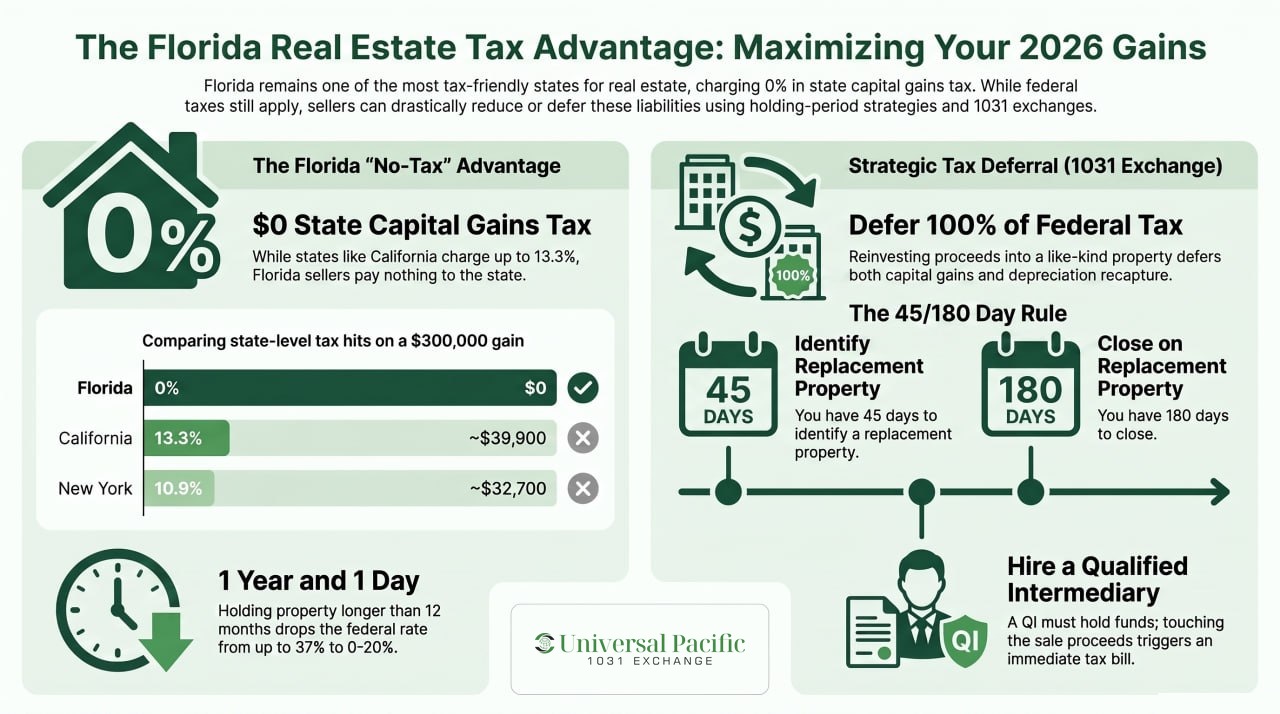
Table Of Contents
- What Is Capital Gains Tax on Real Estate?
- How Are Capital Gains Calculated?
- Does Florida Have Its Own Capital Gains Tax on Real Estate?
- Why Florida’s No-Income-Tax Rule Changes the Math
- How Is Capital Gains Tax on a Florida Sale Calculated in 2026?
- Exclusions Available to Florida Homeowners
- How Can You Minimize Capital Gains Tax When Selling Florida Real Estate?
- How Does a 1031 Exchange Defer Capital Gains Tax in Florida?
- How to Use a 1031 Exchange to Maximize Tax Efficiency
- How Do You Report a Florida Real Estate Sale?
- Ready to Defer Florida Capital Gains with a 1031 Exchange?
- FAQs
- Does Florida have a capital gains tax on real estate?
- What are the 2026 federal long-term capital gains rates?
- Can I exclude capital gains on my Florida primary residence?
- How does depreciation recapture work when I sell a Florida rental?
- How does a 1031 exchange work for Florida investors?
- How does Florida’s capital gains treatment affect non-residents?
- Can real estate commissions be deducted from capital gains?
What Is Capital Gains Tax on Real Estate?
Capital gains tax is the tax on your profit — the sale price minus your adjusted basis — when you sell real estate.
When you sell a property in Florida for more than you put into it, after accounting for improvements, closing costs, and any depreciation you claimed, the IRS treats that profit as a capital gain. Florida doesn’t tax that profit, but the federal government does. What you owe comes down to three things: your income, your filing status, and how long you held the property before selling.
Hold a property for more than a year and the profit is a long-term gain, taxed at the favorable 0%, 15%, or 20% rates. Sell inside a year and it’s a short-term gain, taxed as ordinary income at rates that run from 10% up to 37%. That single distinction, one year and a day, often makes the biggest difference on the whole bill.
How Are Capital Gains Calculated?
The mistake most owners make is subtracting only the purchase price from the sale price. Do that and you’ll calculate a far bigger gain, and a far bigger tax, than you actually owe. The correct formula is: selling price − adjusted basis − selling expenses.
Your adjusted basis starts with the purchase price, then adds the capital improvements you made and the closing costs you paid when you bought, such as legal fees, title insurance, escrow fees, and recording fees.
If you claimed depreciation during your ownership (common on rentals), you subtract it back out. So adjusted basis = original purchase price + closing costs + capital improvements − depreciation claimed over time. That last piece matters at sale time, because the depreciation you subtracted comes back as its own line of tax (more on that below).
Does Florida Have Its Own Capital Gains Tax on Real Estate?
No. Florida does not levy a state capital gains tax on real estate, or on anything else. It’s one of only nine states with no personal income tax, and because a state capital gains tax is really just a slice of income tax, having none of the latter means none of the former. Residents and non-residents alike can sell Florida property without ever filing a state return on the gain. The only capital gains tax in play is federal.
That sounds like a technicality until you run the numbers against a high-tax state. On a large real estate gain, a state rate of even a few percent can cost tens of thousands of dollars, money a Florida seller simply keeps.
Why Florida’s No-Income-Tax Rule Changes the Math
Here’s the part that’s easy to underestimate. In a high-tax state, capital gains are stacked: you pay the federal rate and a state rate on the same profit. Florida removes the second layer entirely. To see what that’s worth, look at the same $300,000 long-term gain sold in four different states in 2026:
| State | Top State Rate on the Gain | State Tax on a $300,000 Gain |
|---|---|---|
| Florida | 0% (no state income tax) | $0 |
| California | up to 13.3% | up to ~$39,900 |
| New York | up to 10.9% | up to ~$32,700 |
| New Jersey | up to 10.75% | up to ~$32,250 |
Same property, same federal bill, same profit — but the Florida seller walks away with up to $40,000 more than the California seller purely because of where the closing happened. That gap is exactly why so many retirees and snowbirds end up establishing Florida residency before selling appreciated property, and why out-of-state investors like buying and selling Florida vacation rentals and second homes. If you’re comparing a sale here against one in a place like California, our California capital gains tax calculator shows the other side of that math.
A few Florida-specific points worth keeping straight. The no-tax advantage is about the gain on a sale, and it’s separate from your homestead exemption, which lowers the annual property taxes on your primary home but has nothing to do with capital gains. Florida also charges no estate or inheritance tax, so property passed to heirs avoids a state death-tax layer too. And while it’s not a tax, remember that Florida’s high homeowners-insurance costs are a real carrying expense, one more reason many owners eventually sell appreciated property here rather than hold it, which makes the capital gains planning below worth doing right.
How Is Capital Gains Tax on a Florida Sale Calculated in 2026?

In Florida the gain is figured the same way as anywhere, but it is taxed only at the federal level — the state adds nothing.
Since Florida has no state capital gains tax, the whole calculation is federal. Start with the gain itself: capital gains = selling price − adjusted basis − selling expenses. Expanding the basis, that’s:
Capital gains = selling price − (purchase price + closing costs + capital improvements − depreciation) − selling expenses.
Selling expenses and closing costs are deductible transactional costs: real estate agent commissions, title fees, transfer tax, legal fees, and Florida’s documentary stamp tax, and they come off the top, shrinking the taxable gain. Capital improvements are major upgrades like a room addition or a full kitchen renovation, not routine repairs or maintenance.
Once you have the long-term gain, here are the 2026 federal long-term capital gains brackets that set your rate (these are the thresholds the IRS indexed for tax year 2026):
| Filing Status | 0% Rate (taxable income up to) | 15% Rate (up to) | 20% Rate (above) |
|---|---|---|---|
| Single | $49,450 | $545,500 | $545,500 |
| Married Filing Jointly | $98,900 | $613,700 | $613,700 |
| Married Filing Separately | $49,450 | $306,850 | $306,850 |
| Head of Household | $66,200 | $579,600 | $579,600 |
Short-term gains (property held a year or less) don’t get these rates. They’re taxed as ordinary income, from 10% to 37% depending on your bracket. Source: IRS Topic No. 409, Capital Gains and Losses.
Two extra federal layers to plan for: the 3.8% NIIT and 25% depreciation recapture
The bracket table isn’t always the whole story. Two other federal rules catch a lot of real estate sellers by surprise:
- The 3.8% Net Investment Income Tax (NIIT). On top of the 0/15/20% rate, high earners owe an extra 3.8% surtax on the lesser of their net investment income (which includes capital gains) or the amount their modified adjusted gross income exceeds a threshold. For 2026 those thresholds are $200,000 (single), $250,000 (married filing jointly), and $125,000 (married filing separately). And unlike the brackets above, they’re fixed by 2013 law and never adjusted for inflation, so more sellers cross them every year. A big one-year gain from a property sale can push your income over the line for that year alone. See IRS Topic No. 559.
- Depreciation recapture at up to 25%. If you claimed depreciation, standard on any rental, the IRS “recaptures” it when you sell. That portion of your gain is unrecaptured Section 1250 gain, taxed at a maximum 25% rate, and the primary-residence exclusion below can’t shelter it. It’s a separate line from the 0/15/20% rate, and it’s the reason the 1031 exchange is so valuable to investors: an exchange defers the recapture too. See IRS Publication 544.
If the property you sold was your primary residence, you may exclude up to $250,000 of gain ($500,000 as a married couple) under Internal Revenue Code Section 121. The examples below show how all of this fits together.
Scenario One: Selling a Primary Residence
Vanessa bought a Sarasota home in 2020 and lived in it as her primary residence until she sold it in early 2026. Her numbers:
- Purchase price in 2020 — $300,000
- Capital improvements — $45,000
- Purchase closing costs — $30,000
- Depreciation claimed for a home office over five years — $10,000
- Selling price in 2026 — $650,000
- Selling expenses — $50,000
Adjusted basis: $300,000 + $45,000 + $30,000 − $10,000 = $365,000.
Capital gain = $650,000 − $365,000 − $50,000 = $235,000.
Because Vanessa met the two-of-five-year test, her $235,000 gain falls entirely under the $250,000 single-filer Section 121 exclusion, so the gain itself is federally tax-free. One catch: the $10,000 of depreciation she claimed can’t be excluded. That piece is recaptured as unrecaptured Section 1250 gain at up to 25%, roughly $2,500. Everything else she keeps, and since Florida adds no state tax, that’s the entire bill.
Scenario Two: Selling a Rental Property
You bought a Florida rental in 2014 for $500,000, put $60,000 into improvements, and sell it in 2026 for $700,000 net of selling expenses. Over 12 years you claimed $145,000 in depreciation. Your adjusted basis is $500,000 + $60,000 − $145,000 = $415,000, so your total gain is $285,000.
That gain splits into two pieces. The $145,000 of depreciation is recaptured at up to 25%. The remaining $140,000 is a long-term capital gain taxed at 15% or 20% depending on your income, and if that income clears the NIIT threshold, add 3.8% on top. A rental never qualifies for the Section 121 exclusion, so none of it is sheltered. Florida still charges nothing, but the federal bill here is real, which is precisely the situation a 1031 exchange is built to solve.
Scenario Three: A Foreign (Non-Resident) Investor
Say you’re a citizen of Singapore who bought a Miami condo for $300,000 all-in and sold it in 2026 for $450,000. As a non-resident alien, you owe federal capital gains tax on the profit, and the sale triggers FIRPTA withholding, generally 15% of the gross sale price held back at closing. You can file to recover any overpayment if your actual gain-based tax is lower. Florida, again, withholds nothing at the state level.
Exclusions Available to Florida Homeowners
The most valuable break for a Florida homeowner is the primary-residence exclusion under Section 121. It lets you exclude up to $250,000 of gain as a single filer, or $500,000 as a married couple filing jointly, when you file your return.
To qualify, the home must have been your primary residence for at least two of the five years before the sale. The two years don’t need to be consecutive, but they must land inside that five-year window, and you can’t have used the exclusion on another sale within the prior two years. It applies to a true primary residence — not a rental or a second home.
Because Florida has no state income tax, a qualifying exclusion wipes out both the federal and state capital gains on that gain at once. For a longtime owner sitting on years of appreciation, that can mean keeping the full proceeds. Just remember the two carve-outs above: the exclusion doesn’t cover depreciation recapture, and it caps at $250k/$500k, so a larger gain still leaves a taxable slice.
How Can You Minimize Capital Gains Tax When Selling Florida Real Estate?

A 1031 exchange or the Section 121 primary-residence exclusion can defer or erase much of the federal bill.
A lot of it comes down to timing. Hold the property past the one-year mark and the profit is a long-term gain at the lower rates; sell earlier and it’s taxed as ordinary income, which is usually higher. Sometimes waiting a few extra months to cross that line is the single best move you can make.
For investment property, a 1031 exchange is the heavyweight tool: roll the proceeds into another like-kind property and you defer the entire federal bill (capital gains and depreciation recapture) as long as the exchange is done by the book. Keep exchanging over time and you can keep deferring. If the property eventually passes to heirs, the stepped-up basis can erase the deferred tax entirely, and Florida charges no inheritance tax on top.
Beyond that: track every improvement so it raises your basis and shrinks the gain; time the sale into a lower-income year to stay in a lower bracket (and, ideally, under the NIIT threshold); and use tax-loss harvesting to offset the gain with losses elsewhere in your portfolio. For a sense of what the process itself runs, see our breakdown of 1031 exchange costs.
How Does a 1031 Exchange Defer Capital Gains Tax in Florida?
A 1031 exchange lets a Florida investor defer capital gains tax by selling an investment or business property and reinvesting the proceeds into another like-kind property. Named after Section 1031 of the Internal Revenue Code, it’s built to keep your capital working instead of handing a chunk to the IRS after every sale.
Rather than cashing out and triggering a taxable event, you use the proceeds to buy a qualifying replacement. The full value stays invested and keeps compounding, and many investors chain multiple exchanges to grow a portfolio without ever paying the deferred tax.
The rules are strict, though. You have 45 days from the sale to identify a replacement property in writing, and 180 days total to close on it, under the Florida 1031 rules and deadlines. The exchange must run through a Qualified Intermediary, and it only covers investment or business property — a primary residence or second home doesn’t qualify unless it’s been converted to a rental.
How to Use a 1031 Exchange to Maximize Tax Efficiency
Here’s the step-by-step for using a 1031 exchange to defer your tax:
1. Hire a Qualified Intermediary (QI). Before you close, line up a Qualified Intermediary — a neutral third party who holds the sale proceeds. You can’t touch the money yourself, or the IRS treats it as constructive receipt and the deferral is gone.
2. Sell your investment property. List and sell as usual, but make sure the QI receives the proceeds at closing, not you, and note in the sale contract that the deal is part of a 1031 exchange.
3. Identify replacement property within 45 days. Within 45 days of the sale, identify one or more like-kind replacements in writing to your QI, following the IRS identification rules. Miss the deadline and the exchange is disqualified.
4. Close on the replacement within 180 days. The 180-day clock runs from the sale of the relinquished property, and extensions are rarely granted, so coordinate closely with your QI.
5. Reinvest all the proceeds. To defer the full tax, roll the entire net proceeds into the replacement. Any cash you keep is “boot” and is taxable.
6. Report the exchange. File Form 8824 with your federal return for the year of the exchange, documenting the properties, the timeline, and the QI’s role.
How Do You Report a Florida Real Estate Sale?

Report the sale to the IRS on Form 8949 and Schedule D — there is no Florida state filing for the gain.
Since Florida has no income tax return, reporting is entirely federal. First, determine your cost basis: purchase price plus improvements, closing costs, and commissions. Then figure the amount realized from the sale. List the details on IRS Form 8949 — purchase and sale dates, proceeds, and adjusted basis.
Carry the totals to Schedule D of Form 1040, where the gain is sorted into short-term or long-term. Keep your paperwork — closing statements, improvement receipts, depreciation records, and any 1031 documents, in case of an audit. If you deferred through a 1031 exchange, file Form 8824 with your return. When rentals or recapture are involved, it’s worth having a tax professional review the numbers.
Ready to Defer Florida Capital Gains with a 1031 Exchange?
If you’re selling investment real estate in Florida and want to avoid a large federal tax bill, a 1031 exchange is one of the most powerful tools you have. It lets you reinvest your profit into another property without paying capital gains tax now, keeping more of your money working for the next deal — an advantage that’s even sharper in a no-state-income-tax state like Florida.
At Universal Pacific 1031 Exchange, we guide investors through the exchange from start to finish. Whether you’re selling a rental, a commercial building, or land, we keep the exchange compliant with every federal rule while keeping your capital in play. Reach out for a free case evaluation and start an exchange today.
FAQs
Selling property in Florida is state-tax-free, but the federal capital gains rules still apply, and they can be significant. These answers cover the questions Florida sellers ask most, based on years of hands-on 1031 exchange work.
Does Florida have a capital gains tax on real estate?
No. Florida is one of nine states with no personal income tax, and with no income tax there’s no state capital gains tax. When you sell Florida property at a profit, the only capital gains tax you owe is federal — long-term gains at 0%, 15%, or 20%, plus a possible 3.8% surtax for high earners. That’s what separates Florida from states like California or New Jersey, where a state tax stacks on top of the federal bill.
What are the 2026 federal long-term capital gains rates?
For 2026, long-term gains are taxed at 0%, 15%, or 20% based on taxable income. The 0% rate reaches up to $49,450 for single filers and $98,900 for married couples filing jointly; the 20% rate kicks in above $545,500 (single) and $613,700 (joint). High earners may also owe the 3.8% Net Investment Income Tax once modified adjusted gross income tops $200,000 single or $250,000 joint.
Can I exclude capital gains on my Florida primary residence?
Yes. Under IRC Section 121 you can exclude up to $250,000 of gain if you’re single, or $500,000 filing jointly, as long as the home was your primary residence for at least two of the last five years. Because Florida adds no state tax, a qualifying exclusion can eliminate your capital gains bill on that gain entirely, though it won’t cover any depreciation you claimed.
How does depreciation recapture work when I sell a Florida rental?
Any depreciation you deducted while renting the property is “recaptured” at sale. That portion of your gain is unrecaptured Section 1250 gain, taxed at a federal rate of up to 25% — separate from the 0/15/20% rate on the rest of the gain, and not covered by the primary-residence exclusion. A 1031 exchange is the main way to defer depreciation recapture along with the capital gains tax.
How does a 1031 exchange work for Florida investors?
Because Florida has no state capital gains tax, a 1031 exchange lets investors defer the full federal tax: capital gains and depreciation recapture. You sell an investment property, a Qualified Intermediary holds the proceeds, and you reinvest into a like-kind replacement within the 45-day identification and 180-day closing windows. File IRS Form 8824 to report it. Done correctly, the entire federal bill is deferred.
How does Florida’s capital gains treatment affect non-residents?
Florida imposes no state capital gains tax on residents or non-residents. Federal tax still applies, and foreign sellers face FIRPTA withholding, generally 15% of the gross sale price held at closing and later reconciled against the actual tax owed. Any overpayment can be reclaimed by filing with the IRS.
Can real estate commissions be deducted from capital gains?
Yes. Commissions paid to real estate agents at closing are selling costs, so they come off your sale proceeds when you calculate the gain. That lowers your taxable gain and, in turn, the capital gains tax you owe.
Disclaimer: This article is for informational purposes only and is not legal, tax, or financial advice. Tax laws change and every situation is different. Please consult a qualified attorney, CPA, or tax advisor before making decisions about your property, sale, or 1031 exchange.
Editorial Policy
All articles are reviewed for accuracy by licensed tax professionals and sourced from official government publications. Read our Editorial Policy →

About The Author
Michael Bergman, CPA
LinkedInMichael Bergman is a California licensed CPA and Real Estate Broker with over 35+ years of CPA-supervised 1031 exchange experience in commercial real estate. Specializing in 1031 tax-deferred exchanges and financial oversight, his expertise covers complex real estate transactions. Michael’s unique blend of financial acumen and real estate knowledge positions him as a trusted advisor in the industry, offering sound advice and strategic insights for successful property management and investment.
Read more →

