1031 Exchange Into Partial Ownership: DST, TIC & Fractional Interests Explained
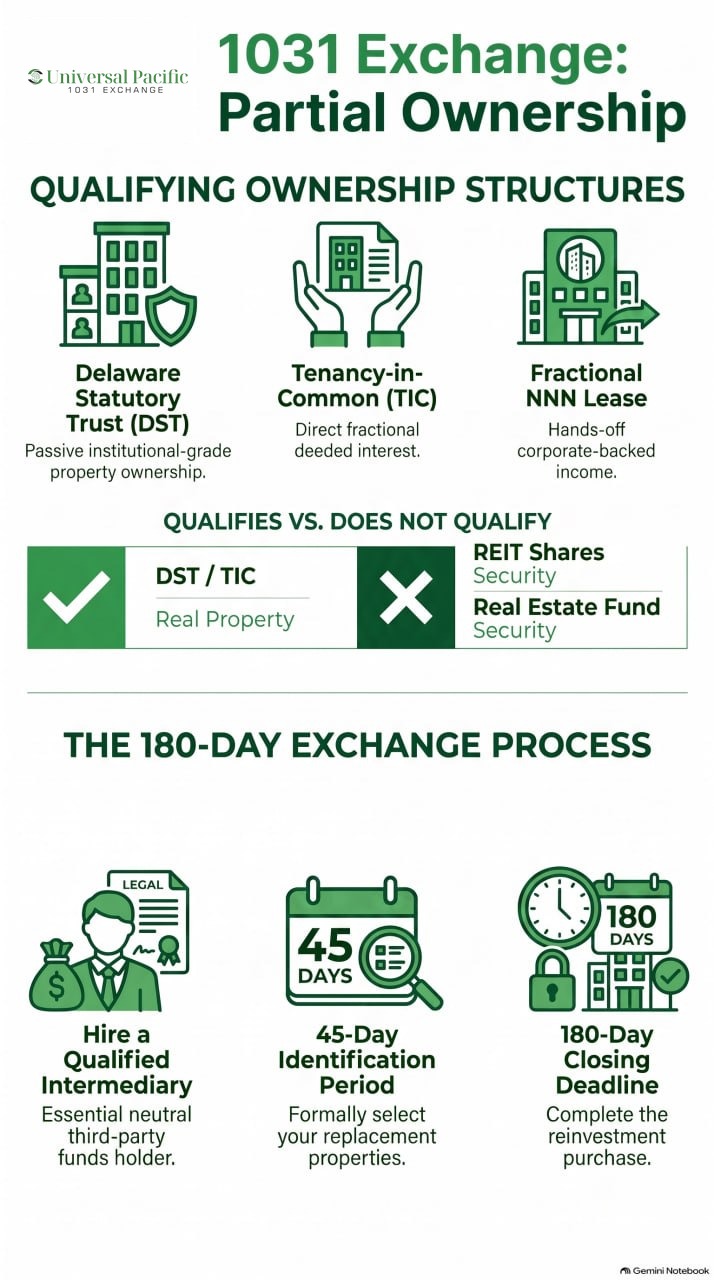
You can complete a 1031 exchange into partial ownership of a replacement property and still defer capital gains tax. The IRS treats certain fractional structures as direct interests in real property, including Tenancy-in-Common (TIC) interests, Delaware Statutory Trusts (DSTs), and fractional shares of Triple Net Lease (NNN) properties. Others, such as REIT shares and most real estate fund interests, do not qualify. Choosing the wrong one turns a tax-deferred exchange into an immediate tax bill.
Since 2015, Universal Pacific 1031 Exchange has served real estate investors across all 50 states as a Qualified Intermediary for 1031 exchanges. Our team brings more than 32 years of experience in the analysis, acquisition, management, brokerage, and disposition of over $100 million in commercial real estate. Contact us today to start an exchange.
In this guide, we’ll break down what partial ownership means in real estate, why it’s a smart choice for a 1031 exchange, the different structures available, and the exact steps to complete the process successfully.
What Is Partial Ownership in Real Estate?

Partial ownership in real estate means that instead of owning a whole real property, an investor owns a fraction or percentage of a jointly owned property. It can be structured in various ways, such as a tenancy-in-common (TIC), Real Estate Investment Trusts (REITs), and Delaware Statutory Trusts (DSTs). Whatever the structure, the primary idea is the same. Partial ownership allows real estate investors to pool their resources with others to gain access to properties they might not be able to afford on their own.
What separates these structures from one another is how you hold your interest, and that detail is what the IRS looks at. In a TIC, your name appears on the deed, and you hold an undivided fractional interest in the property itself. In a DST, the trust holds title, and you hold a beneficial interest in the trust. In a REIT or a real estate fund, you hold shares in a company or a partnership, and the underlying asset is one step removed from you. The first two are treated as real property for exchange purposes. The last is treated as a security, which is why it fails.
The IRS has addressed both qualifying structures directly. Revenue Procedure 2002-22 sets out the conditions under which an undivided fractional interest in rental real property will be treated as co-ownership rather than an interest in a business entity, and it limits the arrangement to no more than 35 co-owners. Revenue Ruling 2004-86, effective July 20, 2004, concluded that a beneficial interest in a properly structured Delaware Statutory Trust is treated as a direct interest in the underlying real estate, making it like-kind to other investment property.
What you actually receive as a partial owner is a pro rata share of everything the property produces. Rental income, operating expenses, depreciation deductions, and eventual sale proceeds are all allocated according to your percentage. You are not a passive lender receiving a fixed return. You are an owner carrying owner-level risk on your slice of the asset, which is exactly why the structure qualifies for exchange treatment in the first place.
Partial ownership also changes what you can realistically buy. An investor exchanging $400,000 of equity has limited options in the whole-property market, particularly in institutional asset classes. That same $400,000 can buy a fractional position in a medical office building or a distribution center that would otherwise require eight figures.
Research by David Ling of the University of Florida and Milena Petrova of Syracuse University found that nearly 88% of properties acquired through like-kind exchanges are eventually disposed of in a taxable sale, and that exchanged properties generate roughly 19% more taxable gain when finally sold. Deferral, in other words, is not avoidance. It is timing.
Why Consider Partial Ownership for a 1031 Exchange?
As an investor, you can consider a 1031 exchange into partial ownership for various good reasons. To start with, fractional ownership in a DST or TIC qualifies as “like-kind” property under 1031 rules. That means that you maintain tax deferral, which is the main goal of a 1031 exchange.
Moreover, partial ownership will give you the opportunity to own a portion of high-value properties that you might find difficult to purchase in full. Instead of looking for ways to finance a property you cannot afford, you can take advantage of partial ownership to own a slice of it.
Another good reason is that it reduces investment risk by helping you diversify your investment into different property types or markets. On top of that, structures like DSTs and REITs don’t require active management responsibilities, and that makes it suitable if you’re looking for a hands-off investment property.
In addition, partial ownership structures often come with pre-arranged financing and ready-to-close deals, making the 1031 exchange process smoother. With that, you don’t have to worry about missing the deadlines in the timeline for a 1031 exchange.
Types of Partial Ownership Options in a 1031 Exchange

When you sell your relinquished property in a 1031 exchange, you can achieve partial ownership of the replacement property using various structures. Each structure defines your ownership in a certain way, with clearly defined rights and privileges. Ultimately, the right choice depends on your financial goals, risk tolerance, and preference for control. But you need to first understand these options so you can decide which one aligns most with your tax-deferred exchange and investment goals. Let’s look at them in detail.
1. Tenancy-in-Common (TIC)
A Tenancy-in-Common (TIC) is a structure where multiple investors each own a separate, undivided interest in the same property. Every owner holds a specific percentage of the property but has the legal right to access and use the entire asset. The key benefit of a TIC structure is that each owner’s fractional ownership interests can be sold, transferred, or inherited without affecting the other owners.
Each TIC owner receives rental income and shares expenses based on their percentage of ownership. As previously mentioned, TIC arrangements can have up to 35 investors, but one of the main challenges is that all co-owners must agree on major decisions, such as selling the property or making improvements. If financing is involved, each investor must individually qualify for a loan, which can complicate the process.
2. Delaware Statutory Trust (DST)
In a Delaware Statutory Trust (DST), multiple investors can own fractional interests in institutional-grade real estate properties, such as apartment complexes, medical offices, industrial buildings, and shopping centers. Unlike a TIC, where you own a direct share of the property, a DST holds the title, and investors are considered beneficiaries. The DST is managed by a trustee, so individual investors have no active management responsibilities.
You receive regular rental income as an investor in a DST, and the DST structure often includes pre-arranged financing, making it easier to close within the required exchange timeline. However, you cannot sell or transfer your share until the trust dissolves, typically after 5–10 years.
Since DSTs provide passive income, they are suitable for investors who want the benefits of real estate ownership without dealing with tenants, maintenance, or day-to-day operations. A DST qualifies as like-kind property under IRS rules, so a DST 1031 exchange is popular among investors looking to retire from active property management.
3. Real Estate Funds or Private Placement Offerings

You can choose to participate in real estate funds or private placement offerings where a group of investors pools their capital to buy and manage properties. They often structure the investments as Limited Partnerships (LPs) or Limited Liability Companies (LLCs). In an LP or LLC, investors hold shares in a fund managing a portfolio of properties, rather than in a specific property. Since these funds invest in multiple properties, they provide diversification, reducing the risk of relying on a single asset.
However, many of these funds do not qualify for a 1031 exchange unless they are specifically structured for that purpose. The IRS considers shares in a real estate fund as securities rather than direct real estate ownership, which means they cannot be exchanged tax-free under 1031 rules. Despite this limitation, real estate funds can be a good option for investors who prioritize professional management, diversification, and long-term appreciation over tax deferral strategies.
4. Triple Net Lease (NNN) Properties with Fractional Ownership
A Triple Net Lease (NNN) property is a commercial real estate investment where the tenant pays for property taxes, insurance, and maintenance costs, in addition to rent. These properties are often leased by major corporations, retail chains, and fast-food restaurants, such as Walgreens, McDonald’s, or Starbucks. If you buy shares in NNN-leased properties, you’ll benefit from steady, long-term income without the responsibility of property management.
If structured as a TIC or DST, fractional ownership in NNN properties qualifies for a 1031 exchange, making it an attractive option for investors looking to defer taxes while earning passive income. The biggest advantage of NNN properties is their predictable revenue streams and low maintenance requirements, as the tenant is responsible for most property expenses. Since these leases often last 10–20 years, they provide stability and consistent cash flow, making them an excellent choice for investors who want minimal risk and hands-off management.
5. Real Estate Investment Trusts (REITs)
A Real Estate Investment Trust (REIT) is a company that owns and manages income-producing properties. Investors buy shares in the REIT, similar to stocks, and receive dividends based on the REIT’s earnings. Some REITs own physical properties, while others invest in mortgages or real estate-related securities.
Although REITs offer passive income, diversification, and liquidity, they do not qualify for 1031 exchanges. This is because the IRS classifies REIT shares as securities rather than direct real estate ownership. However, you can still leverage the tax-deferral benefits of 1031 exchange into a REIT using DSTs as a bridge.
Partial Ownership Structures Compared
The table below summarizes how the five structures differ on the points that decide your exchange.
| Structure | How you hold your interest | Qualifies for 1031? | Your management role | Typical hold period | Main limitation |
|---|---|---|---|---|---|
| Tenancy-in-Common (TIC) | On the deed, undivided fractional interest | Yes | Active, you vote on major decisions | Varies by agreement | Capped at 35 co-owners, and all must agree on major decisions |
| Delaware Statutory Trust (DST) | Beneficial interest, trust holds title | Yes | None, a trustee manages | 5 to 10 years | Illiquid until the trust dissolves, and no new capital allowed |
| Fractional NNN (held as TIC or DST) | Follows the TIC or DST wrapper | Yes, if wrapped in a TIC or DST | None to minimal | 10 to 20 year leases | Depends on a single tenant’s credit |
| Real estate fund (LP or LLC) | Shares or units in the entity | No, unless purpose-built | None | Fund dependent | Treated as a security, not real property |
| REIT | Shares in a company | No | None | Fully liquid | Treated as a security, DST bridge required |
Michael Bergman, President and CEO of Universal Pacific 1031 Exchange and a California CPA licensed since 1990, sees the same mistake repeatedly. “Investors call us on day 40 having identified a fund interest they believe is real estate. It is not, and by then the clock has almost run out. Ask what you will hold, a deed or a share certificate, before you identify anything.”
How to Complete a 1031 Exchange With Partial Ownership
From identifying the right partial ownership structure to completing the 1031 exchange process, you must follow the right steps if you plan to maintain the tax deferral benefits of a 1031 exchange into partial ownership. As an experienced qualified intermediary, we’ve summarized the whole process to help you:
Step 1: Confirm Your Eligibility for a 1031 Exchange
The IRS requires that both the property you are selling and the one you are buying must be used for investment or business purposes. If you plan to invest in partial ownership, your replacement property must be structured in a way that qualifies as “real property” under IRS rules. TICs, DSTs, and fractional ownership in NNN leases are considered valid like-kind exchanges, while Real Estate Investment Trusts (REITs) and real estate funds do not qualify. Remember also that primary residences do not qualify.
Step 2: Engage a Qualified Intermediary (QI)
As per the Internal Revenue Code, you need a qualified intermediary, a neutral third party, to hold the sale proceeds from your relinquished property and facilitate the exchange. If you receive the funds directly, your exchange will be disqualified, and you’ll face immediate tax liabilities. The QI will also handle the legal paperwork, ensure compliance with IRS rules, and assist with the entire process. Because of how complex a partial ownership exchange is, choose a reputable intermediary with experience in 1031 exchanges.
Step 3: Identify a Partial Ownership Structure
As soon as you sell the old property, you have 45 days from that date to identify potential replacement properties. The IRS allows you to identify multiple replacement properties as long as you follow the 200% rule, three-property rule, or the 95% rule. Identifying multiple properties gives you options to choose from, especially if you’re running a 1031 exchange for multiple properties. For partial ownership, identify the structure that best suits your goals.
Step 4: Conduct Due Diligence on the Partial Ownership Structure

Before finalizing your investment, you should thoroughly research the fractional interest structure you are considering. Each type of fractional ownership has its own advantages and limitations, as we’ve discussed earlier. Review factors such as rental income potential, property management structure, investor rights, fees, and exit strategies before committing to an investment.
Step 5: Purchase the Replacement Property Within 180 Days
After the 45-day identification period, you must close on the purchase within the next 135 days, making a total of 180-day exchange timeline. In a partial ownership exchange, this often means buying a fractional share in a DST, TIC, or NNN lease within this time. Remember that the amount you reinvest in the partial ownership structure must be of equal or greater value than the relinquished property sale proceeds. The seller or sponsor of the fractional ownership investment will provide the necessary documentation, such as a subscription agreement or TIC ownership deed.
Step 6: Report the Exchange on Your Tax Return
After completing the 1031 exchange, you must report the transaction on IRS Form 8824 when filing your tax return. This form documents the details of your relinquished and replacement properties, the purchase and sale amounts, any boot in the 1031 exchange, and other required details. We’ve put together a very comprehensive guide here on how to file a 1031 exchange.
Need Help Navigating 1031 Exchange Into Partial Ownership?
Reinvesting into a partial ownership property in a 1031 exchange comes with various benefits, including capital gains tax deferral, access to high-value properties, and passive income. However, not all fractional ownership options qualify, so you need to work with a knowledgeable Qualified Intermediary and conduct thorough due diligence before finalizing your investment.
If you’re considering a partial ownership 1031 exchange, our team can help guide you through the process, making sure you meet IRS requirements while making the most of your investment. Universal Pacific 1031 Exchange has been in the industry for 32+ years, so you can trust we have the experience to help you. Whether you need assistance with identifying the right replacement property, understanding your investment structure, or ensuring compliance with exchange deadlines, we’re here to help. Schedule a free 1031 exchange consultation with us today!
Frequently Asked Questions
Below are common questions about a 1031 exchange into partial ownership and their respective answerss.
Can You Do a 1031 Exchange With Fractional Ownership?
Yes, provided the fractional interest is treated as real property rather than a security. A Tenancy-in-Common interest qualifies because you hold an undivided interest in the property itself, subject to the conditions in Revenue Procedure 2002-22. A Delaware Statutory Trust interest qualifies under Revenue Ruling 2004-86, which treats a properly structured DST beneficial interest as a direct interest in the underlying real estate. Fractional interests in NNN properties qualify when they are wrapped in a TIC or DST. What does not qualify is a share in a REIT, an LP, or an LLC, because those are interests in an entity rather than in real property.
Can a 1031 Exchange Be Partial?
Yes. A partial exchange happens when you reinvest only some of your sale proceeds and take the rest as cash, or when you reduce your debt on the replacement property. The portion you do not reinvest is called boot, and it is taxable in the year of the exchange. The rest of your gain stays deferred. Investors sometimes choose this deliberately when they need liquidity, accepting tax on a slice in exchange for cash in hand. Our guide to a partial 1031 exchange walks through how the math works.
Can You Split a 1031 Exchange Into Multiple Properties?
Yes. Nothing in the rules requires a one-for-one swap, and splitting proceeds across several replacement properties is a common diversification strategy. You might exchange one apartment building into a DST interest, a fractional NNN position, and a small whole property. The constraint is the identification rule you elect, and the requirement that total replacement value equals or exceeds what you sold. See our breakdown of the 1031 exchange identification rules for how to structure this correctly.
What Is the 95% Rule in a 1031 Exchange?
The 95% rule is the third identification option, and it is the least used. Under the three-property rule you may identify up to three properties regardless of value. Under the 200% rule you may identify any number of properties as long as their combined fair market value does not exceed 200% of what you sold. The 95% rule lets you identify any number of properties of any value, but only if you actually acquire at least 95% of the total value you identified. Miss that threshold and the entire exchange fails, not just the portion you did not close. Because there is almost no margin for a deal falling through, most investors rely on the first two rules instead.
This page was reviewed by Michael Bergman, CPA, California CPA #56113. Verify license.
Disclaimer: The information provided in this article is for general informational and educational purposes only and should not be construed as legal, tax, financial, or investment advice. Reading this content does not create a client relationship with Universal Pacific 1031 Exchange. Because every 1031 exchange is unique, you should consult a qualified tax advisor, attorney, or financial professional regarding your specific circumstances before making any investment or tax-related decisions.
Editorial Policy
All articles are reviewed for accuracy by licensed tax professionals and sourced from official government publications. Read our Editorial Policy →
About The Author
 Michael Bergman is a California licensed CPA and Real Estate Broker with over 35+ years of CPA-supervised 1031 exchange experience in commercial real estate. Specializing in 1031 tax-deferred exchanges and financial oversight, his expertise covers complex real estate transactions. Michael’s unique blend of financial acumen and real estate knowledge positions him as a trusted advisor in the industry, offering sound advice and strategic insights for successful property management and investment.