How to 1031 Exchange Into a REIT
Quick answer
You have found a REIT you like, and now you want to know whether your exchange proceeds can go there. They cannot go there directly. The IRS does not treat REIT shares as like-kind property, because a share is a security rather than a direct interest in real property. The route that does work runs through a Delaware Statutory Trust first, then a Section 721 contribution into the REIT’s operating partnership.
Since 2015, Universal Pacific 1031 Exchange has served as a Qualified Intermediary for real estate investors across all 50 states. We know how the 45-day and 180-day clocks behave when the replacement property is a fractional interest rather than a building. To confirm whether a DST can legitimately hold your exchange proceeds before you sign an offering document, contact us today.
Below you will find why REIT shares fail the like-kind test, how the DST and 721 route actually works, what it costs you later, and answers to the questions investors ask most.
Understanding the Basics

A 1031 exchange is also known as a like-kind exchange. It’s a tax deferment strategy that allows investors to reinvest their proceeds from the sale of a relinquished property into another like-kind replacement property without attracting immediate taxes on capital gains.
The U.S. mandates that citizens file all capital gain income from selling a property on their tax returns. However, with a 1031 exchange, you can defer capital gains taxes provided you reinvest the proceeds from the sale of your property into the purchase of a like-kind investment property.
The Internal Revenue Code and 1031 Exchanges
The Internal Revenue Code (IRC) constitutes rules and requirements that govern the 1031 exchange. According to Section 1031 of the IRC, a property that qualifies for a tax-deferred exchange must be real property. It also must have a similar nature or character, even though it may differ in grade or quality. It must be held for investment, trade, or business purposes rather than primarily for sale.
It cannot be intangible or personal property, which rules out inventory, notes, and other securities. A primary residence does not qualify either, because the tax code treats it as personal use property rather than an investment held for business purposes. A REIT share fails for its own reason: Section 1031 lists stocks and securities among the interests that do not qualify, and since 2018 the section has covered real property only. Hold on to that as you read the rest of this article.
What Is a REIT?

A Real Estate Investment Trust (REIT) is a company that allows various investors to pool their funds into a diversified portfolio of income-generating real estate properties. Common examples of properties a REIT may invest in include office buildings, shopping malls, hotels and resorts, warehouses, etc.
REIT companies manage all real property assets in the portfolio. They collect and disburse all income generated from investments to investors. Since REIT investors are not direct owners of properties but stakeholders, REIT companies distribute their income as dividends to investors.
The Internal Revenue Code sets the criteria that all REIT companies must meet to qualify as REITs. A REIT must pay a dividend equal to at least 90% of its taxable income each year and must be taxable as a corporation. Its shares must be fully transferable, and it must be run by a board of directors or trustees.
On the asset side, a REIT must hold at least 75% of its total assets in real estate, cash, and government securities. It must also derive at least 75% of its gross income from rents, mortgage interest, and other real-estate-related sources. It also needs a minimum of 100 shareholders after its first year of existence.
The U.S. Securities and Exchange Commission draws a line that matters a great deal for exchange investors. Publicly traded REITs are listed on an exchange, priced daily, and generally carry lower fees, and their portfolios can be researched before you buy. Non-traded REITs, which are the category most DST roll-ups land in, cannot be sold readily on the open market.
The SEC notes that fees on non-traded REITs usually total roughly 9% to 10% of the investment, and that these REITs typically do not publish an estimated value per share until 18 months after the offering closes. You can be a REIT investor for well over a year before you learn what your interest is worth.
Benefits of Investing in a REIT

Investing in a REIT lets you invest in real estate without buying and managing a property yourself. REITs can also offer income, diversification, and a simple way to gain exposure to the real estate market. Below are some major benefits of a REIT.
Portfolio Diversification
By investing in REITs, you have access to a diversified portfolio of real estate assets, allowing you to spread risk across different property types and geographic regions. It’s more difficult to achieve this kind of diversification with direct real estate investments.
Professional Asset Management
From property acquisition to management and leasing, REITs manage investments through experienced professionals. So, you can leverage this expertise to minimize risks as you don’t need hands-on involvement in property management.
Regular Dividend Income
U.S. law requires REITs to distribute at least 90% of their taxable income as dividends to shareholders, providing a consistent means of income for real estate investors.
Tax Efficiency
A REIT is taxable as a corporation, but it deducts the dividends it pays to shareholders. Distribute at least 90% of taxable income and there is little left to tax at the entity level, which is what leaves more available to pay out.
Low Capital Investment
Unlike direct real estate investments, which often require substantial upfront investments, you can purchase shares of a REIT with less capital.
Investment Growth
REIT companies hold real estate assets that have the potential to grow in value and rental income. In response to the growth, REIT shares also appreciate simultaneously, thus increasing your capital value over time.
Types of REITs

REITs come in several types, depending on the properties they own and how they make money. Each type has its own risks, benefits, and areas of focus, so investors should know the differences before choosing one.
Equity REITs
These REITs own, manage, and generate revenue from real estate assets through rent and property appreciation. Such real estate assets may include office buildings, apartment complexes, shopping centers, etc.
Mortgage REITs
Mortgage REITs are commonly known as mREITs. They generate revenue through net interest from mortgages or mortgage securities associated with commercial or residential real property assets. In other words, mREITs provide real estate owners and operators with mortgages, loans, or mortgage-backed securities.
Hybrid REITs
These REITs combine the investment strategies of both equity REITs and mREITs. They generate revenue from real estate rental income as well as mortgages.
Tax Implications of REIT
Although a regular flow of dividends may sound attractive, REITs also have unique tax consequences. REIT dividend income may incur capital gains tax liabilities, ordinary income, or a return on capital.
Capital gains tax rates are 0%, 15%, or 20% depending on the taxpayer’s income level. Under Revenue Procedure 2025-32, the IRS inflation adjustments for the 2026 tax year, a single filer pays 0% on long-term gains up to $49,450 of taxable income and 15% from there up to $545,500. Above $545,500, the rate becomes 20%. Married couples filing jointly reach the 20% rate at $613,700.
The majority of dividend income is considered ordinary income. Generally, the IRS does not consider REIT dividends qualified dividends, so these dividends do not qualify for reduced capital gains tax. Therefore, the dividend rates follow the investor’s marginal tax rate or tax bracket.
There is one offset the original math often misses. Section 199A allows individual investors to deduct up to 20% of ordinary REIT dividends, which pulls the top effective federal rate on that income from 37% down to 29.6%. The One Big Beautiful Bill Act, signed on July 4, 2025, made that deduction permanent at 20% and removed the sunset that had been scheduled for the end of 2025. It does not turn REIT dividends into qualified dividends, but it narrows the gap more than most comparisons admit.
The Possibility of a 1031 Exchange Into a REIT

Because the IRS does not consider REITs as like-kind properties, directly purchasing REITs with the proceeds from the sale of a relinquished property does not qualify for tax deferral. But you can still enjoy the tax benefits via an indirect approach: DSTs to REITs. Here’s a rundown of the indirect approach.
Before you commit to that route, it helps to see all three of your realistic options side by side. The table below compares what happens to your tax bill, your control, and your ability to exchange again later. Each row can lead to a very different position ten years out, so read it as a comparison of destinations as opposed to a comparison of paperwork.
| Sell outright and pay tax | Direct 1031 into replacement property | 1031 into a DST, then 721 into a REIT | |
|---|---|---|---|
| Tax at the time of the transaction | Capital gains, depreciation recapture, and NIIT due now | Deferred | Deferred through both steps |
| Your control over the asset | None, you are out | Full control over management and sale timing | None, the sponsor decides everything |
| Can you exchange again later | Not applicable | Yes, indefinitely | No, the 1031 chain ends at the 721 contribution |
| Liquidity | Immediate cash | Sell whenever you choose | Limited, often no market until the REIT permits redemption |
| Income profile | None from this asset | Rents, net of your own expenses | Dividends, taxed mostly as ordinary income |
| Estate treatment | Gain already recognized | Step-up in basis at death | Step-up in basis at death on the OP units |
The Indirect Route: DSTs to REITs
A Delaware Statutory Trust (DST) is a legal entity that holds title to a pool of real estate investments and then provides investors with undivided fractional ownership in the form of beneficial interests. DST investors have fractional shares of DST income and appreciation of the investments.
The IRS, under Revenue Ruling 2004-86, provides that DSTs are eligible for a 1031 exchange. So, DSTs may serve as a bridge for a 1031 exchange into REITs. The process involves two major phases.
The first phase involves starting a 1031 exchange of relinquished property into a DST interest. Since DSTs are like-kind, you can purchase a DST interest after selling your relinquished property while postponing capital gains tax. You then hold that interest while the sponsor operates the property.
In the second phase, you can transition your DST investment into an operating unit (OP) of a REIT through a 721 tax-deferred exchange, often known as a UPREIT. That transition happens in one of two ways. Either the DST portfolio is sold to an existing REIT, or a new REIT is created using the real estate investments held in the DST. In both cases, DST investors receive the REIT’s partnership units, which they can later exchange for REIT shares, and the capital gains tax on the original property stays deferred through the contribution itself.
Revenue Ruling 2004-86 also imposes the restrictions the industry calls the seven deadly sins, and they explain why a DST feels so passive. Once the offering closes, the trust cannot take new capital from current or new investors. The trustee cannot refinance, renegotiate, or place new debt on the property. Sale proceeds cannot be reinvested, cash cannot be held beyond normal reserves, and reserves can only sit in short-term debt obligations.
Capital improvements are limited to minor, non-structural repairs and anything required by law. New leases and lease renegotiations are off the table unless a tenant is insolvent or bankrupt. Every one of those limits exists to keep the DST a passive holder of real property rather than an active business, because an active business would be a partnership interest, and a partnership interest is not like-kind.
The Step-by-Step Process
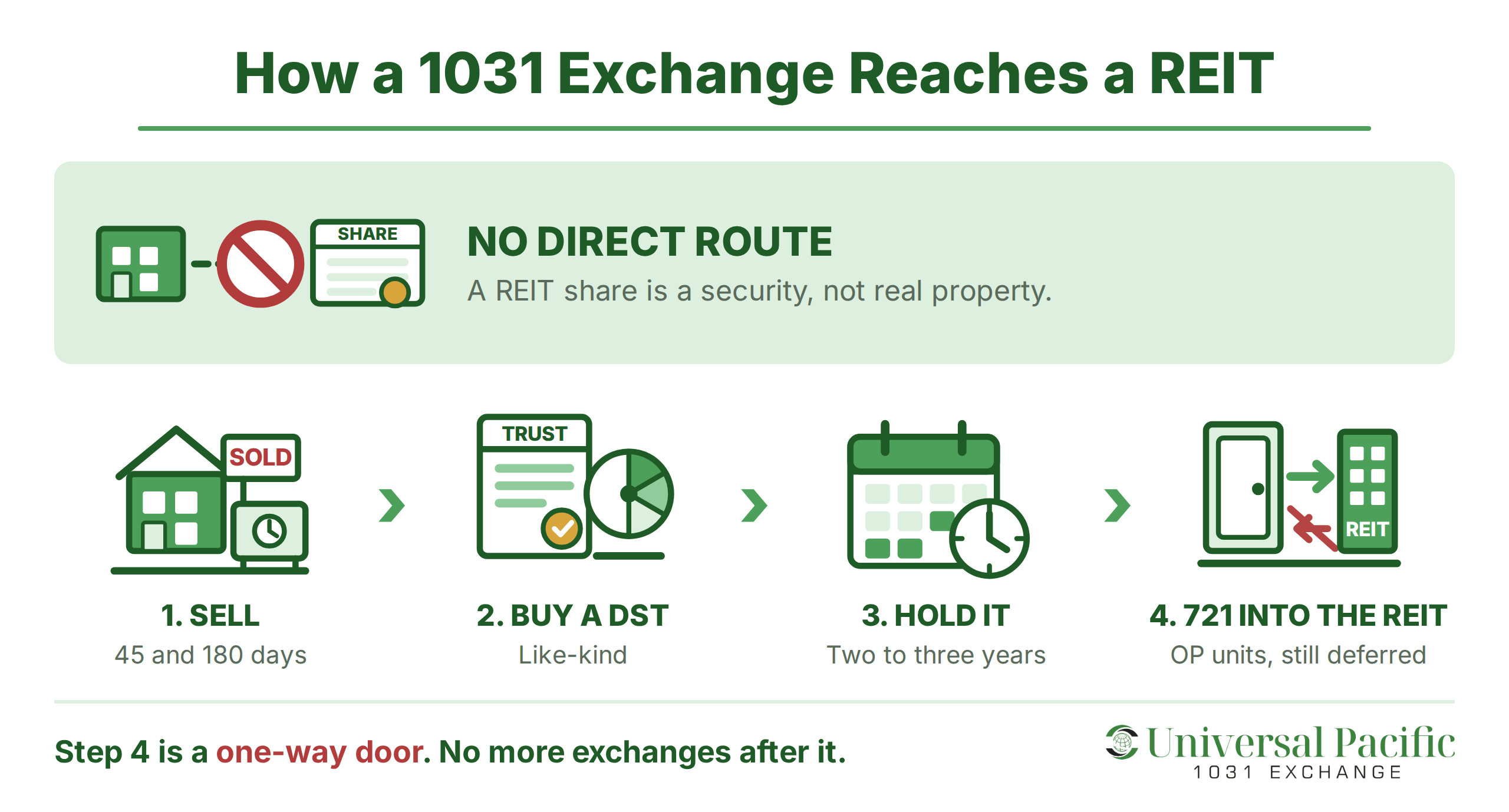
Here is the sequence in the order it actually happens, with the point at which each decision becomes irreversible.
Step 1: Engage a Qualified Intermediary Before Closing
Your exchange has to be set up before the relinquished property sale closes. If the proceeds touch your bank account, the exchange is over, and the gain is recognized. The Qualified Intermediary holds the funds and takes assignment of the sale contract.
Step 2: Confirm the DST Offering Qualifies
Not every fractional real estate offering is a DST, and not every DST is structured to comply with Revenue Ruling 2004-86. Ask for the tax opinion letter, confirm the trust is not permitted to take new capital or refinance, and check whether the sponsor has hardwired a future UPREIT into the documents. Ask which properties involved in the offering carry debt and at what leverage, because your replacement debt is measured against the DST property you are acquiring. Responsibility for that diligence sits with you and your advisors rather than with the sponsor.
Step 3: Identify Within 45 Days
You have 45 calendar days from the closing of the relinquished property to identify replacement property in writing. DST interests are identified by the specific trust and the dollar amount, and the same three-property, 200% and 95% identification rules apply as they would to any other exchange. You still need replacement property of equal or greater value than what you sold, and you still need to reinvest all the proceeds, or the shortfall becomes taxable boot.
Step 4: Close Within 180 Days
The exchange must be completed within 180 days of the relinquished sale, or by your tax return due date, including extensions, whichever comes first. DST closings are usually faster than a building purchase, since you are subscribing to an existing offering rather than negotiating a contract.
Step 5: Hold the DST Interest
This is the step that gets misdescribed most often. There is no statutory holding period, and Section 721 contains no waiting rule. What matters is the 1031 requirement that you hold the replacement property for investment, and the step transaction doctrine, which lets the IRS collapse a fast DST-to-REIT sequence into a single disqualifying transaction. Sponsors typically season a DST for roughly two to three years before a UPREIT roll-up for exactly that reason, not because a statute tells them to.
Step 6: Accept the 721 Contribution and Understand What It Ends
When the sponsor contributes the property to the REIT’s operating partnership, you receive OP units. The deferral survives the contribution. What does not survive is your access to Section 1031, because OP units and REIT shares are not real property. From this point, you can convert OP units to REIT shares or sell them, and either move triggers the deferred gain and the tax liability behind it. What you gain in exchange is scale and diversification that a single replacement property cannot offer. The only remaining way to eliminate that gain is to hold the units until death, when your heirs receive a stepped-up basis under Section 1014.
“Like-Kind” Challenges
For a successful 1031 exchange, the exchange properties must be similar in nature or character. REITs are not like-kind, and the process it takes to convert investment property sales proceeds into DSTs and then REITs can be quite challenging.
“Investors come to us focused entirely on getting into the REIT, and almost never on getting out,” says Michael Bergman, CPA, President and CEO of Universal Pacific 1031 Exchange. “The 721 contribution is a one-way door. Once you are holding OP units, the exchange strategy that got you there is no longer available to you, and that needs to be a deliberate decision rather than a surprise three years later.”
Timing and Deadlines
The IRS is strict with the 1031 exchange timelines: 45 days for identification and 180 days for completing the exchange. The timing is even more critical for a 1031 exchange into REITs, because the DST has to be held long enough to support the position that you acquired it for investment before it is absorbed into a REIT portfolio.
IRS Guidelines
To ensure a successful exchange, the IRC stipulates guidelines that investors must adhere to. You cannot buy a replacement property, immediately convert it into DST interests, and then exchange it for REIT units. This is not because Section 721 includes a numbered waiting period, which is a common misstatement.
The reason is that Section 1031 requires the replacement property to be held for productive use in a trade or business or for investment, and the step transaction doctrine allows the IRS to treat a rapid series of steps as one transaction. A DST that rolls into a REIT weeks after acquisition invites the argument that you never held real property for investment at all.
Financial Implications
The tax benefit of this route is real, but it is not free, and the costs show up in three different places. The next three sections cover what you owe, what you risk, and what you keep. Read them together rather than separately, because a structure that looks efficient on the tax line can look very different once liquidity and fees are counted. In our experience, clients who come to regret this route regret the loss of liquidity rather than the tax result.
Tax Implications
Exchanging a property into a REIT offers tax benefits through the combination of 1031 and 721 tax provisions. However, your dividend income from the REIT is still subject to taxes. These taxes include federal and state capital gain tax, depreciation recapture tax, and Medicare surtax.
Unrecaptured Section 1250 gain is taxed at a maximum of 25%, and the net investment income tax adds 3.8% above $200,000 of modified adjusted gross income for single filers and $250,000 for joint filers. Those NIIT thresholds are fixed by statute and are not indexed for inflation, so more investors cross them every year. Also, any capital gains accrued from selling your REIT shares are subject to immediate taxes.
Risk Assessment
It may be challenging to sell fractional interests before a DST terminates due to its low liquidity and specific holding period. Also, real estate performance resulting from the national economy can affect DST returns, especially during a recession. If a DST eventually goes bankrupt, investors can lose their initial investment.
Two further risks belong on the list. DST offerings are private placements, so they are generally restricted to accredited investors, and your suitability is assessed before you are allowed to subscribe. And where the UPREIT is hardwired into the DST documents, the timing of the 721 contribution belongs to the sponsor rather than to you, which means the taxable clock can start on someone else’s schedule.
Return on Investment
ROI measures investment performance and profitability. For 1031 exchanges, the tax benefits positively influence their ROI. However, for REITs, the taxes imposed on dividend income affect investors’ ROI by minimizing their potential returns. Front-end load matters here too, since the SEC’s 9% to 10% fee range on non-traded REITs comes out of invested capital before a single dollar of return is measured.
Real-World Examples and Case Studies
Let’s consider the case of Billie, a 1031 exchange client who wanted to sell her rental apartment and reinvest the proceeds in a REIT without attracting any capital gains taxes. In compliance with 1031 exchange rules, she exchanged her apartment for a DST interest, thus deferring tax on gains.
After three years of steady income flow from the DST, it matured, completed its cycle, and became a REIT. Billie’s DST interest got rolled over into the REIT operating partnership through a 721 exchange. Eventually, she successfully became an OP unit holder without generating immediate tax liabilities. What Billie also accepted, knowingly, is that her exchange history stopped there. Her heirs, not Billie, are the ones positioned to see that deferred gain disappear.
On the other hand, Sarah, another investor, sold a rental property and wanted to do the same transaction as Billie. During her 1031 exchange, she identified a seemingly attractive DST without thorough due diligence. Due to the DST’s poor management and underperformance, Sarah encountered limited liquidity. As a result, she couldn’t sell her fractional interest, and eventually, she lost her investment capital.
These case studies emphasize the need for proper research to understand the processes and regulations before engaging in a 1031 exchange into a REIT. Also, you can ensure compliance by involving qualified intermediaries throughout the exchange for a smooth experience.
Is a REIT the Right Destination for Your Exchange?
The answer turns less on the REIT itself than on what you want your position to look like in ten years. If you want passive income, professional management, and an estate plan built around a step-up in basis, the DST and 721 route does what it promises. If you want to keep exchanging, keep control, or keep your options open, the one-way door at the 721 contribution should stop you. Everything else in this process is deadlines and paperwork, and both are manageable with the right structure in place from the start.
At Universal Pacific 1031 Exchange, we review every exchange file with a licensed CPA, not just process paperwork. Our team brings 35+ years of experience analyzing, acquiring, managing, brokering, and disposing of over $100 million in commercial real estate, so we can tell you plainly whether a DST offering fits your position or simply fits the sponsor’s timeline. To have your relinquished property and your DST target reviewed before the 45-day clock starts running, start an exchange with us today.
Frequently Asked Questions
This section provides answers to common questions about how to 1031 exchange into a REIT.
Can a 1031 Exchange Go Into a REIT?
Not directly. Section 1031 applies to real property, and a REIT share is a security, so buying REIT stock with exchange proceeds is a taxable sale. The workable path is to exchange into a DST interest, which the IRS treats as real property under Revenue Ruling 2004-86, hold it, and then have the sponsor contribute the underlying property to a REIT’s operating partnership under Section 721. You end up economically invested in the REIT with the gain still deferred, but you get there in two steps rather than one.
What Is the 95% Rule in a 1031 Exchange?
It is the third and least used of the three identification rules. Ordinarily, you may identify up to three replacement properties regardless of value, or any number of properties whose combined value does not exceed 200% of what you sold. The 95% rule is the escape hatch when you have blown past both limits. It lets you identify unlimited properties of any value, but only if you actually acquire at least 95% of the total value you identified. Miss that threshold, even slightly, and the entire exchange fails rather than partially fails, which is why most investors treat it as a last resort rather than a strategy.
Can You 1031 Exchange Stocks to Real Estate?
No. Before 2018, Section 1031 covered a broad range of personal property, but the Tax Cuts and Jobs Act narrowed it to real property only for exchanges completed after that date. Stocks, bonds, partnership interests, and REIT shares are all expressly excluded. This runs in both directions, which is worth noting if you already hold OP units and are hoping to exchange back into a building. You cannot.
Is It Better to Pay Capital Gains or Do a 1031 Exchange?
It depends on what you plan to do next, and honest answers here vary. An exchange makes sense when you intend to stay invested in real estate, when the deferred tax is large relative to the deal, and when you can meet the 45-day and 180-day deadlines without forcing yourself into a bad replacement property. Paying the tax can be the better decision when your gain is small, when you want to exit real estate altogether, or when the only replacement you can find in time is worse than the asset you sold. Deferral is not forgiveness, and a poor property bought under deadline pressure can cost more than the tax would have.
How Can a REIT Avoid Being Taxed?
A REIT is taxable as a corporation, but it may deduct the dividends it pays to shareholders from its taxable income. If a REIT distributes at least 90% of taxable income, meets the asset and income tests, and keeps at least 100 shareholders, there is little or no income left at the entity level to tax. The tax has not disappeared; it has moved. It is collected from you when the dividend lands, which is why most REIT distributions are taxed at ordinary income rates rather than the lower rates that apply to qualified dividends.
This page was reviewed by Michael Bergman, CPA, California CPA #56113. Verify license.
Disclaimer: This article is general information about 1031 exchanges and REIT investing, and it is not tax, legal, or investment advice for your specific circumstances. Tax rates, inflation-adjusted thresholds, and IRS guidance change from year to year, and the structure of any particular DST or REIT offering can differ materially from the general descriptions above. A 1031 exchange defers tax; it does not eliminate it, and fractional interests carry liquidity and principal risk that direct ownership does not. Consult your own CPA or tax attorney before relinquishing a property or subscribing to any offering.
Editorial Policy
All articles are reviewed for accuracy by licensed tax professionals and sourced from official government publications. Read our Editorial Policy →
About The Author
 Michael Bergman is a California licensed CPA and Real Estate Broker with over 35+ years of CPA-supervised 1031 exchange experience in commercial real estate. Specializing in 1031 tax-deferred exchanges and financial oversight, his expertise covers complex real estate transactions. Michael’s unique blend of financial acumen and real estate knowledge positions him as a trusted advisor in the industry, offering sound advice and strategic insights for successful property management and investment.