
Can You Live in a 1031 Exchange Property?
Quick answer
Yes, you can live in a property acquired through a 1031 exchange, but not straight away and not without conditions. Under Internal Revenue Code Section 1031, exchanging properties for personal use does not qualify for capital gains tax deferral.
1031 exchange properties must be like-kind, and both the relinquished and replacement properties must be held for business or investment purposes. To stay compliant and maintain tax benefits, you need to hold the property as an investment first and understand the IRS requirements for converting it into a personal residence.
Universal Pacific 1031 Exchange has served real estate investors in all 50 states as a Qualified Intermediary since 2015, across delayed, simultaneous, reverse and improvement exchanges. Our team brings 35+ years in the analysis, acquisition, management, brokerage, and disposition of more than $100 million in commercial real estate, which is where conversion questions like this one get answered properly. Schedule a free consultation before you start an exchange.
In this article, you’ll learn the IRS rules regulating the conversion of a 1031 exchange property into a residence, the processes involved, and pro tips for a successful conversion for real estate investors.
The Numbers That Govern a Conversion
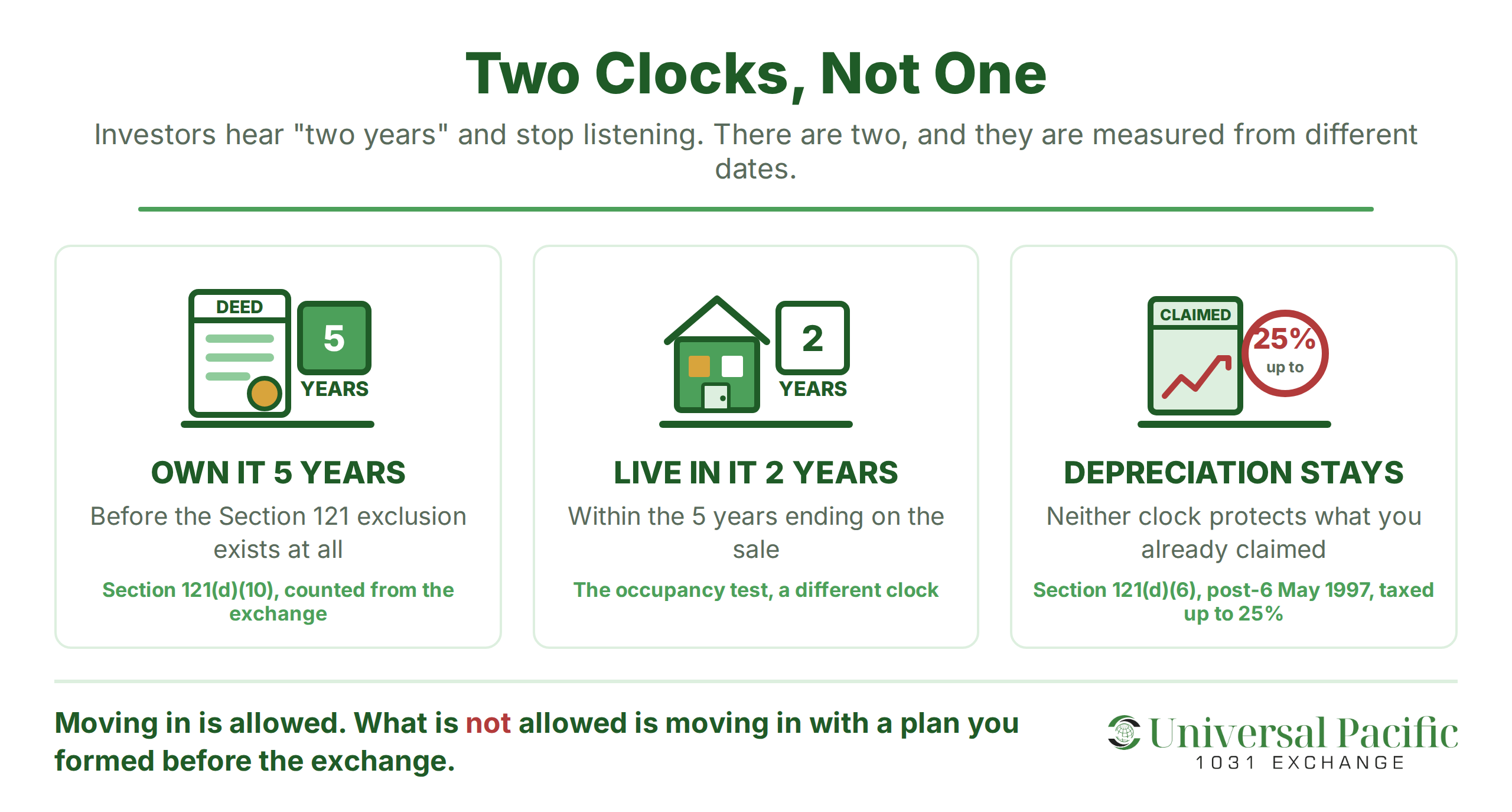
Before the details, it helps to see the thresholds in one place, because most conversion mistakes come from confusing one of these with another.
| What it is | The number | What it decides |
|---|---|---|
| Recommended investment holding | 1 to 2 years | Practitioner guidance on demonstrating investment intent, not a statutory period |
| Ownership before the exclusion applies | 5 years from the date of the exchange | Whether the primary residence exclusion is available at all |
| Occupancy test | 2 years within the 5-year period ending on the sale | Whether the property counts as your principal residence |
| Maximum exclusion | $250,000 single, $500,000 married filing jointly | The cap on gain excluded from income |
| Nonqualified use | Gain allocated by ratio of nonqualified use to total ownership | How much of the gain the exclusion cannot shelter |
| Depreciation after 6 May 1997 | Taxed at up to 25% | The part no holding period protects |
Two of those come straight from Internal Revenue Code section 121 and are the ones investors most often miss. Subsection (d)(10) states that where property was acquired in a section 1031 exchange, the exclusion does not apply to a sale during the five-year period beginning on the date of that acquisition. Subsection (b)(5) then removes from the exclusion any gain allocated to periods of nonqualified use. The IRS explains how the exclusion works in practice in Publication 523.
Michael Bergman, President and CEO of Universal Pacific 1031 Exchange and a California CPA licensed since 1990, sees the same misreading repeatedly. “Investors hear two years and stop listening. Two years is the occupancy test. Five years is how long you must own it before the exclusion exists at all, and those are different clocks measured from different dates.”
General IRS Rules Regarding Personal Use of 1031 Exchange Properties

The Internal Revenue Service (IRS) has stipulated specific rules regarding the personal use of properties acquired through a 1031 exchange, which is primarily designed for investment and business properties. The 1031 exchange rules for primary residence are as follows:
1. Primary Purpose as Investment
The replacement property obtained through a 1031 exchange must be primarily held for investment purposes, not for personal use. This means the intent at the time of the exchange should be to use the property as an investment, rather than a residence.
2. Limited Personal Use
Personal use of the property is allowed but should be limited. The IRS provides a safe harbor rule, under IRS Revenue Procedure 2008-16, where a dwelling unit may qualify for a safe harbor if, during each of the two 12-month periods after the exchange, it is rented at fair rental for at least 14 days and personal use does not exceed the greater of 14 days or 10% of the days it is rented at fair rental.
3. Conversion to Primary Residence
If you wish to convert your 1031 exchange property into your primary residence, you must first hold it under the stipulations for investment use. Although there’s no specific minimum holding period for this, most tax advisors recommend at least one to two years of demonstrable investment use
4. Selling a Converted Residence
If you later sell a replacement property that was acquired through a 1031 exchange and then converted to your primary residence, special rules apply. You can exclude gains of up to $250,000 for single filers and $500,000 for married couples filing jointly on the sale of a primary residence, but with limitations, especially if the sale occurs within 5 years of the exchange.
5. Record Keeping and Documentation
You should keep accurate records and documentation showing the property’s use as an investment, including rental income and efforts to rent the property.
6. Reporting Requirements
You must report any recognized gain due to the receipt of money or unlike property in a 1031 exchange using Form 8824, “Like-Kind Exchanges,” even though no gain or loss is recognized in most cases. You can read our blog to learn how to file a tax return for a 1031 exchange.
7. Consultation with Professionals
Given the complexities and potential for significant tax consequences, it’s advisable to consult with tax professionals or legal advisors who specialize in real estate and tax law to understand these rules fully and how they apply to your specific situation.
How to Convert a 1031 Exchange Property into a Primary Residence?

To successfully convert a 1031 exchange property to a primary residence, you need to understand the right steps to take to defer capital gains tax. Here’s a summary of the steps you need to take.
Step 1: Understand the Tax Implications Before Making Any Changes
Capital gains taxes can be a significant factor when you sell a property that has appreciated in value. If you have lived in your property as a primary residence for a certain period (usually 2 out of the last 5 years in the U.S.), you may qualify for a capital gains tax exclusion.
Step 2: Inform Your Lender About the Change in Use
If your property has a mortgage. Some mortgage terms apply only to investment or rental properties and may change if the property becomes a primary residence.
Step 3: Update Your Insurance
Primary-residence insurance differs from investment-property insurance, as it usually offers more extensive coverage. So, you may need to contact your insurance provider to update your policy.
Step 4: Consider Legal and Zoning Compliance
Depending on your location, make sure the property complies with all local zoning and housing laws, including any permit or inspection requirements for primary residences.
Step 5: Plan Your Actual Move-In and Establish Residency
You might have to change your address for legal documents, voter registration, and other official records.
Step 6: Carry Out Renovations and Modifications
Plan and complete the work needed to make the rental property suitable as your primary residence and improve its fair market value. The type and complexity of the renovation may affect how long this step takes.
Step 7: Establish Residency Duration
Remember that to benefit from certain tax exemptions, you typically need to live in the property as your primary residence for a specific duration.
Potential Risks of Living in a 1031 Exchange Property

Living in a personal property acquired through a 1031 exchange comes with potential risks, mainly around tax implications and compliance with IRS rules. To defer capital gain taxes, both the relinquished property and the replacement property must be held for investment or business purposes. If you move into the replacement property too soon after the exchange, the IRS may consider it not meeting the investment intent. This may disqualify the exchange from tax deferral, which means you may have to pay capital gains taxes.
The IRS may audit 1031 exchanges to verify compliance with the rules. If an audit reveals that the replacement property was not held for investment purposes for a reasonable period before being converted to a primary residence, you might face penalties and taxes. If you eventually sell the replacement property, the portion of the gain attributed to the period when the property was not used as your primary residence (the nonqualified use period) will be subject to capital gains tax. This is according to the changes made by the Housing and Economic Recovery Act of 2008.
Moreover, when you sell a primary residence, you can typically exclude up to $250,000 (or $500,000 for married couples filing jointly) of the capital gain from taxes. However, if you convert a business or investment property acquired through a 1031 exchange to a primary residence, this exclusion is prorated based on the period of qualified use as a primary residence versus nonqualified use.
To mitigate some of the risks, you might need to commit to the personal property for a longer period. You need to hold it as an investment property initially and then as a primary residence for a number of years to meet both the 1031 exchange requirements and the primary residence exclusion rules.
Like any real estate investment, it also carries risk from market fluctuations. If the property’s value decreases during the investment period, it could affect your financial planning. Additionally, changing the property’s use from investment to personal residence can affect mortgage terms and insurance policies, potentially leading to complications or additional costs.
Remember that tax laws and regulations can change over time, and some changes might affect the benefits or viability of living in a 1031 exchange property. Stay up to date on current laws and potential legislative changes.
To manage these risks, consult a tax professional or real estate attorney who specializes in 1031 exchanges. They can provide guidance tailored to your specific situation, helping to ensure compliance with the complex rules governing 1031 exchanges and the use of such properties as primary residences.
Alternatives to Living in a 1031 Exchange Property

If you’re considering alternatives to living in a property acquired through a 1031 exchange, there are several options available. Each alternative has its own advantages and disadvantages, depending on your financial goals, lifestyle preferences, and risk tolerance. Consult financial and real estate professionals, such as an experienced qualified intermediary, to understand the implications of each 1031 exchange option and choose the one that best aligns with your personal and financial objectives.
The alternatives include:
1. Renting Out the 1031 Exchange Property
Instead of living in the 1031 exchange property, you can continue to rent it out. Keeping it as an investment property makes it easier to stay aligned with 1031 exchange requirements. You can then either get a different rental property for personal use or purchase a new property as a separate personal residence.
2. Delayed Use as Primary Residence
Purchase the property through a 1031 exchange and use it as a rental or investment property for a specified period, usually recommended for at least one to two years. After that period, you can convert it into your primary residence, reducing the risks of immediate conversion.
3. Purchasing a Primary Residence Separately
Instead of converting the 1031 exchange property, you could purchase a primary residence independently. This keeps your investment property and personal property distinct, avoiding the complexities and tax implications of mixing the two.
4. Owner-Occupied Multi-Family Property
If you still wish to leverage real estate investment while having a place to live, consider purchasing a multi-family property such as a duplex or a small apartment building. You can live in one unit and rent out the others. That way, you can earn rental income while living on the property, though you’ll need to comply with all applicable tax laws and regulations.
5. Real Estate Investment Trusts (REITs)
If you’re interested in real estate investment but want to avoid the complexities of directly managing properties, investing in REITs could be an alternative. With REITs, you can invest in a diversified portfolio of real estate assets, which can include both residential and commercial properties.
6. Diversifying into Other Investment Types
Instead of reinvesting in another property, you might consider diversifying your portfolio into other types of investments, such as stocks, bonds, or mutual funds. This can spread your risk and help you take advantage of other investment types.
7. Homeownership with Traditional Mortgage
You can choose to simply purchase a primary residence using a traditional mortgage. This is a straightforward approach to homeownership without the complexities of 1031 exchanges and their associated tax implications.
8. Lease with Option to Buy
Another creative approach is to lease a rental property with an option to buy it later. This can help you move into a home you might eventually want to purchase while keeping the arrangement as a rental initially.
Tips For Converting a 1031 Exchange to a Primary Residence
To maximize the tax benefits of your exchange, start by understanding the processes, rules, and requirements for a successful 1031 exchange. Learn about the IRS timelines and potential replacement property identification rules, such as the 200% rule, equal or greater value rule, and 95% rule.
Understand the tax implications next. Familiarize yourself with the tax rules surrounding 1031 exchanges and converting such properties into primary residences. Specifically, understand how the Housing and Economic Recovery Act of 2008 affects the capital gains exclusion for properties previously used as investments. You also need to understand the tax implications of different types of exchanges, such as reverse exchange, delayed exchange, etc.
Maintain investment intent initially by ensuring the property is first used for investment purposes. The IRS does not specify a set period for how long you must hold the property in this manner, but tax professionals often recommend a minimum of one to two years to demonstrate clear investment intent.
Also, document the property’s use by keeping detailed records of its use as an investment, including rental income, lease agreements, and related expenses. This documentation can be crucial if your tax return is ever audited.
Plan the timing of your move carefully. After you’ve held the property for an appropriate investment period, you can then consider converting it into your primary residence. Moving into the property too soon after the exchange could raise questions about whether you genuinely acquired and held it for investment. The five-year rule is different: it generally prevents you from using the Section 121 home-sale exclusion on a sale occurring within five years of acquiring the property through a 1031 exchange.
Also understand the prorated capital gains exclusion. Once you convert the property to your primary residence, two parts of the gain stay outside the exclusion. Gain attributable to periods of nonqualified use cannot be excluded under Section 121. Separately, Section 121(d)(6) carves out the depreciation you claimed, or could have claimed, for periods after 6 May 1997: that portion comes out first as unrecaptured Section 1250 gain and is taxed at up to 25%. Every reader of this page has that exposure, because the property had to be held for investment to qualify for the exchange in the first place, which means it was being depreciated. The calculation is more complex than simply prorating the gain between rental and residential use.
Consult with a tax professional, since tax laws can be complex and are subject to change. Consult a tax advisor or attorney who is experienced with real estate transactions and 1031 exchanges. They can provide personalized advice based on your situation.
Finally, comply with local laws and adjust homeowners insurance. When converting the property for personal use, ensure compliance with any local zoning laws or homeowners association rules. When you change the property’s use from an investment to a primary residence, update your insurance policy accordingly, as coverage needs and premiums may differ.
Need a Qualified Intermediary?
Although properties for personal use do not qualify as like-kind property for tax-deferred exchanges, you can still convert your 1031 exchange property to residential property if you follow the right steps. We recommend seeking guidance from qualified professionals to ensure you’re on the right track before using a 1031 exchange property as your primary residence.
As an experienced qualified intermediary, Universal Pacific 1031 Exchange can help facilitate your exchange and guide you through the conversion process. Call us to start an exchange today.
Frequently Asked Questions
Below are answers to common questions about living in a 1031 exchange property.
Can You Do a 1031 Exchange and Then Live in It?
Yes, but not immediately. The property has to be genuinely held for investment first, which most tax advisors put at one to two years of demonstrable rental use, and your personal use during that time must stay within the 14-day or 10% safe harbor. Converting too quickly invites the IRS to argue the investment intent was never real, which puts the deferral itself at risk. Even after a clean conversion, the Section 121 primary residence exclusion generally cannot be used for a sale occurring within five years after you acquired the property through the exchange.
Is It Better to Pay Capital Gains or Do a 1031 Exchange?
It depends on what you plan to do next. An exchange keeps your full equity working, which suits an investor who intends to stay in real estate and keep building a portfolio. Paying the tax makes sense when you want the cash out, when the gain is small enough that the deferral is not worth the deadlines and intermediary fees, or when you have losses elsewhere to offset it. Remember that deferral is not forgiveness, since the deferred gain carries into the basis of the replacement property and surfaces on a later taxable sale.
What Is the 95% Rule in a 1031 Exchange?
The 95% rule is one of three ways to identify replacement property within the 45-day window. Under it, you may identify any number of properties of any total value, but only if you actually acquire at least 95% of the total value you identified. It is the least used of the three, because falling short of that threshold invalidates the whole exchange rather than just the missed portion. Most investors rely instead on the three-property rule or the 200% rule.
What Would Disqualify a Property From Being Used in a 1031 Exchange?
Property held primarily for personal use is the clearest disqualifier, which is why a primary residence or a vacation home used personally cannot be exchanged. Property held primarily for sale, such as a fix-and-flip or developer inventory, is also excluded. Since 2018, the section applies only to real property, so equipment, vehicles, and collectibles no longer qualify, and interests in a partnership generally do not qualify for Section 1031 treatment, even when the partnership owns real estate. Foreign real property is not like-kind to property located in the United States.
Disclaimer: This article is for general educational purposes only and does not constitute tax, legal, or investment advice. The rules for living in a 1031 exchange property depend on how and when the property is used. Consult a qualified tax or legal professional before making decisions about a 1031 exchange. Universal Pacific 1031 Exchange does not provide tax or legal advice.
This page was reviewed by Michael Bergman, CPA, California CPA #56113. Verify license.
Disclaimer: This article is for general informational purposes only and is not tax or legal advice. The rules for converting a 1031 exchange property into a residence are complex, and their application depends on your specific facts. Tax laws change, and each situation is different. Consult a qualified intermediary and a licensed tax advisor before acting.
Editorial Policy
All articles are reviewed for accuracy by licensed tax professionals and sourced from official government publications. Read our Editorial Policy →
About The Author
 Michael Bergman is a California licensed CPA and Real Estate Broker with over 35+ years of CPA-supervised 1031 exchange experience in commercial real estate. Specializing in 1031 tax-deferred exchanges and financial oversight, his expertise covers complex real estate transactions. Michael’s unique blend of financial acumen and real estate knowledge positions him as a trusted advisor in the industry, offering sound advice and strategic insights for successful property management and investment.