1031 Exchange: How Much to Reinvest
Working out how much of your sale proceeds actually has to go into the next property is the part of a 1031 exchange that keeps most investors up at night. To defer all capital gains tax, you must reinvest the entire net sale proceeds and acquire replacement property worth at least as much as the property you sold. You also have to replace the debt, so any mortgage paid off at closing must be matched with new financing or made up with cash of your own. Anything you hold back, whether in cash or in reduced debt, becomes boot and is taxed.
Universal Pacific 1031 Exchange works through this arithmetic with investors every week. Our team brings 35+ years of experience in the analysis, acquisition, management, brokerage, and disposition of over $100 million in commercial real estate, which is what lets us catch a shortfall while it is still fixable. To run your specific numbers before you commit to a closing date, schedule a free consultation with us today.
As you read through this blog, you’ll understand the 1031 exchange reinvestment requirements, the strategies for maximizing its benefits, how to calculate the reinvestment amount, and potential pitfalls to avoid in your exchange transaction.
Understanding 1031 Exchange Reinvestment Requirements

A 1031 exchange allows an investor to defer capital gains taxes on the sale of investment property by reinvesting the proceeds into a similar investment property. Since the Tax Cuts and Jobs Act took effect on January 1, 2018, the provision applies only to real property. The IRS confirms that exchanges of machinery, equipment, vehicles, artwork, collectibles, patents, and other intangible business assets no longer qualify. To fully benefit from a 1031 exchange and defer all capital gains taxes, you need to adhere to the following reinvestment requirements:
Reinvest Entire Proceeds: All net proceeds from the sale of the initial investment property must be reinvested into the replacement property. If you reinvest part of the sales proceeds, the part that you did not reinvest is considered capital gains. So, you’ll have to pay federal income tax on that part.
Purchase Equal or Greater Value Investment Property: The fair market value of the replacement property must be equal to or greater than the net sale price of the relinquished property, meaning the sale price after closing costs. If the replacement property is of lesser value, you will be charged federal income tax on the difference.
Debt Replacement: If there was a mortgage or any other debt on the relinquished property, the replacement property must carry equal or greater debt. Otherwise, you must add additional cash to make up for any decrease in debt. Failure to do so will make you liable to pay taxes on the reduction as you incur a mortgage boot.
All Cash Must Be Reinvested: Not only the net equity needs to be reinvested. If you received any cash from the relinquished property sale, you must reinvest it too. Retaining any part of the cash, also called “boot,” in a 1031 exchange will make that amount taxable.
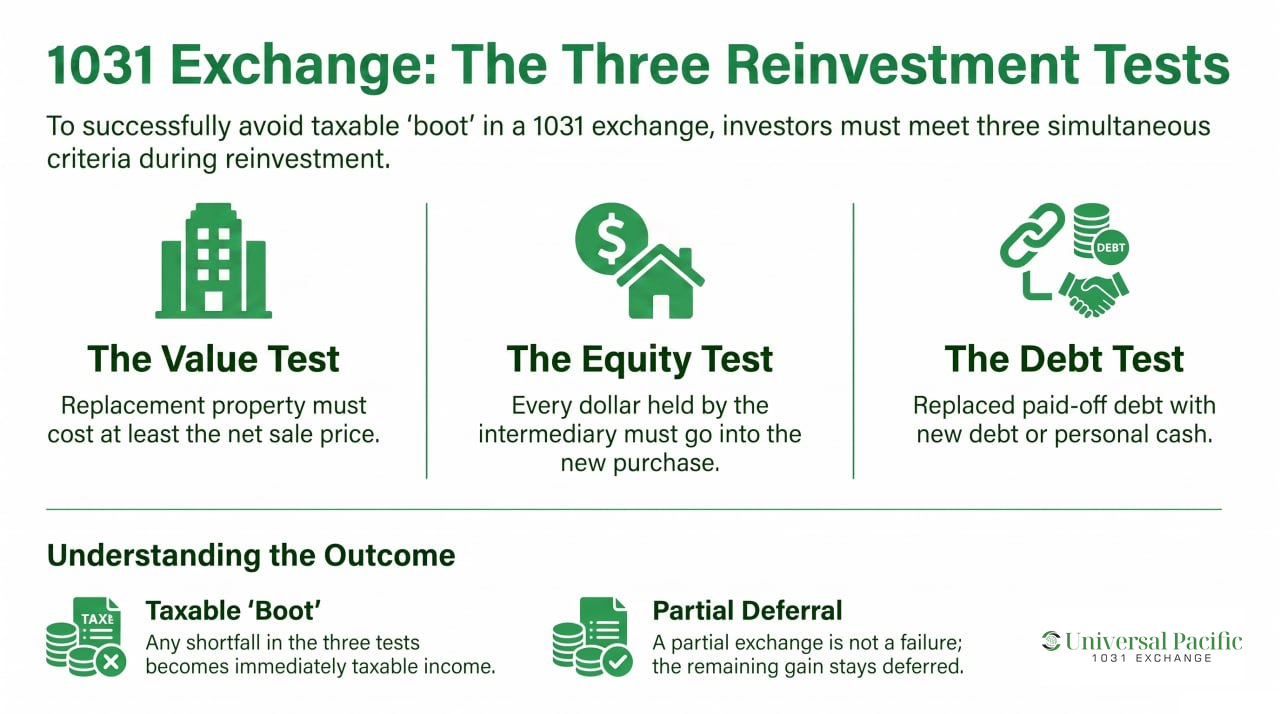
These four requirements are really two tests applied at once. The value test asks whether the replacement property costs at least what the relinquished property sold for. The equity test asks whether every dollar of exchange proceeds went into the purchase. An exchange can satisfy one and fail the other, which is why investors who buy a more expensive property still occasionally end up with a tax bill.
Importance of Reinvesting The Right Amount To Defer Taxes

As a real estate investor, there are many crucial reasons why you should reinvest the right amount in a tax-deferred exchange.
First, you can defer capital gains tax indefinitely when you keep reinvesting all the sales proceeds into a like-kind replacement. This deferral covers federal and state capital gains tax and also the depreciation recapture tax.
Secondly, reinvesting the full amount allows you to invest your capital gains into more valuable investment properties, enhancing your investment portfolio without the immediate tax burden. This leverage can increase cash flow, property appreciation, and the overall value of the investment portfolio over time.
Moreover, reinvesting the full exchange funds helps you avoid boot. “Boot” is the term used for any cash received by the real estate investor in the exchange that is not reinvested. Also, you incur mortgage boot when the debt on the relinquished real estate investment is more than the debt on the new replacement property; taking on more debt than you paid off never creates boot. The boot is taxable, and failing to reinvest the correct amount results in receiving boot, thereby creating a tax liability.
By fully reinvesting the exchange proceeds from the sale, investors maintain their equity position in their real estate portfolio. This approach helps in wealth building and in achieving long-term financial goals, as it allows the investment to continue growing tax-deferred.
Again, by reinvesting the right amount, you can strategically move your investments into properties with higher growth potential, better locations, or more favorable market conditions without the immediate tax consequences.
Remember that the IRS has specific rules for what qualifies as a like-kind exchange. Failure to comply can result in the denial of the exchange by the IRS, leading to immediate tax liabilities and potential penalties. Reinvesting the correct amount helps you comply with these IRS rules.
What Happens If You Reinvest Less Than the Full Amount
A partial exchange is not a failed exchange. If you fall short on either test, the shortfall is treated as boot and taxed, while the rest of the gain stays deferred. Understanding which shortfall you are creating matters, because the two kinds of boot arise in different ways and only one of them can be fixed with a checkbook at closing.
The table below applies each scenario to a property that sold for $500,000 with $10,000 in closing costs and a $200,000 mortgage paid off at closing, leaving $490,000 in net sale proceeds and $290,000 of cash held by the qualified intermediary.
| Scenario | Replacement property price | New debt | Exchange cash used | Taxable boot |
|---|---|---|---|---|
| Full deferral | $600,000 | $300,000 | All $290,000 | None |
| Cash boot | $490,000 | $240,000 | $250,000, with $40,000 taken back | $40,000 |
| Mortgage boot | $440,000 | $150,000 | All $290,000 | $50,000 in reduced debt |
| Both | $400,000 | $150,000 | $250,000, with $40,000 taken back | $90,000 combined |
Cash boot is money you simply keep. Mortgage boot is debt you fail to replace, and it is taxed even though no cash ever reaches your pocket, which is the version that surprises people. You can cure mortgage boot by bringing additional cash to the replacement closing. However, you can’t cure cash boot after the fact because once the proceeds are released to you, the exchange treatment for that portion is gone. In either case, the taxable amount is capped at your total realized gain.
How to Calculate 1031 Exchange Reinvestment Amounts

Let’s study this simplified step-by-step illustration with sample figures to help you understand how to calculate these amounts.
Example Scenario:
Let’s assume you are selling an office building (Property A) and planning to reinvest the proceeds into a new investment property (Property B) using a 1031 exchange.
Sale price of Property A: $500,000
Accumulated depreciation claimed: $50,000
Original purchase price of Property A: $300,000
Closing costs on sale (e.g., broker fees, legal fees): $10,000
Remaining mortgage on Property A: $200,000
Step 1: Calculate Net Sale Proceeds
First, calculate the net sale proceeds by subtracting any closing costs from the sale price of Property A.
Net Sale Proceeds = Sale Price − Closing Costs
Net Sale Proceeds = $500,000 − $10,000 =$490,000
Step 2: Determine Total Gain
Next, calculate the total gain from the sale, which is the difference between the net sale proceeds and the adjusted basis of Property A. The adjusted basis is the original purchase price minus any depreciation claimed.
Adjusted Basis = Original Purchase Price − Depreciation
Adjusted Basis = $300,000 − $50,000 = $250,000
Total Gain = Net Sale Proceeds − Adjusted Basis
Total Gain = $490,000 − $250,000 = $240,000
Step 3: Separate Your Exchange Cash From Your Payoff
The mortgage is paid off at closing, so it never reaches the qualified intermediary. Subtracting it from the net sale proceeds tells you how much cash you will actually have available to put toward Property B.
Exchange Cash Held by the QI = Net Sale Proceeds − Mortgage Payoff Exchange Cash Held by the QI = $490,000 − $200,000 = $290,000
Step 4: Calculate Reinvestment Amounts
To defer all taxes, the total purchase price of Property B must be at least the net sale price of Property A, and all $290,000 of exchange cash must go into the purchase.
Minimum replacement property purchase price: $490,000
Minimum exchange cash to reinvest: $290,000
Step 5: Consider Debt Replacement
If Property A had a mortgage that was paid off at sale, the replacement property must have equal or greater debt, or you must add additional cash to offset any decrease in mortgage liability. Since Property A carried $200,000, Property B needs at least $200,000 in new financing or an equivalent amount of your own cash.
If you choose a replacement property (Property B) with a purchase price of $600,000 and take on a new mortgage of $300,000, here’s how it aligns with 1031 requirements:
Purchase price of Property B: $600,000
New mortgage on Property B: $300,000
Cash required at closing (Purchase Price − New Mortgage): $300,000
Exchange cash available from the QI: $290,000
Additional cash you contribute: $10,000
The value test passes because $600,000 exceeds the $490,000 net sale price. The equity test passes because the full $290,000 of exchange cash went into the purchase. The debt test passes because $300,000 of new financing exceeds the $200,000 that was paid off. Adding $10,000 of your own money is always permitted and never creates boot. This scenario therefore defers the entire $240,000 gain.
Potential Pitfalls in 1031 Reinvestment and How to Avoid Them

For a successful tax-deferred exchange, you need to understand the IRS regulations and other legal requirements. Especially for people without a legal background, it’s best to consult with an experienced qualified intermediary for guidance. Below are some common pitfalls to identify and the best ways to avoid them.
1. Missing Critical Deadlines
The IRS stipulates strict timelines for a 1031 exchange: 45 days to identify potential replacement properties after selling the relinquished property, and 180 days to close on one of the identified properties, or the due date of that year’s tax return including extensions, whichever comes first. Failing to meet these deadlines can disqualify the exchange, making all gains immediately taxable.
Solution: Plan the exchange well in advance. Work with a qualified intermediary (QI) who can help ensure all paperwork and transactions comply with timelines.
2. Improper Identification of Replacement Properties
According to the IRS, you can identify multiple replacement properties provided you adhere to either the three-property rule or the 200% rule. Mistakes in identifying replacement properties correctly or over-identifying without meeting the valuation tests can invalidate the exchange.
Solution: Understand the rules for property identification and consult with a QI to correctly identify potential replacements.
3. Not Reinvesting Enough Funds

You must reinvest all net proceeds from the sale into the replacement property to fully defer taxes. If you don’t reinvest all, you may attract tax liabilities.
Solution: Ensure that the total purchase price of the replacement property is equal to or greater than the sale price of the relinquished property, and reinvest all net proceeds.
4. Failure to Match or Exceed Debt Levels
The new property must have equal or greater debt attached to it than the one sold. Otherwise, you must add additional cash to offset any decrease. Not meeting this requirement can lead to tax on the reduction as “boot.”
Solution: Carefully structure the financing of the replacement property or use additional cash to ensure debt levels are maintained or increased.
5. Violating Same Taxpayer Requirement
The tax return and name appearing on the title of the sold property must match the tax return and title on the replacement property. Changing entity structures or titles can disqualify the exchange.
Solution: Maintain consistent use of entities or individual names from the relinquished property to the replacement property.
6. Not Using a Qualified Intermediary
If you attempt to execute a 1031 exchange without a QI, you may disqualify your exchange since direct receipt of proceeds from the sale triggers a taxable event. Also, you may encounter challenges that may attract severe legal consequences due to inexperience.
Solution: Engage a QI before selling the relinquished property to hold the proceeds and facilitate the exchange, ensuring you never take direct possession of the funds. “The single most common way we see an exchange fall apart is the client calling us after the sale has already closed,” says Michael Bergman, CPA, President and CEO of Universal Pacific 1031 Exchange, whose California CPA license has been active since 1990. “Once the proceeds hit your account, there is nothing a qualified intermediary can do. The exchange agreement has to be signed before the relinquished property transfers, not after.”
Ready to Calculate Your Own Reinvestment Amount?
To fully defer capital gains taxes in a 1031 exchange, you need to reinvest the entire net sales price and carry over all the debt from the relinquished property to the replacement property. This ensures that all the capital gains are rolled over into the new investment, allowing you to defer taxes effectively.
For proper guidance on how to see through the entire 1031 exchange as well as stick to the reinvestment requirements, engage the services of a reputable qualified intermediary. Our professionals at Universal Pacific 1031 Exchange have the required expertise needed to help you with the reinvestment of any asset class. You can contact us to book a free consultation today.
Frequently Asked Questions
These are the questions investors ask us most often once they start putting real numbers against the reinvestment rules.
How much do I have to reinvest in a 1031 exchange?
To defer the full gain, reinvest all of it. In practice, that means three things at once: the replacement property must cost at least what the relinquished property sold for, every dollar of exchange proceeds held by your qualified intermediary must go into the purchase, and any debt paid off at the sale must be replaced with new debt or with additional cash of your own. Reinvesting less does not void the exchange, but the shortfall becomes boot and is taxable up to the amount of your realized gain.
What is the 95% rule in a 1031 exchange?
The 95% rule is the third and least-used identification option under Treasury Regulation section 1.1031(k)-1. If you identify more than three replacement properties and their combined fair market value exceeds 200% of what you sold, the exchange can still stand, but only if you actually acquire at least 95% of the total value of everything you identified. Miss that threshold, and you are treated as having identified no property at all, which fails the exchange entirely. It exists as a safety valve for investors assembling a portfolio of smaller properties, and it is unforgiving enough that most exchanges are structured to fit within the three-property or 200% rules instead.
Is it better to pay capital gains or do a 1031 exchange?
It depends on the size of the gain and whether you intend to stay invested in real estate. The tax you avoid is not just the headline capital gains rate. According to IRS Topic 409, long-term capital gains are taxed at 0%, 15%, or 20% depending on taxable income, and the unrecaptured section 1250 gain from depreciation you claimed is taxed at a maximum of 25%. On top of that, higher earners owe the 3.8% net investment income tax, and California taxes capital gains as ordinary income at rates reaching 13.3%. A large gain with years of depreciation behind it can face a combined bill well above what investors expect, which is what makes deferral valuable. Paying the tax can still be the better choice when the gain is small, when you want out of real estate entirely, or when you need the liquidity more than the deferral.
What is the average 1031 fee?
Qualified intermediary fees for a standard delayed exchange generally run between roughly $600 and $1,500, with an additional few hundred dollars for each replacement property beyond the first. Reverse and improvement exchanges cost substantially more, commonly several thousand dollars, because they require an exchange accommodation titleholder to take title to a property and hold it. These are market ranges rather than published figures, and they vary by intermediary and by transaction complexity, so ask for a written fee schedule before you engage anyone. Weigh the fee against the tax at stake: on the example above, a four-figure fee defers tax on a $240,000 gain.
This page was reviewed by Michael Bergman, CPA, California CPA #56113. Verify license.
Disclaimer: This article explains general 1031 exchange principles and is not tax, legal, or investment advice for any particular transaction. Tax treatment of an exchange depends on your specific facts, your entity structure, your state of residence, and the timing of your closings, and the figures used in the worked example are illustrative only. Fee ranges reflect general market observations rather than a quoted price. Consult your own CPA or tax attorney before relinquishing a property, and engage a qualified intermediary before the sale closes, because an exchange cannot be created after proceeds have been received.
Editorial Policy
All articles are reviewed for accuracy by licensed tax professionals and sourced from official government publications. Read our Editorial Policy →
About The Author
 Michael Bergman is a California licensed CPA and Real Estate Broker with over 35+ years of CPA-supervised 1031 exchange experience in commercial real estate. Specializing in 1031 tax-deferred exchanges and financial oversight, his expertise covers complex real estate transactions. Michael’s unique blend of financial acumen and real estate knowledge positions him as a trusted advisor in the industry, offering sound advice and strategic insights for successful property management and investment.