Can an LLC Do a 1031 Exchange?
Quick answer
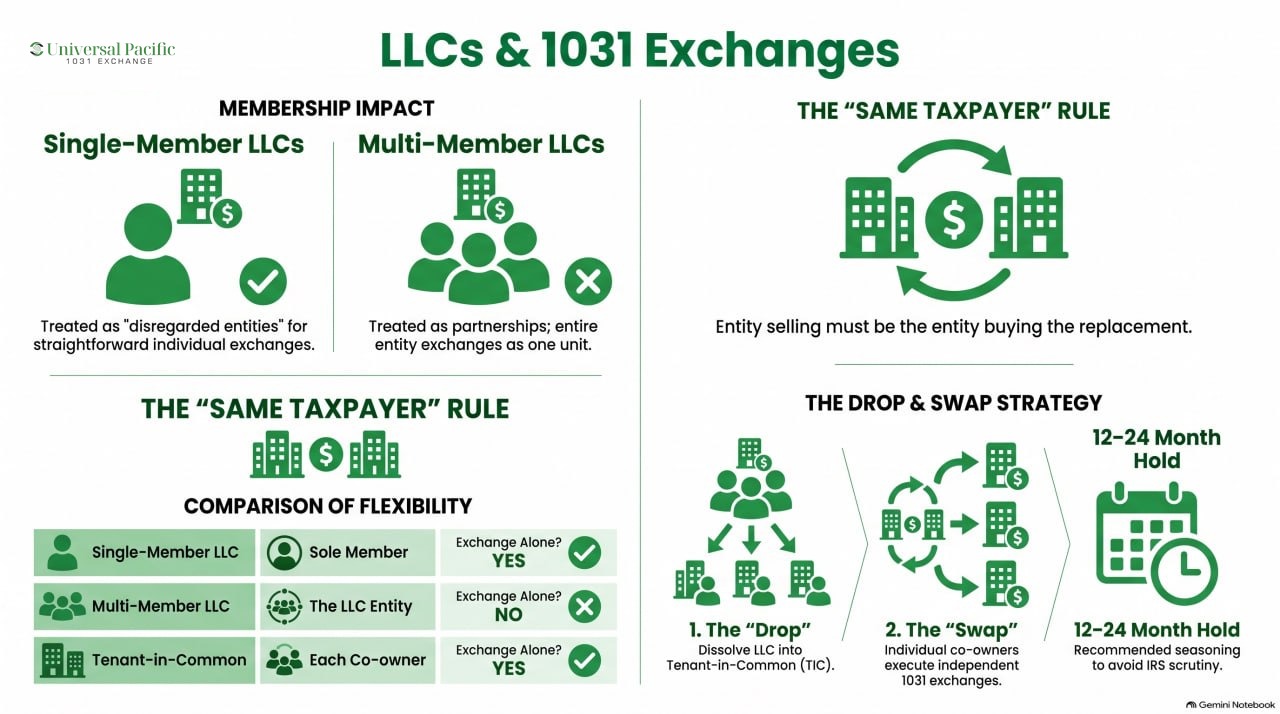
Yes, an LLC can do a 1031 exchange and defer capital gains tax, provided the same taxpayer that sells the relinquished property also acquires the replacement property. How that works depends almost entirely on whether your LLC has one member or several. The IRS disregards a single-member LLC, so the owner and the company are treated as the same taxpayer and the exchange is straightforward. A multi-member LLC defaults to partnership treatment, which means the company exchanges as a single unit and no individual member can peel off and exchange alone.
Over the past three decades, Universal Pacific 1031 Exchange has built a solid reputation of being one of the most reliable Qualified Intermediary (QI) service providers in Los Angeles, California and beyond. We have a team of CPAs and other experts with requisite foresight to detect and solve common and rare challenges LLCs encounter during 1031 exchanges. Book a free consultation now and let’s guide you towards a successful exchange.
This article not only answers the question of whether it’s possible to run a 1031 exchange using an LLC but also dives into how you can go about such transactions.
How Does a 1031 Exchange Work With an LLC?
A 1031 exchange with an LLC involves selling an old property and buying a new one in an IRS-compliant manner to defer capital gains taxes. Most real estate investors prefer this over owning and exchanging assets in their names because LLCs protect them from certain legal liabilities. All it takes for the transaction to be successful is strict adherence to the guidelines of Section 1031 of the Internal Revenue Code.
Since the 2017 tax law changes, Section 1031 applies only to real property held for productive use in a trade or business or for investment. The same statute sets the deadlines every exchange runs on, which are 45 days to identify replacement property and 180 days to complete the exchange. The IRS real estate tax tips on like-kind exchanges confirm those windows run concurrently from the date you transfer the relinquished property.
Can an LLC Do a 1031 Exchange?
Yes, you can run a 1031 exchange using an LLC. However, it must meet stringent IRS conditions. One such requirement is that the asset in question must be a property held solely for investment purposes. That means it must not be the personal property of any LLC member or an asset purchased for quick flips.
The other condition is that the taxpayer whose name is on the title document must be the same taxpayer selling the asset. Section 1031 sets no minimum holding period, but practitioners commonly recommend holding the property for 12 to 24 months before initiating an exchange, because a short hold invites the IRS to argue the property was never held for investment.
While the rule is not negotiable, its implementation differs depending on whether it’s a single-member or multi-member LLC, as we will discuss shortly.
Single-Member vs. Multi-Member LLCs in 1031 Exchanges

In clear terms, a single-member LLC is one owned by only one individual, while a multi-member LLC is characterized by having two or more members. However, in community property states like Arizona, New Mexico, California, or Texas, a married couple can jointly own an LLC and still refer to it as a single-member LLC. This is done mainly for federal tax purposes.
The distinction is not a matter of interpretation. The IRS states plainly that an LLC with only one member is treated as an entity disregarded as separate from its owner unless it files Form 8832, while a domestic LLC with at least two members is classified as a partnership for federal income tax purposes unless it files that same form. Everything that follows in this article flows from those two default classifications.
A multi-member LLC cannot initiate a 1031 exchange transaction using properties held in any of its active or former members’ names. Neither can any member of the LLC run a distinct exchange using the company’s properties.
The reason is that the IRS treats a limited liability company as a partnership and demands factual cohesion among the members when it comes to 1031 exchanges or any issue that pertains to tax payments.
This is one instance where the single-member LLC setup has the upper hand over the multi-member framework. Because the IRS sees a single-member LLC as a disregarded entity, the sole member or owner can run a 1031 exchange using the LLC’s properties.
Being a disregarded entity means that taxes accrued to the LLC are paid by the owner. Hence, the exact taxpayer rule is observed. Clearly, the IRS does not grant multi-member LLCs such flexibility. If you must run a 1031 exchange using the LLC’s real estate investment property held in a member’s name, transfer the title to the LLC at least 12 – 24 months before the exchange.
Another major difference between a single-member and multi-member LLC is that the latter is susceptible to disputes during 1031 exchanges. The unwillingness of any member of the LLC to proceed with the transaction will void it. However, the deal may still go through if the members can dissolve the partnership, share profits and liabilities, and give exiting members the fair value of their percentage ownership of the asset.
One of the best ways to do this is through the drop-and-swap strategy. Whichever the situation or membership structure, you need to work with a seasoned Qualified Intermediary that understands the nuances of 1031 exchanges in an LLC to avoid some of the common pitfalls real estate investors face.
Common Entity Structuring Strategies for LLCs in a 1031 Exchange

As we’ve established earlier, LLCs can perform 1031 exchanges irrespective of their structures. However, challenges may arise when one or more members of the company decide to opt out of the transaction. In such cases, the LLC must restructure itself to run an IRS-compliant exchange. Otherwise, the IRS may find grounds to cancel the deferral of capital gains taxes if the transaction goes through.
Two of the notable strategies often implemented to achieve this goal are the “drop and swap strategy” and “swap and drop strategy.” Both strategies revolve around the tenants-in-common (TIC) ownership structure. Before we explain these strategies in detail, we will need to explain TIC and how it differs from an LLC.
Tenants-in-Common (TIC) vs. LLC Ownership
Tenants-in-common is a real estate ownership structure where members have fractional undivided interests in an investment property. You can’t refer to it as a partnership because it’s not a legal entity but a co-ownership. As such, each member can sell, transfer, or make any decision regarding their stake in the asset independently.
Taxes are also filed separately, and every member’s name is written in the title document. This is quite different from an LLC, where title documents contain only the name of the company and not that of the individual members.
This is because the LLC holds the asset on behalf of the members, who, in turn, have partnership interests in the entity. But one major benefit of an LLC over a TIC when it comes to managing financed real estate investments is that the former gives members liability protection while the latter does not. In the face of a lawsuit or business debts, you stand a greater risk of losing your fractional interest in a TIC than you would in an LLC.
When it comes to running a 1031 exchange, the IRS recognizes the direct ownership of the individual tenants in a tenancy in common. Consequently, any of the co-owners of a property may decide to independently sell their fractional interest via a 1031 exchange without compelling the other members to sell.
After the transaction, the title document of the relinquished property will be modified. The names of the existing co-owners who didn’t partake in the 1031 exchange will remain, while those of the exited members will be replaced with the name of the buyer of the fractional interest.
In contrast, individual members of an LLC cannot initiate or execute a 1031 exchange without the full participation of other members. If disagreements arise on this ground, members must implement any good restructuring strategy of the company to avoid taxable events.
How the Ownership Structures Compare
The table below sets the four structures side by side on the points that decide whether an exchange is possible and who gets to make the call.
Michael Bergman, President and CEO of Universal Pacific 1031 Exchange and a California CPA licensed since 1990, sees where these deals break down. “Nobody calls us about an LLC until one member says no. By then the property is in escrow, and the restructuring window has closed. The conversation that saves the exchange is the one you have a year early, when nobody is arguing yet.”
Drop and Swap Strategy

The drop-and-swap strategy involves two steps. The first, which is the “drop,” is the dissolution of the limited liability company into a tenant-in-common structure. Every member will be given fractional undivided interests in the LLC properties according to their percentage membership interests.
In the second step (swap), the co-owners who want to proceed with the exchange can do so with their stakes in the asset. After selling their interests, they can buy a like-kind replacement property with a fair market value equal to or greater than the proceeds they realized.
This strategy is so flexible that if there are five co-owners of the asset, they can conduct five different 1031 exchanges without incurring any immediate tax liabilities. However, it’s important that you allow a reasonable holding period between the creation of the TIC and the commencement of the exchange. While the IRS did not stipulate any official time, experts suggest that 12 – 24 months is ideal.
Anything less than that, especially a few weeks before the deal closes, may trigger IRS scrutiny, as they may assume you’re trying to exploit the system to manipulate taxes.
How to Execute a Drop and Swap, Step by Step
Because the sequence matters more than any single decision in it, here is the order our team works through with clients.
Step 1: Confirm the Members’ Intentions in Writing
Establish who wants to exchange and who wants to cash out, and document it. A verbal understanding is worth nothing if a member reverses position after the property is listed.
Step 2: Review the Operating Agreement and the Title
Check what the operating agreement requires for dissolution and distribution, and confirm the property is actually titled in the LLC’s name rather than a member’s. Title problems surface constantly and take weeks to unwind.
Step 3: Distribute the Property Into Tenancy-in-Common
The LLC deeds undivided fractional interests to each member in proportion to their membership interest. Each member’s name now appears on the title, and each becomes an independent taxpayer for exchange purposes.
Step 4: Let the Tenancy-in-Common Season
Hold the TIC structure in place before listing. The IRS sets no fixed period, but a distribution executed days before a sale is the fact pattern most likely to draw a challenge.
Step 5: Engage a Qualified Intermediary Before Closing
| Structure | Who the IRS treats as the taxpayer | Can one owner exchange alone? | Liability protection | Main constraint |
|---|---|---|---|---|
| Single-member LLC | The sole member, since the LLC is disregarded | Yes, the member and the LLC are the same taxpayer | Yes | Adding a second member changes the classification |
| Multi-member LLC | The LLC itself, classified as a partnership | No, the LLC must exchange as a unit | Yes | One dissenting member can stop the exchange |
| Tenants-in-common | Each co-owner individually | Yes, each interest exchanges independently | No | No liability shield, and co-owners must still agree on the property itself |
| Delaware Statutory Trust | The beneficiary holding the interest | Yes, the beneficial interest is treated as real property | Yes, through the trust structure | Illiquid until the trust dissolves, and no active management role |
Each exchanging co-owner needs a QI in place before the sale closes so the proceeds never reach them. A co-owner who takes receipt of funds has a taxable sale, regardless of what the others do.
Step 6: Run Each Exchange on Its Own Clock
Every exchanging co-owner identifies replacement property within 45 days and closes within 180 days. Members who chose to cash out simply pay tax on their share and exit.
Swap and Drop Strategy
The swap and drop strategy is the reverse of the drop & swap strategy. It involves conducting the 1031 exchange first before dissolving the LLC into a TIC. After the dissolution, the co-owners can decide to sell or transfer their fractional interests in the property as they deem fit.
Let’s remember that the reason for these strategies in the first instance is that one or more members of the company want to take their profit from the sale of a property instead of reinvesting it into a new property.
If such members are not in a hurry to cash out, others can convince them to see the deal through and sell off their stakes in the replacement property afterward. But it can only work if the concerned members can wait for a holding period of 12 – 24 months after the exchange before taking profits. The reason is that selling off too soon may void the transaction’s tax deferral status.
Alternative Ownership Structures for LLCs in a 1031 Exchange
Members of LLCs can explore several other options to execute a 1031 exchange without attracting IRS penalties. These alternatives include the following:
Delaware Statutory Trust (DST)

Delaware Statutory Trust is a legal trust established under Delaware State law for holding real estate investment assets. DST has several advantages, one of which is that it allows beneficiaries to enjoy passive income since they must delegate the management of the assets to a trustee.
This makes DST a popular choice for retirement planning and LLC dissolution. An LLC can perform a 1031 exchange involving DST ownership in two different ways.
The first way is to conduct the exchange as an LLC and then proceed to buy a replacement property already structured as a DST. Their investment will be considered a purchase of a beneficial interest in the DST.
In this case, the LLC becomes a beneficiary of the trust. Alternatively, members of the LLC may decide to conduct the exchange as individual entities and buy separate beneficial interests in the same or different DSTs.
For this to work, the company must first be dropped to a TIC via the drop & swap strategy. Every other step we discussed under the drop & swap strategy will follow suit, but the replacement property will be structured as a DST.
Reverse 1031 Exchange
As the name suggests, a reverse 1031 exchange reverses the procedures of the regular 1031 exchange. Here, you will purchase the replacement property before selling the relinquished property. This strategy comes in handy when you stumble upon a good deal sooner than you’re ready to offload the old asset.
However, you cannot hold the title of both properties at the same time. Hence, the Qualified Intermediary will create a parking arrangement to help you remain IRS-compliant. This involves creating a separate LLC known as an Exchange Accommodation Titleholder (EAT) to temporarily hold the title of the replacement property purchased.
Risks and Challenges for LLCs in a 1031 Exchange
Running 1031 exchanges using an LLC is not a walk in the park. That’s why you need to work with a highly experienced 1031 exchange firm that can easily navigate the nuances of such transactions without triggering IRS penalties. These are some of the challenges real estate investors face when performing like-kind exchanges using LLCs.
Title and ownership complications come first because the taxpayer rule is not always easy to observe in LLCs. This is because some of the properties a typical LLC owns may not be held in its name. At times, the title may be in the name of the member who closed the deal. To avoid these complications and the ensuing delays arising from title transfer, your company must ensure that the titles of all assets it purchases are registered in its name.
Timing Constraints is another major risk. 1031 exchanges observe strict timelines, such as the 45-day window to identify replacement properties and the 180-day timeframe to complete the entire deal. In addition to this, you may have to wait for about 12 – 24 months before initiating a 1031 exchange if you dissolve the LLC into a TIC. This timeframe also applies when you transfer the title of a property from a member to the LLC. Hence, endeavor to plan early to avoid missing the deadline. Go through your title documents early and be sure you’ve got the right structure before proceeding.
Member Disagreements are the third challenge. It’s not uncommon for members of an LLC to develop unreconcilable disagreements. When this occurs, dissolution often follows. That’s why it’s important to have a robust operating agreement that can capture different kinds of issues in the LLC and provide predetermined steps to handle them. Also, you should consider holding periodic, strategic meetings to ascertain members’ intentions about the future and the investment direction of the company. This will help you know whether everyone is on the same page.
IRS Scrutiny: The IRS is seemingly more mindful of 1031 exchanges using LLCs, probably because they are more complicated and susceptible to breaking the rules. Working with a seasoned QI may be your best bet to avoid any issues with the IRS. You should also keep accurate records, including receipts, documents, emails, etc., in preparation for a potential investigation from the IRS. This will help you prove your innocence against any allegation from them.
Lack of Flexibility is another common issue. It’s difficult to use “LLC” and “flexibility” in the same sentence when it comes to 1031 exchanges. Compared to tenants in common, an LLC is quite rigid, which is also why it attracts so much IRS scrutiny. Apart from the risk of liabilities, a DST or TIC may be a great idea if you’re investing with one or more partners. However, discuss with your investment advisor before making a decision.
Need a Qualified Intermediary for Your LLC’s 1031 Strategy?
Running a 1031 exchange using your LLC may be tricky, but it’s not impossible. It requires proper planning and a good understanding of the different strategies that you could employ in the face of member disagreements.
Above all, you need to engage the services of an experienced and specialized Qualified Intermediary, as this is your best chance to avoid tax pitfalls.
Universal Pacific 1031 Exchange has been in the business of helping LLCs and individuals execute successful, hassle-free 1031 exchanges through our QI services. Our QIs are seasoned professionals in tax and other related matters, and have all it takes to ensure you get all the tax benefits a 1031 exchange can afford you. You can book a free consultation or visit any of our 1031 exchange offices to start an exchange today.
Frequently Asked Questions (FAQs)
In addition to all we’ve discussed, these are common questions you may have with regard to using your LLC to run an exchange.
Can Each LLC Member Do a Separate 1031 Exchange?
Yes, each LLC member can do a separate 1031 exchange if the LLC business structure is dropped to tenants in common through the drop and swap strategy. If there were seven members in the LLC before it was dropped, seven of them can run seven different 1031 exchanges.
What Happens if LLC Ownership Changes Before the Exchange?
If the LLC ownership changes immediately before the exchange, the IRS may disqualify the transaction. To avoid this, you should wait 12 – 24 months after the change of ownership before proceeding with the transaction.
What if Some Members of an LLC Want to Exchange but Others Don’t?
You should apply the drop & swap strategy to dissolve the company so that members who don’t want the exchange can take their profit and leave, while others can forge ahead.
This page was reviewed by Michael Bergman, CPA, California CPA #56113. Verify license.
Disclaimer: The information in this article is for general educational purposes only and is not legal, tax, financial, or investment advice. Every 1031 exchange has unique circumstances and requirements. Consult a qualified tax or legal professional before making decisions regarding your exchange.
Editorial Policy
All articles are reviewed for accuracy by licensed tax professionals and sourced from official government publications. Read our Editorial Policy →
About The Author
 Michael Bergman is a California licensed CPA and Real Estate Broker with over 35+ years of CPA-supervised 1031 exchange experience in commercial real estate. Specializing in 1031 tax-deferred exchanges and financial oversight, his expertise covers complex real estate transactions. Michael’s unique blend of financial acumen and real estate knowledge positions him as a trusted advisor in the industry, offering sound advice and strategic insights for successful property management and investment.