1031 Exchange Debt Rules
Quick answer
1031 exchange debt rules were designed to ensure that investors fully reinvest both their equity and property-related liabilities to maintain the tax-deferred status of the exchange. The main idea is that you must replace the debt you give up, or add enough cash to make up the difference.
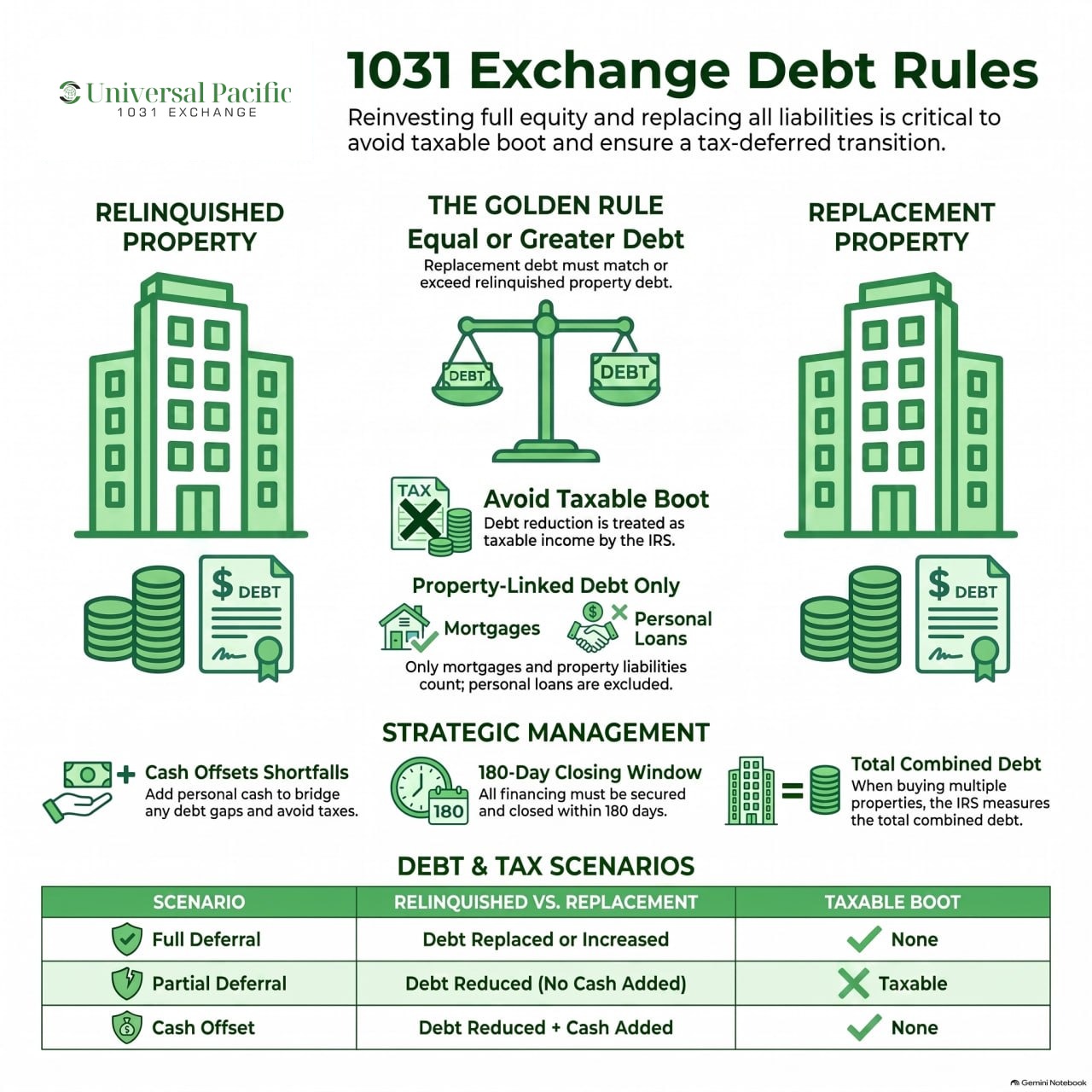
As stipulated by the IRS, the debt on the replacement property must be equal to or greater than the debt on the relinquished property, and any boot in the 1031 exchange is taxable. Understanding these debt rules in a 1031 exchange helps prevent taxable events and ensures your exchange maintains its tax-deferred benefits.
At Universal Pacific 1031 Exchange, our licensed CPA professionals have 35+ years of experience helping investors legally defer capital gains through IRS-compliant 1031 exchanges. We provide the professional guidance you need to navigate debt rules, protect your profits, follow IRS timelines, and structure your exchange to support available tax-deferral benefits. Contact us today to start an exchange with professional support you can trust.
This guide breaks down everything you need to know about 1031 exchange debt rules, how debt affects an exchange, legal and tax implications you must know, and top strategies for managing debt in 1031 exchanges.
What Is Debt in a 1031 Exchange?

In a 1031 exchange, debt refers to any mortgages, loans, or other liabilities tied to the investment property being sold or acquired. Real estate runs on debt. The Federal Reserve reported about $3.96 trillion in commercial mortgages outstanding at the end of 2025. It is important because the IRS looks at both the equity you own and the debt you assume to determine whether you are reinvesting your full investment and qualifying for tax deferral.
Debt affects how much capital gains tax you can defer in a 1031 exchange. If you reduce debt or take cash out when acquiring the replacement property, it can create “boot,” which is taxable. Conversely, taking on more debt or matching the existing debt of the relinquished property helps maintain the full tax-deferred benefits.
Investors use these rules when trading from one property to another, across many property types. A retail property, an apartment, or an office can all work, as long as each is property held for investment. In essence, understanding debt in a 1031 exchange is about tracking liabilities and net equity. It ensures the exchange is structured correctly, protects your tax deferral, and helps you make informed decisions about trading up or across properties.
What Are the 1031 Exchange Debt Rules?
1031 exchange debts, including mortgages, loans, and other liabilities, affect your net equity and determine whether any cash or debt reduction could trigger taxable gain. That’s why you need to understand the debt rules to prevent potential tax liability. These rules apply to all like-kind exchanges of real property. The key debt rules in a 1031 exchange include the following:
1. Replacement Property Debt Must Match or Exceed Relinquished Property Debt
To qualify for full tax deferral, the total debt on the replacement property must be equal to or greater than the debt on the property you sold. In practice, you acquire the replacement property with a target replacement value that matches or beats the old one. The replacement must also be of equal or greater value overall. This ensures that you are reinvesting the same level of financial commitment rather than reducing liabilities while avoiding taxes. If the replacement property carries less debt, the IRS may view the difference as taxable gain.
2. Taking on Less Debt Can Create Taxable “Boot”
If the debt on the replacement property is less than the debt on the relinquished property, the difference is called “mortgage boot.” Boot is taxable in the year of the exchange, and it reduces the amount of gain you can defer. Therefore, you must carefully plan the structure of debt in the replacement property to avoid or minimize paying taxes on boot.
3. Cash Can Offset Lower Debt
If you acquire the replacement property with less debt, you can avoid boot by contributing additional cash to make up the difference. The IRS considers both debt and cash when calculating reinvested value, so combining cash with debt can help maintain full tax-deferred status.
4. Debt Can Be From Any Source
The Internal Revenue Code allows debt from any legitimate source to count toward the exchange. The debt can come from new mortgages, assumed loans, or other property-related financing. The key is that the debt must be legally enforceable and tied to the property.
5. Personal Loans Usually Do Not Count
Loans that are personal in nature, such as credit cards or personal lines of credit, generally do not count toward meeting the debt requirements of a 1031 exchange. The debt must be directly associated with the property being exchanged, not personal obligations of the investor.
6. Debt Is Measured Net of Payoffs
When calculating debt for a 1031 exchange, any loans paid off at closing are subtracted from the total. For example, if part of the relinquished property’s mortgage is paid off before the exchange, only the remaining balance counts toward the required debt on the replacement property. That way, you have a more accurate comparison of liabilities.
7. All Debt Is Considered at Closing
The IRS evaluates all debt as of the closing date of the replacement property. Any adjustments or new loans after closing are not counted, so it’s essential to structure financing correctly at the time of purchase. Accurate closing statements and documentation are critical to proving compliance with the debt rules.
How Does Debt Impact Your 1031 Exchange Timeline?
Debt rules do not stand alone. They sit inside the strict 1031 exchange timeline, so timing and financing must line up. You have 45 days from the sale of the relinquished property to identify potential replacement properties in writing. The replacement must be properly identified within that 45-day window. You then have 180 days from that sale to close on the replacement property. The 180-day deadline can end sooner, on the due date of your tax return.
Financing has to be ready inside that same window. Remember that closing costs and financing fees also apply on both sides of the exchange. Because the IRS measures debt at closing, your loan on the replacement property must be approved and in place by the 180-day deadline. A lender delay can push you past the deadline or leave you short on debt, which creates mortgage boot.
A common pitfall is identifying a property you cannot finance in time. Suppose you sell a property with a $400,000 mortgage and identify a replacement, but your new loan is not approved by day 180. You may be forced to close with less debt and pay tax on the shortfall. Planning financing early, alongside your qualified intermediary, keeps the debt and the timeline aligned.
Tax and Legal Considerations in 1031 Exchange Debt Rules
Debt rules in a 1031 exchange affect both your tax outcome and legal compliance. Because the IRS closely reviews how debt is handled, understanding these legal and tax consequences will help you avoid taxable boot, preserve full tax deferral, and reduce legal risk.
From a tax perspective, reducing debt or taking cash proceeds out of an exchange can create taxable boot. For tax purposes, debt relief and cash are treated the same. The IRS compares the debt on the relinquished property to the debt on the replacement property, along with any cash boot received, to determine whether gain is fully deferred. It also looks at the property transferred on both sides.
That comparison decides whether the gain is fully deferred. Hence, you need proper planning to ensure net equity and liabilities are fully reinvested and reported accurately. Under IRS rules, debt relief is treated as money received, so net debt relief counts as taxable boot. The IRS explains the basics in its like-kind exchange guidance.
From a legal standpoint, all loans used in the exchange must be properly documented and tied to the property. Exchange agreements, loan documents, and closing statements must clearly reflect how debt is structured and transferred. That’s why working with a Qualified Intermediary, lender, and tax professional is important. They help ensure the exchange follows IRS rules and withstands legal or audit scrutiny.
Top Strategies to Manage Debt in 1031 Exchange
It takes proper understanding and careful planning to comply with the 1031 exchange debt rules and avoid taxable boot. Here are some effective strategies you can apply.
1. Match or Increase Your Replacement Property Debt
One of the safest strategies is to take on equal or greater debt on the replacement property compared to the property you sold. This helps ensure you are fully reinvesting your financial commitment and avoids mortgage boot. It is especially useful when aiming for full tax deferral.
2. Use Cash to Offset Lower Debt
If you want to reduce debt on the replacement property, you can add cash to make up the difference. The IRS allows cash to offset lower debt, as long as your total reinvestment meets exchange requirements. Some investors instead place leftover equity into a Delaware Statutory Trust to stay fully invested. This strategy provides flexibility when restructuring financing.
3. Plan Financing Before Closing
Debt is measured at closing, so you should finalize financing in advance. Working with lenders and your Qualified Intermediary early helps ensure the loan structure aligns with exchange rules and avoids last-minute issues.
4. Combine Debt Across Multiple Properties
When buying multiple replacement properties, the IRS looks at total combined debt, not each property individually. So, you can spread debt across properties as long as the overall debt meets or exceeds the debt at the relinquished property closing.
5. Work Closely With Your Qualified Intermediary and Tax Advisor
A Qualified Intermediary (QI) is required in a 1031 exchange to hold the sale proceeds and prevent you from having direct control of the funds. If you receive or control the money, even briefly, the exchange can be disqualified and the entire gain may become taxable. A QI also prepares the exchange agreement and ensures the transactions meet key 1031 exchange deadlines.
Tax advisors also play a critical role in structuring the exchange correctly, especially when debt, multiple properties, or partial conversions are involved. They help you understand how mortgage payoff, debt replacement, depreciation recapture, and potential boot affect your tax outcome. As Michael Bergman, CPA, president of Universal Pacific 1031 Exchange, puts it, “Most failed exchanges we see are not about the property. They are about debt that was not replaced or cash that was not tracked.” Their guidance helps you plan ahead, avoid costly mistakes, and maximize long-term tax deferral.
Avoiding Boot: Common Mistakes in 1031 Exchange Debt Rules
Boot is any value you receive in an exchange that is not like-kind property, including cash, debt relief, or other property. Debt relief creates boot when the debt on your replacement property is lower than the debt you paid off. That difference is treated as money received, and it is taxable. Most debt mistakes trace back to this one idea.
A few mistakes come up again and again. Some investors buy a cheaper replacement property and take on far less debt. Others pull cash out at closing instead of reinvesting it. Some pay off a mortgage with exchange funds and forget it counts as debt relief. Each move can create boot and a surprise tax bill. Receiving cash at closing is considered taxable, even if the rest of the exchange qualifies. Boot also lowers your tax basis in the replacement property.
The table below shows how debt choices play out. These figures are simplified examples, not tax advice.
| Scenario | Relinquished Debt | Replacement Debt | Cash Added | Taxable Boot |
|---|---|---|---|---|
| Debt fully replaced | $300,000 | $300,000 | $0 | None |
| Less debt, no cash | $300,000 | $200,000 | $0 | $100,000 |
| Less debt, offset with cash | $300,000 | $200,000 | $100,000 | None |
| More debt on replacement | $300,000 | $350,000 | $0 | None |
The IRS gives a worked example of this. In Treasury Regulation 1.1031(d)-2, an investor is relieved of a $150,000 mortgage. They take on an $80,000 mortgage and pay $40,000 in cash. The $30,000 of net debt relief that remains is taxed as boot. Matching debt across the relinquished and replacement properties is the path to full deferral. To avoid boot, match or exceed your old debt, reinvest all the net proceeds, and confirm the numbers with your qualified intermediary before closing.
Comparing Debt Treatment in Reverse 1031 Exchange vs. Traditional Exchange
A traditional deferred exchange sells the relinquished property first, then buys the replacement. A reverse 1031 exchange flips that order, so you acquire the replacement property before you sell the old one. Debt works differently in each, mostly because of timing and who holds title during the exchange.
In a reverse exchange, an exchange accommodation titleholder holds the new property while you arrange financing and sell the old one. The IRS provides a safe harbor for reverse exchanges under Revenue Procedure 2000-37. It lets an accommodation party park the replacement real estate, which must be qualifying real property. Lenders treat these loans as more complex, since the structure is less common. The table below compares the two on the points that matter most for debt.
| Feature | Traditional Exchange Debt Rules | Reverse Exchange Debt Rules |
|---|---|---|
| Debt replacement timing | Financed when you buy, after the sale | Financed up front, before the sale closes |
| Debt amount requirements | Match or exceed relinquished debt | Match or exceed relinquished debt |
| Tax implications | Debt shortfall creates mortgage boot | Same boot rules, but timing raises the risk |
| Complexity level | Moderate | Higher, with more moving parts |
A reverse exchange can suit you when the right replacement property appears before your sale closes. The tradeoff is tighter financing and higher costs. Because the debt rules still apply, a qualified intermediary and a tax advisor should map the numbers before you commit.
Need Assistance From a Skilled Qualified Intermediary?

Understanding and applying the 1031 exchange debt rules is essential to preserving full tax deferral and avoiding unexpected tax liability. To keep to these rules, ensure that debt obligations are correctly structured and use equity strategically. Be mindful of financing constraints, lender requirements, and legal implications, all of which can strongly impact the exchange outcome.
You need experienced guidance from a qualified intermediary to ensure your exchange is structured correctly, and our team is here to help. With 35+ years of experience, our team ensures that your transaction is aligned with applicable IRS rules while maximizing your tax-deferral benefits. We’ll guide you through the 1031 exchange process from start to finish. Contact us to schedule a free consultation today or visit our 1031 exchange office in Los Angeles.
Frequently Asked Questions
When it comes to debt in a 1031 exchange, investors often have questions about loans, refinancing, and structuring the replacement property. Here are clear answers to the most common questions:
What Happens if I Take On Less Debt for My Replacement Property?
If your replacement property has less debt than your relinquished property, the difference is treated as taxable “boot.” This means you could owe capital gains tax on the portion of debt reduction.
Can I Avoid Taking on New Debt by Adding Cash Instead?
Yes, you can add cash to make up the difference, but the IRS treats cash added as part of your investment. You must ensure that the total value of the replacement property plus any cash added still meets the tax-deferred exchange requirements.
Can I Refinance Before Doing a 1031 Exchange to Pull Out Cash?
Refinancing before the exchange can trigger taxable boot if it reduces your debt on the relinquished property. Any cash pulled out counts as received proceeds and may be taxable unless properly offset with debt on the replacement property.
Can I Refinance Right After My 1031 Exchange Closes?
Yes, refinancing after the exchange is generally allowed and does not affect the original 1031 exchange. This can help you access cash or adjust loan terms without creating taxable boot.
Do I Need to Use the Same Lender for the Replacement Property?
No, you do not need to use the same lender. The key is that the replacement property’s debt is structured to meet or exceed the relinquished property’s debt to avoid taxable boot.
Does Seller Financing Count as Debt in a 1031 Exchange?
Yes, seller financing is considered debt for exchange purposes. The IRS treats it the same as a traditional mortgage when calculating debt relief and determining potential boot.
This page was reviewed by Michael Bergman, CPA, California CPA #56113. Verify license.
Disclaimer: This article is for general informational purposes only and is not tax or legal advice. The 1031 exchange debt rules are complex, and their application depends on your specific facts. Tax laws change, and each situation is different. Consult a qualified intermediary and a licensed tax advisor before acting.
Editorial Policy
All articles are reviewed for accuracy by licensed tax professionals and sourced from official government publications. Read our Editorial Policy →
About The Author
 Michael Bergman is a California licensed CPA and Real Estate Broker with over 35+ years of CPA-supervised 1031 exchange experience in commercial real estate. Specializing in 1031 tax-deferred exchanges and financial oversight, his expertise covers complex real estate transactions. Michael’s unique blend of financial acumen and real estate knowledge positions him as a trusted advisor in the industry, offering sound advice and strategic insights for successful property management and investment.