Reverse 1031 Exchange Financing: A Comprehensive Guide
You find the right replacement property, but you are not ready to sell your current property yet. A reverse 1031 exchange lets you buy the new property first and sell the old one later. The IRS has a safe harbor for these transactions, but the financing can be difficult. You need a plan for how to fund the purchase while you wait to sell your existing property.
Universal Pacific 1031 Exchange has provided qualified intermediary services since 2015 and serves investors in all 50 states. For reverse exchanges, the team forms and capitalizes the Exchange Accommodation Titleholder, prepares the Qualified Exchange Accommodation Agreement, and coordinates with lenders, title companies, and escrow. If you are planning a reverse 1031 exchange, contact us before opening escrow.
This article breaks down what reverse exchange financing means, how it works, and its benefits.
How Reverse 1031 Exchange Financing Works
A reverse 1031 exchange may feel unfamiliar because most investors know the forward exchange, where the sale comes first. In a forward exchange, you sell the old property, a qualified intermediary holds the proceeds, and you buy the replacement property within 180 days. A reverse exchange changes the order. You buy the replacement property first, then sell the property you plan to give up.
The complication is that Section 1031 requires an exchange. You cannot exchange a property with yourself. So you cannot simply buy the new property in your own name and sell the old one later. Someone else has to hold the title in the meantime. That someone is the exchange accommodation titleholder, usually a single-member LLC formed by your exchange accommodator for this one transaction.
This structure comes from Revenue Procedure 2000-37, which created a safe harbor for parking arrangements. If you follow it, the IRS will not challenge the treatment of the EAT as beneficial owner of the parked property. The tradeoff is that the safe harbor runs on a clock, and the clock is short.
1. Identify and Secure the Replacement Property
You negotiate the purchase yourself, then assign the contract to the EAT before closing. Nothing about the deal changes for the seller. What changes is who appears on the deed, which surprises sellers who weren't told in advance.
2. Fund the Purchase Before the Old Property Sells
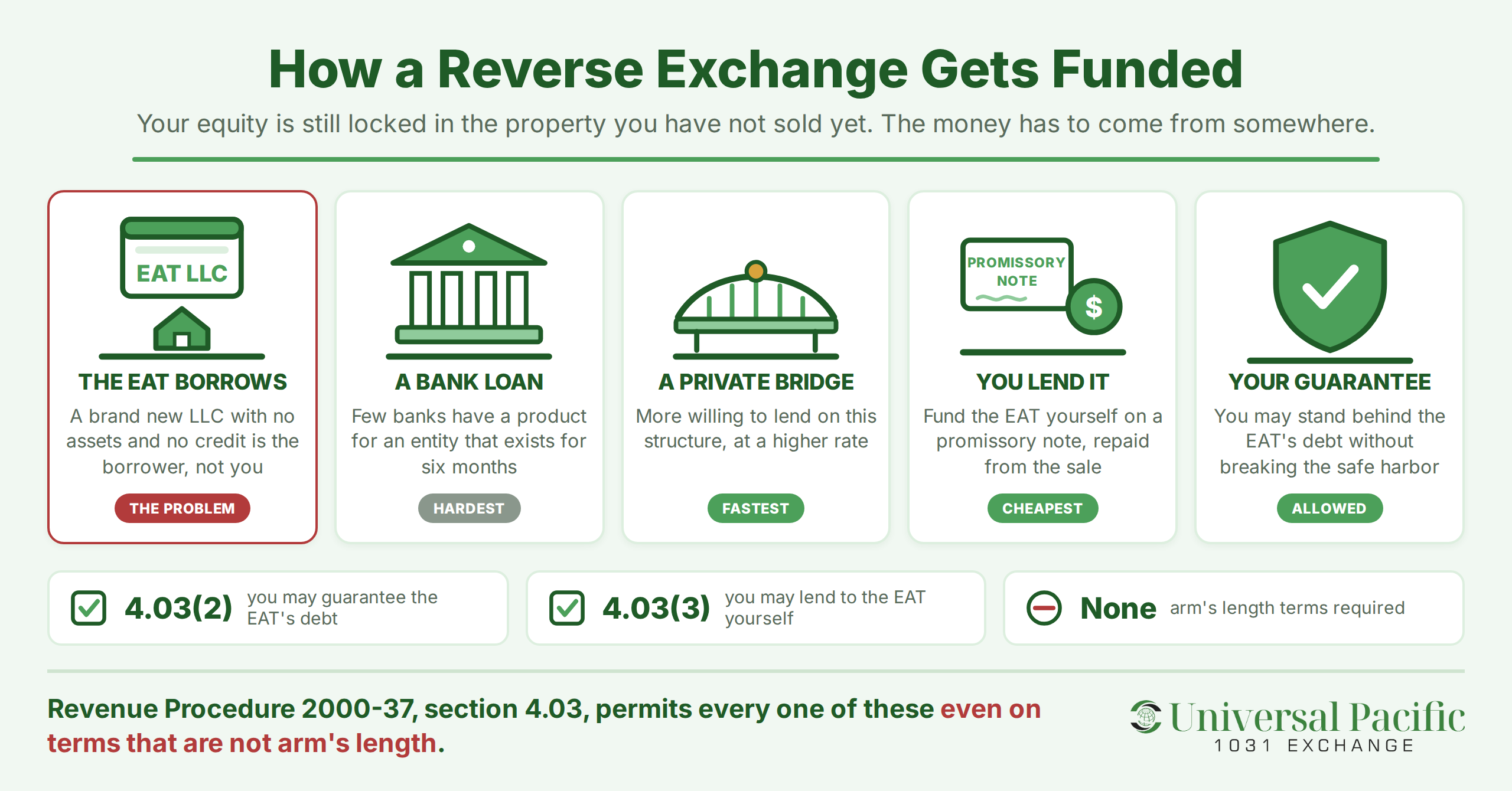
This is the hard step. The EAT is a brand new entity with no assets and no operating history, and it is the borrower. Your equity is still locked in the existing property, so the loan funds have to come from somewhere else.
3. Complete the Exchange Inside the Safe Harbor
Once the original property sells, the qualified intermediary uses those exchange funds to buy the parked property out of the EAT. Title then transfers to you. Do this within 180 days of the parking date, and the entire transaction stays inside the safe harbor. The process has to satisfy IRS regulations at every step.
Two timing rules can cause problems in a reverse exchange. The 45-day identification period applies to the property you plan to sell, not the replacement property, which is different from a forward exchange. The 180-day deadline is firm, so a delayed sale does not give you extra time. You can still identify multiple or alternative properties, just as you can in a forward exchange.
The deadlines below come straight from the revenue procedure. Missing any of them costs you the safe harbor, not just time.
| Deadline | What has to happen | Authority |
|---|---|---|
| Day 0 | The EAT takes qualified indicia of ownership of the parked property | Rev. Proc. 2000-37, section 4.02(1) |
| Within 5 business days | The written qualified exchange accommodation agreement is signed | Section 4.02(3) |
| Within 45 days | The relinquished property is formally identified | Section 4.02(4) |
| Within 180 days | The parked property is transferred out to you or to a buyer | Section 4.02(5) |
| 180 days combined | Total time both properties may sit in the arrangement | Section 4.02(6) |
Benefits of Reverse 1031 Exchange for Deferring Capital Gains Taxes
The tax benefit is identical to a forward exchange. You defer capital gains taxes, depreciation recapture, and the net investment income tax. The condition is that you acquire investment property of equal or greater value and move all the equity across. Nothing about running the exchange backward reduces the tax deferral.
The main difference is when you have to deal with the costs of the exchange. In a forward exchange, you sell the old property first, then have 45 days to identify a replacement and 180 days to complete the purchase. If you miss those deadlines, the sale may become taxable. In a reverse exchange, you buy the replacement property first, so a delayed sale means paying the costs of holding both properties for longer. For some investors, that trade-off is worth it.
The other advantage is negotiating position. In competitive markets, a seller takes the buyer who can close, not the buyer waiting on their own sale. A reverse structure lets you bid like a cash buyer while keeping the tax deferral intact. That matters most when an investor finds the ideal property in a market with almost no supply. Parking one property while the other property sells is the whole point of the structure.
Private Bridge Lending for Reverse 1031 Exchanges
Financing a reverse exchange can be difficult for a reason that has little to do with current credit conditions. The July 2026 Senior Loan Officer Opinion Survey included responses from 56 domestic banks, and some banks reported easing their standards for commercial real estate loans. The bigger issue is that a reverse exchange does not fit neatly into the way many banks normally underwrite a loan.
The bank is lending to a borrower that may be a newly formed LLC, while the property may only be held for at most six months. Many large banks do not have a loan product designed for that setup. Private bridge lenders are often more willing to work with these deals, but the convenience comes at a higher cost.
Revenue Procedure 2000-37 is what makes the structure financeable, and the relevant language sits in section 4.03. Under section 4.03(2), you may guarantee the EAT’s obligations, including secured or unsecured debt incurred to acquire the property. Under section 4.03(3), you may loan or advance funds to the EAT directly, or guarantee a loan to it. Neither arrangement breaks the safe harbor, and the revenue procedure says so even where the terms are not arm’s length.
That last point is worth sitting with. You can be the lender. Investors with cash or an untapped equity line often fund the EAT themselves with a promissory note. That avoids outside financing entirely, and the sale proceeds repay them. For our clients, it is usually the cheapest structure available.
The mistake is calling the bank after you are already in contract. By then you are asking a credit officer to learn a new structure on your timeline. Bring the lender in before you sign anything, and the same loan becomes routine.
When you choose a private lender, ask how many reverse exchanges they have funded. Ask whether they will lend to a non-recourse entity with a personal guarantee behind it. Ask what the interest-only payment looks like, and what happens if the relinquished property has not sold by day 170. A lender who has done this before has an answer ready.
What Happens if You Fall Outside the Safe Harbor
You are not automatically taxed if you miss the 180 days, but you lose the protection, and the analysis changes completely. Section 3.04 of the revenue procedure says ownership then gets determined without regard to the safe harbor at all.
The leading example is Estate of Bartell v. Commissioner, 147 T.C. 140, decided in 2016. An accommodator held title to replacement property for 17 months while the taxpayer built a drugstore on it. The Tax Court still treated it as a valid like-kind exchange. A facilitator, it held, need not carry the benefits and burdens of ownership.
Investors hear that and assume the 180 days is flexible. It is not. The IRS formally disagreed in Action on Decision 2017-06, issued in August 2017, and its recommendation was a single word: nonacquiescence. The Service stated it will not follow Bartell for reverse exchanges outside Rev. Proc. 2000-37. Winning that argument means litigating it.
One more trap. Revenue Procedure 2004-51 modified the safe harbor. It does not apply if you owned the replacement property within the 180 days before transferring it to the EAT. Parking property you already own to fund improvements on it falls outside the safe harbor.
Eligibility Requirements for Reverse 1031 Exchange Financing
The property rules match any other 1031 exchange. Both sides must be real property held for productive use in a trade or business or for investment. Since 2018, personal property no longer qualifies. Your primary residence does not qualify, and neither does property held mainly for resale.
The entity rules are stricter than investors expect. The EAT cannot be you or a disqualified person. That broadly means your agent, employee, attorney, or accountant within the two years before the exchange. This is also why a related party cannot simply hold the property for you as a favor. Selling the relinquished property to a related party carries its own restrictions under section 1031(f).
Ownership has to match on both ends. If an LLC owns the old property, that same LLC generally needs to acquire the new one. Investors sometimes try to solve a partnership split by transferring a membership interest mid-exchange, which creates problems rather than fixing them.
On paperwork, expect the qualified exchange accommodation agreement and the assignment of your purchase contract. Add the LLC formation documents and the acquisition loan documents naming the EAT as borrower. A lease is needed if you will occupy the property during the parking period, plus both closing statements.
Costs run higher than a forward exchange for the same reason the work does: a second closing, a parking entity to form and capitalize, and short-term interest while the property sits. Our breakdown of reverse 1031 exchange costs sets out where the money goes. Whatever the accommodator charges, it will not include lender fees, the second set of closing costs, or transfer tax where the parking transfer triggers it.
Maximizing Investment Potential with Reverse 1031 Exchange Financing
The best time to arrange financing is before you find the property. If a lender has already reviewed your finances and understands the EAT structure, you can move much faster when the right property comes along. That can save you weeks of back-and-forth when you are trying to close.
Price the relinquished property to sell, not to test the market. The 180-day clock is the real constraint in the entire transaction. An ambitious asking price is the most common reason a reverse exchange fails. Consider listing it the same week the parking closes.
The value of the properties also matters. Your replacement property generally needs to be worth at least as much as the property you are giving up. Also, you need to reinvest the exchange proceeds to avoid taxable boot. Work out the numbers before you commit to the purchase so you are not dealing with a shortfall at closing.
Build the team early. You need a qualified intermediary who handles reverse files routinely and a lender who has funded them. You also need a CPA to model the tax consequences and a title company that has done a parking transfer. Careful planning across those four is what separates a clean exchange from an expensive one.
Is a Reverse Exchange the Right Structure for Your Next Purchase?
A reverse exchange fits when the replacement property is genuinely hard to replace, and your existing property will sell within six months. It fits poorly when the old property is overpriced, illiquid, or not yet listed. Run the arithmetic on the deferred tax against the added fees and interest before committing, because the structure is not cheap. The one decision you cannot postpone is financing, because arranging it after contract is what kills these deals.
Universal Pacific 1031 Exchange serves real estate investors in all 50 states, and every exchange is reviewed by a CPA before it closes. Exchange funds sit in segregated, bank-custodied accounts, and we carry $2 million in errors and omissions coverage. Give us a call to start an exchange today.
Frequently Asked Questions
This section provides answers to common questions about reverse 1031 exchange financing.
What Is a Reverse 1031 Exchange?
It is a real estate transaction structured as a like-kind exchange in reverse order. You acquire the replacement property before selling the relinquished property, with an exchange accommodation titleholder holding title to one of them in the meantime. The tax treatment matches a forward exchange, so you still defer capital gains taxes when you trade up in value. What differs is the sequence and the fact that someone else must hold title while both properties are in play.
How Does Reverse 1031 Exchange Financing Work?
The EAT is the borrower, not you, and the loan is secured by the parked property. Because the EAT is a new entity with no history, lenders typically want your personal guarantee behind it, which Rev. Proc. 2000-37 expressly permits. You may also lend to the EAT yourself using a promissory note. When the old property sells, the loan is paid off from those proceeds and the property transfers to you.
What Are the Benefits of Using Reverse 1031 Exchange Financing?
You buy when the right property appears rather than when your sale closes, which matters when good assets are scarce. You remove the risk of selling first and failing to find suitable replacement property within 45 days. You can negotiate like a cash buyer. And the full tax deferral stays available, so the benefits of the exchange are unchanged.
How Can Universal Pacific Assist with Reverse 1031 Exchange Financing?
We are not a lender, and no qualified intermediary should be. Our role is the structure around the loan. We form and capitalize the EAT and draft the qualified exchange accommodation agreement. We work directly with your lender on the EAT borrowing question. We coordinate title and escrow on both the parking transfer and the exit transfer, and track your dates. The structure looks complex from outside, but getting it right is what makes a lender comfortable.
What Are the Key Considerations for Investors Using Reverse 1031 Exchange Financing?
Cost, timing, and safe harbor compliance, in that order. Reverse exchanges carry higher accommodator fees, two sets of closing costs, and short-term interest, so the deferred tax needs to justify the spend. The 180-day limit does not bend for a slow market. The arrangement only protects you if every requirement of the revenue procedure is met. Fall outside it, and you are in Bartell territory, against an IRS that will not follow that case.
This page was reviewed by Michael Bergman, CPA, California CPA #56113. Verify license.
Disclaimer: This article is general information about section 1031 and reverse exchange structures, and it is not tax, legal, or investment advice. Universal Pacific 1031 Exchange acts as a Qualified Intermediary and does not provide legal, tax, or real estate advice. Revenue procedure requirements, deadlines, and tax consequences depend on the specific facts of your transaction and on rules that change. Speak with your own CPA or tax attorney before structuring an exchange.
Editorial Policy
All articles are reviewed for accuracy by licensed tax professionals and sourced from official government publications. Read our Editorial Policy →
About The Author
 Michael Bergman is a California licensed CPA and Real Estate Broker with over 35+ years of CPA-supervised 1031 exchange experience in commercial real estate. Specializing in 1031 tax-deferred exchanges and financial oversight, his expertise covers complex real estate transactions. Michael’s unique blend of financial acumen and real estate knowledge positions him as a trusted advisor in the industry, offering sound advice and strategic insights for successful property management and investment.