1031 Exchange Buyer Risk: How Can You Reduce It?
Quick answer
To successfully defer capital gains tax using the 1031 exchange, you're required to follow all the rules stipulated by the IRS. For buyers, such rules include identifying qualified properties, using a qualified intermediary, reinvesting all the sale proceeds, meeting strict deadlines, and reporting the exchange on their tax return.
In an attempt to fulfill all these, there are various risks you may encounter as a buyer in the exchange, and these risks may disqualify your exchange if you don't manage them properly. Understanding these risks will help you find effective ways to minimize them so you can enjoy tax deferral and other benefits of a 1031 exchange.
At Universal Pacific 1031 Exchange, we're committed to helping you maximize your 1031 exchange tax benefits and increase your investment return. With 35+ years of experience handling successful exchanges, you can trust us for experienced guidance throughout the process. Schedule a free consultation with us now to start an exchange.
In this blog, you'll learn all you need to know about the risks involved for the buyer in a 1031 exchange and how real estate investors can minimize these risks.
Understanding 1031 Exchange Buyer Risk
1031 exchange buyer risk is the chance that something goes wrong on the purchase side of an exchange and costs you the tax deferral. A 1031 exchange is a tax deferral strategy for real estate investments. It lets real estate investors defer capital gains and avoid immediate tax liability on a sale.
Each real estate transaction carries risk, and done well, exchanges help investors grow their real estate portfolios. Buyer risk shows up in two situations. The first is when you are the investor buying replacement property to complete your own exchange. The second is when you buy a property from a seller who is running a 1031 exchange.
In the first case, the risk is missing a deadline, mishandling funds, or buying the wrong property. In the second case, the risk is a delay or a failed exchange on the seller’s side that stalls your closing. Michael Bergman, CPA, president of Universal Pacific 1031 Exchange, sees the same pattern again and again.
“Most buyer risk is really timing risk,” he says. “When you set the identification and closing dates early, the exchange stops feeling like a gamble.” That mindset shapes how his team structures each deal.
Buyer risk differs from seller risk in where the pressure lands. Sellers worry about identifying and closing on a replacement in time. Buyers worry about the quality of the deal and about cooperating without taking on cost or delay. Knowing which role you play is the first step to managing the risk.
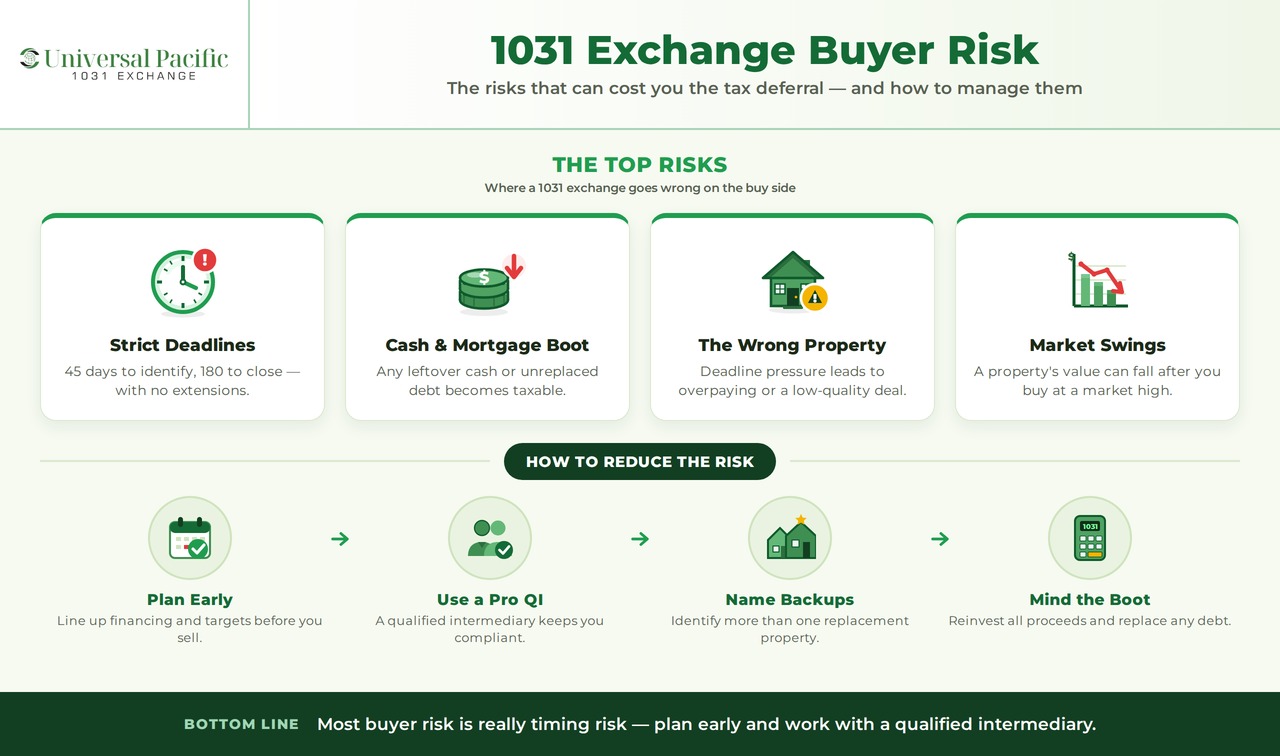
Top 7 Potential 1031 Exchange Buyer Risks

While there are many significant benefits of a 1031 exchange, it also comes with risks that you must understand to avoid financial loss, tax penalties, or poor investment decisions. Let's look at some of the most common risks in detail.
1. Strict Deadlines and Time Pressure
The IRS has strict deadlines for completing a 1031 exchange. For example, from the day you sell your relinquished property, you MUST formally identify the potential replacement properties within the next 45 days. You must also complete the purchase of one or more of the replacement properties within the next 135 days, making the timeline for a 1031 exchange a total of 180 days.
If you miss any of these deadlines, the exchange is disqualified, and you'll have to pay capital gains taxes on the sale of your investment property. For example, if you are delayed due to financing issues or difficulty finding a suitable replacement property, you could end up losing the tax benefits entirely. Since these deadlines are not flexible, they can force you to make rushed decisions, settle for a less-than-ideal property, or overpay just to meet the deadline.
2. Risk of Loss of Tax Deferral
To maintain your tax deferral status, you must carefully structure a 1031 exchange according to the rules stipulated by the Internal Revenue Code. For example, you cannot touch the exchange proceeds from the sale of your property. The exchange funds must be held by a qualified intermediary (QI). Simple mistakes, such as not using a qualified intermediary or misidentifying properties, can result in losing all the tax benefits of the exchange. Additionally, having consistently failed 1031 exchanges may catch the eye of the IRS, which may expose you to unprecedented audits.
3. Difficulty Finding the Right Replacement Property
Not every property qualifies for a 1031 exchange. The replacement property must be “like-kind,” which means it must be similar in use and nature to the property sold. Remember that the properties involved must be held for business or investment use over time; hence, personal property does not qualify. The challenge lies in finding properties that can benefit from a 1031 exchange tax deferral while also fitting your investment goals, all within the 45-day identification window.
If the real estate market is competitive, suitable properties may sell quickly, leaving you with fewer options. You may also need to expand your search geographically, making the process more complex. The risk is that you could end up purchasing a property that doesn't align with your investment strategy, has hidden problems, or doesn't generate the income you need.
4. Overpaying for a Property Due to Deadline Pressure

The pressure of meeting the IRS deadlines often makes buyers more willing to pay a higher price. Sellers who know you're doing a 1031 exchange might use your urgency to their advantage, increasing the property price or setting unfavorable terms. For instance, if your sale generates $1 million and you're struggling to find a replacement, you might overpay for a property worth only $900,000 just to reinvest the proceeds in time.
Another reason you might overpay is to meet the equal or greater value rule. Remember that the replacement property must have equal or greater value than the relinquished property. Generally, overpaying can lower your returns, increase your mortgage payments, or leave you with a property that doesn't match its price tag in terms of value or income potential.
5. Cash Boot and Unexpected Tax Bills
Your exchange is only fully tax-deferred if you reinvest all proceeds from the sale and replace any debt on the sold property. If there's leftover cash after the exchange, known as boot in a 1031 exchange, it becomes taxable. For example, if you sell a property for $500,000 but only reinvest $450,000, the remaining $50,000 is taxable income. That way, you could face a large and unexpected tax bill if you don't structure your exchange correctly.
Similarly, if the mortgage on your new property is lower than the old one, the difference (called “mortgage boot”) is taxable as well. For instance, if your sold property had a $300,000 mortgage, your potential replacement property must also have at least $300,000 in financing (or equivalent cash investment).
6. Risk of Property Valuation and Market Fluctuations
The real estate market can be unpredictable sometimes. You might buy a property during a market high, only to see its value drop later. Factors like local demand, economic downturns, and interest rate increases can affect your investment fair market value over time.
For example, buying in a declining neighborhood or in a market where property values are inflated could leave you with a property that loses value. A decrease in the property's value can hurt your equity and make it harder to sell or refinance in the future.
7. Purchasing a Low-Quality Property
When under time pressure, you might skip important steps like inspecting the property or reviewing its history. This can lead to buying a property with serious problems, such as structural issues, zoning violations, or difficult tenants.
For instance, rushing through the due diligence process might result in buying a property that looks good on paper but requires costly repairs or has unresolved legal disputes. Such hidden issues can result in unexpected expenses, reduced income, or even legal troubles, reducing the overall return on your investment.
How to Reduce 1031 Exchange Buyer Risk Effectively

Now that you can identify the risks involved for the buyer, it's important you learn how you can minimize these risks so you can make the most of your exchanges. Here, we've provided you with some practical steps to help you.
Plan Ahead and Start Early
The strict deadlines mean there's no room for delays. That's why you need to start planning well before your relinquished property sale. Planning early allows you to research potential replacement properties, check how suitable they are, and prepare financing in advance. Without early preparation, you might feel rushed and make poor decisions. It's also helpful to create a detailed timeline to track milestones like sale dates, property identification, and closing.
Work with Qualified Professionals
The 1031 exchange process involves complex rules, so having experienced professionals is helpful. A qualified intermediary (QI) is required to hold the sale proceeds and make sure you comply with IRS rules. Tax advisors or CPAs help with tax calculations, while a real estate agent and an attorney assist in finding suitable properties and reviewing contracts. Working with a team of experienced professionals reduces the chance of mistakes and ensures you stay compliant with the applicable rules.
Identify Multiple Replacement Properties
To provide more flexible options, it's better to identify more than one property within the 45-day deadline. The IRS allows multiple properties, up to three or more, under specific replacement property identification rules such as the 200% rule and the three property rule. This way, if your first choice doesn't work out or if issues arise during the closing process, you have backups to fall back on without missing the deadline.
Choose the Right Market and Property
Always research replacement properties carefully. Inspect the property for possible structural issues, environmental risks, or zoning restrictions that might affect its use. Check the title history to ensure there are no unresolved liens or disputes. For rental properties, verify tenant leases, rental income, and occupancy rates.
Look for properties in areas with steady demand, potential for appreciation, and reliable income streams. Additionally, avoid overpaying by learning how to determine the FMV of the like-kind property you received or by getting professional appraisals. It's also good to identify what disqualifies a property from being used in a 1031 exchange and avoid it.
Secure Financing Early
Delays in getting financing can jeopardize the 180-day deadline. Get pre-approved for loans before selling your property. Use lenders experienced in 1031 exchanges and consider alternative options, like bridge loans, to avoid funding issues. Additionally, you can set reminders for the 45-day identification period and the 180-day closing deadline. Stay in regular contact with your intermediary, agents, and lenders to ensure everything stays on track.
Understand Boot and Debt Replacement Rules
To fully defer taxes, reinvest all sale proceeds and replace any mortgage debt from the sold property. Any boot, whether cash or mortgage, will be subject to capital gains tax. Work with a tax advisor to calculate these amounts and avoid surprises.
Prepare for Contingencies
Unforeseen issues, like delays in closing or title disputes, can disrupt the exchange. Have a backup plan by identifying alternative properties and securing additional funds for unexpected costs. Open communication with your team ensures quick solutions.
In addition, tax laws governing 1031 exchanges can change, and market conditions can fluctuate. Keep yourself informed about IRS updates, economic factors, and real estate trends to adjust your strategy as needed.
1031 Exchange Rules Impacting Buyer Risk
A few core rules drive most buyer risk in a 1031 exchange. IRS regulations set specific requirements and strict timelines for every exchange. Meeting them lets you defer tax without recognizing gain and avoids harsh tax consequences. The 45-day identification period and the 180-day exchange period are the two most important.
The IRS explains both deadlines on its like-kind exchange page. These deadlines are strict, with one exception: federally declared disasters. After the January 2025 Los Angeles wildfires, the IRS postponed affected 1031 deadlines to October 15, 2025. You also cannot take constructive receipt of the sale proceeds, which is why a qualified intermediary holds the funds. Miss any of these, and the exchange fails.
Two lesser-known rules also shape buyer risk. Both deal with how many properties you can identify and how long you must hold what you buy.
The 95% Rule Explained
The IRS lets you identify replacement property under one of three tests. The three property rule lets you name up to three properties at any value. The 200% rule lets you name more than three, as long as their total value stays within 200% of the relinquished property. These limits come from Treasury Regulation 26 CFR 1.1031(k)-1.
The 95% rule is the fallback. If you identify more than the first two rules allow, a stricter test applies. You must then acquire at least 95% of the total value you identified. Miss that, and the whole exchange can fail. For buyers, this rule punishes over-identifying without a real plan to close.
The 5-Year Rule in 1031 Exchanges
The 5-year rule matters if you ever plan to convert a 1031 property into a home. Under Section 121(d)(10), a special hold applies. You must own a property acquired through a 1031 exchange for at least five years. Only then can you claim the primary residence exclusion. This stops investors from quickly turning a deferred-gain property into a tax-free home sale. Buyers who plan a future conversion should factor this timeline in early.
What If You’re Buying from a Seller Doing a 1031 Exchange?
Sometimes you are not the exchanger. You are simply buying a property, and the seller is using a 1031 exchange. In this case, the contract may ask you to cooperate with the seller’s exchange. This cooperation clause is common and usually low-risk for you.
A cooperation clause typically says you agree to let the seller assign the contract to a qualified intermediary. It also says the exchange will not delay your closing or add cost to you. For example, the clause may state that cooperation is at no expense or liability to the buyer. Read it, and make sure it protects you on both points.
The main buyer risks here are delay and uncertainty. If the seller’s exchange runs into trouble, your closing could slip. Do your due diligence on the seller’s timeline before you commit. A qualified intermediary and your own attorney can review the cooperation language so you are not exposed to the seller’s tax problem.
Comparing Buyer Risks in a Reverse 1031 Exchange vs. a Standard Exchange
A standard 1031 exchange sells the relinquished property first, then buys the replacement within 180 days. A reverse 1031 exchange flips that order. You buy the replacement property first, then sell the old one later. The IRS set out the safe harbor for this structure in Revenue Procedure 2000-37. The reverse structure removes the risk of not finding a replacement in time, but it raises other risks.
The table below compares the two on the points that matter most to a buyer.
| Factor | Standard 1031 Exchange | Reverse 1031 Exchange |
|---|---|---|
| Order | Sell first, then buy | Buy first, then sell |
| Main timing risk | Finding a replacement in 45 days | Selling the old property in 180 days |
| Financing | Uses sale proceeds toward the purchase | Needs cash or a loan up front |
| Complexity | Lower | Higher, uses an accommodation titleholder |
| Cost | Lower fees | Higher fees and closing costs |
A reverse exchange suits a buyer who has found the ideal property and can fund it before selling. A standard exchange suits a buyer who wants lower cost and complexity. Neither removes risk entirely, so plan the timing carefully.
How Does a 1031 Exchange Affect the Seller?
For sellers in a 1031 exchange, the strategy offers some notable benefits as well as some risks. In terms of the advantages, selling your property in a 1031 exchange enables you to defer capital gains taxes when you reinvest the sale proceeds into like-kind investment properties. It's also an opportunity to diversify your portfolio and spread risk across different property types, locations, or markets. Through a 1031 exchange, you can also increase the worth of your investment portfolio since you have more capital available to acquire more properties.
On the flip side, it may be challenging for sellers to identify replacement property after selling the relinquished property, especially in a competitive market. Of course, sellers also face the strict 180-day timeline. For a 1031 exchange with multiple properties, sellers must make sure all the transactions are completed within 180 days or they lose the tax deferral benefit. Additionally, they may eventually pay capital gains taxes if they sell the replacement property outside of a 1031 exchange.
Reducing the risks for sellers follows the same principles – plan and start early, work with an experienced qualified intermediary, real estate agents and other relevant professionals, get financing as early as possible, and prepare for potential unforeseen situations.
Are There Specific Types of Properties That Pose Higher Risks in a 1031 Exchange?

Yes, certain types of properties can pose higher risks in a 1031 exchange due to factors such as market volatility, legal or regulatory issues, maintenance requirements, or challenges in meeting IRS rules. Examples of such properties include:
Vacant land or undeveloped property's value depends heavily on location and future development potential, which can be uncertain. If zoning laws or economic conditions change, the land's value could drop. Additionally, vacant land typically generates no income, making it a risky choice if cash flow is a priority for you.
Properties with environmental or legal issues can be costly. Cleaning up environmental concerns, such as contamination or hazardous materials, takes time and money, and failure to address them could lead to legal disputes or regulatory fines. Similarly, properties with unclear titles, ongoing lawsuits, or zoning violations can create challenges in completing the exchange within the required timeframe.
High-vacancy rental properties may struggle to generate enough cash flow to cover expenses such as mortgage payments, taxes, and maintenance. High-vacancy properties often signal issues like poor location, outdated facilities, or mismanagement, which can be expensive to resolve.
Specialized or single-use properties such as restaurants, residential properties, gas stations, or medical facilities, are harder to sell and may not appeal to a broad range of buyers. These properties also require specialized maintenance and may become obsolete if the industry they serve declines.
Vacation homes or short-term rental properties, such as those listed on Airbnb or similar platforms, can create challenges in a 1031 exchange. The IRS requires properties to be held for investment purposes, not for personal use. If the real property has been used for personal vacations or other non-investment purposes, it might not qualify, or you might need advanced 1031 exchange options such as the 1031 exchange for vacation homes.
When purchasing a property from a relative or related party, you must carefully follow the 1031 exchange rules for related parties. The IRS closely scrutinizes these transactions, and any missteps could disqualify the exchange. For instance, in Ocmulgee Fields, Inc. v. Commissioner, the court rejected a 1031 exchange involving related parties. As a result, about $6.1 million in capital gains became taxable.
Properties with uncooperative sellers or buyers can introduce delays and legal complications. For example, if a seller backs out or if the buyer of your relinquished property cannot close on time, it may prevent you from meeting the 180-day deadline, disqualifying the exchange.
Common Buyer Concerns and Misconceptions About 1031 Exchange Risks
A common worry is that a 1031 exchange is bad for buyers. In most cases, it is not. Cooperating with a seller’s exchange rarely adds cost or risk when the contract is written correctly. The exchange is the seller’s tax matter, not yours.
Another misconception is that a 1031 exchange always causes delays or messy closings. A well-run exchange, with a qualified intermediary in place, usually closes on the normal schedule. Problems tend to come from poor planning, not from the exchange itself.
Buyers sometimes assume they have no protection. In fact, you can negotiate protections into the contract, such as a no-cost-no-liability cooperation clause and firm closing dates. Knowing your role and your rights turns most of this worry into routine paperwork.
Need Help to Minimize Your Risks Surrounding 1031 Exchanges?
Most of the risks associated with 1031 exchanges are due to the pressure of deadlines, the identification of the right replacement properties, and other strict rules of the exchange. When you identify and understand these risks, it's easier to figure out proactive steps to take to reduce them and maximize the benefits of the exchange. You don't even need to tackle these challenges yourself alone. It's best to work with a top qualified intermediary and other real estate professionals for experienced guidance.
At Universal Pacific 1031 Exchange, we're dedicated to assisting you in achieving a successful exchange. Our professional 1031 intermediaries in Los Angeles are equipped to guide you through a seamless process, optimizing your returns while deferring taxes. Take the first step by scheduling a FREE consultation call with us today!
FAQ
These are common questions about a 1031 exchange buyer risk and their respective answers.
Is a 1031 Exchange Bad for a Buyer?
Usually not. If you are buying from a seller doing a 1031 exchange, a proper cooperation clause protects you from cost and liability. If you are the exchanger, the main risks are deadlines and boot, both of which good planning controls.
What Is the 95% Rule in a 1031 Exchange?
The 95% rule applies when you identify more replacement property than the three property rule or 200% rule allow. In that case, you must acquire at least 95% of the total value you identified, or the exchange can fail.
What Is the 5-Year Rule for 1031 Exchanges?
If you convert a 1031 property into your primary residence, a five-year hold applies. You must own it that long before claiming the Section 121 exclusion. It prevents a quick, tax-free flip of deferred-gain property.
What Is a Poor Man’s 1031 Exchange?
A poor man’s 1031 exchange is an informal term for using other tax tools to reduce a gain without a formal exchange. Examples include the primary residence exclusion or offsetting gains with losses. These strategies do not defer gain the way a real 1031 exchange does.
This page was reviewed by Michael Bergman, CPA, California CPA #56113. Verify license.
Disclaimer: This blog is for informational purposes only and is not legal, tax, or financial advice. Every 1031 exchange is different. Please consult your attorney, CPA, or tax advisor before making any decisions.
Editorial Policy
All articles are reviewed for accuracy by licensed tax professionals and sourced from official government publications. Read our Editorial Policy →
About The Author
 Michael Bergman is a California licensed CPA and Real Estate Broker with over 35+ years of CPA-supervised 1031 exchange experience in commercial real estate. Specializing in 1031 tax-deferred exchanges and financial oversight, his expertise covers complex real estate transactions. Michael’s unique blend of financial acumen and real estate knowledge positions him as a trusted advisor in the industry, offering sound advice and strategic insights for successful property management and investment.