

Are 1031 Exchanges Going Away? Where Section 1031 Stands in 2026

No, 1031 exchanges are not going away, and investors can still defer capital gains taxes by exchanging one investment property for another. As of November 2026, no law has limited Section 1031 since 2017, and the 2025 tax law left it untouched. Some bills that would cap it have been introduced, such as the Equal Tax Act (S. 4122, March 2026), but none has moved past committee. Another bill introduced this year would widen the exchange to certain primary residences rather than narrow it.
At Universal Pacific 1031 Exchange, Michael Bergman, CPA, who has been licensed in California since 1990 and is also a California real estate broker, supervises every transaction. Our qualified intermediary services cover delayed, reverse, and improvement exchanges in all 50 states, with segregated accounts and $2 million E&O insurance. You can schedule a free consultation before you list your property.
This article explains where Section 1031 stands now, why lawmakers keep revisiting it, and which rules apply to your next exchange.
Table Of Contents
- Are 1031 Exchanges Going Away in 2026?
- What Is a 1031 Exchange Under the Internal Revenue Code?
- How Did the Tax Cuts and Jobs Act Change 1031 Exchanges?
- Did the One Big Beautiful Bill Act Change Section 1031?
- What Proposals Have Tried to Limit or Eliminate 1031 Exchanges?
- Why Do Lawmakers Keep Looking at Section 1031?
- Is Any New 1031 Legislation Pending Right Now?
- What 1031 Exchange Rules Apply Today?
- How Should Real Estate Investors Plan a 1031 Exchange Now?
- What Happens If an Exchange Fails or the Rules Change Later?
- Ready to Plan Your Next 1031 Exchange?
- Frequently Asked Questions
Are 1031 Exchanges Going Away in 2026?

The White House, where each federal budget proposal starts.
As of November 2026, Section 1031 remains unchanged from what was done by the 2017 Tax Cuts and Jobs Act. That was the last time Congress narrowed exchanges, and no legislation passed afterward that limited them. Some bills that would cap Section 1031 for real estate have been introduced since, such as the Equal Tax Act (S. 4122, March 2026), but none has moved past committee.
The White House has not asked for any budget limits in its last two budgets. According to the National Association of Realtors, the FY2026 budget, released in May 2025, was the first in four years without any proposal to cap exchanges. We also found no 1031 proposal in coverage of the FY2027 budget, which came out on April 3, 2026.
That describes the current record, not a forecast about what future Congresses might do. Lawmakers have considered proposals for repealing and imposing caps on Section 1031 before and could consider them again. Currently, the 1031 exchanges that you plan for today are the same ones that investors have been using since 2018.
What Is a 1031 Exchange Under the Internal Revenue Code?
A 1031 exchange allows you to sell an investment property and use the money from that sale to buy a new replacement property without paying tax right away. Exchanging investment or business real estate for other similar real estate does not trigger any taxable gain or loss according to Section 1031 of the Internal Revenue Code.
The deferral covers federal capital gains tax and depreciation recapture you would otherwise owe on a taxable sale. The deferred gain stays with your new property so that it remains inside it. By keeping money invested, you get better cash flow because you are putting more equity into subsequent purchases. You can repeat the process without immediate tax, which is why investors use a like-kind exchange as a long-term tax deferral strategy.
What Counts as Like-Kind Property?

Raw land and an apartment building count as like-kind real estate.
Like-kind refers to the nature or character of the property, not its grade or quality. Two properties of the same nature can differ in age, condition, size, and location within the United States. According to Treasury regulations, both raw land and commercial properties are considered to be of like kind. Improved and unimproved real estate are treated similarly.
That rule leaves investors a lot of flexibility to reposition their holdings in real estate. You can swap raw land for an apartment building. And you can exchange one rental property for several replacement properties. Investors also trade this way to convert one investment property into a share in something bigger and rebalance their portfolio of real estate investments.
The test that trips people up is how you use the property, not what type it is. Both the relinquished and replacement properties must be held for investment or business use, so dealer inventory does not qualify. A business property such as a warehouse counts as business real estate, and it can be exchanged for a rental.
What Property Does Not Qualify?
A primary residence does not qualify, and neither does a vacation home you use personally. If you sell real property held for investment and buy a home to live in, that purchase does not qualify either. Section 121 may let you exclude gains from your primary home, according to information we have in our guide for 1031 exchanges and a primary residence.
Personal property such as equipment, vehicles, and artwork has been outside Section 1031 since 2018. A narrow incidental-property rule in the regulations lets a small amount of personal property come along with real estate without breaking the exchange, but that property is still taxable boot.
Location matters too, because Section 1031(h) says U.S. real property and foreign real estate are not like-kind to each other. A foreign exchange transaction can still be covered; we have a page that explains if a 1031 exchange applies to foreign property and covers such transactions.
How Did the Tax Cuts and Jobs Act Change 1031 Exchanges?
The Tax Cuts and Jobs Act, signed on December 22, 2017, changed the word “property” to “real property” in Section 1031. It covered exchanges that took place after December 31, 2017, but for exchanges where one side closed before then, they continued to use the old rules.
The IRS sums up the result in its real estate tax tips: “Section 1031 now applies only to exchanges of real property and not to exchanges of personal or intangible property.” Vehicles and equipment fleets lost their status as eligible items, but real estate still gets full benefits.
Treasury’s final regulations defining real property, known as T.D. 9935, were released in November 2020 and published on December 2, 2020. Some trade coverage cites 2021, but the rules apply to exchanges beginning after December 2, 2020. They range over land and buildings, as well as structural parts and anything that state or local law considers to be real property.
Did the One Big Beautiful Bill Act Change Section 1031?
No. The One Big Beautiful Bill Act became Pub. L. 119-21 when the President signed it on July 4, 2025, and it did not change Section 1031. A full-text search of the enacted law turns up no reference to Section 1031 or to like-kind exchanges.
That’s important because reconciliation bills tend to be where revenue raisers end up. Some commentators call 1031 stronger after the 2025 law, but that reflects other provisions, and the text of Section 1031 did not change.
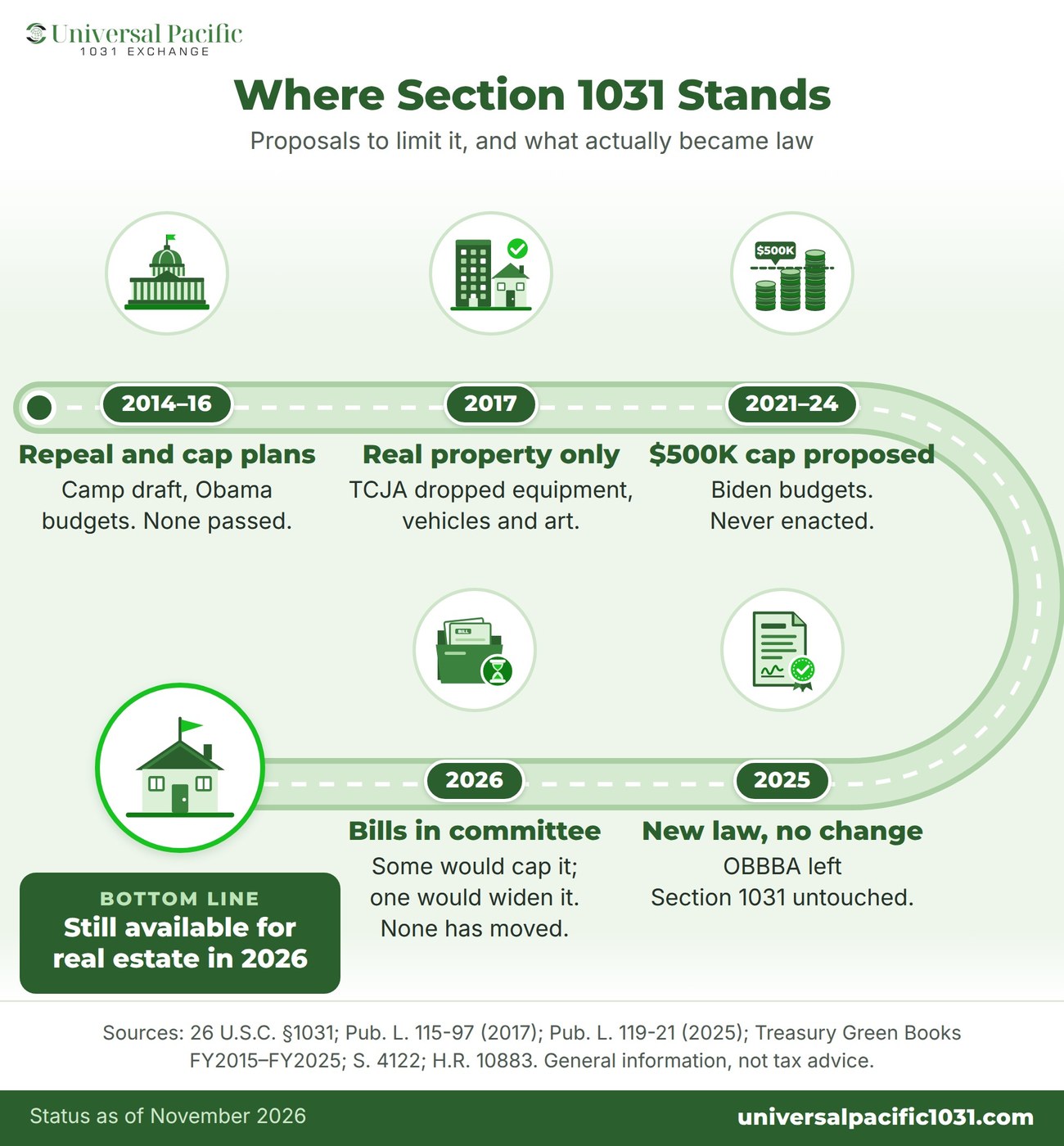
Since 2017, every attempt to cap or repeal Section 1031 has failed.
What Proposals Have Tried to Limit or Eliminate 1031 Exchanges?
Section 1031 has faced four main proposals since 2014, from full repeal to annual caps on deferred gain. The table below summarizes each one, and none of them became law.
| Proposal | Year | What It Would Have Done | Outcome |
|---|---|---|---|
| Camp Tax Reform Act discussion draft | 2014 | Repeal Section 1031 for exchanges after 2014, with a binding-contract exception. | Not enacted |
| Obama budgets, FY2015 to FY2017 | 2014 to 2016 | Cap deferral at $1 million of gain per taxpayer per year, indexed for inflation. | Not enacted |
| Build Back Better drafts | 2021 | Float a $500,000 cap as a pay-for in reconciliation. | Dropped from the House Ways and Means pay-for list in September 2021 |
| Biden Green Books from FY2022 to FY2025 | 2021 to 2024 | Cap the deferral at $500,000 per taxpayer per year, or $1 million for joint filers. | Not enacted |
Treasury’s FY2025 Green Book scored the Biden cap at $19.678 billion over fiscal years 2025 to 2034. In the year of the exchange, gains above the limit would have been taxed.
Why Do Lawmakers Keep Looking at Section 1031?
Section 1031 is a scored tax expenditure, which puts it on lists of possible revenue raisers. In a report dated December 3, 2025, the Joint Committee on Taxation puts the cost at $53.6 billion for FY2025-2029. That amounts to roughly $10 to $11 billion a year in lost federal revenue.
Talk about limiting exchanges keeps coming up in debates over federal budgets because mentioning such an item draws people’s attention. The cap, worth $500,000, has already been drafted and scored. This means that if there were a new administration, they could reactivate this fairly quickly. Deferral is also worth more when tax rates are higher, so changes to capital gains taxation shift what an exchange is worth.
How Do 1031 Exchanges Incentivize Real Estate Investment?
Industry coalitions say that exchanges encourage investment in real estate and promote turnover among properties. When reading those numbers, you should keep in mind that much of the research supporting that view has been funded by the same groups.
A 2015 EY study sponsored by the Section 1031 Like-Kind Exchange Coalition found that repealing the like-kind exchange rules would reduce GDP in the long run by roughly $8.1 billion per year. A 2021 EY study prepared for the 1031 Like-Kind Exchange Coalition credited the rules with supporting 568,000 jobs.
In 2015, researchers Ling and Petrova examined more than 1.6 million real estate transactions for the Real Estate Like-Kind Exchange Coalition. They found repeal would push prices down in the short run and raise rents over time. If exchanges were eliminated, they estimated that rents would have to rise 8 to 13 percent over the longer run before new construction would be viable. That pressure would manifest itself both in market rents and rental income for landlords.
Their 2020 follow-up found that 1031 buyers use less debt and put in more of their investment capital. Taken together, these industry-funded studies argue that repeal or a tight cap could reduce property transactions and investment. Real estate coalitions push hard with this information, and the exchange industry members held 110 meetings in April 2026 on Capitol Hill.
Is Any New 1031 Legislation Pending Right Now?

H.R. 10883 would allow some home-for-home swaps if enacted.
Yes, but none has moved past committee, and the newest bill we found widens the exchange rather than narrows it. On October 22, 2026, Reps. Mike Lawler and Josh Gottheimer introduced H.R. 10883, the American Home Mobility Act.
The bill lets taxpayers trade their principal residence, as Section 121 defines such a house, for another one that is used in the same way. It would cover exchanges completed after December 31, 2026, but only if Congress passes it.
As of November 2026, the bill sits in the House Ways and Means Committee with no further action. This is not a law, and investors shouldn’t plan to sell their primary residence around this.
The Equal Tax Act (S. 4122), introduced on March 17, 2026, by Sen. Markey, would cap deferred gain at $500,000 a year and $1 million over a lifetime, with exceptions such as farm property; it was referred to the Senate Finance Committee and has not moved since.
What 1031 Exchange Rules Apply Today?
These are the rules investors follow as of November 2026, drawn from the statute, the Treasury regulations, and IRS guidance.
What Are the Identification and Closing Deadlines?
You have 45 days to identify a replacement property and 180 days to buy that property. Both the 45-day and 180-day clocks start the day the relinquished property closes.
There is a surprise for investors if they sell at the end of the year because there is a time window of 180 days. Under Treas. Reg. 1.1031(k)-1, it ends at the earlier of day 180 or the due date (including extensions) for your federal income tax return. To ensure you have the full 180 days, consider filing for an extension if your relinquished property sells in late fall.
Your identification must be in writing, signed by you, and delivered before the deadline at the end of day 45. Many investors follow the three-property rule, one of two main identification rules, to name up to three properties of any value. The 200 percent rule allows more potential replacement properties if their total fair market value stays within twice the sale price.
Missing either of the deadlines usually results in this being taxed as a sale for that year. Presidentially declared disasters can postpone deadlines, and the installment-sale rules may change when some failed exchanges are taxed.
Why Do You Need a Qualified Intermediary?
A qualified intermediary holds your sale proceeds so you avoid constructive receipt of your money. If you manage to get the funds from the exchange before the exchange deadline, the IRS will see this as a cash sale.
A qualified intermediary is a safe harbor in the regulations, not a requirement written into the statute. Qualified escrow accounts and trusts also exist, and a simultaneous swap needs none of them. In practice, a QI holds the sale proceeds in nearly every delayed exchange, and you don’t have control of the exchange funds.
You and the QI must sign a written exchange agreement before the relinquished property closes. That agreement must bar you from receiving, pledging, or borrowing using the funds during the exchange period.
The independence rule is narrower than many investors think, and it is built on a two-year lookback. Someone who is disqualified includes your employees, attorneys, accountants, brokers, or agents who work for you within two years prior to your first transfer. Someone who has only worked with you on 1031 exchanges isn’t disqualified, and neither are regular services related to titles, escrows, or banks.
How Do Equal or Greater Value and Boot Affect Your Tax Liability?
You do not need to buy property of equal or greater value to complete a valid exchange. Buying equal or greater value and reinvesting all net cash is what gets you full tax deferral.
Any additional items received as part of this trade will be subject to taxation, and they are called boot in a 1031 exchange. Boot includes cash, non-like-kind property, and net debt relief, according to the IRS Form 8824 instructions. Gain is recognized up to the amount of cash or other boot you receive, but never more than your realized gain.
Mortgage boot shows up when your new loan is smaller than the one paid off and you add no cash. The gain recognized on boot can include depreciation recapture, which raises your tax liability for the year. Tax considerations will increase as the cost of boot goes up. So do some math before signing a contract for your purchase.
What Are Reverse, Improvement, and Construction Exchanges?
A standard deferred exchange sells first and buys second, but some deals need the opposite order. You can purchase replacement property before selling the relinquished one with a reverse exchange.
An exchange accommodation titleholder owns title to one piece of real estate in a reverse exchange (Rev. Proc. 2000-37). That parking spot arrangement secures your purchase while you sell off the property you’re letting go.
An exchange for improvement, also known as a construction exchange, follows the same title holder structure. The titleholder holds the replacement property while improvements are built, so the work can count toward the value you reinvest.

In an improvement exchange, construction on the replacement property can count toward the value you reinvest.
How Should Real Estate Investors Plan a 1031 Exchange Now?
Good planning starts before your property is listed, not after a buyer makes an offer. The steps below roughly follow the typical order of a delayed exchange, from first contact through to tax time.
Step 1. Talk to Your Tax Advisor and a Qualified Intermediary Early
Get your tax advisor and a qualified intermediary in before putting your current investment property up for sale or signing a contract. Planning early allows them to estimate the deferral of gains and flag any title or debt issues.
Step 2. Sign the Written Exchange Agreement Before Closing
Please sign the written agreement with the QI before closing on the relinquished property. If the sale closes first and the proceeds reach you, it is too late to set up the exchange.
Step 3. Calendar the Identification and Closing Deadlines
Mark the deadlines for both 45 days and 180 days from when the property is closed. Check your deadline for your federal income tax return at day 180 and request an extension if you expect to have that return due earlier than that date.
Step 4. Identify Potential Replacement Properties in Writing
Within 45 days, please send the QI a signed written list of potential replacement properties. Most investors use the three-property rule, while the 200 percent rule allows a longer list with a value limit.
Step 5. Match the Value and Debt of the Property You Sold
To reach full tax deferral, buy a replacement property of equal or greater value and carry equal or greater debt. To offset lower debt, you can add cash, but any shortfall is taxable boot.
Step 6. Close Within 180 Days and Report the Exchange
Close on the new property within 180 days, then report the exchange on Form 8824 with your return. Our guide on how to report a 1031 exchange walks through each line of the form.
Step 7. Keep Proper Documentation and Watch Future Proposals
Document every step of the process, from the agreement on exchange to the closing documents and identification notices. Keep an eye on future budget proposals because if they change later, that could impact trades you have planned for many years in the future.
What Happens If an Exchange Fails or the Rules Change Later?
If an exchange fails, the deferred gain generally becomes taxable in the year of sale. That bill can include capital gains tax, depreciation recapture, and state income tax, as our guide to a failed 1031 exchange explains.
Past cap proposals were written to apply going forward, not to exchanges already finished. The FY2025 Green Book version would have covered exchanges completed in taxable years beginning after December 31, 2024. The Tax Cuts and Jobs Act allowed ongoing exchanges that were active at the end of 2017 to proceed under old rules.
The IRS says gain in a like-kind exchange is deferred, not forgiven, and that distinction matters for long-term plans. You can keep deferring gain in subsequent exchanges, and Section 1014 resets the basis to fair market value at death. That step-up can erase deferred gains over a lifetime of transactions, and this is still a separate topic for policy discussion.
Ready to Plan Your Next 1031 Exchange?
As of November 2026, Section 1031 remains unchanged and has not been modified by the 2025 tax law. Past proposals stalled, and the 2026 bills we found have not moved past committee. The deadlines and boot rules still decide whether your sale stays tax-deferred, so planning early protects the result.
Michael Bergman, CPA, has been a licensed California CPA since 1990 and is a licensed real estate broker who works from our Beverly Drive office in Los Angeles. Our experienced professionals hold exchange funds in segregated accounts backed by $2 million in E&O insurance for investors in all 50 states. If you’re having an upcoming sale on an investment property, contact us today.
Frequently Asked Questions
Universal Pacific 1031 Exchange works with investors in all 50 U.S. states for delayed, reverse, and improvement exchanges. Michael Bergman, CPA, oversees every exchange, and these are the questions we hear most about the future of Section 1031.
Can You Still Do a 1031 Exchange in 2026?
Yes, as of November 2026, Section 1031 fully applies to real estate used for either investment or business purposes. No new laws have been enacted since the 2017 Tax Cuts and Jobs Act that limit it. Some bills that would cap it have been introduced, but none has moved past committee.
Did the One Big Beautiful Bill Act Eliminate 1031 Exchanges?
No, the One Big Beautiful Bill Act, signed July 4, 2025, does not amend Section 1031 or mention like-kind exchanges.
Can You Use a 1031 Exchange on a Primary Residence?
Not under current law; that’s because primary residences are not held for investment or business use. H.R. 10883 would allow some home-for-home swaps if enacted, but as of November 2026, it remains in committee.
Does Personal Property Still Qualify for a 1031 Exchange?
Since January 1, 2018, Section 1031 has applied only to real estate. Federal law now says that equipment, vehicles, and art no longer qualify for exchanges on a like-kind basis.
How Many Times Can You Do a 1031 Exchange?
There is no limit as to how many exchanges you can do. Each exchange must meet the rules on its own, and related-party exchanges carry a two-year holding rule.
Disclaimer: This article is for general information only and is not tax, legal, or investment advice. Tax laws do change. Consult with a qualified tax advisor or real estate attorney about your specific case. Universal Pacific 1031 Exchange serves as a qualified intermediary and does not give any tax or legal advice.
Editorial Policy
All articles are reviewed for accuracy by licensed tax professionals and sourced from official government publications. Read our Editorial Policy →

About The Author
Michael Bergman, CPA
Michael Bergman is a California licensed CPA and Real Estate Broker with over 35+ years of CPA-supervised 1031 exchange experience in commercial real estate. Specializing in 1031 tax-deferred exchanges and financial oversight, his expertise covers complex real estate transactions. Michael’s unique blend of financial acumen and real estate knowledge positions him as a trusted advisor in the industry, offering sound advice and strategic insights for successful property management and investment.
Read more →

